Comprehensive Guide to Saturated Hydrocarbons
Understanding Saturated Hydrocarbons and Their Characteristics
Defining Saturated Hydrocarbons and Their Molecular Structure
Saturated hydrocarbons are organic compounds composed exclusively of carbon and hydrogen atoms, where every carbon-carbon bond is a single bond. This saturation means each carbon atom forms four single covalent bonds, either with other carbons or hydrogens, leaving no room for double or triple bonds. These compounds are commonly referred to as alkanes when they have an open-chain structure.
Typically, alkanes follow the general molecular formula \( \mathrm{C_nH_{2n+2}} \), indicating the number of hydrogen atoms relative to carbon atoms in a fully saturated chain.
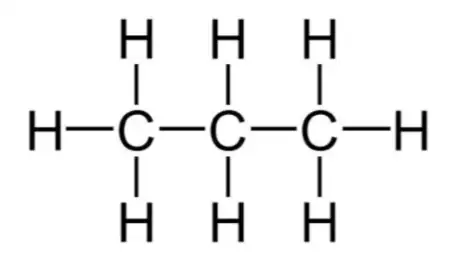
Structural model of propane (C3H8) illustrating single carbon-carbon bonds
In the propane molecule, all carbon atoms are connected by single bonds, and the remaining valencies are satisfied by hydrogen atoms, confirming its saturated nature.
Example: Calculating Hydrogen Atoms in a Saturated Hydrocarbon
Determine the number of hydrogen atoms in a saturated hydrocarbon with 5 carbon atoms.
Solution:
Using the general formula for alkanes:
\[ \mathrm{H} = 2n + 2 \]
where \( n = 5 \), so
\[ \mathrm{H} = 2 \times 5 + 2 = 12 \]
Therefore, the molecular formula is \( \mathrm{C_5H_{12}} \).
Classification and Structural Variations of Saturated Hydrocarbons
Exploring Different Types: Alkanes and Cycloalkanes
Saturated hydrocarbons can be categorized based on their carbon skeletons into two main groups: alkanes and cycloalkanes. Alkanes possess either straight or branched chains of carbon atoms, while cycloalkanes feature carbon atoms arranged in one or more ring structures.
While alkanes follow the formula \( \mathrm{C_nH_{2n+2}} \), cycloalkanes have a general formula of \( \mathrm{C_nH_{2n}} \) for monocyclic rings, reflecting the loss of two hydrogen atoms due to ring formation. For polycyclic cycloalkanes, the formula adjusts to \( \mathrm{C_nH_{2n+2-2r}} \), where \( r \) represents the number of rings.
Examples of saturated hydrocarbons include butane (\( \mathrm{C_4H_{10}} \)), octane (\( \mathrm{C_8H_{18}} \)), cyclohexane (\( \mathrm{C_6H_{12}} \)), and cyclopropane (\( \mathrm{C_3H_6} \)).
Example: Determining the Formula of a Cycloalkane
Find the molecular formula of a cycloalkane containing 7 carbon atoms and one ring.
Solution:
Using the formula for cycloalkanes:
\[ \mathrm{H} = 2n + 2 - 2r \]
where \( n = 7 \) and \( r = 1 \), so
\[ \mathrm{H} = 2 \times 7 + 2 - 2 \times 1 = 14 + 2 - 2 = 14 \]
Thus, the molecular formula is \( \mathrm{C_7H_{14}} \).
Properties, Isomerism, and Applications of Saturated Hydrocarbons
Physical Characteristics and Structural Isomerism in Alkanes
Alkanes exhibit physical properties that depend on their molecular size and structure. Short-chain alkanes (up to four carbons) are gases at room temperature, medium chains (5 to 17 carbons) are liquids, and longer chains (above 18 carbons) are solids. This trend arises due to increasing molecular weight and intermolecular forces.
Alkanes with more than three carbon atoms can display chain isomerism, where molecules share the same molecular formula but differ in the arrangement of their carbon skeletons. For instance, butane (\( \mathrm{C_4H_{10}} \)) has two chain isomers: n-butane and isobutane.
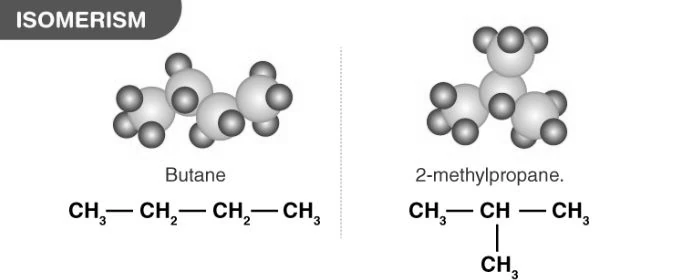
Illustration of chain isomers of butane showing different carbon arrangements
Ring Strain and Stability in Cycloalkanes
Cycloalkanes possess ring structures that introduce strain due to bond angle deviations from the ideal tetrahedral angle of 109.5°. Smaller rings, such as cyclopropane with a bond angle of 60°, experience significant ring strain, making them less stable compared to larger rings.
This strain affects their physical properties, often resulting in higher melting and boiling points than comparable alkanes.
Practical Uses of Saturated Hydrocarbons
Saturated hydrocarbons have diverse applications, primarily as fuels and industrial chemicals. Methane is widely used for heating and as a fuel in vehicles, and in liquefied form, it serves as rocket fuel. Ethane is employed in refrigeration and as a precursor for ethylene production.
Propane acts as a propellant in aerosol sprays and fuel for hot air balloons. Octane is a critical component of gasoline, enhancing engine performance. Cycloalkanes are utilized in motor fuels, diesel, and the manufacture of synthetic materials like rubber and nylon.
Example: Identifying Uses of Specific Saturated Hydrocarbons
Match the following saturated hydrocarbons with their common uses:
Methane
Ethane
Propane
Octane
Answer:
Methane: Fuel for heating and vehicles, rocket fuel in liquefied form.
Ethane: Refrigerant in cryogenic systems, raw material for ethylene production.
Propane: Propellant in aerosol sprays, fuel for hot air balloons.
Octane: Key gasoline component to prevent engine knocking.
Quick Reference: Key Facts on Saturated Hydrocarbons
Aspect | Details |
|---|---|
Definition | Hydrocarbons with only single carbon-carbon bonds |
General Formula (Alkanes) | \( \mathrm{C_nH_{2n+2}} \) |
General Formula (Cycloalkanes) | \( \mathrm{C_nH_{2n}} \) (monocyclic), \( \mathrm{C_nH_{2n+2-2r}} \) (polycyclic) |
Types | Alkanes (linear/branched), Cycloalkanes (ring structures) |
Isomerism | Chain isomerism in alkanes with more than 3 carbons |
Physical State | Gases (up to 4 C), Liquids (5-17 C), Solids (18+ C) |
Ring Strain | Present in cycloalkanes, highest in cyclopropane |
Common Uses | Fuels, refrigerants, propellants, raw materials for polymers |
Glossary of Important Terms
Term | Meaning |
|---|---|
Alkane | A saturated hydrocarbon with only single bonds and an open chain |
Cycloalkane | A saturated hydrocarbon with carbon atoms arranged in a ring |
Saturation | Condition where all carbon atoms have single bonds only |
Isomerism | Compounds with the same formula but different structures |
Chain Isomerism | Isomerism due to different arrangements of carbon chains |
Ring Strain | Instability in cyclic compounds due to bond angle distortion |
Hybridization (sp3) | Type of orbital mixing in carbon atoms forming single bonds |
Propellant | Substance used to expel contents from aerosol cans |
Boiling Point | Temperature at which a liquid turns into vapor |
Combustion | Chemical reaction of a substance with oxygen producing heat |
Frequently Asked Questions
What defines a saturated hydrocarbon?
Saturated hydrocarbons are compounds where all carbon atoms are connected by single bonds only, with no double or triple bonds present.
Which isomerism is commonly observed in alkanes?
Alkanes primarily exhibit chain isomerism, where the carbon atoms are arranged differently in the chain but maintain the same molecular formula.
Why are alkenes more reactive than alkanes?
Alkenes contain carbon-carbon double bonds with pi bonds that are easier to break, making them more reactive than alkanes, which have only single bonds.
What causes cycloalkanes to be less stable than alkanes?
Cycloalkanes experience ring strain due to bond angles deviating from the ideal tetrahedral angle, reducing their stability compared to open-chain alkanes.
List some common applications of alkanes.
Alkanes are used as fuels, in aerosol propellants, rocket fuels, and as raw materials in the production of polymers like rubber and nylon.
Various molecular models representing saturated hydrocarbons
Educational materials and resources on saturated hydrocarbons