Understanding Light Reflection and Its Varieties
Fundamentals of Light Reflection
Concept and Mechanism of Reflection
Reflection occurs when a beam of light strikes a smooth, polished surface and bounces back into the original medium. The incoming beam is called the incident ray, and the beam that returns is the reflected ray. A perpendicular line drawn at the point of incidence on the surface is known as the normal. The angles formed between the incident and reflected rays with the normal are called the angle of incidence and angle of reflection, respectively.
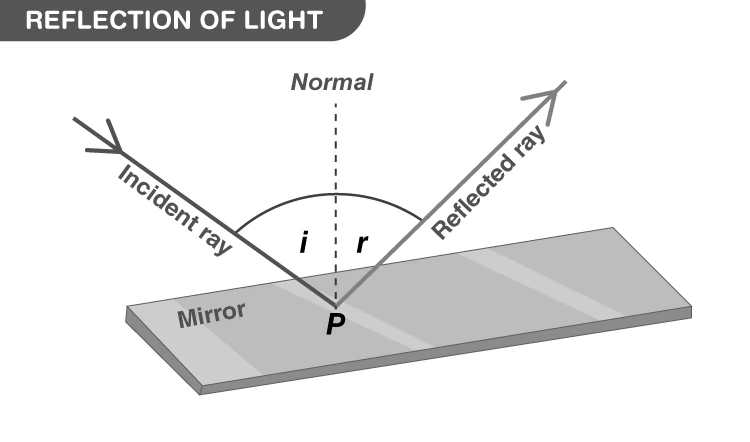
Illustration of light reflection on a plane mirror
Example Problem
A ray of light strikes a flat mirror at an angle of \( 30^\circ \) to the normal. Calculate the angle at which the light is reflected.
Solution:
According to the law of reflection, the angle of incidence equals the angle of reflection.
Given, angle of incidence \( i = 30^\circ \)
Therefore, angle of reflection \( r = i = 30^\circ \)
The light ray is reflected at an angle of \( 30^\circ \) to the normal.
Fundamental Laws Governing Reflection
The behavior of light during reflection is governed by two essential laws:
The incident ray, reflected ray, and the normal at the point of incidence all lie in the same plane.
The angle of incidence is always equal to the angle of reflection.
These laws apply universally to all reflecting surfaces such as mirrors, polished metals, and calm water surfaces.
Exam Tip: Always remember that the equality of angles is measured with respect to the normal, not the surface.
Example Problem
A light ray hits a mirror at an angle of incidence of \( 45^\circ \). What is the angle between the incident ray and the reflected ray?
Solution:
Angle of incidence \( i = 45^\circ \)
Angle of reflection \( r = 45^\circ \)
The angle between the incident and reflected rays is:
\[ \theta = i + r = 45^\circ + 45^\circ = 90^\circ \]
Hence, the rays form a right angle.
Varieties of Light Reflection
Specular Reflection: Clear and Defined Images
Specular reflection, also called regular reflection, occurs on highly polished surfaces like mirrors. These surfaces have a uniform reflective coating that causes light rays to reflect at consistent angles, producing sharp and clear images without distortion or blurring.
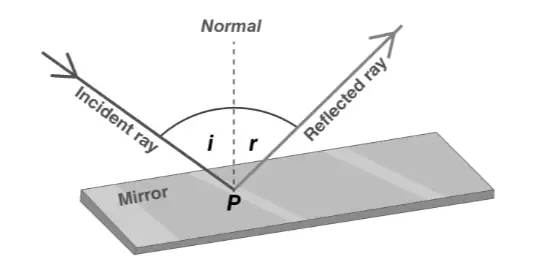
Example of specular reflection on a mirror
Example Problem
A ray of light strikes a mirror at an angle of \( 60^\circ \) to the normal. Describe the nature of the reflected ray and the image formed.
Solution:
The angle of reflection equals the angle of incidence, so the reflected ray makes \( 60^\circ \) with the normal.
Since the surface is smooth and polished, the reflection is specular, producing a clear and sharp image.
The image formed is virtual, upright, and of the same size as the object.
Diffuse Reflection: Scattered Light from Rough Surfaces
When light falls on rough or uneven surfaces, it reflects in multiple directions due to irregularities. This scattered reflection is called diffuse reflection. It prevents the formation of clear images but allows us to see objects that do not shine, such as paper or cloth.
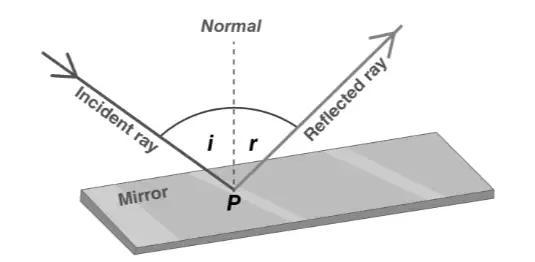
Diffuse reflection from a rough surface
Example Problem
Explain why a white wall appears visible even though it is not shiny.
Solution:
The wall’s surface is rough, causing incident light rays to scatter in many directions.
This scattered light reaches our eyes from multiple angles, making the wall visible.
Since the reflection is diffuse, no clear image is formed.
Multiple Reflections: Images from Two or More Mirrors
When two mirrors are placed at an angle, light can reflect back and forth between them multiple times, creating several images of a single object. The number of images depends on the angle between the mirrors. As the angle decreases, the number of images increases, becoming infinite when the mirrors are parallel.
The formula to calculate the number of images formed between two mirrors is:
\[ \text{Number of images} = \frac{360^\circ}{\text{angle between mirrors}} - 1 \]
Example Problem
Two mirrors are placed at an angle of \( 45^\circ \). How many images of an object placed between them will be visible?
Solution:
Using the formula:
\[ \text{Number of images} = \frac{360^\circ}{45^\circ} - 1 = 8 - 1 = 7 \]
Therefore, 7 images will be seen.
Summary and Quick Reference
Concept | Key Points | Example |
|---|---|---|
Reflection of Light | Light ray bounces off a smooth surface; incident ray, reflected ray, and normal lie in one plane; angle of incidence equals angle of reflection. | Light hitting a mirror at \(30^\circ\) reflects at \(30^\circ\). |
Specular Reflection | Occurs on polished surfaces; produces clear, sharp images; uniform reflection angles. | Mirror reflection with angle of incidence \(60^\circ\) results in a clear image. |
Diffuse Reflection | Occurs on rough surfaces; light scatters in many directions; no clear image formed. | White wall visible due to scattered light. |
Multiple Reflection | Light reflects multiple times between two mirrors; number of images depends on angle between mirrors. | Two mirrors at \(45^\circ\) produce 7 images. |
Glossary of Key Terms
Term | Definition |
|---|---|
Incident Ray | The incoming light ray that strikes a surface. |
Reflected Ray | The light ray that bounces off the surface after reflection. |
Normal | A perpendicular line drawn at the point of incidence on the reflecting surface. |
Angle of Incidence | The angle between the incident ray and the normal. |
Angle of Reflection | The angle between the reflected ray and the normal. |
Specular Reflection | Reflection from a smooth surface producing a clear image. |
Diffuse Reflection | Reflection from a rough surface causing scattered light. |
Multiple Reflection | Successive reflections between two or more mirrors. |
Virtual Image | An image formed by reflected rays that appear to come from a point behind the mirror. |
Plane Mirror | A flat mirror that reflects light to form virtual images. |
Frequently Asked Questions
What is meant by the reflection of light?
Reflection of light is the phenomenon where a light ray strikes a smooth surface and bounces back into the original medium.
What are the fundamental laws of reflection?
The incident ray, reflected ray, and normal lie in the same plane, and the angle of incidence equals the angle of reflection.
What distinguishes specular reflection from diffuse reflection?
Specular reflection occurs on smooth surfaces producing clear images, while diffuse reflection happens on rough surfaces scattering light in many directions.
How is the number of images formed between two mirrors calculated?
The number of images is given by \(\frac{360^\circ}{\text{angle between mirrors}} - 1\).
Why do rough surfaces not produce clear images?
Because the irregularities cause light rays to reflect in multiple directions, preventing the formation of sharp images.
Visual representation of light reflection concepts
Reflection on a mirror surface
Light rays reflecting from a surface
Demonstration of reflection
Experiment showing light reflection
Reflection on a rough surface
Register with BYJU'S for free PDFs and live videos