Understanding Nearsightedness: Causes, Symptoms, and Correction
How the Human Eye Focuses on Objects at Different Distances
Mechanism of Focusing for Near and Distant Objects
The human eye adjusts its lens curvature to focus images clearly on the retina, depending on the object's distance. When observing nearby objects, the eye's lens becomes more curved, resulting in a shorter focal length that allows the image to form precisely on the retina. Conversely, for distant objects, the lens flattens, increasing the focal length to focus the image correctly.
Changes in the lens curvature directly influence the focal length: a highly curved lens has a short focal length suitable for close objects, while a less curved lens has a longer focal length for distant vision. This dynamic adjustment is essential for clear vision across various distances.
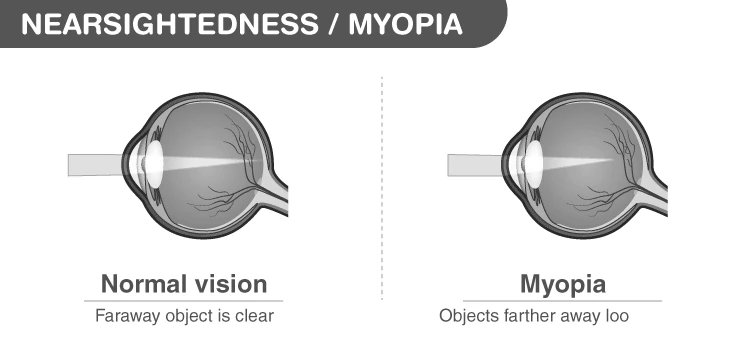
Diagram illustrating the focusing mechanism in myopia
Example: Lens Curvature and Focal Length
Suppose the curvature radius of the eye's lens changes from 10 mm to 7 mm when focusing on a nearby object. Explain how this affects the focal length and the ability to see close objects clearly.
Solution:
The focal length \( f \) of a lens is related to its curvature radius \( R \) by the lensmaker's formula. A decrease in radius of curvature from 10 mm to 7 mm means the lens becomes more curved.
Since focal length is inversely proportional to curvature, the focal length shortens, allowing the eye to focus light rays from nearby objects onto the retina, resulting in clear vision.
Understanding Nearsightedness (Myopia): Causes and Effects
What Leads to Nearsightedness?
Nearsightedness, or myopia, arises when the eye's optical system causes images of distant objects to focus in front of the retina rather than directly on it. This typically happens due to an elongated eyeball or an excessively curved cornea, which increases the eye's refractive power beyond normal.
Genetic factors play a significant role; children with myopic parents have a higher likelihood of developing the condition. Additionally, environmental factors such as prolonged close work and certain health issues like uncontrolled diabetes or cataract formation can contribute to the onset of myopia.
Visual representation of image formation in nearsightedness
Example: Effect of Eyeball Length on Image Formation
An eye with a normal axial length of 24 mm develops myopia due to elongation to 26 mm. Explain how this change affects the image formation of distant objects.
Solution:
The elongation causes the image of distant objects to form before the retina instead of on it, resulting in blurred vision for faraway objects. The eye's focal length remains the same, but the increased eyeball length shifts the image forward, causing nearsightedness.
Recognizing Symptoms and Correcting Nearsightedness
Identifying Signs of Myopia
Common indicators of nearsightedness include squinting to see distant objects clearly, frequent headaches due to eye strain, and difficulty reading signs or text from afar. Individuals may also experience tiredness in the eyes after prolonged visual tasks.
Early detection is crucial to prevent worsening of the condition and to maintain comfortable vision during daily activities.
Example: Symptom Identification
A student complains of frequent headaches and difficulty seeing the blackboard clearly. What condition might this indicate, and what simple test can confirm it?
Solution:
The symptoms suggest possible myopia.
A vision test involving reading letters at various distances can confirm the diagnosis.
Consultation with an eye specialist is recommended for accurate assessment.
Calculating the Required Lens Power for Correction
The power of the lens needed to correct myopia can be estimated using the combined focal length formula for lenses:
\[ \frac{1}{f} = \frac{1}{f_1} + \frac{1}{f_2} \]
Here, \( f \) is the effective focal length of the combined system, \( f_1 \) is the focal length of the corrective lens, and \( f_2 \) is the focal length of the eye.
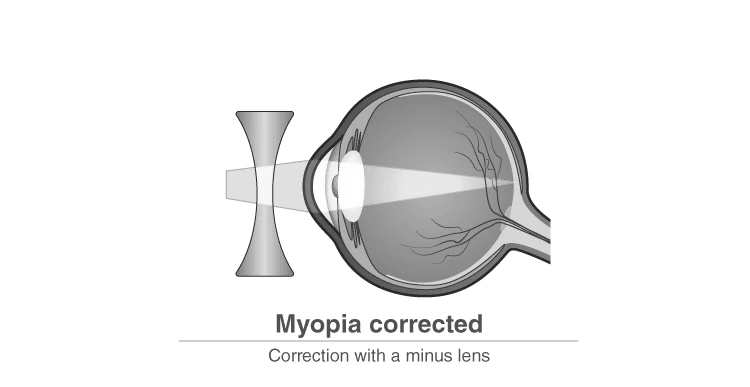
Since myopic eyes focus images in front of the retina, a diverging (concave) lens with negative focal length is used to adjust the focal point back onto the retina.
Example: Lens Power Calculation
A person with myopia has an eye focal length of 22 mm, but the image forms 18 mm from the lens. Calculate the focal length and power of the corrective lens needed.
Solution:
Given:
Eye focal length, \( f_2 = 22 \text{ mm} = 0.022 \text{ m} \)
Image forms at \( f = 18 \text{ mm} = 0.018 \text{ m} \)
Using the formula:
\[ \frac{1}{f} = \frac{1}{f_1} + \frac{1}{f_2} \implies \frac{1}{f_1} = \frac{1}{f} - \frac{1}{f_2} \]
Substituting values:
\[ \frac{1}{f_1} = \frac{1}{0.018} - \frac{1}{0.022} = 55.56 - 45.45 = 10.11 \text{ m}^{-1} \]
Thus, \( f_1 = \frac{1}{10.11} = 0.099 \text{ m} \approx 10 \text{ cm} \)
The power \( P \) of the lens is:
\[ P = \frac{100}{f_1(\text{cm})} = \frac{100}{-10} = -10 \text{ diopters} \]
The negative sign indicates a diverging lens is required.
Methods to Correct Nearsightedness
Myopia is commonly corrected using concave lenses that diverge incoming light rays before they enter the eye, ensuring the image forms precisely on the retina. This adjustment compensates for the eye's excessive refractive power or elongated shape.
Other corrective options include contact lenses and refractive surgeries, but concave lenses remain the most accessible and widely used solution.
Example: Lens Application for Myopia
A patient’s eye focuses distant images 15 mm in front of the retina. What type of lens should be prescribed, and why?
Solution:
The image forms before the retina, indicating myopia.
A concave (diverging) lens is prescribed to spread the light rays slightly so that the image shifts back onto the retina.
This restores clear vision for distant objects.
Summary Table for Quick Revision
Aspect | Details |
|---|---|
Definition | Condition where distant objects appear blurry due to image focusing in front of retina |
Primary Cause | Elongated eyeball or overly curved cornea increasing refractive power |
Common Symptoms | Squinting, headaches, eye strain, difficulty seeing distant objects |
Correction Method | Use of concave (diverging) lenses to adjust focal point onto retina |
Lens Power Formula | \( \frac{1}{f} = \frac{1}{f_1} + \frac{1}{f_2} \) |
Lens Type for Correction | Concave lens with negative focal length |
Genetic Influence | Hereditary factors increase risk of myopia |
Other Causes | Uncontrolled diabetes, cataract development |
Age Group Affected | Mostly young individuals and adolescents |
Visual Effect | Clear vision for near objects, blurred vision for distant objects |
Glossary of Key Terms
Term | Meaning |
|---|---|
Myopia | A vision defect where distant objects appear blurred due to improper focusing |
Focal Length | The distance between the lens and the point where light rays converge to form a clear image |
Cornea | The transparent front part of the eye that refracts light entering the eye |
Concave Lens | A lens that diverges light rays, used to correct myopia |
Retina | The light-sensitive layer at the back of the eye where images are formed |
Refractive Power | The ability of the eye's lens system to bend light rays to focus images |
Axial Length | The length of the eyeball from front to back |
Image Formation | The process of light rays converging to create a visible picture on the retina |
Diverging Lens | Another term for concave lens that spreads out light rays |
Hereditary | Genetic transmission of traits or conditions from parents to offspring |
Frequently Asked Questions
What is myopia?
Myopia is a vision condition where distant objects appear blurry because the eye focuses images in front of the retina.
What is another name for myopia?
Myopia is also commonly called nearsightedness or short-sightedness.
What is a common symptom of myopia?
Difficulty seeing distant objects clearly, often accompanied by squinting or eye strain.
How do you calculate the power of a lens needed to correct myopia?
The power is calculated using the formula \(\frac{1}{f} = \frac{1}{f_1} + \frac{1}{f_2}\), where \(f_1\) is the focal length of the corrective lens.
Is heredity a factor in developing myopia?
True. Genetic factors can increase the likelihood of developing myopia.