Understanding Homologous Series in Organic Chemistry
Fundamentals of Homologous Series
Defining the Concept and Its Core Features
A homologous series consists of organic compounds that share a common functional group and exhibit similar chemical behaviors. Each successive compound in the series differs from the previous one by a repeating unit of a methylene group, \(-\mathrm{CH}_2-\). This structural pattern results in a general formula that applies to all members within the series, allowing for systematic classification of organic molecules based on their carbon chain length.
For instance, alkanes follow the general formula \( \mathrm{C}_n\mathrm{H}_{2n+2} \), alkenes follow \( \mathrm{C}_n\mathrm{H}_{2n} \), and alkynes follow \( \mathrm{C}_n\mathrm{H}_{2n-2} \). These series demonstrate how the carbon chain length influences molecular composition while maintaining consistent functional groups.
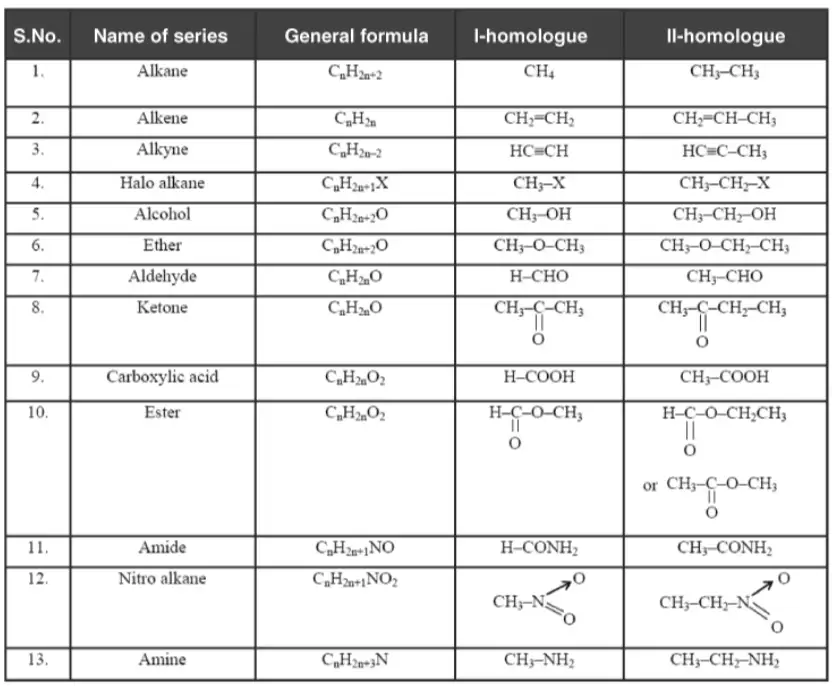
Illustration of Homologous Series
Example Problem
Identify whether the following compounds belong to the same homologous series: \( \mathrm{C}_3\mathrm{H}_8 \) and \( \mathrm{C}_4\mathrm{H}_{10} \).
Solution:
First, calculate the difference in the number of carbon atoms: \(4 - 3 = 1\).
Next, calculate the difference in hydrogen atoms: \(10 - 8 = 2\).
Since the difference corresponds to one \(-\mathrm{CH}_2-\) unit (which contains 1 carbon and 2 hydrogens), these compounds differ by a methylene group.
Both compounds fit the alkane general formula \( \mathrm{C}_n\mathrm{H}_{2n+2} \), confirming they belong to the same homologous series.
Illustrations and Properties of Homologous Series
Examples and Physical Trends in Homologous Compounds
Members of a homologous series differ by a single \(-\mathrm{CH}_2-\) group, which leads to predictable changes in their physical properties. For example, methane (\( \mathrm{CH}_4 \)), ethane (\( \mathrm{C}_2\mathrm{H}_6 \)), and propane (\( \mathrm{C}_3\mathrm{H}_8 \)) are consecutive alkanes differing by one methylene unit each.
Similarly, alkenes such as ethene (\( \mathrm{C}_2\mathrm{H}_4 \)), propene (\( \mathrm{C}_3\mathrm{H}_6 \)), and butene (\( \mathrm{C}_4\mathrm{H}_8 \)) follow the general formula \( \mathrm{C}_n\mathrm{H}_{2n} \) and differ by \(-\mathrm{CH}_2-\) units as well.
Physical properties like melting point, boiling point, and solubility gradually change with increasing molecular mass due to the addition of bonds and molecular size. Chemical properties remain consistent within the series because the functional group remains unchanged.
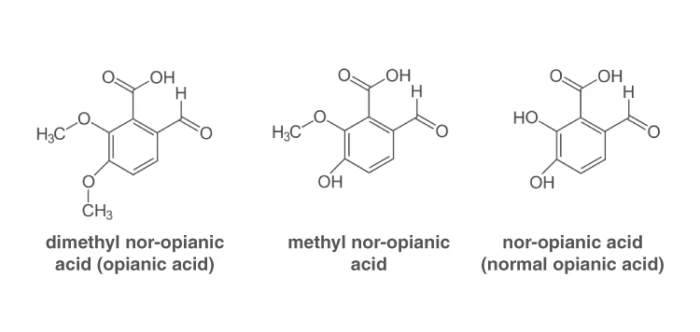
Examples of Homologous Series
Example Problem
Explain why the boiling points of alcohols such as methanol (\( \mathrm{CH}_3\mathrm{OH} \)), ethanol (\( \mathrm{C}_2\mathrm{H}_5\mathrm{OH} \)), and propanol (\( \mathrm{C}_3\mathrm{H}_7\mathrm{OH} \)) increase progressively.
Solution:
All these alcohols share the same functional group \(-\mathrm{OH}\), which governs their chemical behavior.
As the carbon chain length increases, molecular mass and surface area increase, enhancing van der Waals forces.
Stronger intermolecular forces require more energy to break, resulting in higher boiling points.
Thus, the boiling points rise gradually from methanol to propanol due to increasing molecular size and bonding interactions.
Significance and Applications of Homologous Series
Systematic Study and Predictive Power in Organic Chemistry
The concept of homologous series allows chemists to organize organic compounds systematically. By understanding one member of a series, scientists can predict the properties and reactions of other members, simplifying the study of organic chemistry.
This approach aids in the synthesis, identification, and application of organic molecules in various fields such as pharmaceuticals, materials science, and industrial chemistry.
Conceptual Diagram of Homologous Series
Applications of Homologous Series
Example Problem
How does the knowledge of homologous series assist in predicting the chemical behavior of unknown organic compounds?
Solution:
Since members of a homologous series share the same functional group, their chemical reactions are similar.
By studying known members, chemists can infer reaction mechanisms and products for new compounds in the series.
This reduces experimental trial and error, saving time and resources in research and industry.
It also helps in designing compounds with desired properties by modifying chain length systematically.
Quick Reference: Key Features of Homologous Series
Aspect | Description |
|---|---|
Definition | Series of compounds differing by \(-\mathrm{CH}_2-\) units with same functional group |
General Formula | Common formula applicable to all members (e.g., \( \mathrm{C}_n\mathrm{H}_{2n+2} \) for alkanes) |
Chemical Properties | Nearly identical due to shared functional group |
Physical Properties | Gradual change with increasing molecular mass (boiling point, melting point, solubility) |
Successive Difference | One methylene group (\(-\mathrm{CH}_2-\)) difference between adjacent members |
Members Called | Homologues |
Importance | Facilitates systematic study and prediction of organic compounds |
Glossary of Important Terms
Term | Meaning |
|---|---|
Homologous Series | A group of compounds with the same functional group differing by \(-\mathrm{CH}_2-\) units |
Functional Group | Specific group of atoms responsible for characteristic chemical reactions |
Methylene Group | The \(-\mathrm{CH}_2-\) unit that differentiates members of a homologous series |
Alkanes | Saturated hydrocarbons with general formula \( \mathrm{C}_n\mathrm{H}_{2n+2} \) |
Alkenes | Unsaturated hydrocarbons with one double bond, formula \( \mathrm{C}_n\mathrm{H}_{2n} \) |
Alkynes | Unsaturated hydrocarbons with one triple bond, formula \( \mathrm{C}_n\mathrm{H}_{2n-2} \) |
Homologues | Individual members of a homologous series |
General Formula | Algebraic formula representing all members of a homologous series |
Intermolecular Forces | Forces between molecules affecting physical properties like boiling point |
Gradation | Systematic variation in physical properties across a series |
Frequently Asked Questions
What are the main characteristics of a homologous series?
Members share the same functional group, have a common general formula, exhibit similar chemical properties, and differ by a \(-\mathrm{CH}_2-\) unit.
How can you identify if compounds belong to the same homologous series?
If each successive compound differs by one methylene group (\(-\mathrm{CH}_2-\)) and shares the same functional group, they belong to the same homologous series.
Why do homologous series members have similar chemical properties?
Because they contain the same functional group, which determines their chemical reactivity, their chemical properties remain consistent.
What distinguishes two different homologous series from each other?
They differ in their functional groups and general formulas, even though members within each series differ by \(-\mathrm{CH}_2-\) units.
What term is used for individual compounds within a homologous series?
Each compound is called a homologue, and the phenomenon of such series is known as homology.