Understanding the Heating Effect of Electric Current
Fundamentals of Heat Generation by Electric Current
How Electric Current Produces Heat
When an electric current passes through a conductor, it often causes the conductor to warm up. This phenomenon occurs because electrical energy is partly transformed into heat energy due to the resistance offered by the material. This conversion of electrical energy into heat is known as the heating effect of current, also called Joule heating or resistive heating. It was first studied by James Prescott Joule in the 19th century, who demonstrated that the heat produced depends on the current, resistance, and duration of current flow.
Joule's experiments involved passing current through wires submerged in water and measuring the temperature rise over time. He concluded that the heat generated is directly proportional to the square of the current, the resistance of the conductor, and the time for which the current flows. Importantly, this heating effect is independent of the current's direction.
The mathematical expression for the heat produced is:
\[ H \propto I^2 R t \]
where:
\(I\) is the current in amperes
\(R\) is the resistance in ohms
\(t\) is the time in seconds
Example Problem
A copper wire with resistance \(5 \, \Omega\) carries a current of \(3 \, \text{A}\) for \(4\) minutes. Calculate the heat energy produced in the wire. (Take \(1 \, \text{minute} = 60 \, \text{seconds}\))
Solution:
Given:
Resistance, \(R = 5 \, \Omega\)
Current, \(I = 3 \, \text{A}\)
Time, \(t = 4 \times 60 = 240 \, \text{seconds}\)
Heat produced is given by Joule's law:
\[ H = I^2 R t \]
Substituting the values:
\[ H = (3)^2 \times 5 \times 240 = 9 \times 5 \times 240 = 10800 \, \text{Joules} \]
Therefore, the wire produces \(10800 \, \text{J}\) of heat energy.
Practical Uses of the Heating Effect in Daily Life
Common Devices Utilizing Electric Heating
The heating effect of electric current is harnessed in many household and industrial appliances. These devices convert electrical energy into heat to perform useful tasks efficiently.
Some notable applications include:
Incandescent Bulbs: The filament, usually tungsten, heats up due to current flow until it glows, producing light.
Electric Irons: The heating element warms up to press clothes. A bimetallic strip acts as a thermostat to regulate temperature by breaking the circuit when a set temperature is reached.
Room Heaters: These use resistive wires to generate heat, often with a circuit breaker for safety.
Electric Fuses: Made of metals like copper or zinc, fuses melt when excessive current flows, breaking the circuit and preventing damage.
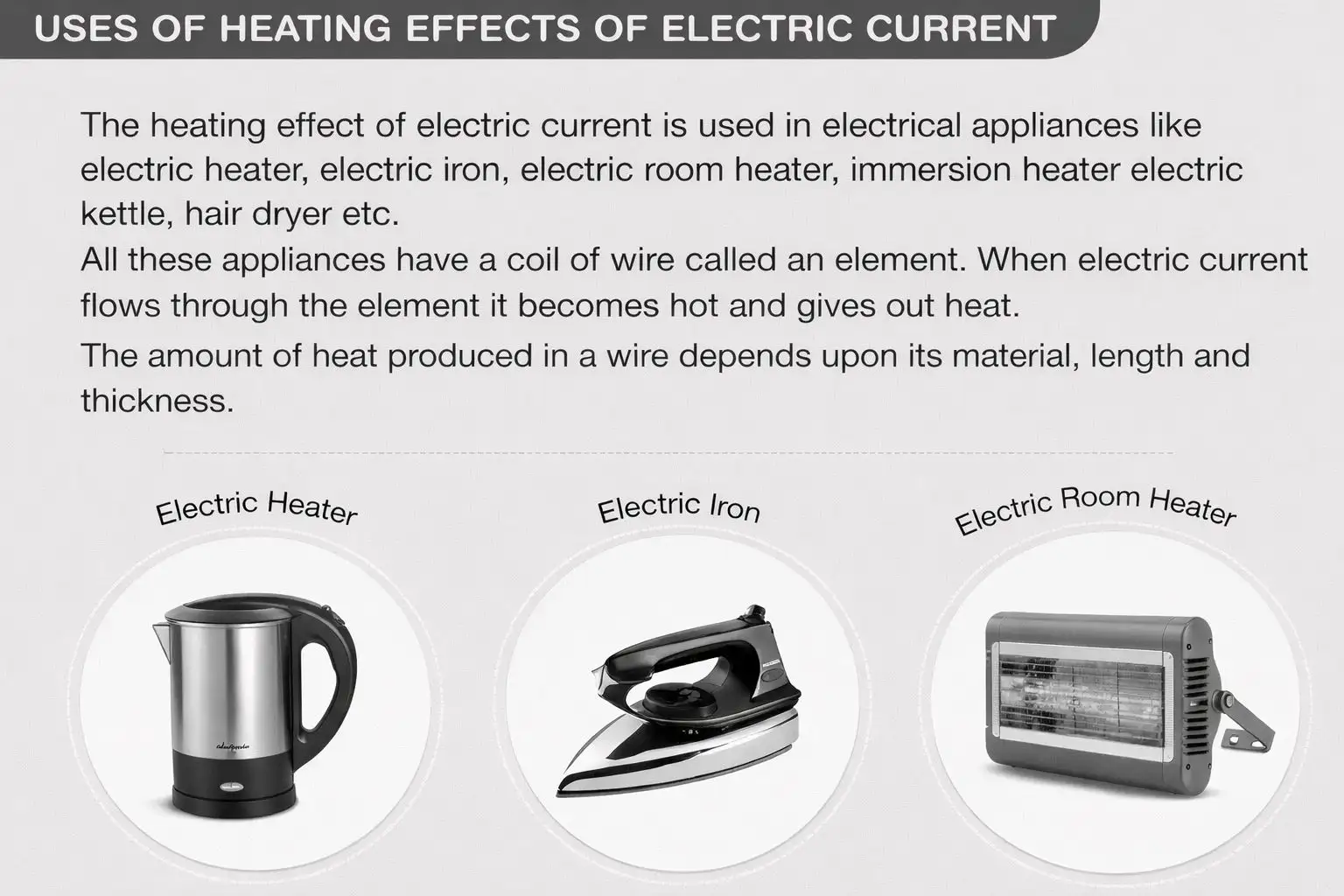
Illustration showing the heating effect of electric current in various appliances
Example Problem
An electric heater has a resistance of \(20 \, \Omega\) and is connected to a \(220 \, \text{V}\) supply. Calculate the heat produced in \(10\) minutes.
Solution:
Given:
Resistance, \(R = 20 \, \Omega\)
Voltage, \(V = 220 \, \text{V}\)
Time, \(t = 10 \times 60 = 600 \, \text{seconds}\)
First, calculate the current using Ohm's law:
\[ I = \frac{V}{R} = \frac{220}{20} = 11 \, \text{A} \]
Now, calculate heat produced using Joule's law:
\[ H = I^2 R t = (11)^2 \times 20 \times 600 = 121 \times 20 \times 600 = 1,452,000 \, \text{J} \]
The heater produces \(1,452,000 \, \text{J}\) of heat in 10 minutes.
Exploring the Mechanism Behind Heat Generation
Why Does Current Cause Heating?
When electrons move through a conductor, they collide with the atoms of the material. These collisions cause the atoms to vibrate more vigorously, which manifests as heat. The resistance of the conductor determines how much energy is lost as heat. Materials with higher resistance convert more electrical energy into heat for the same current.
This effect is independent of the current's direction, meaning alternating current (AC) and direct current (DC) both produce heating as long as current flows.
Electron collisions inside a conductor leading to heat generation
Example Problem
A resistor of resistance \(10 \, \Omega\) carries a current of \(2 \, \text{A}\) for \(5\) minutes. Calculate the heat produced and explain why the resistor heats up.
Solution:
Given:
Resistance, \(R = 10 \, \Omega\)
Current, \(I = 2 \, \text{A}\)
Time, \(t = 5 \times 60 = 300 \, \text{seconds}\)
Heat produced:
\[ H = I^2 R t = (2)^2 \times 10 \times 300 = 4 \times 10 \times 300 = 12,000 \, \text{J} \]
The resistor heats up because the moving electrons collide with atoms in the resistor, causing them to vibrate and generate heat energy.
Quick Reference: Key Points on Heating Effect of Current
Parameter | Symbol | Unit | Role in Heating Effect |
|---|---|---|---|
Electric Current | \(I\) | Amperes (A) | Heat produced is proportional to the square of current |
Resistance | \(R\) | Ohms (\(\Omega\)) | Heat produced increases with resistance |
Time | \(t\) | Seconds (s) | Longer current flow produces more heat |
Heat Energy | \(H\) | Joules (J) | Energy converted from electrical to heat |
Voltage | \(V\) | Volts (V) | Related to current by Ohm's law |
Glossary of Important Terms
Term | Definition |
|---|---|
Electric Current | Flow of electric charge through a conductor |
Resistance | Property of a material that opposes current flow |
Joule Heating | Heat produced due to current passing through a resistor |
Ohm's Law | Relationship between voltage, current, and resistance: \(V=IR\) |
Fuse | Safety device that melts to break circuit on excess current |
Bimetallic Strip | Two metals bonded together that bend with temperature changes |
Conduction | Heat transfer through direct contact of particles |
Convection | Heat transfer through fluid movement |
Radiation | Heat transfer through electromagnetic waves |
Electric Heater | Device that converts electrical energy into heat for warming spaces |
Frequently Asked Questions
What is meant by the heating effect of electric current?
It is the process where electrical energy is converted into heat energy when current passes through a conductor with resistance.
Which factors influence the amount of heat produced in a conductor?
The heat generated depends on the current squared, the resistance of the conductor, and the time duration of current flow.
Can the heating effect occur with both AC and DC currents?
Yes, the heating effect happens regardless of current direction, so both alternating and direct currents produce heat.
Give two examples where the heating effect of current is used.
Electric irons and electric bulbs are common devices that utilize the heating effect of current.
What safety device uses the heating effect to protect electrical circuits?
The electric fuse melts due to excessive heat generated by high current, breaking the circuit to prevent damage.