Comprehensive Overview of Ethanoic Acid
Fundamental Structure and Characteristics of Ethanoic Acid
Understanding the Molecular Composition and Physical Traits
Ethanoic acid, commonly known as acetic acid, is a member of the carboxylic acid family with the chemical formula \( \mathrm{CH_3COOH} \). It is slightly denser than water, possessing a density of approximately \( 1.05 \, \text{g/cm}^3 \). When diluted to about 5-8% concentration in water, it forms vinegar, widely used as a preservative in food items such as pickles. The term "acetic acid" is the more familiar name for ethanoic acid in everyday usage.
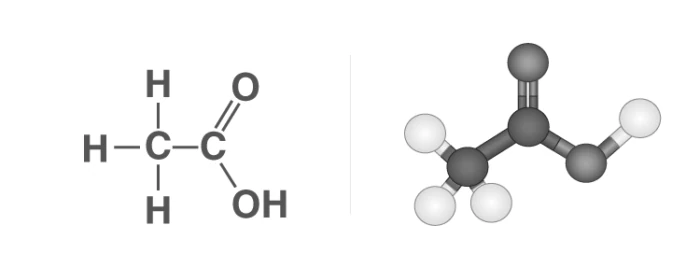
Molecular representation of Ethanoic Acid
Example Problem
Calculate the mass of ethanoic acid present in 250 mL of vinegar if the vinegar contains 6% ethanoic acid by volume and the density of vinegar is \(1.01 \, \text{g/cm}^3\).
Solution:
First, find the mass of the vinegar:
\[ \text{Mass of vinegar} = \text{Volume} \times \text{Density} = 250 \, \text{mL} \times 1.01 \, \frac{\text{g}}{\text{mL}} = 252.5 \, \text{g} \]
Next, calculate the mass of ethanoic acid (6% by volume, assuming volume percentage approximates mass percentage here):
\[ \text{Mass of ethanoic acid} = 6\% \times 252.5 \, \text{g} = 0.06 \times 252.5 = 15.15 \, \text{g} \]
Therefore, the vinegar contains approximately 15.15 grams of ethanoic acid.
Distinctive Properties and Physical Behavior of Ethanoic Acid
Exploring the Unique Characteristics and Terminology
Ethanoic acid is often called glacial acetic acid due to its relatively high melting point of \(16^\circ \text{C}\). This property causes it to solidify or "freeze" under cold conditions, resembling ice crystals, hence the term "glacial." This behavior is uncommon among many organic acids and is important for its storage and handling.
Solidified glacial acetic acid crystals
Example Problem
At what temperature does ethanoic acid solidify, and why is it called glacial acetic acid?
Answer:
Ethanoic acid freezes at \(16^\circ \text{C}\), which is relatively high for an organic acid.
Due to this freezing point, it forms ice-like crystals under cool conditions.
This crystalline appearance resembles glaciers, hence the name "glacial acetic acid."
Chemical Reactions Involving Ethanoic Acid
Key Reactions and Their Practical Implications
Ethanoic acid participates in several important chemical reactions that highlight its versatility. One of the most notable is esterification, where it reacts with alcohols to form esters, compounds known for their pleasant fruity aromas. These esters are widely used in perfumes and flavoring agents.
The general esterification reaction with ethanol is:
\[ \mathrm{CH_3COOH} + \mathrm{CH_3CH_2OH} \xrightarrow{\text{acid catalyst}} \mathrm{CH_3COOCH_2CH_3} + \mathrm{H_2O} \]
Esters can be hydrolyzed by alkalis in a process called saponification, producing alcohol and a carboxylate salt, which is fundamental in soap making:
\[ \mathrm{CH_3COOC_2H_5} + \mathrm{NaOH} \rightarrow \mathrm{C_2H_5OH} + \mathrm{CH_3COONa} \]
Ethanoic acid also reacts with bases to form salts and water, similar to mineral acids. Additionally, it reacts with carbonates and bicarbonates to release carbon dioxide gas, water, and a salt:
\[ \mathrm{CH_3COOH} + \mathrm{NaHCO_3} \rightarrow \mathrm{CH_3COONa} + \mathrm{H_2O} + \mathrm{CO_2} \]
Reaction of ethanoic acid with sodium bicarbonate producing carbon dioxide
Example Problem
Calculate the volume of carbon dioxide gas produced at STP when 0.5 moles of ethanoic acid react completely with sodium bicarbonate.
Solution:
The balanced reaction is:
\[ \mathrm{CH_3COOH} + \mathrm{NaHCO_3} \rightarrow \mathrm{CH_3COONa} + \mathrm{H_2O} + \mathrm{CO_2} \]
From the equation, 1 mole of ethanoic acid produces 1 mole of \( \mathrm{CO_2} \).
Therefore, 0.5 moles of ethanoic acid will produce 0.5 moles of \( \mathrm{CO_2} \).
At STP, 1 mole of gas occupies \(22.4 \, \text{L}\), so:
\[ \text{Volume of } \mathrm{CO_2} = 0.5 \times 22.4 = 11.2 \, \text{L} \]
Hence, 11.2 liters of carbon dioxide gas is released.
Practical Applications and Industrial Uses of Ethanoic Acid
Utilization Across Various Sectors
Ethanoic acid is extensively employed in multiple industries due to its chemical properties. It serves as a precursor in the synthesis of esters, vinegar production, and manufacturing of polymers. Vinegar, which contains diluted ethanoic acid, has been found to help regulate elevated blood sugar levels.
In laboratories, ethanoic acid is used to lyse red blood cells to facilitate the examination of white blood cells. It also acts as a solvent in producing substances like camphor and is a common ingredient in cooking. Photographers use it as a stop bath during film development to halt the action of developer chemicals.
In agriculture, farmers apply acetic acid to livestock silage to inhibit fungal and bacterial growth, preserving the feed quality.
Example Problem
List three industrial or practical uses of ethanoic acid and briefly explain their significance.
Answer:
Vinegar Production: Diluted ethanoic acid forms vinegar, widely used as a food preservative and flavoring agent.
Solvent Use: It acts as a solvent in manufacturing camphor and other chemicals, facilitating various industrial processes.
Photographic Processing: Used as a stop bath to halt the development of photographic films, ensuring image quality.
Quick Reference Summary
Aspect | Details |
|---|---|
Chemical Formula | \( \mathrm{CH_3COOH} \) |
Common Name | Acetic Acid |
Density | Approximately \(1.05 \, \text{g/cm}^3\) |
Melting Point | \(16^\circ \text{C}\) (Glacial Acetic Acid) |
Key Reactions | Esterification, Neutralization, Reaction with Carbonates |
Uses | Vinegar, Solvent, Preservative, Polymer Production |
Glossary of Important Terms
Term | Definition |
|---|---|
Ethanoic Acid | A carboxylic acid with formula \( \mathrm{CH_3COOH} \), commonly called acetic acid. |
Glacial Acetic Acid | Pure ethanoic acid that solidifies at \(16^\circ \text{C}\), forming ice-like crystals. |
Carboxylic Acid | Organic acids containing the carboxyl group \(-COOH\). |
Esterification | Chemical reaction between an acid and an alcohol producing an ester and water. |
Esters | Organic compounds with fruity smells formed by esterification. |
Saponification | Base-catalyzed hydrolysis of esters producing alcohol and salt (soap). |
Neutralization | Reaction of an acid with a base producing salt and water. |
Vinegar | A dilute aqueous solution of ethanoic acid used as a preservative and condiment. |
Density | Mass per unit volume, typically expressed in \( \text{g/cm}^3 \). |
Polymer | Large molecules composed of repeating structural units, often synthesized using ethanoic acid derivatives. |
Frequently Asked Questions
What are the primary industrial uses of ethanoic acid?
Ethanoic acid is mainly used in producing esters, vinegar, polymers, solvents, and as a preservative in food industries.
Is ethanoic acid effective as a food preservative?
Yes, it acts as a natural antibacterial agent and preservative, especially in pickling and edible films.
Why is ethanoic acid classified as a weak acid?
Because it only partially ionizes in water, establishing an equilibrium between the acid and its ions.
What causes esters to have a sweet fragrance?
Esters have low intermolecular forces and lack hydrogen bonding, making them volatile with pleasant fruity odors.
How does ethanoic acid react with sodium bicarbonate?
It reacts to produce sodium acetate, water, and carbon dioxide gas, which causes effervescence.