Understanding Electric Generators: Principles and Applications
Fundamentals of Electric Generators
Basic Concept and Energy Conversion
An electric generator is a device that transforms mechanical energy into electrical energy. This mechanical input is typically supplied by sources such as steam turbines, gas turbines, or wind turbines. The generator then converts this mechanical motion into an electric current, which powers electrical grids and various devices.
Unlike electric motors that convert electrical energy into mechanical energy, generators perform the reverse operation. Despite their functional differences, both machines share many design similarities.
Example: A wind turbine provides mechanical energy to a generator shaft rotating at 1500 revolutions per minute (rpm). If the generator produces an output voltage of 220 V at this speed, what would be the output voltage if the shaft speed increases to 1800 rpm, assuming all other factors remain constant?
Solution:
The output voltage of a generator is directly proportional to the speed of the rotating shaft. Let \( V_1 = 220 \text{ V} \) at \( N_1 = 1500 \text{ rpm} \), and \( V_2 \) be the voltage at \( N_2 = 1800 \text{ rpm} \).
\[ \frac{V_1}{N_1} = \frac{V_2}{N_2} \implies V_2 = V_1 \times \frac{N_2}{N_1} = 220 \times \frac{1800}{1500} = 220 \times 1.2 = 264 \text{ V} \]
Therefore, the output voltage at 1800 rpm is \( 264 \text{ V} \).
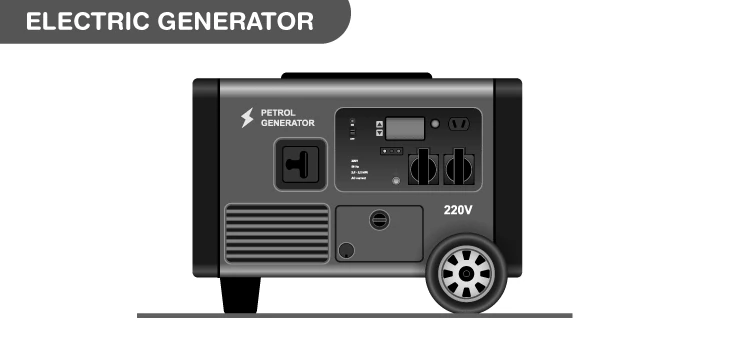
Various types of electrical generators in operation
Historical Development and Operating Principle
Evolution from Electrostatic to Electromagnetic Generators
Before the link between electricity and magnetism was understood, early generators operated on electrostatic principles. These machines, however, were limited by their low power output and insulation challenges at high voltages, making them unsuitable for large-scale power generation.
The breakthrough came in 1831 when Michael Faraday invented the first electromagnetic generator, known as the Faraday disk. This device demonstrated that moving a conductor within a magnetic field induces an electric current, laying the foundation for modern generators.
Example: Explain why electrostatic generators were not practical for commercial electricity production.
Answer:
They produced very low power outputs, insufficient for large-scale use.
High voltage insulation was difficult to achieve, leading to safety and efficiency issues.
The machines were inefficient and unreliable compared to electromagnetic generators.
Principle of Electromagnetic Induction
Modern generators operate based on electromagnetic induction, a principle discovered by Faraday. When a conductor moves through a magnetic field, a voltage difference is created across its ends, causing electric charges to flow and generate current.
This principle is the cornerstone of how mechanical energy is converted into electrical energy in generators.
Example: A coil of wire is rotated in a magnetic field, inducing an emf of 12 V. If the speed of rotation doubles, what will be the new emf induced?
Solution:
Since induced emf is proportional to the rate of change of magnetic flux, doubling the speed doubles the emf.
\[ E_2 = 2 \times E_1 = 2 \times 12 = 24 \text{ V} \]
The new induced emf is \( 24 \text{ V} \).
Structure, Types, and Applications of Generators
Key Components of an Electric Generator
An electric generator consists of several essential parts that work together to convert mechanical energy into electrical energy efficiently:
Frame: The supporting structure that holds all components.
Engine: Supplies the mechanical energy, often powered by turbines.
Alternator: Converts mechanical input into electrical output.
Fuel System: Provides fuel to keep the engine running.
Voltage Regulator: Maintains a stable output voltage.
Cooling System: Prevents overheating by dissipating heat.
Lubrication System: Ensures smooth operation of moving parts.
Exhaust System: Removes waste gases from combustion.
Charger: Keeps the generator’s battery charged.
Main Control Panel: Interface for monitoring and controlling the generator.
Example: Why is a voltage regulator important in a generator system?
Answer:
It ensures the output voltage remains constant despite load changes.
Prevents damage to electrical devices connected to the generator.
Improves the reliability and safety of the power supply.
Classification of Generators Based on Output Current
Generators are primarily categorized by the type of current they produce:
Alternating Current (AC) Generators: Also called single-phase generators, typically limited to outputs around 25 kW. They produce voltage that alternates direction periodically.
Direct Current (DC) Generators: These are subdivided into shunt, series, and compound-wound types. Shunt generators are commonly used for battery charging, series generators for street lighting, and compound-wound generators combine features of both.
Example: A DC generator is used to charge batteries in a workshop. Which type of DC generator is most suitable and why?
Answer:
A shunt-wound DC generator is ideal because it provides a relatively constant voltage output.
This stability is essential for safely charging batteries without overcharging.
Practical Uses of Electric Generators
Electric generators are indispensable in various sectors due to their ability to provide reliable power:
They supply electricity to urban power grids, supporting homes and industries.
Portable generators serve as backup power sources for households and small businesses.
Construction sites rely on generators before permanent power connections are established.
Generators help reduce fuel consumption by efficiently converting mechanical energy.
Laboratories use generators for experiments requiring variable voltage outputs.
They power electric motors and are integral in transportation systems.
Industrial electric generator setup
Control panel of a modern electric generator
Quick Reference: Summary of Electric Generators
Aspect | Details |
|---|---|
Definition | Device converting mechanical energy into electrical energy |
Primary Principle | Electromagnetic induction |
Inventor | Michael Faraday (1831) |
Main Components | Frame, Engine, Alternator, Fuel System, Voltage Regulator, Cooling System, Lubrication System, Exhaust System, Charger, Control Panel |
Types | AC Generators (single-phase), DC Generators (shunt, series, compound) |
Common Mechanical Energy Sources | Steam turbines, gas turbines, wind turbines |
Applications | Power grids, backup power, construction sites, laboratories, transportation |
Glossary of Key Terms
Term | Meaning |
|---|---|
Alternator | Component that converts mechanical energy into alternating electrical energy |
Electromagnetic Induction | Process of generating voltage by moving a conductor in a magnetic field |
Faraday Disk | The first electromagnetic generator invented by Michael Faraday |
Shunt Generator | Type of DC generator with field windings connected parallel to the armature |
Series Generator | DC generator with field windings connected in series with the armature |
Compound-Wound Generator | Generator combining both series and shunt field windings |
Voltage Regulator | Device that maintains constant output voltage from a generator |
Mechanical Energy | Energy possessed by an object due to its motion or position |
AC Generator | Generator producing alternating current output |
DC Generator | Generator producing direct current output |
Frequently Asked Questions
Can a generator function as a motor?
Yes, in principle, any electric generator can operate as a motor and vice versa, as both involve electromagnetic principles.
What types of electrical current can generators produce?
Generators can produce either alternating current (AC) or direct current (DC), depending on their design and application.
What defines an AC generator?
An AC generator converts mechanical energy into electrical energy that alternates direction periodically, producing alternating current.
How does a DC generator differ from an AC generator?
A DC generator produces electrical energy in the form of direct current, where the flow of electrons is unidirectional.
How is electricity generated using dam water?
Water stored in dams has potential energy, which converts to kinetic energy when released. This kinetic energy rotates the generator’s shaft, producing electricity through electromagnetic induction.