Understanding Prisms and Light Dispersion
Fundamentals of Prism Geometry and Light Refraction
Defining the Structure and Angles of a Prism
A prism is a transparent solid figure characterized by two triangular faces and three rectangular lateral surfaces. The triangular faces are inclined towards each other at a specific angle, commonly referred to as the prism's refracting angle or the angle of the prism. This angle plays a crucial role in determining how light bends when passing through the prism.
Another key concept is the angle of deviation, which is the angle formed between the incoming light ray and the outgoing ray after refraction through the prism. This deviation depends on the prism's geometry and the properties of the light.
Example Problem: Calculating the Angle of Deviation
A glass prism has a refracting angle of \( 60^\circ \). A light ray enters the prism and emerges with an angle of deviation of \( 40^\circ \). If the angle of incidence is \( 50^\circ \), determine the angle of emergence.
Solution:
Using the relation between the angles in a prism:
\[ A = i + e - D \]
Where:
\( A \) = angle of prism = \( 60^\circ \)
\( i \) = angle of incidence = \( 50^\circ \)
\( e \) = angle of emergence (unknown)
\( D \) = angle of deviation = \( 40^\circ \)
Rearranging for \( e \):
\[ e = D + A - i = 40^\circ + 60^\circ - 50^\circ = 50^\circ \]
Therefore, the angle of emergence is \( 50^\circ \).
Mechanism and Effects of Light Dispersion through a Prism
How White Light Splits into Colors
Dispersion refers to the phenomenon where white light separates into its constituent colors when it passes through a prism. This occurs because different colors (wavelengths) of light bend by different amounts due to their varying speeds in the prism material. The deviation angle is inversely related to the wavelength, meaning shorter wavelengths bend more than longer ones.
White light consists of multiple colors including violet, indigo, blue, green, yellow, and red. Among these, red light has the longest wavelength and bends the least, while violet has the shortest wavelength and bends the most. This variation causes the light to spread out into a spectrum of colors.
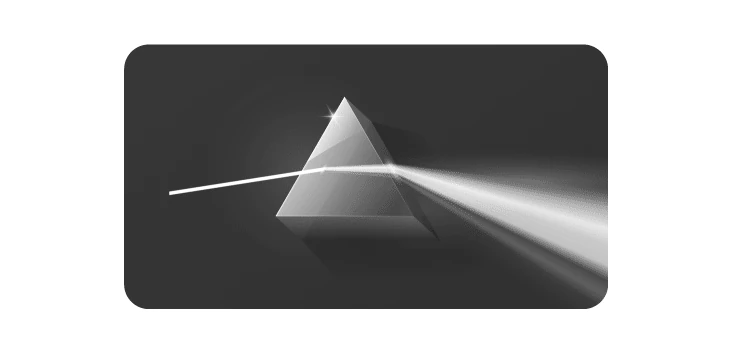
Illustration of White Light Dispersion by a Prism
Example Problem: Understanding Color Deviation
When white light passes through a prism, the violet light deviates by \( 42^\circ \) while the red light deviates by \( 38^\circ \). Calculate the difference in deviation angles between violet and red light.
Solution:
The difference in deviation is:
\[ \Delta D = 42^\circ - 38^\circ = 4^\circ \]
This difference causes the visible spectrum to spread out, producing the familiar rainbow of colors.
Practical Observations and Spectrum Formation
Formation of the Visible Spectrum by a Glass Prism
When a beam of white light enters a glass prism, it undergoes refraction at both the entry and exit surfaces. Due to the wavelength-dependent speed of light in glass, each color bends differently, resulting in a spread of colors known as the visible spectrum. The red color, having the longest wavelength, appears at the top of the spectrum with the least deviation, while violet, with the shortest wavelength, appears at the bottom with the greatest deviation.
The prism itself does not create colors but acts as a medium that separates the mixed white light into its individual components.
Visible Spectrum Produced by a Glass Prism
Example Problem: Spectrum Angle Calculation
A glass prism produces a spectrum where the violet light deviates by \( 43^\circ \) and the red light deviates by \( 39^\circ \). If the angle of the prism is \( 60^\circ \), find the average deviation angle of the spectrum.
Solution:
Average deviation angle is:
\[ \frac{43^\circ + 39^\circ}{2} = 41^\circ \]
This average gives an estimate of the central deviation of the white light through the prism.
Quick Reference Summary
Term | Definition | Key Point |
|---|---|---|
Prism | A transparent solid with two triangular bases and three rectangular sides | Angle between triangular faces is the prism angle |
Angle of Prism | The angle between the two refracting surfaces | Determines the bending of light |
Angle of Deviation | The angle between incident and emergent rays | Varies with wavelength and prism angle |
Dispersion | Separation of white light into colors | Caused by wavelength-dependent refraction |
Wavelength | Distance between successive peaks of a wave | Red has longest, violet shortest in visible spectrum |
Refraction | Bending of light when passing between media | Depends on refractive indices |
Visible Spectrum | Range of colors visible to the human eye | Produced by dispersion of white light |
Red Light | Light with longest wavelength (~700 nm) | Least deviation in prism |
Violet Light | Light with shortest wavelength (~400 nm) | Greatest deviation in prism |
Refractive Index | Ratio of speed of light in vacuum to medium | Determines bending angle |
Glossary of Key Terms
Term | Meaning |
|---|---|
Prism | A transparent solid with flat surfaces that refract light |
Angle of Prism | The angle between the two triangular faces of a prism |
Angle of Deviation | The angle between the incident and emergent rays after refraction |
Dispersion | The splitting of white light into its component colors |
Refraction | The bending of light as it passes from one medium to another |
Wavelength | The distance between two consecutive peaks of a wave |
Visible Spectrum | The range of colors visible to the human eye |
Refractive Index | A measure of how much light slows down in a medium |
Emergent Ray | The ray that exits the prism after refraction |
Incident Ray | The ray of light that strikes the surface of the prism |
Frequently Asked Questions
What is the primary function of a prism in optics?
A prism is used to refract light, often to separate white light into its constituent colors through dispersion.
How does the angle of the prism affect light deviation?
The angle of the prism determines the extent to which light bends; a larger prism angle generally causes greater deviation.
Why does violet light deviate more than red light in a prism?
Because violet light has a shorter wavelength, it slows down more in the prism material, causing it to bend more than red light.
What causes the dispersion of white light?
Dispersion occurs due to the wavelength-dependent refractive index of the prism material, causing different colors to bend by different amounts.
Can a prism create colors on its own?
No, a prism only separates existing colors in white light; it does not generate colors.