Understanding Fossil Fuels and Their Role in Energy Production
Fundamentals of Fossil Fuels as Energy Sources
Origin and Composition of Fossil Fuels
Fossil fuels are energy resources derived from the ancient remains of plants and animals that have decomposed over millions of years beneath the Earth's surface. These organic materials, subjected to intense heat and pressure within the Earth's crust, transform into carbon-rich substances such as coal, petroleum, and natural gas. These fuels constitute a major portion of the global energy supply, accounting for nearly 80% of the energy generated worldwide.
Fossil fuels serve a wide range of applications, from heating in rural households to powering large-scale electricity generation plants. While some uses involve direct combustion, such as in gas stoves and vehicles, the predominant application is in electricity production through thermal power plants.
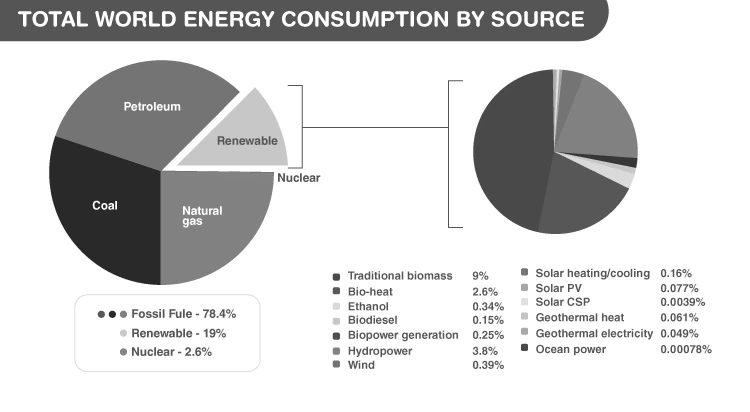
Example Problem
A country produces 5000 MW of electricity, with 78% coming from fossil fuels. Calculate the amount of electricity generated from fossil fuels and the remaining from other sources.
Solution:
Electricity from fossil fuels = \( 0.78 \times 5000 = 3900 \text{ MW} \)
Electricity from other sources = \( 5000 - 3900 = 1100 \text{ MW} \)
Thus, 3900 MW is generated using fossil fuels, while 1100 MW comes from alternative energy sources.
Mechanism of Electricity Generation in Thermal Power Plants
Working Principle and Components of Thermal Power Stations
Thermal power plants convert the chemical energy stored in fossil fuels into electrical energy. This process involves burning fuels such as coal or petroleum to produce heat, which then converts water into high-pressure steam. The steam drives turbines connected to electrical generators, transforming mechanical energy into electricity.
The turbine consists of alternating rows of fixed blades called stators and movable blades called rotors, mounted on a horizontal shaft. When pressurized steam strikes the rotor blades, it causes the turbine to spin, which in turn rotates the generator shaft to produce electricity. Depending on the working fluid, turbines are classified as steam turbines or gas turbines.
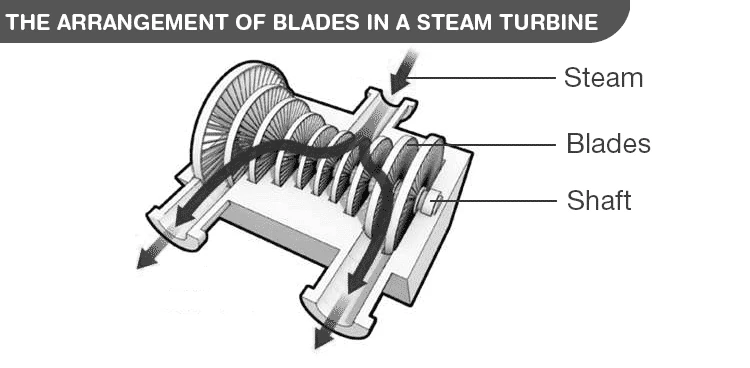
Example Problem
A thermal power plant uses coal to generate 1500 MW of electricity with an efficiency of 22%. Calculate the amount of energy input from coal required.
Solution:
Efficiency \( \eta = \frac{\text{Output energy}}{\text{Input energy}} \times 100 \)
Rearranged, Input energy = \( \frac{\text{Output energy} \times 100}{\eta} \)
Input energy = \( \frac{1500 \times 100}{22} = 6818.18 \text{ MW} \)
Therefore, approximately 6818 MW of energy from coal is needed to produce 1500 MW of electrical power.
Environmental Impact and Future Outlook of Fossil Fuel Usage
Consequences of Fossil Fuel Dependence and Energy Demand Trends
Global energy consumption is projected to rise by 60% by the year 2030, with fossil fuels expected to supply about 85% of this demand. Currently, there are over 50,000 operational coal-fired power plants worldwide, contributing significantly to carbon emissions. The emissions from these plants exceed the natural capacity of the environment to absorb carbon dioxide, exacerbating climate change.
Among fossil fuels, coal is the most polluting and least efficient. The increasing reliance on coal to meet energy needs poses serious environmental challenges. It is crucial to transition towards cleaner and more sustainable energy sources to mitigate pollution and conserve natural resources.
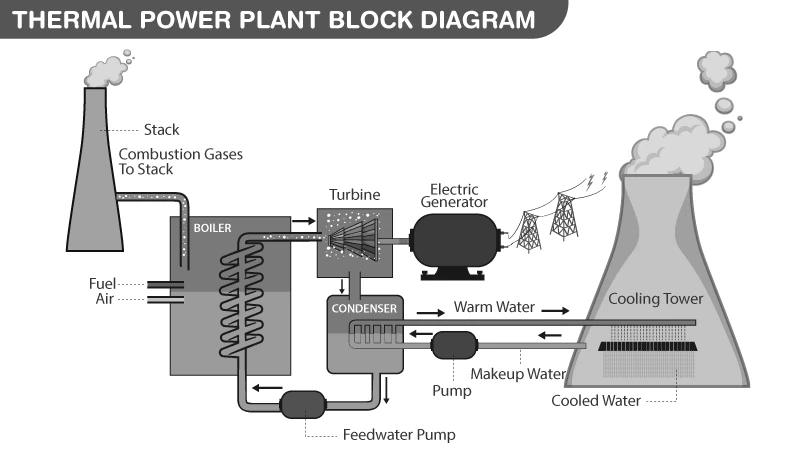
Example Problem
If a coal power plant emits 900 million tonnes of CO₂ annually and natural absorption removes only 450 million tonnes, calculate the excess carbon dioxide contributing to atmospheric pollution.
Solution:
Excess CO₂ = Emissions - Absorption = \( 900 - 450 = 450 \) million tonnes
This excess carbon dioxide accumulates in the atmosphere, intensifying the greenhouse effect.
Quick Reference: Key Points on Fossil Fuels and Thermal Power
| Aspect | Details |
|---|---|
| Definition | Energy sources formed from decomposed organic matter over millions of years |
| Main Types | Coal, Petroleum, Natural Gas |
| Primary Use | Electricity generation, heating, transportation fuel |
| Thermal Power Plant Efficiency | 20-25% for coal/oil plants, up to 40% for gas turbines |
| Environmental Impact | High carbon emissions, air pollution, climate change contributor |
| Global Energy Share | Approximately 80% currently, projected 85% by 2030 |
| Energy Conversion | Chemical energy → Thermal energy → Mechanical energy → Electrical energy |
| Turbine Function | Converts steam or gas pressure into rotational mechanical energy |
| Challenges | Non-renewable, pollution, resource depletion |
| Future Direction | Shift towards cleaner, renewable energy sources |
Glossary of Important Terms
| Term | Meaning |
|---|---|
| Fossil Fuels | Energy sources formed from ancient organic matter under heat and pressure |
| Coal | A solid fossil fuel primarily composed of carbon |
| Petroleum | Liquid fossil fuel used mainly for fuel and industrial purposes |
| Natural Gas | Gaseous fossil fuel used for heating and electricity generation |
| Thermal Power Plant | Facility that generates electricity by converting heat energy from fuel combustion |
| Turbine | Machine that converts fluid pressure into rotational mechanical energy |
| Stator | Fixed blades in a turbine that direct the flow of steam or gas |
| Rotor | Movable blades in a turbine that rotate to produce mechanical energy |
| Efficiency | Ratio of useful output energy to input energy, expressed as a percentage |
| Carbon Emissions | Release of carbon dioxide into the atmosphere from burning fossil fuels |
Frequently Asked Questions
How are fossil fuels formed?
Fossil fuels originate from the decomposition of buried organic materials subjected to heat and pressure over millions of years beneath the Earth's surface.
Are fossil fuels renewable or non-renewable?
Fossil fuels are non-renewable because they take millions of years to form and cannot be replenished within a human timescale.
What are the main types of fossil fuels?
The primary fossil fuels include coal, petroleum (crude oil), and natural gas.
What is the role of a thermal power plant?
A thermal power plant generates electricity by burning fossil fuels to produce steam, which drives turbines connected to generators.
Does burning coal contribute to pollution?
Yes, burning coal releases pollutants and greenhouse gases, contributing significantly to air pollution and climate change.