Chemical Behavior and Reactions of Carbon Compounds
Oxidation Processes in Carbon and Its Derivatives
Understanding Oxidation in Carbon Compounds
Carbon and its compounds readily undergo oxidation, especially during combustion. Oxidation involves the addition of oxygen or the removal of electrons from a substance. For instance, alcohols can be oxidized to form carboxylic acids. Agents that facilitate the addition of oxygen to other substances are called oxidizing agents, such as alkaline potassium permanganate and potassium dichromate. When carbon burns in oxygen, it forms carbon dioxide or carbon monoxide depending on oxygen availability and reaction conditions. Strong oxidizing agents typically convert most carbon compounds into oxidized products.
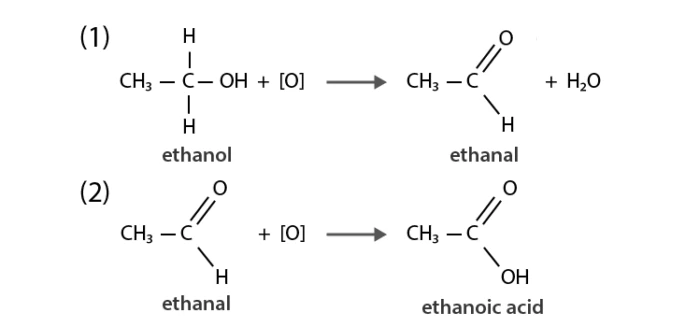
Illustration of chemical properties of carbon compounds
Example Problem
When ethanol (\(C_2H_5OH\)) is oxidized using potassium dichromate in acidic medium, it forms acetic acid (\(CH_3COOH\)). Write the balanced chemical equation for this oxidation.
Solution:
The oxidation of ethanol to acetic acid can be represented as:
\[ C_2H_5OH + 2[O] \rightarrow CH_3COOH + H_2O \]
Here, \([O]\) represents the oxygen supplied by the oxidizing agent (potassium dichromate in acidic medium).
Addition Reactions in Unsaturated Carbon Compounds
Mechanism and Significance of Addition Reactions
Addition reactions occur when unsaturated hydrocarbons, which contain double or triple bonds, react with other atoms or molecules to form saturated compounds. A common example is the hydrogenation of vegetable oils, where hydrogen is added to unsaturated fats in the presence of a catalyst, converting them into saturated fats. Catalysts accelerate these reactions without being consumed. Addition reactions are exclusive to compounds with multiple bonds, as these bonds provide sites for new atoms to attach.
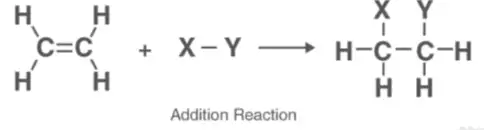
Hydrogenation of unsaturated vegetable oils
Example Problem
Propene (\(C_3H_6\)) undergoes hydrogenation in the presence of a nickel catalyst. Write the chemical equation for this reaction and identify the product.
Solution:
Propene is an unsaturated hydrocarbon with a double bond. Hydrogenation adds hydrogen across this double bond:
\[ C_3H_6 + H_2 \xrightarrow{\text{Ni catalyst}} C_3H_8 \]
The product is propane (\(C_3H_8\)), a saturated hydrocarbon.
Substitution Reactions in Saturated Hydrocarbons
How Substitution Alters Carbon Compounds
Substitution reactions involve replacing a less reactive atom or group in a molecule with a more reactive one. These reactions are typical in saturated hydrocarbons. For example, when methane reacts with chlorine under sunlight, chlorine atoms replace hydrogen atoms, forming chloromethane and other derivatives. This process is driven by the higher reactivity of chlorine compared to hydrogen. The products are often higher homologues of the original hydrocarbon.
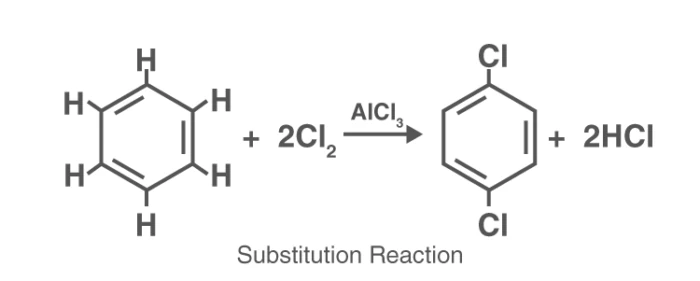
Chlorination reaction of saturated hydrocarbons
Example Problem
Methane reacts with chlorine in the presence of sunlight. Write the balanced equation for the formation of chloromethane.
Solution:
The substitution of one hydrogen atom by chlorine in methane is:
\[ CH_4 + Cl_2 \xrightarrow{h\nu} CH_3Cl + HCl \]
Here, \(h\nu\) represents the energy from sunlight initiating the reaction.
Combustion Characteristics of Carbon-Based Fuels
Energy Release and Flame Properties in Combustion
Combustion is the process where carbon and its compounds react with oxygen to release heat and light. This reaction is fundamental for energy production in industries and daily life. The nature of the flame depends on the type of carbon compound burned. Saturated hydrocarbons typically produce a clean blue flame, while unsaturated hydrocarbons may generate a yellow, sooty flame due to incomplete combustion. Limited oxygen supply causes incomplete combustion, resulting in black smoke and soot deposits. For example, kerosene stoves have air inlets to ensure sufficient oxygen for clean burning.
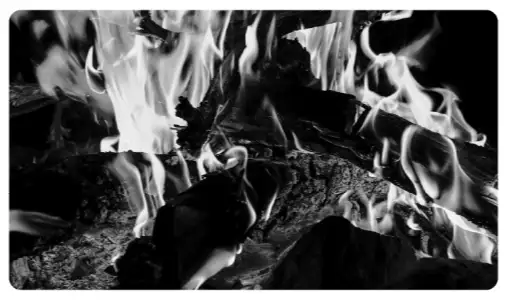
Combustion of carbon compounds releasing energy
Example Problem
Write the balanced chemical equation for the complete combustion of ethane (\(C_2H_6\)) and calculate the amount of oxygen required to completely burn 1 mole of ethane.
Solution:
The combustion reaction is:
\[ 2C_2H_6 + 7O_2 \rightarrow 4CO_2 + 6H_2O \]
For 2 moles of ethane, 7 moles of oxygen are needed. Therefore, for 1 mole of ethane:
\[ \frac{7}{2} = 3.5 \text{ moles of } O_2 \]
Thus, 3.5 moles of oxygen are required for complete combustion of 1 mole of ethane.
Exam Tip
Remember, incomplete combustion produces carbon monoxide and soot, which are harmful pollutants. Always ensure adequate oxygen supply for clean combustion.
Quick Reference: Summary of Carbon Compound Reactions
Reaction Type | Description | Example |
|---|---|---|
Oxidation | Addition of oxygen or removal of electrons; converts alcohols to acids | \(C_2H_5OH \rightarrow CH_3COOH\) |
Addition | Unsaturated compounds add atoms across multiple bonds | \(C_3H_6 + H_2 \rightarrow C_3H_8\) |
Substitution | Replacement of atoms by more reactive elements in saturated hydrocarbons | \(CH_4 + Cl_2 \rightarrow CH_3Cl + HCl\) |
Combustion | Reaction with oxygen releasing heat and light | \(2C_2H_6 + 7O_2 \rightarrow 4CO_2 + 6H_2O\) |
Glossary of Key Terms
Term | Definition |
|---|---|
Oxidation | A chemical process involving the addition of oxygen or loss of electrons. |
Addition Reaction | A reaction where atoms add to a molecule with multiple bonds, saturating it. |
Substitution Reaction | A reaction where one atom or group replaces another in a molecule. |
Combustion | A rapid reaction with oxygen producing heat and light. |
Catalyst | A substance that speeds up a reaction without being consumed. |
Unsaturated Hydrocarbon | Hydrocarbons containing double or triple bonds. |
Saturated Hydrocarbon | Hydrocarbons with only single bonds between carbon atoms. |
Homologue | Compounds differing by a repeating unit, usually -CH₂-. |
Hydrogenation | Addition of hydrogen to unsaturated compounds to saturate them. |
Incomplete Combustion | Combustion with insufficient oxygen producing carbon monoxide and soot. |
Frequently Asked Questions
1. What are the main chemical reactions involving carbon?
Carbon primarily undergoes oxidation, addition, substitution, and combustion reactions, each playing a vital role in its chemical behavior.
2. Why is carbon dioxide non-combustible?
Carbon dioxide does not burn because it is already fully oxidized; it also acts as a fire suppressant and forms weakly acidic solutions in water.
3. What unique features does carbon exhibit in its compounds?
Carbon can form four covalent bonds, catenate to form long chains, and participate in multiple bonding, making its compounds highly versatile and stable.
4. How do saturated and unsaturated hydrocarbons differ in combustion?
Saturated hydrocarbons burn with a clean blue flame, while unsaturated hydrocarbons often produce yellow, sooty flames due to incomplete combustion.
5. What is the role of catalysts in addition reactions?
Catalysts accelerate addition reactions by lowering activation energy without being consumed, enabling processes like hydrogenation of oils.