Fundamentals and Processes of Metallurgy
Overview of Metal Extraction and Refinement
Understanding Metallurgy and Its Scope
Metallurgy is the branch of science and technology concerned with extracting metals from their natural mineral deposits and refining them to obtain pure metals. Minerals, which are compounds containing metals combined with earth materials like sand, limestone, and rocks, serve as the primary source. When these minerals contain sufficient metal content to be economically extracted, they are called ores. The process of metallurgy encompasses not only the extraction but also the purification of metals and the creation of alloys to enhance their properties.

Illustration representing Metallurgy
Example Problem
A mineral sample contains metal compounds mixed with sand and limestone. Identify the term used for such a mineral and explain why it is important in metallurgy.
Solution:
The mineral containing metal compounds mixed with sand and limestone is called an ore.
Ores are important because they contain metals in sufficient concentration to be extracted economically.
Metallurgy focuses on extracting metals from these ores and purifying them for practical use.
Key Stages in the Metallurgical Workflow
Sequential Steps in Metal Extraction
The extraction of metals from ores involves a series of carefully controlled steps to ensure maximum yield and purity. The main stages include:
Crushing and Grinding: Breaking down the ore into fine particles to facilitate further processing.
Ore Concentration: Removing unwanted impurities or gangue to enrich the metal content.
Metal Extraction: Isolating the metal from the concentrated ore through chemical or thermal methods.
Refining: Purifying the extracted metal to remove residual impurities.
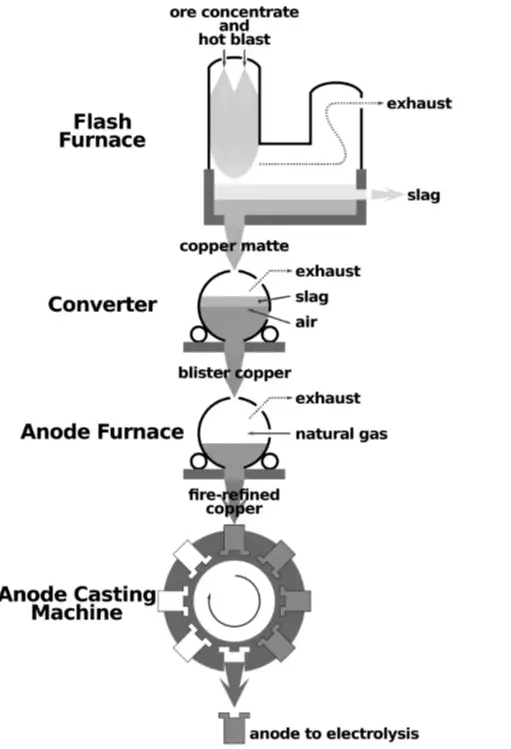
Copper Flash Smelting Process
Example Problem
List the main steps involved in extracting a metal from its ore and briefly describe the purpose of each step.
Solution:
Crushing and Grinding: To reduce ore size for easier handling and processing.
Concentration: To separate valuable metal particles from impurities.
Extraction: To chemically or thermally separate the metal from the ore.
Refining: To purify the metal to a usable standard.
Fundamental Principles Behind Metallurgical Techniques
Methods for Ore Preparation and Purification
Metallurgical processes rely on several fundamental principles to separate metals from their ores effectively. These include:
1. Pulverization
The initial step involves crushing the ore into fine powder using crushers or ball mills. This increases the surface area for subsequent processing.
2. Ore Concentration Techniques
Concentration removes unwanted materials from the ore. Common methods include:
Hydraulic Washing: Ore is washed on a sloped, corrugated surface with water flowing over it. Denser metal particles settle in grooves while lighter impurities are washed away.
Magnetic Separation: Crushed ore is passed over a magnetic wheel that attracts magnetic particles, separating them from non-magnetic waste.
Froth Flotation: Crushed ore is mixed with oil and water, then air is bubbled through. Metal particles attach to oil and rise as froth, separating from impurities.
3. Thermal Treatments
Heating processes modify the ore chemically:
Roasting: Heating sulfide ores in the presence of oxygen to convert them into oxides.
Calcination: Heating carbonate or hydrated oxide ores in the absence of air to remove volatile components.
Example Problem
Explain the difference between roasting and calcination and provide an example of when each is used.
Solution:
Roasting involves heating ores in the presence of air, typically used for sulfide ores to convert them into oxides.
Calcination is heating ores without air, used for carbonate ores to decompose them by removing carbon dioxide.
For example, roasting is applied to zinc sulfide ore, while calcination is used for limestone (calcium carbonate).
Summary of Metallurgical Concepts
Term | Definition |
|---|---|
Ore | A mineral containing metal compounds from which metals can be economically extracted. |
Flux | A substance added during smelting to remove impurities (gangue) from the ore. |
Concentration | The process of removing impurities to increase the metal content in the ore. |
Roasting | Heating sulfide ores in the presence of oxygen to convert them into oxides. |
Calcination | Heating carbonate or hydrated oxide ores in the absence of air to remove volatile substances. |
Smelting | Applying heat to ore to extract base metals by melting and chemical reduction. |
Hydraulic Washing | Separating ore particles based on density using water flow on a sloped surface. |
Magnetic Separation | Using magnetic forces to separate magnetic ore particles from non-magnetic impurities. |
Froth Flotation | Separating ore particles by making them hydrophobic and floating them as froth. |
Refining | Purification of extracted metals to remove residual impurities. |
Glossary of Metallurgical Terms
Term | Meaning |
|---|---|
Alloy | A mixture of two or more metals to improve properties. |
Gangue | Non-metallic impurities present in ores. |
Electrolytic Refining | Purification of metals using electrolysis. |
Pulverization | Grinding ore into fine powder. |
Smelting | Heating ore to extract metal by melting. |
Flux | Material added to remove impurities during smelting. |
Calcination | Heating ore in absence of air to remove volatile components. |
Roasting | Heating ore in presence of air to convert sulfides to oxides. |
Concentration | Process of increasing metal content by removing impurities. |
Hydraulic Washing | Separation of ore particles by density using water flow. |
Common Questions on Metallurgy
What are the main methods used to concentrate ores?
The primary ore concentration methods include hydraulic washing, magnetic separation, and froth flotation, each exploiting different physical properties to separate metal-rich particles from impurities.
How do roasting and calcination differ in metallurgical processes?
Roasting involves heating ores in the presence of air to convert sulfides into oxides, while calcination heats ores without air to decompose carbonates or hydrated oxides.
Why is refining necessary after metal extraction?
Extracted metals often contain impurities such as carbon, phosphorus, and silicon. Refining removes these impurities to produce pure metals suitable for industrial use.
What is the role of flux in smelting?
Flux is added during smelting to combine with impurities (gangue) and form slag, which can be easily separated from the molten metal.
How is pulverization important in metallurgy?
Pulverization increases the surface area of ores by grinding them into fine powder, facilitating more efficient chemical reactions during extraction.