Comprehensive Guide to Sodium Bicarbonate: Properties, Preparation, and Applications
Understanding Sodium Bicarbonate and Its Origins
Fundamentals and Historical Background
Sodium bicarbonate, commonly referred to as baking soda, is a chemical compound with the formula \( \mathrm{NaHCO_3} \). It consists of sodium ions (\( \mathrm{Na^+} \)) and bicarbonate ions (\( \mathrm{HCO_3^-} \)), forming a white crystalline powder known for its mildly alkaline and salty taste, somewhat similar to washing soda (sodium carbonate).
Historically, natural deposits of sodium bicarbonate, such as nahcolite, have been found dissolved in mineral springs and as part of the mineral natron. The ancient Egyptians utilized natron primarily as a cleansing agent. The industrial production of sodium bicarbonate began in the 19th century, with significant advancements by chemists like Nicolas Leblanc and later entrepreneurs John Dwight and Austin Church, who established manufacturing processes using sodium carbonate and carbon dioxide.
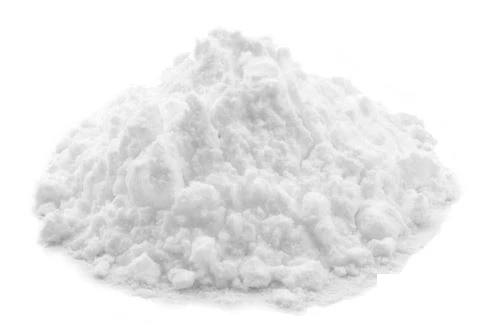
The Chemical Formula of Baking Soda is NaHCO3
Example: Identifying the Components of Baking Soda
Explain the ionic composition of sodium bicarbonate and its physical characteristics.
Solution:
Sodium bicarbonate is composed of sodium ions (\( \mathrm{Na^+} \)) and bicarbonate ions (\( \mathrm{HCO_3^-} \)).
It appears as a white, odorless crystalline solid.
Its taste is mildly alkaline and slightly salty, similar to washing soda.
Industrial Synthesis and Chemical Behavior of Sodium Bicarbonate
Manufacturing via the Solvay Process
The Solvay process is the primary industrial method for producing sodium bicarbonate and sodium carbonate. This economical technique utilizes carbon dioxide, ammonia, water, and concentrated brine (sodium chloride solution) as raw materials. The key chemical reactions involved are:
\[ \mathrm{CO_2 + H_2O + NH_3 + NaCl \rightarrow NaHCO_3 + NH_4Cl} \]
Subsequently, sodium bicarbonate can be thermally decomposed to yield sodium carbonate, carbon dioxide, and water:
\[ 2\,\mathrm{NaHCO_3} \rightarrow \mathrm{Na_2CO_3} + \mathrm{CO_2} + \mathrm{H_2O} \]
The carbon dioxide generated is recycled within the process to enhance efficiency.
Example: Calculating Sodium Bicarbonate Produced
In a Solvay process setup, if 100 g of sodium chloride reacts completely, calculate the theoretical mass of sodium bicarbonate formed. (Molar masses: \( \mathrm{NaCl} = 58.44\,\text{g/mol} \), \( \mathrm{NaHCO_3} = 84.01\,\text{g/mol} \))
Solution:
Calculate moles of sodium chloride: \[ n = \frac{100\,\text{g}}{58.44\,\text{g/mol}} \approx 1.71\,\text{mol} \]
From the reaction, 1 mole of NaCl produces 1 mole of NaHCO3.
Calculate mass of sodium bicarbonate: \[ m = 1.71\,\text{mol} \times 84.01\,\text{g/mol} \approx 143.6\,\text{g} \]
Therefore, 143.6 g of sodium bicarbonate can be theoretically produced.
Characteristics and Practical Applications of Baking Soda
Physical and Chemical Properties
Sodium bicarbonate is a non-flammable, odorless white crystalline solid with a melting point around \( 50^\circ \mathrm{C} \). It is basic in nature and its dust is not explosive. These properties make it safe and versatile for various uses.
Common Uses in Daily Life and Industry
Baking soda serves multiple roles due to its chemical behavior:
Neutralizes excess stomach acid, acting as an antacid to relieve indigestion.
Softens water during washing, enhancing detergent efficiency.
Generates carbon dioxide upon decomposition, which helps dough rise in baking.
Produces soapy foam useful in fire extinguishers.
Removes dirt gently without damaging materials.
Functions as a pesticide and neutralizer for acidic substances.
Incorporated in cosmetics, ear drops, and personal care products.
Baking Soda Powder Used in Various Applications
Example: Role of Baking Soda in Baking
Explain how sodium bicarbonate helps in the rising of dough during baking.
Solution:
When heated, sodium bicarbonate decomposes to produce carbon dioxide gas:
\[ 2\,\mathrm{NaHCO_3} \rightarrow \mathrm{Na_2CO_3} + \mathrm{CO_2} + \mathrm{H_2O} \]
The released \( \mathrm{CO_2} \) forms bubbles in the dough, causing it to expand and become fluffy.
This chemical leavening is essential for the texture and volume of baked goods.
Summary Table: Key Facts About Sodium Bicarbonate
Aspect | Details |
|---|---|
Chemical Formula | \( \mathrm{NaHCO_3} \) |
Physical State | White crystalline powder |
Melting Point | Approximately \( 50^\circ \mathrm{C} \) |
Nature | Basic (alkaline) |
Industrial Production | Solvay process |
Common Uses | Antacid, baking, cleaning, fire extinguishing, pesticide |
Decomposition Reaction | \( 2\,\mathrm{NaHCO_3} \rightarrow \mathrm{Na_2CO_3} + \mathrm{CO_2} + \mathrm{H_2O} \) |
Glossary of Important Terms
Term | Definition |
|---|---|
Sodium Bicarbonate | A chemical compound with formula \( \mathrm{NaHCO_3} \), commonly known as baking soda. |
Bicarbonate Ion | The polyatomic ion \( \mathrm{HCO_3^-} \) present in sodium bicarbonate. |
Solvay Process | An industrial method to produce sodium carbonate and sodium bicarbonate using brine and ammonia. |
Leavening Agent | A substance that produces gas to make dough rise, such as sodium bicarbonate in baking. |
Antacid | A compound that neutralizes stomach acidity to relieve indigestion. |
Carbon Dioxide | A gas (\( \mathrm{CO_2} \)) released during the decomposition of sodium bicarbonate. |
Natron | A natural mineral mixture containing sodium carbonate and sodium bicarbonate. |
Melting Point | The temperature at which a solid becomes liquid; for sodium bicarbonate, about \( 50^\circ \mathrm{C} \). |
Alkaline | Basic in nature; having a pH greater than 7. |
Decomposition | A chemical reaction where a compound breaks down into simpler substances. |
Frequently Asked Questions
What substances react with baking soda to produce carbon dioxide?
Baking soda reacts with acidic ingredients like vinegar, lemon juice, or yogurt to release carbon dioxide gas, which helps in leavening baked goods.
Which acid is necessary to activate sodium bicarbonate in recipes?
Acids such as buttermilk, brown sugar, or cream of tartar react with sodium bicarbonate to initiate the release of carbon dioxide during cooking.
What is the typical pH of a baking soda solution?
A 0.1 molar solution of sodium bicarbonate has a pH around 8.3, indicating a mildly alkaline nature.
How is baking soda synthesized in a laboratory setting?
By bubbling carbon dioxide through a saturated sodium carbonate solution, sodium bicarbonate precipitates out as a white crystalline solid due to its lower solubility.
Is baking soda naturally occurring or artificially produced?
While sodium bicarbonate occurs naturally in mineral deposits, most commercial baking soda is manufactured industrially through chemical processes like the Solvay method.