Understanding Atmospheric Refraction and Its Effects on Sunrise and Sunset
Fundamentals of Light Refraction
Concept and Principles of Refraction
Refraction occurs when waves, such as light, change their direction as they pass from one medium to another with a different optical density. This bending of light is a common natural phenomenon and is essential in understanding how light behaves when transitioning between substances like air, water, or glass.
When light travels from a less dense medium to a denser medium, it bends towards the normal, and when it moves from a denser to a less dense medium, it bends away from the normal. This behavior is governed by Snell's law, which relates the angles of incidence and refraction to the refractive indices of the two media.
Example Problem
A light ray passes from air into water at an angle of incidence of \( 40^\circ \). Given the refractive index of water is 1.33, calculate the angle of refraction inside the water.
Solution:
Using Snell's law:
\[ n_1 \sin \theta_1 = n_2 \sin \theta_2 \]
Where:
\( n_1 = 1.00 \) (refractive index of air)
\( \theta_1 = 40^\circ \) (angle of incidence)
\( n_2 = 1.33 \) (refractive index of water)
\( \theta_2 = ? \) (angle of refraction)
Calculate \( \sin \theta_2 \):
\[ \sin \theta_2 = \frac{n_1}{n_2} \sin \theta_1 = \frac{1.00}{1.33} \times \sin 40^\circ = 0.7519 \times 0.6428 = 0.4833 \]
Therefore,
\[ \theta_2 = \sin^{-1}(0.4833) \approx 28.9^\circ \]
The light ray bends towards the normal, making an angle of approximately \( 28.9^\circ \) inside the water.
Atmospheric Refraction: How Earth's Atmosphere Bends Light
Understanding Refraction in the Atmosphere
Atmospheric refraction refers to the bending of light rays as they pass through the Earth's atmosphere, which consists of layers with varying densities and temperatures. Since air density decreases with altitude, light rays traveling through these layers change direction gradually, causing objects to appear shifted from their true positions.
This effect is especially noticeable near the horizon, where the light from celestial bodies like the sun or stars passes through a thicker layer of atmosphere, resulting in significant bending.
Example Problem
Explain why stars appear to twinkle when observed from Earth, considering atmospheric refraction.
Solution:
Light from stars passes through multiple layers of the Earth's atmosphere with varying densities and temperatures.
These variations cause continuous bending and shifting of the light path, changing the apparent position of the star.
The rapid fluctuations in the refractive index cause the star's light to vary in brightness and position, producing the twinkling effect.
Explaining the Early Sunrise and Delayed Sunset Phenomena
Why Do We See the Sun Rise Earlier Than Its Actual Position?
At sunrise, the sun is physically just below the horizon. However, due to atmospheric refraction, the sun's rays bend as they travel from the denser lower atmosphere to the less dense upper layers. Our eyes perceive these bent rays as coming in a straight line, making the sun appear above the horizon earlier than its true geometric position.
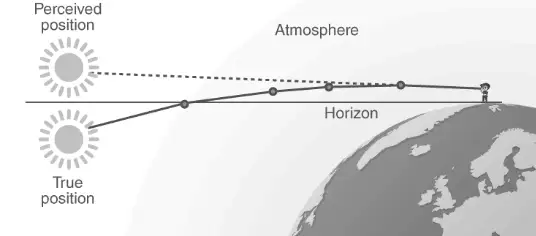
Diagram showing how atmospheric refraction causes the sun to appear earlier at sunrise and later at sunset
This bending causes the sun to be visible approximately 2 minutes before it actually crosses the horizon line.
Example Problem
If the sun is geometrically 0.5° below the horizon at sunrise, estimate the approximate time in minutes before the actual sunrise that the sun becomes visible due to atmospheric refraction. Assume the sun moves at an angular speed of 15° per hour across the sky.
Solution:
<
The sun moves \( 15^\circ \) per hour, which is \( \frac{15^\circ}{60 \text{ min}} = 0.25^\circ/\text{min} \).
Given the sun is \( 0.5^\circ \) below the horizon, the time taken to move this angle is:
\[ t = \frac{0.5^\circ}{0.25^\circ/\text{min}} = 2 \text{ minutes} \]
Therefore, atmospheric refraction causes the sun to appear approximately 2 minutes earlier than its actual geometric sunrise.
Why Does Sunset Appear Delayed After the Sun Has Set?
Similarly, at sunset, the sun has already moved below the horizon, but atmospheric refraction bends its light rays over the horizon, making the sun visible for a short time after it has actually set. This effect causes the sunset to appear later than the sun's true position.
The apparent position of the sun is thus shifted upwards, creating a delay in the observed sunset time.
Example Problem
Calculate the approximate delay in minutes for the sunset visibility caused by atmospheric refraction if the sun is 0.5° below the horizon and moves at 15° per hour.
Solution:
<
Using the same angular speed as before:
\[ t = \frac{0.5^\circ}{0.25^\circ/\text{min}} = 2 \text{ minutes} \]
This means the sun remains visible for about 2 minutes after it has geometrically set due to atmospheric refraction.
Quick Reference Summary
Term | Definition | Key Point |
|---|---|---|
Refraction | Bending of waves when passing between different media | Depends on optical density difference |
Snell's Law | Relationship between angles and refractive indices | \( n_1 \sin \theta_1 = n_2 \sin \theta_2 \) |
Refractive Index | Ratio of speed of light in vacuum to medium | Indicates how much light slows down |
Atmospheric Refraction | Bending of light by Earth's atmosphere layers | Causes apparent position shifts of celestial bodies |
Apparent Sunrise | Sun visible before actual geometric rise | Due to light bending upwards |
Apparent Sunset | Sun visible after actual geometric set | Due to light bending over horizon |
Twinkling of Stars | Fluctuation in star brightness and position | Caused by atmospheric refraction variations |
Angle of Incidence | Angle between incoming ray and normal | Used in refraction calculations |
Angle of Refraction | Angle between refracted ray and normal | Determined by Snell's law |
Optical Density | Measure of how much a medium slows light | Higher density means slower light speed |
Glossary of Key Terms
Term | Meaning |
|---|---|
Refraction | The bending of light as it passes between different media. |
Snell's Law | Mathematical law describing refraction angles. |
Refractive Index | Ratio indicating how much light slows in a medium. |
Atmospheric Refraction | Refraction of light caused by Earth's atmosphere. |
Angle of Incidence | Angle between incoming light and the normal line. |
Angle of Refraction | Angle between refracted light and the normal line. |
Optical Density | Property of a medium affecting light speed. |
Horizon | The apparent line where Earth and sky meet. |
Twinkling | Fluctuation in star brightness due to atmospheric effects. |
Sunrise | Moment when the sun appears above the horizon. |
Frequently Asked Questions
What is an example of refraction observed in nature?
The twinkling of stars is a natural example of refraction caused by the Earth's atmosphere bending starlight.
What are the fundamental laws governing refraction?
Refraction follows two main laws: the incident ray, refracted ray, and normal lie in the same plane, and the ratio of the sine of the angle of incidence to the sine of the angle of refraction is constant (Snell's law).
How is the refractive index defined?
The refractive index quantifies how much the speed of light is reduced inside a medium compared to vacuum.
What happens when white light passes through a prism?
White light splits into its constituent colors (red, orange, yellow, green, blue, violet) due to refraction at different angles for each wavelength.
Can you name two practical uses of refraction?
Refraction is utilized in devices like spectacles and cameras, as well as peepholes in doors and movie projectors.