Understanding the Section Formula in Coordinate Geometry
Determining Coordinates Using the Section Formula
Concept of Internal Division of a Line Segment
When a point divides a line segment joining two points in a certain ratio, the coordinates of that point can be calculated using the section formula. Suppose two points are given as \( P(x_1, y_1) \) and \( Q(x_2, y_2) \), and a point \( M \) divides the segment \( PQ \) internally in the ratio \( m:n \). The coordinates of \( M \) are given by:
\[ M(x, y) = \left( \frac{m x_2 + n x_1}{m + n}, \frac{m y_2 + n y_1}{m + n} \right) \]
This formula helps in finding the exact location of the dividing point on the line segment.
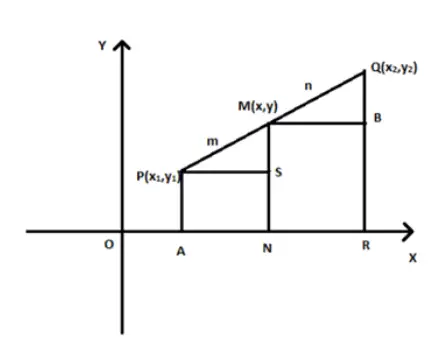
This image shows a graph on the XY coordinate plane with points P, Q, M, and several line segments forming right triangles. It illustrates the concept of coordinates and slopes of line segments. Step-by-Step Explanation: 1. Identify points P and Q with coordinates \((x_1, y_1)\) and \((x_2, y_2)\). 2. Point M \((x, y)\) lies on the line segment joining P and Q. 3. Vertical and horizontal lines from these points form right triangles, showing changes in x and y values. 4. The slope \(m\) and \(n\) represent the rise over run between these points. 5. This helps in understanding how to find slope and coordinates between points on a line.
Example: Finding Coordinates of a Dividing Point
Find the coordinates of the point that divides the line segment joining \( A(3, 7) \) and \( B(-4, 1) \) internally in the ratio 2:3.
Solution:
Given \( (x_1, y_1) = (3, 7) \), \( (x_2, y_2) = (-4, 1) \), and ratio \( m:n = 2:3 \).
Using the section formula:
\[ x = \frac{2 \times (-4) + 3 \times 3}{2 + 3} = \frac{-8 + 9}{5} = \frac{1}{5} = 0.2 \]
\[ y = \frac{2 \times 1 + 3 \times 7}{2 + 3} = \frac{2 + 21}{5} = \frac{23}{5} = 4.6 \]
Therefore, the point dividing the segment is \( (0.2, 4.6) \).
Proof and Application of the Section Formula
Deriving the Formula Using Similar Triangles
Consider points \( P(x_1, y_1) \) and \( Q(x_2, y_2) \) on the coordinate plane, and a point \( M(x, y) \) dividing \( PQ \) internally in the ratio \( m:n \). By constructing perpendiculars and using the properties of similar triangles, the ratio of the segments on the x-axis and y-axis can be related to the coordinates, leading to the section formula.
This geometric approach confirms the formula's validity and helps visualize the division of the segment.
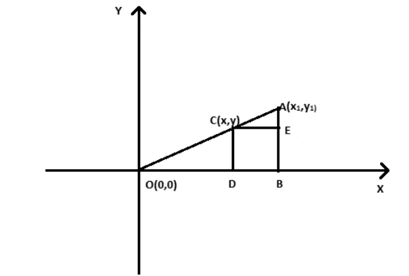
Geometric Proof of the Section Formula
Example: Verifying Coordinates Using the Section Formula
Point \( C \) divides the line segment \( OA \), where \( O \) is the origin and \( A(6, 9) \), in the ratio 3:2. Find the coordinates of \( C \).
Solution:
Using the section formula for internal division with \( m:n = 3:2 \) and \( O(0,0) \), \( A(6,9) \):
\[ x = \frac{3 \times 6 + 2 \times 0}{3 + 2} = \frac{18}{5} = 3.6 \]
\[ y = \frac{3 \times 9 + 2 \times 0}{3 + 2} = \frac{27}{5} = 5.4 \]
Thus, \( C \) has coordinates \( (3.6, 5.4) \).
External Division and Special Cases in Section Formula
Coordinates for External Division
The section formula also applies when a point divides a line segment externally. If a point \( P \) divides the segment joining \( A(x_1, y_1) \) and \( B(x_2, y_2) \) externally in the ratio \( m:n \), the coordinates of \( P \) are:
\[ P(x, y) = \left( \frac{m x_2 - n x_1}{m - n}, \frac{m y_2 - n y_1}{m - n} \right) \]
This formula is useful when the dividing point lies outside the segment.
Midpoint as a Special Case
When the point divides the segment into two equal parts, i.e., the ratio is 1:1, the point is the midpoint. The midpoint coordinates are given by:
\[ M = \left( \frac{x_1 + x_2}{2}, \frac{y_1 + y_2}{2} \right) \]
This is a simplified form of the section formula for equal division.
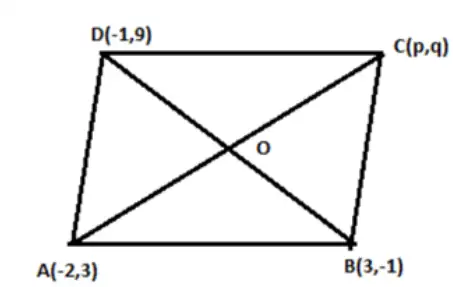
This image shows a parallelogram ABCD with vertices A(-2,3), B(3,-1), D(-1,9), and C at point (p,q). The diagonals AC and BD intersect at point O. Step-by-step explanation: 1. A parallelogram is a four-sided figure whose opposite sides are parallel. 2. Points A, B, D are given with coordinates, while point C is unknown (p, q). 3. Diagonals AC and BD intersect at point O. 4. In a parallelogram, the diagonals bisect each other, so O is the midpoint of both AC and BD. 5. To find (p, q), use the midpoint formula: - O is the midpoint of AC, so \(O = \left(\frac{-2 + p}{2}, \frac{3 + q}{2}\right)\) - O is also the midpoint of BD, so \(O = \left(\frac{3 + (-1)}{2}, \frac{-1 + 9}{2}\right)\) 6. By equating these, solve for p and q to find the coordinates of point C.
Example: Finding Midpoint Coordinates
Calculate the midpoint of the segment joining \( X(2, -3) \) and \( Y(8, 5) \).
Solution:
Using the midpoint formula:
\[ x = \frac{2 + 8}{2} = \frac{10}{2} = 5 \]
\[ y = \frac{-3 + 5}{2} = \frac{2}{2} = 1 \]
Therefore, the midpoint is \( (5, 1) \).
Example: Coordinates for External Division
Find the coordinates of the point dividing the segment joining \( A(7, 4) \) and \( B(1, -2) \) externally in the ratio 3:1.
Solution:
Using the external division formula:
\[ x = \frac{3 \times 1 - 1 \times 7}{3 - 1} = \frac{3 - 7}{2} = \frac{-4}{2} = -2 \]
\[ y = \frac{3 \times (-2) - 1 \times 4}{3 - 1} = \frac{-6 - 4}{2} = \frac{-10}{2} = -5 \]
The point dividing externally has coordinates \( (-2, -5) \).
Summary of Key Formulas and Concepts
Division Type | Ratio | Coordinates of Dividing Point |
|---|---|---|
Internal Division | \( m:n \) | \( \left( \frac{m x_2 + n x_1}{m + n}, \frac{m y_2 + n y_1}{m + n} \right) \) |
External Division | \( m:n \) | \( \left( \frac{m x_2 - n x_1}{m - n}, \frac{m y_2 - n y_1}{m - n} \right) \) |
Midpoint (Special Case) | 1:1 | \( \left( \frac{x_1 + x_2}{2}, \frac{y_1 + y_2}{2} \right) \) |
Glossary of Important Terms
Term | Definition |
|---|---|
Coordinate Geometry | Branch of geometry using coordinates to represent points and figures. |
Line Segment | A part of a line bounded by two endpoints. |
Ratio | A comparison of two quantities showing their relative sizes. |
Internal Division | When a point divides a segment between two points. |
External Division | When a point divides the extension of a segment outside the endpoints. |
Midpoint | The point that divides a segment into two equal parts. |
Section Formula | Formula to find coordinates of a point dividing a segment in a given ratio. |
Similar Triangles | Triangles with equal corresponding angles and proportional sides. |
Coordinate Plane | A two-dimensional plane defined by x and y axes. |
Perpendicular | A line meeting another at a right angle (90°). |
Frequently Asked Questions
What is the main use of the section formula?
The section formula helps find the exact coordinates of a point dividing a line segment in a given ratio, either internally or externally.
How is the midpoint related to the section formula?
The midpoint is a special case of the section formula where the ratio is 1:1, giving the average of the coordinates of the endpoints.
Can the section formula be applied to three-dimensional geometry?
Yes, the section formula extends to 3D by including the z-coordinate with a similar ratio-based formula.
What is the difference between internal and external division?
Internal division occurs when the point lies between the two endpoints, while external division happens when the point lies outside the segment, extending the line.
How do similar triangles help in proving the section formula?
By constructing perpendiculars and using angle similarity, the ratios of sides correspond to coordinate differences, leading to the derivation of the formula.