Understanding the Link Between Polynomial Zeros and Coefficients
Fundamentals of Polynomial Zeros and Their Coefficients
Defining Zeros and Their Connection to Polynomial Factors
A polynomial's zero is a real number that, when substituted into the polynomial, results in zero. Formally, if \( P(x) \) is a polynomial and \( a \) is a real number such that \( P(a) = 0 \), then \( a \) is called a zero of \( P(x) \). This concept is closely tied to the Factor Theorem, which states that if \( k \) is a zero of \( P(x) \), then the binomial \( (x - k) \) divides \( P(x) \) exactly, making it a factor.
Understanding this relationship is crucial for analyzing polynomials and solving equations efficiently.
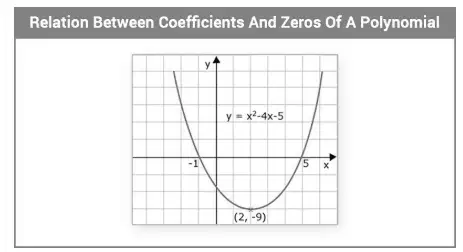
The image shows a graph of the quadratic function \( y = x^2 - 4x - 5 \). The parabola opens upward and crosses the x-axis at \( x = -1 \) and \( x = 5 \), which are the zeros (roots) of the polynomial. The vertex of the parabola is at the point (2, -9). Step-by-step explanation: 1. The polynomial given is \( y = x^2 - 4x - 5 \). 2. The zeros of the polynomial are the x-values where the graph touches the x-axis; here, those are \( -1 \) and \( 5 \). 3. These zeros are found by solving the equation \( x^2 - 4x - 5 = 0 \). 4. The vertex, (2, -9), is the lowest point on the parabola, showing the minimum value of the function. 5. The shape of the parabola is determined by the coefficient of \( x^2 \), which is positive, so it opens upward. 6. The coefficients \(-4\) and \(-5\) affect the position and shape of the parabola, and the zeros relate to these coefficients via factoring or the quadratic formula.
Example:
Verify if \( x = 2 \) is a zero of the polynomial \( P(x) = x^2 - 5x + 6 \).
Solution:
Substitute \( x = 2 \) into \( P(x) \):
\[ P(2) = (2)^2 - 5 \times 2 + 6 = 4 - 10 + 6 = 0 \]
Since \( P(2) = 0 \), \( x = 2 \) is indeed a zero of the polynomial, and \( (x - 2) \) is a factor of \( P(x) \).
Exploring Linear Polynomials and Their Zeros
Characteristics and Zero Calculation of First-Degree Polynomials
Linear polynomials are expressions where the highest power of the variable is one. They take the form \( ax + b \), where \( a \) and \( b \) are constants and \( a \neq 0 \). The zero of such a polynomial is the value of \( x \) that satisfies the equation \( ax + b = 0 \).
By rearranging, the zero can be found as:
\[ x = -\frac{b}{a} \]
Example:
Find the zero of the linear polynomial \( 5x - 15 \).
Solution:
Set the polynomial equal to zero:
\[ 5x - 15 = 0 \]
Solving for \( x \):
\[ 5x = 15 \implies x = \frac{15}{5} = 3 \]
Thus, the zero of the polynomial is \( x = 3 \).
Understanding Quadratic Polynomials and Their Zero Relationships
Sum and Product of Zeros in Second-Degree Polynomials
A quadratic polynomial is a second-degree expression of the form \( ax^2 + bx + c \), where \( a \neq 0 \). If \( \alpha \) and \( \beta \) are the zeros of this polynomial, they satisfy the following relationships derived from the coefficients:
Sum of zeros: \( \alpha + \beta = -\frac{b}{a} \)
Product of zeros: \( \alpha \beta = \frac{c}{a} \)
These formulas provide a quick way to find the combined properties of the zeros without explicitly solving the quadratic equation.
Example:
Determine the sum and product of zeros for the quadratic polynomial \( 3x^2 - 12x + 9 \).
Solution:
Given \( a = 3 \), \( b = -12 \), and \( c = 9 \).
Sum of zeros:
\[ \alpha + \beta = -\frac{b}{a} = -\frac{-12}{3} = 4 \]
Product of zeros:
\[ \alpha \beta = \frac{c}{a} = \frac{9}{3} = 3 \]
Therefore, the sum of zeros is 4 and the product is 3.
Analyzing Cubic Polynomials and Their Zero-Coefficient Relations
Sum, Pairwise Products, and Product of Zeros in Third-Degree Polynomials
Cubic polynomials have the general form \( ax^3 + bx^2 + cx + d \), with \( a \neq 0 \). If the zeros are \( \alpha \), \( \beta \), and \( \gamma \), the following relationships hold:
Sum of zeros: \( \alpha + \beta + \gamma = -\frac{b}{a} \)
Sum of products of zeros taken two at a time: \( \alpha \beta + \beta \gamma + \gamma \alpha = \frac{c}{a} \)
Product of zeros: \( \alpha \beta \gamma = -\frac{d}{a} \)
Diagram showing zeros and coefficients in cubic polynomials
Example:
For the cubic polynomial \( 2x^3 - 9x^2 + 12x - 4 \), find the sum of zeros, sum of pairwise products, and the product of zeros.
Solution:
Given \( a = 2 \), \( b = -9 \), \( c = 12 \), and \( d = -4 \).
Sum of zeros:
\[ \alpha + \beta + \gamma = -\frac{b}{a} = -\frac{-9}{2} = \frac{9}{2} = 4.5 \]
Sum of products of zeros taken two at a time:
\[ \alpha \beta + \beta \gamma + \gamma \alpha = \frac{c}{a} = \frac{12}{2} = 6 \]
Product of zeros:
\[ \alpha \beta \gamma = -\frac{d}{a} = -\frac{-4}{2} = 2 \]
Hence, the sum of zeros is 4.5, the sum of pairwise products is 6, and the product of zeros is 2.
Practical Application: Finding Zeros and Their Properties
Worked Example on Quadratic Polynomial Zeros
Consider the quadratic polynomial \( 5x^2 - 16 \). We will find its zeros and then calculate their sum and product.
First, rewrite the polynomial as:
\[ 5x^2 - 16 = 0 \]
Solving for \( x \):
\[ 5x^2 = 16 \implies x^2 = \frac{16}{5} \implies x = \pm \sqrt{\frac{16}{5}} = \pm \frac{4}{\sqrt{5}} = \pm \frac{4\sqrt{5}}{5} \]
Thus, the zeros are \( \frac{4\sqrt{5}}{5} \) and \( -\frac{4\sqrt{5}}{5} \).
Calculating the sum of zeros:
\[ \frac{4\sqrt{5}}{5} + \left(-\frac{4\sqrt{5}}{5}\right) = 0 \]
Calculating the product of zeros:
\[ \left(\frac{4\sqrt{5}}{5}\right) \times \left(-\frac{4\sqrt{5}}{5}\right) = -\frac{16 \times 5}{25} = -\frac{80}{25} = -\frac{16}{5} \]
Example:
Find the sum and product of zeros for the polynomial \( 5x^2 - 16 \).
Solution:
Zeros are \( \pm \frac{4\sqrt{5}}{5} \).
Sum of zeros = 0.
Product of zeros = \( -\frac{16}{5} \).
Summary Table: Key Relations Between Zeros and Coefficients
Polynomial Type | General Form | Sum of Zeros | Product of Zeros | Additional Relations |
|---|---|---|---|---|
Linear | \( ax + b \) | \( -\frac{b}{a} \) | Not applicable | Single zero equals \( -\frac{b}{a} \) |
Quadratic | \( ax^2 + bx + c \) | \( -\frac{b}{a} \) | \( \frac{c}{a} \) | Two zeros \( \alpha, \beta \) |
Cubic | \( ax^3 + bx^2 + cx + d \) | \( -\frac{b}{a} \) | \( -\frac{d}{a} \) | Sum of pairwise products: \( \frac{c}{a} \) |
Glossary of Important Terms
Term | Definition |
|---|---|
Polynomial | An algebraic expression consisting of variables and coefficients combined using addition, subtraction, and multiplication. |
Degree | The highest power of the variable in a polynomial. |
Zero of a Polynomial | A value of \( x \) for which the polynomial evaluates to zero. |
Factor Theorem | States that if \( k \) is a zero of \( P(x) \), then \( (x-k) \) is a factor of \( P(x) \). |
Linear Polynomial | A polynomial of degree one, generally in the form \( ax + b \). |
Quadratic Polynomial | A polynomial of degree two, generally in the form \( ax^2 + bx + c \). |
Cubic Polynomial | A polynomial of degree three, generally in the form \( ax^3 + bx^2 + cx + d \). |
Sum of Zeros | The addition of all zeros of a polynomial. |
Product of Zeros | The multiplication of all zeros of a polynomial. |
Coefficient | A numerical factor multiplying the variable(s) in a term of a polynomial. |
Frequently Asked Questions
What is the significance of the sum of zeros in a polynomial?
The sum of zeros provides a direct relationship to the coefficients of the polynomial, allowing quick calculation without solving the equation.
How can the product of zeros help in polynomial factorization?
Knowing the product of zeros helps in reconstructing the polynomial and verifying factors, especially in quadratic and cubic polynomials.
Is the zero always a real number?
Zeros can be real or complex numbers depending on the polynomial and its coefficients.
Can a polynomial have fewer zeros than its degree?
No, a polynomial of degree \( n \) has exactly \( n \) zeros in the complex number system, counting multiplicities.
How does the Factor Theorem assist in finding zeros?
It states that if \( (x - k) \) is a factor, then \( k \) is a zero, enabling factorization and root finding.