Comprehensive Guide to Quadratic Equations
Fundamentals of Quadratic Equations
Understanding the Quadratic Equation Structure
A quadratic equation is a polynomial equation of degree two, typically expressed as \( ax^2 + bx + c = 0 \), where \( a, b, c \in \mathbb{R} \) and \( a \neq 0 \). Here, \( a \) is the leading coefficient, \( b \) the linear coefficient, and \( c \) the constant term. The solutions to this equation, known as roots, are the values of \( x \) that satisfy the equation.
These roots can be real or complex, depending on the discriminant value. The quadratic equation always has two roots, which may be distinct, equal, or complex conjugates.
Example: Finding Roots of a Quadratic Equation
Problem: Determine the roots of the quadratic equation \( 2x^2 - 5x + 3 = 0 \).
Solution:
The discriminant \( D \) is calculated as:
\[ D = b^2 - 4ac = (-5)^2 - 4 \times 2 \times 3 = 25 - 24 = 1 \]
Since \( D > 0 \), the roots are real and distinct. Using the quadratic formula:
\[ x = \frac{-b \pm \sqrt{D}}{2a} = \frac{5 \pm 1}{4} \]
Thus, the roots are:
\[ x_1 = \frac{5 + 1}{4} = \frac{6}{4} = 1.5, \quad x_2 = \frac{5 - 1}{4} = \frac{4}{4} = 1 \]
Discriminant and Root Characteristics
Role of the Discriminant in Determining Roots
The discriminant \( D = b^2 - 4ac \) is crucial in understanding the nature of the roots of a quadratic equation:
- If \( D > 0 \), the equation has two distinct real roots.
- If \( D = 0 \), the roots are real and equal.
- If \( D < 0 \), the roots are complex conjugates.
This helps in predicting the behavior of the quadratic function without explicitly solving it.
Example: Identifying Root Nature Using Discriminant
Problem: For the quadratic equation \( x^2 + 4x + 5 = 0 \), determine the nature of its roots.
Solution:
Calculate the discriminant:
\[ D = 4^2 - 4 \times 1 \times 5 = 16 - 20 = -4 \]
Since \( D < 0 \), the roots are complex and conjugate pairs.
Methods for Solving Quadratic Equations
Algebraic Techniques for Finding Roots
Quadratic equations can be solved using various algebraic methods:
- Factoring: Expressing the quadratic as a product of two binomials.
- Completing the Square: Rewriting the equation in the form \( (x + p)^2 = q \).
- Quadratic Formula: Using the formula \( x = \frac{-b \pm \sqrt{b^2 - 4ac}}{2a} \) for direct computation.
- Square Root Method: Applicable when the quadratic is in the form \( x^2 = k \).
Choosing the appropriate method depends on the specific equation and context.
Example: Solving by Completing the Square
Problem: Solve \( x^2 + 6x + 5 = 0 \) by completing the square.
Solution:
Rewrite the equation:
\[ x^2 + 6x = -5 \]
Add \( \left(\frac{6}{2}\right)^2 = 9 \) to both sides:
\[ x^2 + 6x + 9 = -5 + 9 \]
\[ (x + 3)^2 = 4 \]
Taking square roots:
\[ x + 3 = \pm 2 \]
Therefore, the roots are:
\[ x = -3 \pm 2 \implies x_1 = -1, \quad x_2 = -5 \]
Graphical Interpretation of Quadratic Functions
Analyzing the Parabola and Its Roots
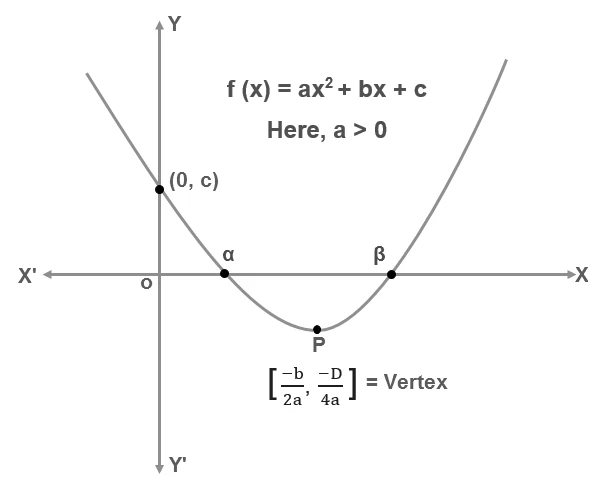
The graph of a quadratic function \( f(x) = ax^2 + bx + c \) is a parabola. The coefficient \( a \) determines the direction of the parabola:
- If \( a > 0 \), the parabola opens upwards.
- If \( a < 0 \), it opens downwards.
The vertex of the parabola is located at \( \left(-\frac{b}{2a}, f\left(-\frac{b}{2a}\right)\right) \). The roots correspond to the points where the parabola intersects the x-axis.
Example: Interpreting the Graph of a Quadratic
Problem: Describe the graph of \( f(x) = -x^2 + 4x - 3 \) and find its vertex.
Solution:
Since \( a = -1 < 0 \), the parabola opens downward.
Vertex x-coordinate:
\[ x_v = -\frac{b}{2a} = -\frac{4}{2 \times (-1)} = 2 \]
Vertex y-coordinate:
\[ f(2) = -(2)^2 + 4 \times 2 - 3 = -4 + 8 - 3 = 1 \]
Thus, the vertex is at \( (2, 1) \), representing the maximum point of the parabola.
Range and Extremes of Quadratic Functions
Determining Maximum and Minimum Values
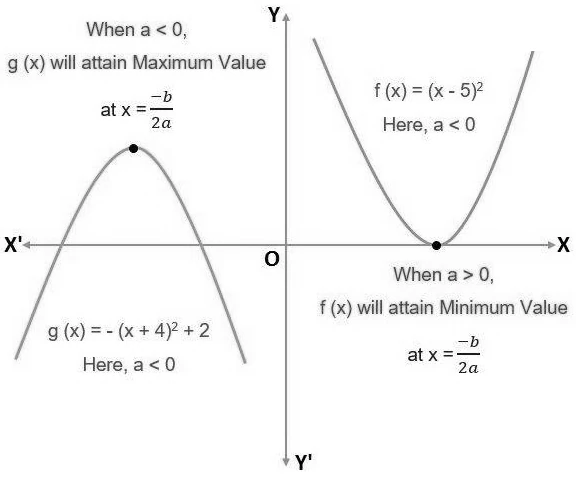
The range of a quadratic function depends on the direction of its parabola:
- If \( a > 0 \), the function has a minimum value at the vertex, and the range is \( [f(x_v), \infty) \).
- If \( a < 0 \), the function has a maximum value at the vertex, and the range is \( (-\infty, f(x_v)] \).
The vertex value is calculated as \( f(x_v) = c - \frac{b^2}{4a} \).
Example: Finding the Minimum Value of a Quadratic
Problem: Find the minimum value of \( f(x) = 3x^2 - 12x + 7 \).
Solution:
Since \( a = 3 > 0 \), the parabola opens upwards and has a minimum at the vertex.
Vertex x-coordinate:
\[ x_v = -\frac{b}{2a} = -\frac{-12}{2 \times 3} = 2 \]
Minimum value:
\[ f(2) = 3(2)^2 - 12(2) + 7 = 12 - 24 + 7 = -5 \]
Therefore, the minimum value of the function is \(-5\) at \( x = 2 \).
Relations Between Roots and Coefficients
Connecting Roots to Equation Coefficients
For a quadratic equation \( ax^2 + bx + c = 0 \) with roots \( \alpha \) and \( \beta \), the following relationships hold:
\[ \alpha + \beta = -\frac{b}{a}, \quad \alpha \beta = \frac{c}{a} \]
These formulas are useful for forming quadratic equations when roots are known or for analyzing root properties without solving the equation.
Example: Forming Quadratic Equation from Roots
Problem: Construct a quadratic equation with roots \( 3 \) and \( -5 \).
Solution:
Sum of roots:
\[ S = 3 + (-5) = -2 \]
Product of roots:
\[ P = 3 \times (-5) = -15 \]
Quadratic equation:
\[ x^2 - Sx + P = 0 \implies x^2 + 2x - 15 = 0 \]
Quadratic Equations with Shared Roots
Conditions for Common Roots Between Quadratics
Two quadratic equations \( a_1x^2 + b_1x + c_1 = 0 \) and \( a_2x^2 + b_2x + c_2 = 0 \) share a root if the following condition is satisfied:
\[ \frac{b_1 c_2 - b_2 c_1}{c_1 a_2 - c_2 a_1} = \frac{c_1 a_2 - c_2 a_1}{a_1 b_2 - a_2 b_1} \]
If both roots are common, then the ratios of coefficients are equal:
\[ \frac{a_1}{a_2} = \frac{b_1}{b_2} = \frac{c_1}{c_2} \]
Example: Finding Parameter for Common Root
Problem: Determine the values of \( k \) such that the quadratics \( 5x^2 - 3x + 2 = 0 \) and \( 10x^2 + kx + 4 = 0 \) share a root.
Solution:
Using the common root condition:
\[ \frac{(-3)(4) - (k)(2)}{(2)(10) - (4)(5)} = \frac{(2)(10) - (4)(5)}{(5)(k) - (10)(-3)} \]
Simplify numerator and denominator:
\[ \frac{-12 - 2k}{20 - 20} = \frac{20 - 20}{5k + 30} \]
Since denominator is zero, the condition reduces to:
\[ 5k + 30 = 0 \implies k = -6 \]
Thus, \( k = -6 \) ensures a common root.
Advanced Quadratic Forms: Biquadratic Equations
Definition and Solution Approach
Biquadratic equations are quartic polynomials lacking odd-degree terms, generally expressed as:
\[ z^4 + a z^2 + c = 0 \]
These can be solved by substituting \( y = z^2 \), reducing the equation to a quadratic in \( y \), which can then be solved using standard methods.
Example: Solving a Biquadratic Equation
Problem: Find the roots of \( x^4 - 5x^2 + 6 = 0 \).
Solution:
Substitute \( y = x^2 \), yielding:
\[ y^2 - 5y + 6 = 0 \]
Factorizing:
\[ (y - 2)(y - 3) = 0 \implies y = 2 \text{ or } y = 3 \]
Back-substitute to find \( x \):
\[ x^2 = 2 \implies x = \pm \sqrt{2}, \quad x^2 = 3 \implies x = \pm \sqrt{3} \]
Therefore, the roots are \( \pm \sqrt{2} \) and \( \pm \sqrt{3} \).
Summary Table: Key Quadratic Equation Concepts
| Concept | Formula/Condition | Interpretation |
|---|---|---|
| General Form | \( ax^2 + bx + c = 0 \) | Standard quadratic equation |
| Discriminant | \( D = b^2 - 4ac \) | Determines nature of roots |
| Roots | \( x = \frac{-b \pm \sqrt{D}}{2a} \) | Solutions of the quadratic |
| Sum of Roots | \( \alpha + \beta = -\frac{b}{a} \) | Sum related to coefficients |
| Product of Roots | \( \alpha \beta = \frac{c}{a} \) | Product related to coefficients |
| Vertex | \( \left(-\frac{b}{2a}, c - \frac{b^2}{4a}\right) \) | Point of maximum or minimum |
| Nature of Roots |
\( D > 0 \): Real & distinct \( D = 0 \): Real & equal \( D < 0 \): Complex conjugates |
Root classification |
| Common Root Condition | \( \frac{b_1 c_2 - b_2 c_1}{c_1 a_2 - c_2 a_1} = \frac{c_1 a_2 - c_2 a_1}{a_1 b_2 - a_2 b_1} \) | Condition for shared root |
| Biquadratic Equation | \( z^4 + a z^2 + c = 0 \) | Quartic reducible to quadratic |
Glossary of Quadratic Equation Terms
| Term | Definition |
|---|---|
| Quadratic Equation | An equation of degree two in the form \( ax^2 + bx + c = 0 \). |
| Discriminant | The expression \( b^2 - 4ac \) determining root nature. |
| Roots | Values of \( x \) satisfying the quadratic equation. |
| Vertex | The highest or lowest point on the parabola. |
| Leading Coefficient | The coefficient \( a \) of \( x^2 \) in the quadratic. |
| Sum of Roots | The sum \( \alpha + \beta = -\frac{b}{a} \). |
| Product of Roots | The product \( \alpha \beta = \frac{c}{a} \). |
| Factoring | Expressing the quadratic as a product of binomials. |
| Completing the Square | Rearranging to form a perfect square trinomial. |
| Biquadratic Equation | A quartic equation with only even powers of \( x \). |
Frequently Asked Questions
What are the common methods to solve quadratic equations?
Quadratic equations can be solved by factoring, completing the square, using the quadratic formula, or extracting square roots, depending on the equation's form.
How is the discriminant used in quadratic equations?
The discriminant \( D = b^2 - 4ac \) indicates whether roots are real and distinct, real and equal, or complex conjugates.
What is the significance of the vertex in a quadratic graph?
The vertex represents the maximum or minimum value of the quadratic function, depending on the parabola's direction.
How can I form a quadratic equation if the roots are known?
Use the relation \( x^2 - (\alpha + \beta)x + \alpha \beta = 0 \), where \( \alpha \) and \( \beta \) are the roots.
What conditions ensure two quadratics share a common root?
Two quadratics share a root if their coefficients satisfy the relation \( \frac{b_1 c_2 - b_2 c_1}{c_1 a_2 - c_2 a_1} = \frac{c_1 a_2 - c_2 a_1}{a_1 b_2 - a_2 b_1} \).