Comprehensive Guide to Polynomials: Concepts, Types, and Operations
Understanding the Fundamentals of Polynomials
Essence and Definition of Polynomials
Polynomials are algebraic expressions formed by combining variables, constants, and exponents using addition, subtraction, and multiplication. Importantly, division by a variable is not permitted within polynomial expressions. The term "polynomial" originates from the Greek words "poly" meaning many, and "nomial" meaning terms, indicating expressions with multiple terms.
Each polynomial consists of terms separated by plus or minus signs. For example, the expression \(x^2 + x - 12\) contains three terms: \(x^2\), \(x\), and \(-12\).
Variables, also called indeterminates, are symbols like \(x\), \(y\), or \(a\), while constants are fixed numbers such as 1, 2, or 3. Exponents indicate the power to which a variable is raised, for example, the 5 in \(x^5\).
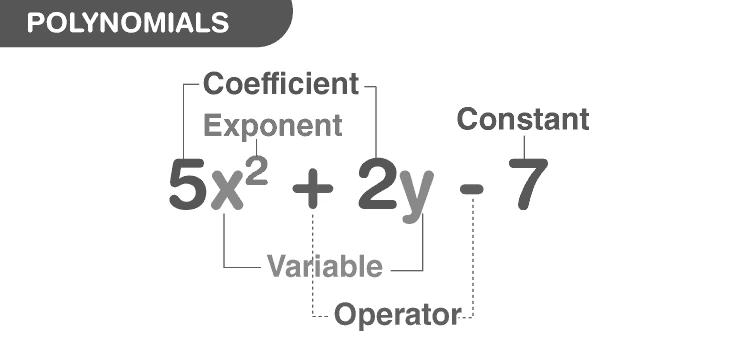
Illustration of polynomial terms and variables
Example: Identify the terms, variables, and constants in the polynomial \(3x^3 - 4x + 7\).
Solution: The terms are \(3x^3\), \(-4x\), and \(7\). The variable is \(x\), and the constant term is 7.
Classification and Characteristics of Polynomial Expressions
Standard Form and Degree of Polynomials
A polynomial is typically expressed in its standard form, where terms are arranged in descending order of their exponents. The general form of a polynomial function with degree \(n\) is:
\[ P(x) = a_n x^n + a_{n-1} x^{n-1} + \cdots + a_1 x + a_0 \]
Here, \(a_n, a_{n-1}, \ldots, a_0\) are coefficients belonging to real numbers, and \(a_n \neq 0\). The degree of the polynomial is the highest exponent \(n\).
For example, in \(P(x) = 6s^4 + 3x^2 + 5x + 19\), the degree is 4, as the highest power of the variable is 4.
Example: Determine the degree of the polynomial \(7y^5 - 2y^3 + 4y - 8\).
Solution: The highest exponent is 5, so the degree of the polynomial is 5.
Types of Polynomials Based on Number of Terms
Polynomials are categorized by the count of their terms:
Monomial: Contains a single term, e.g., \(5x\), \(3\), or \(-4a^2b\).
Binomial: Comprises exactly two terms, such as \(x^2 + 3\) or \(6a^4 + 17x\).
Trinomial: Has three terms, for example, \(4x^2 + 9x + 7\) or \(-8a^4 + 2x + 7\).
Polynomials with more terms: Quadronomials (4 terms), pentanomials (5 terms), and so forth.
Expressions involving division by variables, like \(\frac{1}{x} + 2\), are not considered polynomials.
Example: Classify the polynomial \(3x^2 - 5x + 4\).
Solution: It has three terms, so it is a trinomial.
Key Properties and Theorems Governing Polynomials
Fundamental Properties of Polynomial Expressions
Polynomials follow several important properties and theorems that aid in their manipulation and understanding:
Division Algorithm: For polynomials \(P(x)\) and \(G(x)\), there exist quotient \(Q(x)\) and remainder \(R(x)\) such that \[ P(x) = G(x) \cdot Q(x) + R(x) \] where \(R(x) = 0\) or the degree of \(R(x)\) is less than the degree of \(G(x)\).
Bezout’s Theorem: A polynomial \(P(x)\) is divisible by \((x - a)\) if and only if \(P(a) = 0\).
Remainder Theorem: When \(P(x)\) is divided by \((x - a)\), the remainder is \(P(a)\).
Factor Theorem: \(Q(x)\) is a factor of \(P(x)\) if dividing \(P(x)\) by \(Q(x)\) leaves zero remainder.
Intermediate Value Theorem: If \(P(x)\) is continuous and \(P(x) \neq P(y)\) for \(x < y\), then \(P(x)\) attains every value between \(P(x)\) and \(P(y)\) on the interval \([x, y]\).
Degree Rules: For polynomials \(P\) and \(Q\), \[ \deg(P \pm Q) \leq \max(\deg(P), \deg(Q)) \] and \[ \deg(P \times Q) = \deg(P) + \deg(Q). \]
Roots and Divisibility: If \(P\) is divisible by \(Q\), every root of \(Q\) is also a root of \(P\).
Descartes’ Rule of Signs: The number of positive real roots of \(P(x)\) is equal to or less than the number of sign changes in the coefficients by an even number.
Fundamental Theorem of Algebra: Every non-constant polynomial with complex coefficients has at least one complex root.
Complex Conjugate Root Theorem: If \(a - bi\) is a root of a polynomial with real coefficients, then \(a + bi\) is also a root, and \((x^2 - 2ax + a^2 + b^2)\) is a factor.
Summary of important polynomial properties
Example: Verify if \(x - 2\) is a factor of \(P(x) = x^3 - 4x^2 + 5x - 2\).
Solution: Calculate \(P(2)\): \[ P(2) = 2^3 - 4 \times 2^2 + 5 \times 2 - 2 = 8 - 16 + 10 - 2 = 0 \] Since \(P(2) = 0\), by the Factor Theorem, \(x - 2\) is a factor of \(P(x)\).
Methods for Solving Polynomial Equations
Approach to Linear Polynomial Equations
Linear polynomials are first-degree expressions. To solve such equations, isolate the variable and simplify. The equation is set equal to zero before solving.
Example: Solve the linear polynomial equation \(4x - 12 = 0\).
Solution:
\[ 4x - 12 = 0 \] \[ 4x = 12 \] \[ x = \frac{12}{4} = 3 \] Thus, the solution is \(x = 3\).
Techniques for Quadratic Polynomial Equations
Quadratic polynomials have degree two. To solve, arrange terms in descending order, set the equation to zero, and factorize or use other algebraic methods.
Example: Find the roots of the polynomial \(x^3 + 2x^2 - 9x - 18 = 0\).
Solution: First, group terms: \[ x^3 + 2x^2 - 9x - 18 = 0 \] \[ (x^3 + 2x^2) - (9x + 18) = 0 \] Factor each group: \[ x^2(x + 2) - 9(x + 2) = 0 \] Factor out \((x + 2)\): \[ (x + 2)(x^2 - 9) = 0 \] Further factor \(x^2 - 9\): \[ (x + 2)(x - 3)(x + 3) = 0 \] So, the solutions are: \[ x = -2, \quad x = 3, \quad x = -3 \]
Example of polynomial factorization to find roots
Performing Arithmetic Operations on Polynomials
Adding Polynomial Expressions
When adding polynomials, combine like terms—those with the same variables raised to the same powers. The resulting polynomial's degree is at most the highest degree among the addends.
Example: Add the polynomials \(4x^3 + 2x^2y + 3xy - 5y^2\) and \(2x^3 + 5x^2y - xy + 6y^2 - 4\).
Solution: Combine like terms: \[ (4x^3 + 2x^3) + (2x^2y + 5x^2y) + (3xy - xy) + (-5y^2 + 6y^2) + (-4) \] \[ = 6x^3 + 7x^2y + 2xy + y^2 - 4 \]
Subtracting Polynomial Expressions
Subtraction is similar to addition but involves changing the signs of the terms in the polynomial being subtracted before combining like terms.
Example: Subtract \(3x^2 + 4xy - 2y^2 + 7\) from \(6x^2 - xy + y^2 - 3\).
Solution: \[ (6x^2 - xy + y^2 - 3) - (3x^2 + 4xy - 2y^2 + 7) \] \[ = 6x^2 - xy + y^2 - 3 - 3x^2 - 4xy + 2y^2 - 7 \] \[ = (6x^2 - 3x^2) + (-xy - 4xy) + (y^2 + 2y^2) + (-3 - 7) \] \[ = 3x^2 - 5xy + 3y^2 - 10 \]
Multiplying Polynomial Expressions
Multiplying polynomials involves applying the distributive property to multiply each term in one polynomial by every term in the other, then combining like terms. The degree of the product is the sum of the degrees of the factors.
Example: Multiply \((5x - 2y)\) by \((3x + 4y)\).
Solution: \[ (5x)(3x) + (5x)(4y) - (2y)(3x) - (2y)(4y) \] \[ = 15x^2 + 20xy - 6xy - 8y^2 \] \[ = 15x^2 + 14xy - 8y^2 \]
Dividing Polynomial Expressions
Division of polynomials may not always yield a polynomial. When dividing polynomials with multiple terms, the long division method is used. The quotient and remainder are determined stepwise until no terms remain to be brought down.
Example: Divide \(8s^3 + 4s^2 + 6s + 12\) by \(2s^2 + s + 3\).
Solution: Using long division:
Step 1: Divide leading terms: \(\frac{8s^3}{2s^2} = 4s\).
Step 2: Multiply divisor by \(4s\): \(4s \times (2s^2 + s + 3) = 8s^3 + 4s^2 + 12s\).
Step 3: Subtract: \((8s^3 + 4s^2 + 6s + 12) - (8s^3 + 4s^2 + 12s) = -6s + 12\).
Step 4: Divide leading term: \(\frac{-6s}{2s^2}\) is not possible (degree less), so remainder is \(-6s + 12\).
Final answer: \[ \frac{8s^3 + 4s^2 + 6s + 12}{2s^2 + s + 3} = 4s + \frac{-6s + 12}{2s^2 + s + 3} \] Since remainder is non-zero, the division does not result in a polynomial.
Examples of polynomial addition, subtraction, multiplication, and division
Summary Table: Quick Reference on Polynomials
Aspect | Description | Example |
|---|---|---|
Polynomial | Expression with variables, constants, exponents combined by +, -, × (no division by variable) | \(x^2 + 3x - 5\) |
Degree | Highest exponent of variable in polynomial | Degree of \(4x^3 + 2x\) is 3 |
Monomial | Polynomial with one term | \(7a^4\) |
Binomial | Polynomial with two terms | \(x^2 + 5\) |
Trinomial | Polynomial with three terms | \(3x^2 - 2x + 1\) |
Addition | Combine like terms | \((x^2 + 3x) + (2x^2 + 4) = 3x^2 + 3x + 4\) |
Subtraction | Subtract like terms | \((5x^2 + x) - (3x^2 - 2x) = 2x^2 + 3x\) |
Multiplication | Distribute and combine like terms | \((x + 2)(x - 3) = x^2 - x - 6\) |
Division | Long division method; may yield quotient and remainder | \(\frac{x^3 - 2x^2 + x}{x - 1} = x^2 - x + 2 + \frac{2}{x - 1}\) |
Glossary of Key Polynomial Terms
Term | Meaning |
|---|---|
Polynomial | An algebraic expression with variables, constants, and exponents combined by addition, subtraction, and multiplication. |
Monomial | A polynomial with only one term. |
Binomial | A polynomial consisting of exactly two terms. |
Trinomial | A polynomial with exactly three terms. |
Degree | The highest exponent of the variable in a polynomial. |
Coefficient | The numerical factor multiplying the variable in a term. |
Constant Term | A term without any variable. |
Factorization | Expressing a polynomial as a product of its factors. |
Remainder Theorem | States that the remainder of dividing a polynomial by \((x - a)\) is \(P(a)\). |
Factor Theorem | States that \((x - a)\) is a factor of \(P(x)\) if and only if \(P(a) = 0\). |
Frequently Asked Questions (FAQs)
What defines a polynomial?
A polynomial is an expression made up of variables, constants, and exponents combined using addition, subtraction, and multiplication, without division by variables.
How is the degree of a polynomial determined?
The degree is the highest power of the variable present in the polynomial.
What is the difference between monomial, binomial, and trinomial?
Monomial has one term, binomial has two terms, and trinomial has three terms.
Can polynomials be divided by other polynomials?
Yes, but the division may not always result in a polynomial; sometimes a remainder is left.
How do you add or subtract polynomials?
By combining like terms—terms with the same variables and exponents—through addition or subtraction.
Students engaging with polynomial concepts
Access to study materials and video lessons on polynomials