Fundamentals and Applications of Coordinate Geometry
Understanding the Cartesian Coordinate System
Basics of Coordinates and the Cartesian Plane
Coordinate geometry, also known as analytic geometry, bridges algebra and geometry by representing geometric figures through algebraic equations on a plane. The Cartesian plane is formed by two perpendicular lines: the horizontal x-axis and the vertical y-axis, intersecting at the origin (0,0). This plane is divided into four quadrants, each characterized by the signs of the x and y coordinates:
Quadrant I: \( (+x, +y) \)
Quadrant II: \( (-x, +y) \)
Quadrant III: \( (-x, -y) \)
Quadrant IV: \( (+x, -y) \)
Any point on this plane is identified by an ordered pair \((x, y)\), where \(x\) is the abscissa (horizontal distance) and \(y\) is the ordinate (vertical distance).
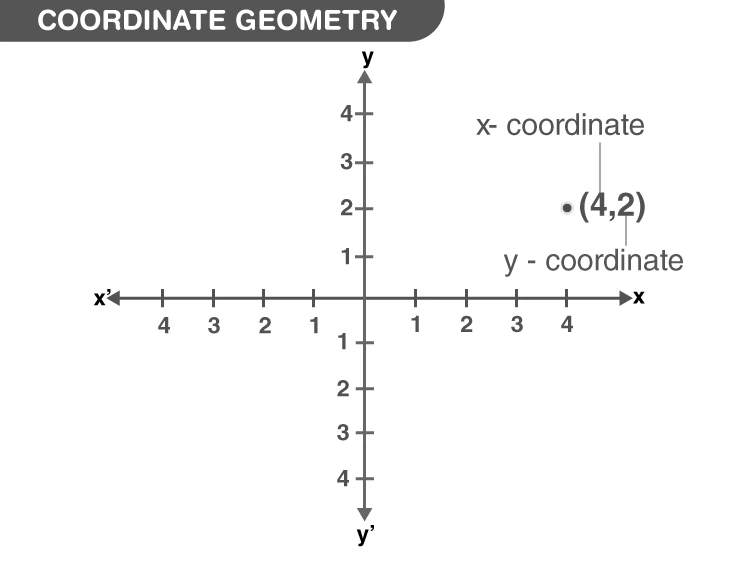
Coordinate Geometry Fig. 1: Cartesian Plane with a point (4,2)
Example:
Identify the quadrant of the point \(P(-5, 3)\) and state its abscissa and ordinate.
Solution:
The point \(P(-5, 3)\) lies in Quadrant II because \(x\) is negative and \(y\) is positive.
Abscissa (x-coordinate) = \(-5\)
Ordinate (y-coordinate) = \(3\)
Equations and Slopes of Lines in the Coordinate Plane
Forms of Linear Equations and Slope Calculation
Lines in the Cartesian plane can be expressed in various algebraic forms. The most common are:
General form: \(Ax + By + C = 0\), where \(A\), \(B\), and \(C\) are constants.
Slope-intercept form: \(y = mx + c\), where \(m\) is the slope and \(c\) is the y-intercept.
Intercept form: \(\frac{x}{a} + \frac{y}{b} = 1\), where \(a\) and \(b\) are the x- and y-intercepts respectively.
The slope \(m\) of a line indicates its steepness and direction. From the general form, the slope can be derived by rearranging the equation:
\[ Ax + By + C = 0 \implies By = -Ax - C \implies y = -\frac{A}{B}x - \frac{C}{B} \]
Comparing with \(y = mx + c\), the slope is:
\[ m = -\frac{A}{B} \]
Example:
Find the slope of the line given by the equation \(5x - 2y + 7 = 0\).
Solution:
Rearranging:
\[ -2y = -5x - 7 \implies y = \frac{5}{2}x + \frac{7}{2} \]
Therefore, the slope is \(m = \frac{5}{2}\).
Key Formulas and Theorems in Coordinate Geometry
Distance Between Two Points
To find the distance between two points \(A(x_1, y_1)\) and \(B(x_2, y_2)\) on the plane, use the distance formula derived from the Pythagorean theorem:
\[ d = \sqrt{(x_2 - x_1)^2 + (y_2 - y_1)^2} \]
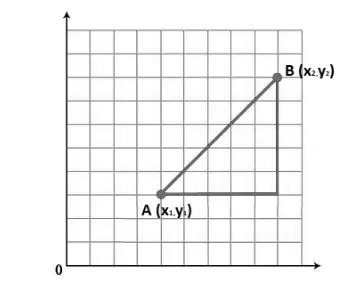
This image shows a graph with two points, A and B, plotted on a grid. Point A has coordinates \((x_1, y_1)\) and point B has coordinates \((x_2, y_2)\). A line connects points A and B, forming a right triangle with the axes. Step-by-step explanation: 1. Identify the coordinates of points A and B on the grid. 2. Draw a horizontal line from point A to directly below point B. 3. Draw a vertical line from this point to point B, forming a right triangle. 4. This setup is typically used to calculate the distance between the two points or to understand the change in \(x\) and \(y\) values. 5. The horizontal leg of the triangle represents the difference in x-values, \((x_2 - x_1)\), and the vertical leg represents the difference in y-values, \((y_2 - y_1)\).
Example:
Calculate the distance between points \(P(2, -1)\) and \(Q(-4, 3)\).
Solution:
\[ d = \sqrt{(-4 - 2)^2 + (3 - (-1))^2} = \sqrt{(-6)^2 + (4)^2} = \sqrt{36 + 16} = \sqrt{52} = 2\sqrt{13} \]
Midpoint of a Line Segment
The midpoint \(M\) of the segment joining points \(A(x_1, y_1)\) and \(B(x_2, y_2)\) is the average of their coordinates:
\[ M = \left( \frac{x_1 + x_2}{2}, \frac{y_1 + y_2}{2} \right) \]
Example:
Find the midpoint of the segment connecting \(R(6, 2)\) and \(S(2, 10)\).
Solution:
\[ M = \left( \frac{6 + 2}{2}, \frac{2 + 10}{2} \right) = (4, 6) \]
Angle Between Two Lines
Given two lines with slopes \(m_1\) and \(m_2\), the angle \(\theta\) between them satisfies:
\[ \tan \theta = \left| \frac{m_1 - m_2}{1 + m_1 m_2} \right| \]
Special cases:
If the lines are parallel, \(m_1 = m_2\), then \(\tan \theta = 0\) and \(\theta = 0^\circ\).
If the lines are perpendicular, \(m_1 m_2 = -1\), then the denominator is zero, implying \(\theta = 90^\circ\).
Example:
Find the angle between lines with slopes \(3\) and \(-\frac{1}{3}\).
Solution:
\[ \tan \theta = \left| \frac{3 - (-\frac{1}{3})}{1 + 3 \times (-\frac{1}{3})} \right| = \left| \frac{3 + \frac{1}{3}}{1 - 1} \right| = \frac{\frac{10}{3}}{0} \]
The denominator is zero, so \(\theta = 90^\circ\). The lines are perpendicular.
Section Formula: Dividing a Line Segment
A point \(P\) divides the segment joining \(A(x_1, y_1)\) and \(B(x_2, y_2)\) in the ratio \(m:n\). The coordinates of \(P\) are:
Internal division:
\[ P = \left( \frac{m x_2 + n x_1}{m + n}, \frac{m y_2 + n y_1}{m + n} \right) \]
External division:
\[ P = \left( \frac{m x_2 - n x_1}{m - n}, \frac{m y_2 - n y_1}{m - n} \right) \]
Example:
Find the coordinates of the point dividing the segment between \(A(1, 4)\) and \(B(7, 10)\) internally in the ratio \(2:3\).
Solution:
\[ P = \left( \frac{2 \times 7 + 3 \times 1}{2 + 3}, \frac{2 \times 10 + 3 \times 4}{2 + 3} \right) = \left( \frac{14 + 3}{5}, \frac{20 + 12}{5} \right) = (3.4, 6.4) \]
Area of a Triangle Using Coordinates
The area of a triangle with vertices at \(A(x_1, y_1)\), \(B(x_2, y_2)\), and \(C(x_3, y_3)\) is given by:
\[ \text{Area} = \frac{1}{2} \left| x_1(y_2 - y_3) + x_2(y_3 - y_1) + x_3(y_1 - y_2) \right| \]
If the area is zero, the points are collinear.
Example:
Calculate the area of the triangle with vertices \(A(2, 3)\), \(B(5, 7)\), and \(C(8, 3)\).
Solution:
\[ \text{Area} = \frac{1}{2} |2(7 - 3) + 5(3 - 3) + 8(3 - 7)| = \frac{1}{2} |2 \times 4 + 5 \times 0 + 8 \times (-4)| = \frac{1}{2} |8 + 0 - 32| = \frac{1}{2} \times 24 = 12 \]
Practical Applications and Problem Solving in Coordinate Geometry
Distance Calculation Between Points
Using the distance formula, one can determine the length of a segment between any two points on the plane, which is essential in various geometric and real-world problems.
Example:
Find the distance between points \(M(3, 7)\) and \(N(-1, 2)\).
Solution:
\[ d = \sqrt{(-1 - 3)^2 + (2 - 7)^2} = \sqrt{(-4)^2 + (-5)^2} = \sqrt{16 + 25} = \sqrt{41} \]
Equation of a Line Parallel to a Given Line
Lines parallel to a given line share the same slope. To find the equation of a line parallel to \(Ax + By + C = 0\) passing through a point \((x_0, y_0)\), keep the slope constant and find the new intercept.
Example:
Find the equation of a line parallel to \(4x - 3y = 12\) passing through \((2, 5)\).
Solution:
Rewrite the given line in slope-intercept form:
\[ 4x - 3y = 12 \implies -3y = -4x + 12 \implies y = \frac{4}{3}x - 4 \]
Slope \(m = \frac{4}{3}\). Equation of parallel line:
\[ y = \frac{4}{3}x + c \]
Substitute point \((2, 5)\):
\[ 5 = \frac{4}{3} \times 2 + c \implies 5 = \frac{8}{3} + c \implies c = 5 - \frac{8}{3} = \frac{15 - 8}{3} = \frac{7}{3} \]
Final equation:
\[ y = \frac{4}{3}x + \frac{7}{3} \]
Summary of Essential Coordinate Geometry Formulas
Concept | Formula | Explanation |
|---|---|---|
Distance Between Two Points | \( d = \sqrt{(x_2 - x_1)^2 + (y_2 - y_1)^2} \) | Calculates the length of the segment joining two points. |
Midpoint of a Segment | \( M = \left( \frac{x_1 + x_2}{2}, \frac{y_1 + y_2}{2} \right) \) | Finds the point exactly halfway between two points. |
Slope of a Line | \( m = \frac{y_2 - y_1}{x_2 - x_1} \) or \( m = -\frac{A}{B} \) from \(Ax + By + C=0\) | Measures the steepness of a line. |
Equation of a Line (Slope-Intercept) | \( y = mx + c \) | Represents a line with slope \(m\) and y-intercept \(c\). |
Angle Between Two Lines | \( \tan \theta = \left| \frac{m_1 - m_2}{1 + m_1 m_2} \right| \) | Calculates the angle formed by two intersecting lines. |
Section Formula (Internal) | \( \left( \frac{m x_2 + n x_1}{m + n}, \frac{m y_2 + n y_1}{m + n} \right) \) | Coordinates of a point dividing a segment internally in ratio \(m:n\). |
Section Formula (External) | \( \left( \frac{m x_2 - n x_1}{m - n}, \frac{m y_2 - n y_1}{m - n} \right) \) | Coordinates of a point dividing a segment externally in ratio \(m:n\). |
Area of Triangle | \( \frac{1}{2} |x_1(y_2 - y_3) + x_2(y_3 - y_1) + x_3(y_1 - y_2)| \) | Calculates the area of a triangle given its vertices. |
Glossary of Key Terms in Coordinate Geometry
Term | Definition |
|---|---|
Abscissa | The x-coordinate of a point in the Cartesian plane. |
Ordinate | The y-coordinate of a point in the Cartesian plane. |
Cartesian Plane | A two-dimensional plane defined by perpendicular x- and y-axes. |
Origin | The point \((0,0)\) where the x-axis and y-axis intersect. |
Slope | A measure of the steepness of a line, calculated as rise over run. |
Midpoint | The point that divides a line segment into two equal parts. |
Section Formula | Formula to find coordinates of a point dividing a segment in a given ratio. |
Collinear Points | Points that lie on the same straight line. |
Intercept | The point where a line crosses the x-axis or y-axis. |
Angle Between Lines | The measure of inclination between two intersecting lines. |
Frequently Asked Questions on Coordinate Geometry
What do abscissa and ordinate represent in coordinate geometry?
The abscissa is the x-coordinate (horizontal value) and the ordinate is the y-coordinate (vertical value) of a point on the Cartesian plane.
How is the Cartesian plane structured?
It consists of two perpendicular axes: the x-axis (horizontal) and the y-axis (vertical), dividing the plane into four quadrants and intersecting at the origin (0,0).
Why is coordinate geometry important in real life?
It is used in technology for locating positions on screens, in aviation for navigation, in GPS mapping, and in various fields requiring spatial analysis.
How can the slope of a line be determined from its general equation?
By rewriting the general form \(Ax + By + C = 0\) into slope-intercept form \(y = mx + c\), the slope is \(m = -\frac{A}{B}\).
What does it mean if the area of a triangle formed by three points is zero?
It indicates that the three points are collinear, meaning they lie on the same straight line.