Mastering Quadratic Equations Using Completing the Square
Understanding Quadratic Equations and Their Roots
Introduction to Quadratic Expressions
A quadratic equation is a polynomial equation where the highest power of the variable is two. Although the prefix "quad" suggests four, in mathematics, "quadratic" refers to squaring the variable. The general form of a quadratic equation is:
\[ ax^2 + bx + c = 0 \]
Here, \(a\), \(b\), and \(c\) are real numbers with \(a \neq 0\), and \(x\) is the variable. Because the degree is two, such equations have two solutions or roots, which are the values of \(x\) that satisfy the equation.
There are multiple techniques to find these roots, including factoring, using the quadratic formula, and the method of completing the square, which we will explore in detail.
Visualizing Quadratic Terms Geometrically
To better grasp the structure of a quadratic expression, consider representing each term as a geometric shape:
The term \(x^2\) corresponds to the area of a square with side length \(x\).
The term \(bx\) can be visualized as the area of a rectangle with sides \(b\) and \(x\).
The constant term \(c\) is represented as the area of a square with area \(c\).
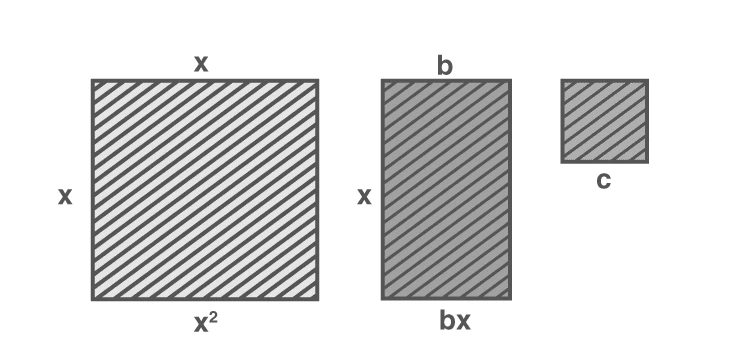
Geometric representation of \(x^2\), \(bx\), and \(c\)
Completing the Square: Concept and Formula Derivation
Step-by-Step Construction of a Perfect Square
Completing the square involves transforming the quadratic expression into a perfect square trinomial plus a constant. By splitting the rectangle representing \(bx\) into two equal parts, each with area \(\frac{b}{2} \times x\), and rearranging these parts around the square \(x^2\), we approach forming a larger square.
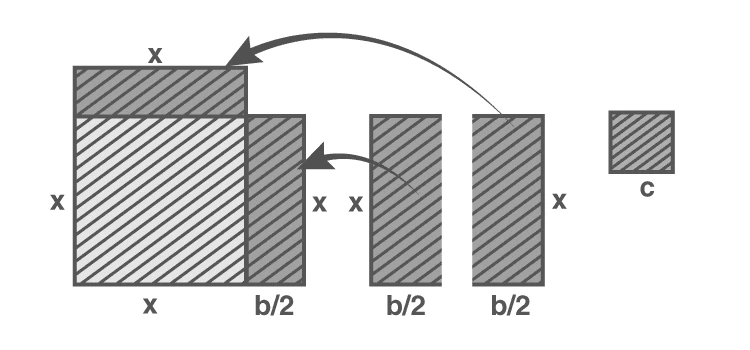
Rearranged geometric figures to approach a perfect square
To complete the square, a small square of side \(\frac{b}{2}\) units is added, which is cut from the square representing \(c\). This final arrangement forms a perfect square with side length \(x + \frac{b}{2}\).
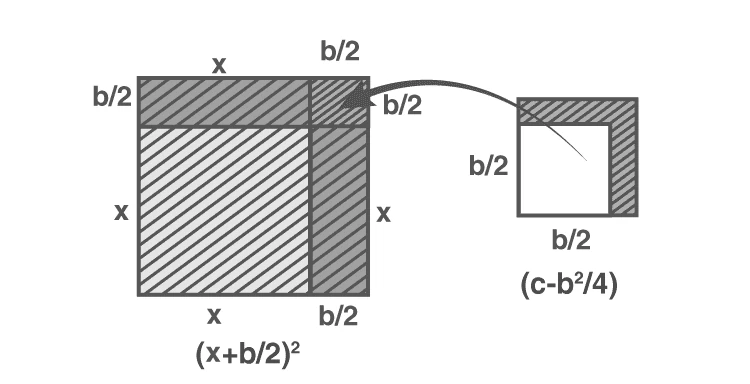
Completed square formed by rearranged figures
Mathematical Expression of Completing the Square
From the geometric construction, the quadratic expression can be rewritten as:
\[ x^2 + bx + c = \left(x + \frac{b}{2}\right)^2 + \left(c - \frac{b^2}{4}\right) \]
Setting the quadratic equal to zero, we have:
\[ \left(x + \frac{b}{2}\right)^2 + \left(c - \frac{b^2}{4}\right) = 0 \]
Rearranging gives:
\[ \left(x + \frac{b}{2}\right)^2 = -\left(c - \frac{b^2}{4}\right) \]
This formula is the foundation for solving quadratic equations by completing the square.
Applying the Completing the Square Method
Systematic Procedure to Solve Quadratics
To solve a quadratic equation \(ax^2 + bx + c = 0\) using completing the square, follow these steps:
Rewrite the equation so that the constant term is on the right side: \(ax^2 + bx = -c\).
If \(a \neq 1\), divide the entire equation by \(a\) to normalize the coefficient of \(x^2\) to 1.
Add the square of half the coefficient of \(x\), \(\left(\frac{b}{2a}\right)^2\), to both sides.
Express the left side as a perfect square trinomial.
Take the square root of both sides.
Solve for \(x\) to find the roots.
Mathematically, starting from:
\[ ax^2 + bx + c = 0 \]
Dividing by \(a\):
\[ x^2 + \frac{b}{a}x + \frac{c}{a} = 0 \]
Adding and subtracting \(\left(\frac{b}{2a}\right)^2\):
\[ \left(x + \frac{b}{2a}\right)^2 - \left(\frac{b}{2a}\right)^2 + \frac{c}{a} = 0 \]
Rearranged as:
\[ \left(x + \frac{b}{2a}\right)^2 = \frac{b^2 - 4ac}{4a^2} \]
If the discriminant \(b^2 - 4ac \geq 0\), taking square roots yields:
\[ x + \frac{b}{2a} = \pm \frac{\sqrt{b^2 - 4ac}}{2a} \]
Which leads to the quadratic formula for roots.
Example 1: Solving \(x^2 + 6x - 7 = 0\) by Completing the Square
Solution:
Given equation:
\[ x^2 + 6x - 7 = 0 \]
Identify coefficients: \(b = 6\), \(c = -7\).
Rewrite as:
\[ \left(x + \frac{6}{2}\right)^2 = -\left(-7 - \frac{6^2}{4}\right) \]
\[ (x + 3)^2 = 7 + 9 = 16 \]
Taking square roots:
\[ x + 3 = \pm 4 \]
So,
\[ x = 1 \quad \text{or} \quad x = -7 \]
Thus, the roots are \(1\) and \(-7\).
Example 2: Finding Roots of \(2x^2 - 7x + 3 = 0\) Using Completing the Square
Solution:
Given equation:
\[ 2x^2 - 7x + 3 = 0 \]
Divide entire equation by 2 to normalize:
\[ x^2 - \frac{7}{2}x + \frac{3}{2} = 0 \]
Identify \(b = -\frac{7}{2}\), \(c = \frac{3}{2}\).
Calculate:
\[ c - \frac{b^2}{4} = \frac{3}{2} - \frac{\left(-\frac{7}{2}\right)^2}{4} = \frac{3}{2} - \frac{\frac{49}{4}}{4} = \frac{3}{2} - \frac{49}{16} = \frac{24}{16} - \frac{49}{16} = -\frac{25}{16} \]
Rewrite as:
\[ \left(x - \frac{7}{4}\right)^2 = -\left(-\frac{25}{16}\right) = \frac{25}{16} \]
Taking square roots:
\[ x - \frac{7}{4} = \pm \frac{5}{4} \]
Therefore,
\[ x = \frac{7}{4} \pm \frac{5}{4} \]
Roots are:
\[ x = 3 \quad \text{or} \quad x = \frac{1}{2} \]
Student grasping the completing the square technique
Practice Problems to Reinforce Completing the Square
Try Solving These Quadratic Equations
Apply the completing the square method to find the roots of the following:
Find roots of \(4x^2 + 3x + 5 = 0\).
Determine roots of \(5x^2 - 6x - 2 = 0\).
Identify two consecutive odd positive integers whose squares add up to 290.
For additional practice and detailed solutions, consider downloading BYJU’S – The Learning App from the Google Play Store.
Summary Table: Key Points on Completing the Square
Concept | Details |
|---|---|
Quadratic Equation | Polynomial of degree 2, \(ax^2 + bx + c = 0\), with \(a \neq 0\) |
Completing the Square | Rewriting \(x^2 + bx + c\) as \(\left(x + \frac{b}{2}\right)^2 + \left(c - \frac{b^2}{4}\right)\) |
Steps to Solve | Isolate constant, normalize coefficient of \(x^2\), add \(\left(\frac{b}{2a}\right)^2\), factor, take square root, solve for \(x\) |
Quadratic Formula | Derived from completing the square: \(\displaystyle x = \frac{-b \pm \sqrt{b^2 - 4ac}}{2a}\) |
Discriminant | \(b^2 - 4ac\), determines nature of roots |
Glossary of Important Terms
Term | Definition |
|---|---|
Quadratic Equation | An equation of the form \(ax^2 + bx + c = 0\) where \(a \neq 0\) |
Root | A value of \(x\) that satisfies the quadratic equation |
Completing the Square | Method of rewriting a quadratic expression as a perfect square plus a constant |
Discriminant | The expression \(b^2 - 4ac\) indicating the nature of roots |
Perfect Square Trinomial | A trinomial that can be factored into \((x + d)^2\) form |
Coefficient | Numerical factor multiplying a variable term |
Variable | Symbol representing an unknown quantity, usually \(x\) |
Binomial | An algebraic expression with two terms |
Square Root | A value that, when multiplied by itself, gives the original number |
Normalization | Adjusting the coefficient of \(x^2\) to 1 by dividing the entire equation |
Frequently Asked Questions
What is the main advantage of completing the square over other methods?
Completing the square provides a systematic way to solve any quadratic equation and helps derive the quadratic formula, making it versatile and insightful.
Can completing the square be used if the coefficient of \(x^2\) is not 1?
Yes, but first divide the entire equation by the coefficient of \(x^2\) to normalize it before applying the method.
What does the discriminant tell us about the roots?
The discriminant \(b^2 - 4ac\) indicates whether roots are real and distinct, real and equal, or complex.
Is completing the square useful for graphing quadratic functions?
Yes, it helps rewrite the quadratic in vertex form, revealing the vertex and axis of symmetry for graphing.
How do I handle negative values under the square root when completing the square?
Negative values indicate complex roots; you can express the roots using imaginary numbers involving \(i = \sqrt{-1}\).