Calculating Triangle Area Using Coordinate Geometry
Understanding Triangles and Their Properties
Fundamentals of Triangles and Their Classification
A triangle is a polygon with three sides, three edges, and three vertices. It is one of the simplest shapes in geometry, forming a closed figure in a two-dimensional plane. Triangles can be categorized based on their side lengths or angles, such as equilateral, isosceles, scalene, acute, right, or obtuse triangles. Recognizing these types helps in applying appropriate formulas for area and perimeter calculations.
Example: Identify the type of triangle with sides measuring 5 cm, 5 cm, and 8 cm.
Solution: Since two sides are equal (5 cm and 5 cm) and the third is different (8 cm), the triangle is isosceles.
Calculating Triangle Area: Essential Methods
Area Using Base and Height
The most straightforward way to find a triangle's area is when the base length and the corresponding altitude (height) are known. The area is half the product of these two measurements. This method is fundamental and often used in various geometric problems.
Example: Find the area of a triangle with a base of 10 cm and a height of 6 cm.
Solution: Using the formula \( A = \frac{1}{2} \times \text{base} \times \text{height} \), we get:
\[ A = \frac{1}{2} \times 10 \times 6 = 30 \text{ cm}^2 \]
Thus, the area is 30 square centimeters.
Area Using Heron's Formula with Side Lengths
When the lengths of all three sides of a triangle are known, Heron's formula provides a reliable way to calculate the area without needing the height. First, compute the semi-perimeter, then apply the formula to find the area. This method is especially useful when the height is difficult to measure.
The semi-perimeter \( s \) is given by:
\[ s = \frac{a + b + c}{2} \]
The area \( A \) is then:
\[ A = \sqrt{s(s - a)(s - b)(s - c)} \]
Example: Calculate the area of a triangle with sides 7 cm, 8 cm, and 9 cm.
Solution: First, find the semi-perimeter:
\[ s = \frac{7 + 8 + 9}{2} = 12 \text{ cm} \]
Then, apply Heron's formula:
\[ A = \sqrt{12(12 - 7)(12 - 8)(12 - 9)} = \sqrt{12 \times 5 \times 4 \times 3} = \sqrt{720} \approx 26.83 \text{ cm}^2 \]
The area is approximately 26.83 square centimeters.
Determining Area from Coordinates of Vertices
When the coordinates of a triangle's vertices in the Cartesian plane are given, the area can be found using coordinate geometry techniques. This involves calculating the lengths of sides using the distance formula or directly applying a formula derived from the vertices' coordinates. This approach is particularly useful in analytic geometry.
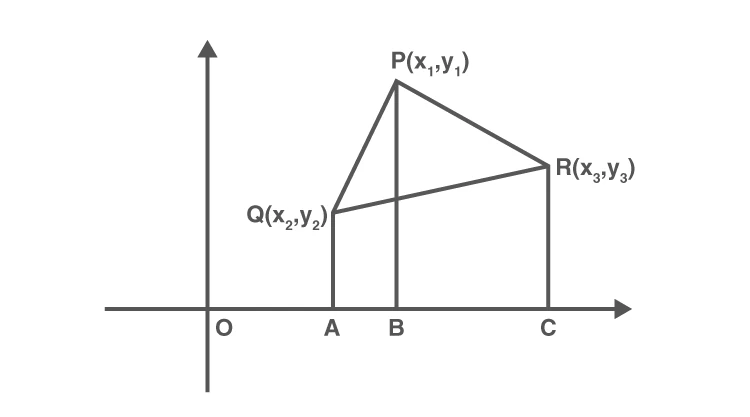
Triangle PQR with perpendiculars drawn to the x-axis forming trapeziums
Consider triangle \( PQR \) with vertices \( P(x_1, y_1) \), \( Q(x_2, y_2) \), and \( R(x_3, y_3) \). The area can be calculated by decomposing the figure into trapeziums and using their areas.
The area of trapezium \( PQAB \) is:
\[ \text{Area}_{PQAB} = \frac{1}{2} (y_1 + y_2)(x_1 - x_2) \]
The area of trapezium \( PBCR \) is:
\[ \text{Area}_{PBCR} = \frac{1}{2} (y_1 + y_3)(x_3 - x_1) \]
The area of trapezium \( QACR \) is:
\[ \text{Area}_{QACR} = \frac{1}{2} (y_2 + y_3)(x_3 - x_2) \]
Combining these, the area of triangle \( PQR \) is:
\[ \text{Area}_{PQR} = \text{Area}_{PQAB} + \text{Area}_{PBCR} - \text{Area}_{QACR} \]
Which simplifies to the formula:
\[ A = \frac{1}{2} \left[ x_1(y_2 - y_3) + x_2(y_3 - y_1) + x_3(y_1 - y_2) \right] \]
This formula gives the area directly from the coordinates.
Example: Find the area of triangle \( ABC \) with vertices \( A(2, 3) \), \( B(5, 3) \), and \( C(4, 7) \).
Solution: Using the coordinate formula:
\[ A = \frac{1}{2} [2(3 - 7) + 5(7 - 3) + 4(3 - 3)] \]
\[ = \frac{1}{2} [2(-4) + 5(4) + 4(0)] = \frac{1}{2} [-8 + 20 + 0] = \frac{12}{2} = 6 \text{ square units} \]
The area of triangle \( ABC \) is 6 square units.
Additional Concepts: Perimeter and Distance in Triangles
Calculating the Perimeter of a Triangle
The perimeter of a triangle is the total length around the figure, found by adding the lengths of all three sides. When vertices are given, side lengths can be determined using the distance formula, then summed to find the perimeter.
The distance between two points \( (x_1, y_1) \) and \( (x_2, y_2) \) is:
\[ d = \sqrt{(x_2 - x_1)^2 + (y_2 - y_1)^2} \]
Example: Find the perimeter of triangle with vertices \( A(1, 1) \), \( B(4, 1) \), and \( C(1, 5) \).
Solution: Calculate side lengths:
\[ AB = \sqrt{(4-1)^2 + (1-1)^2} = \sqrt{3^2 + 0} = 3 \]
\[ BC = \sqrt{(1-4)^2 + (5-1)^2} = \sqrt{(-3)^2 + 4^2} = \sqrt{9 + 16} = 5 \]
\[ CA = \sqrt{(1-1)^2 + (5-1)^2} = \sqrt{0 + 4^2} = 4 \]
Perimeter \( P = AB + BC + CA = 3 + 5 + 4 = 12 \) units.
Summary Table for Quick Reference
Method | Formula | Required Data | Notes |
|---|---|---|---|
Base and Height | \( A = \frac{1}{2} \times b \times h \) | Base length and corresponding altitude | Simple and direct for known height |
Heron's Formula | \( A = \sqrt{s(s - a)(s - b)(s - c)} \) | Lengths of all three sides | Height not needed; uses semi-perimeter \( s \) |
Coordinate Geometry | \( A = \frac{1}{2} [x_1(y_2 - y_3) + x_2(y_3 - y_1) + x_3(y_1 - y_2)] \) | Coordinates of vertices | Useful for analytic geometry problems |
Perimeter | \( P = a + b + c \) | Lengths of all sides | Sum of side lengths |
Glossary of Key Terms
Term | Definition |
|---|---|
Altitude | The perpendicular height from a vertex to the opposite side |
Base | The side of a triangle chosen for reference in area calculation |
Coordinate Geometry | Branch of geometry using coordinates to study figures |
Distance Formula | Formula to calculate distance between two points in a plane |
Heron's Formula | Formula to find area using all three side lengths |
Perimeter | Total length around a polygon |
Polygon | A closed figure with straight sides |
Semi-perimeter | Half of the perimeter of a triangle |
Vertex | A corner point where two sides meet |
Trapezium | A quadrilateral with at least one pair of parallel sides |
Frequently Asked Questions
How do I find the area of a triangle if I only know the coordinates of its vertices?
Use the coordinate geometry formula: \( A = \frac{1}{2} |x_1(y_2 - y_3) + x_2(y_3 - y_1) + x_3(y_1 - y_2)| \) to calculate the area directly from the vertices.
What is the advantage of Heron's formula over the base-height method?
Heron's formula does not require the height of the triangle, only the lengths of the three sides, making it useful when the height is unknown or difficult to measure.
Can the area of a triangle be zero? What does it imply?
If the area calculated is zero, it means the three points are collinear and do not form a triangle.
How is the perimeter of a triangle calculated from coordinates?
Calculate the distance between each pair of vertices using the distance formula, then sum these lengths to find the perimeter.
Is it necessary to know the type of triangle before calculating its area?
No, the area formulas apply to all triangle types, but knowing the type can help choose the most convenient method.
Additional Visual Reference
Triangle vertices plotted on coordinate axes