CLASS 9 . SCIENCE . EXPLORATION . SOUND WAVES-CHARACTERISTICS-AND-APPLICATIONS
Chapter 10 : Sound Waves: Characteristics and Applications
Ch 10
SCIENCE
CLASS 9
Sound Production
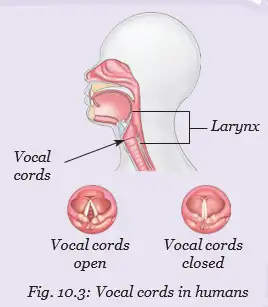
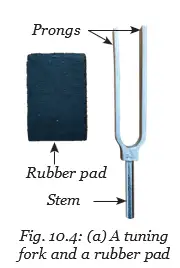
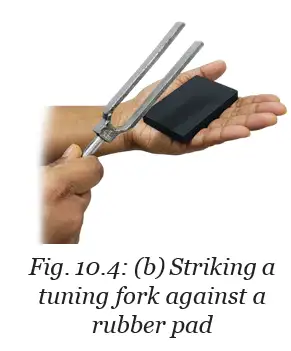
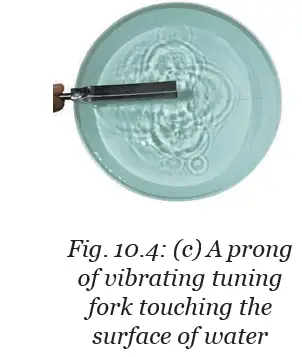
Sound is produced by vibrating objects. When an object vibrates, it causes the surrounding medium (air, water, or solid) to vibrate as well, creating sound waves. For example, plucking a stretched rubber band or striking a metal object causes vibrations that produce sound. In humans, sound is produced by the vibration of vocal cords located in the larynx. Musical instruments produce sound through vibrating strings, membranes, or air columns.
When an object vibrates, it causes the particles of the surrounding medium (such as air, water, or solids) to vibrate as well. These vibrations create sound waves that travel through the medium to reach our ears. For example, plucking a stretched rubber band causes it to vibrate, producing sound. Similarly, striking a metal object causes it to vibrate and produce sound. In humans, sound is produced by the vibration of vocal cords located inside the larynx. Musical instruments produce sound through the vibration of strings, membranes, or air columns, which act as sources of sound.
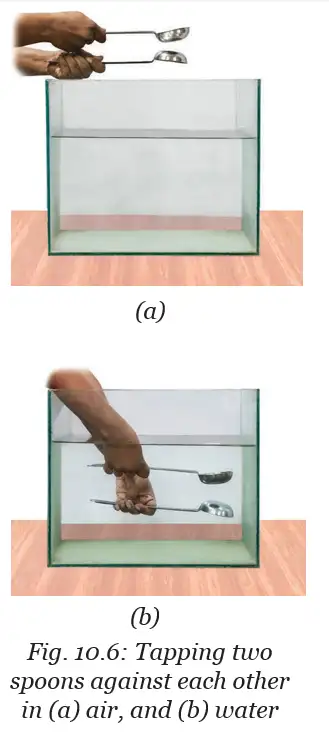
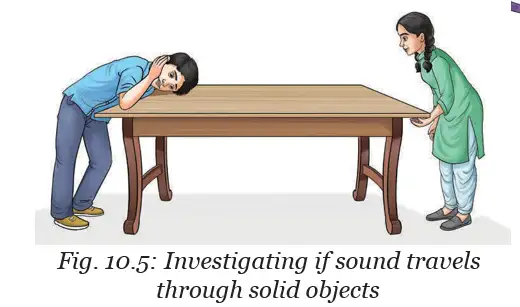
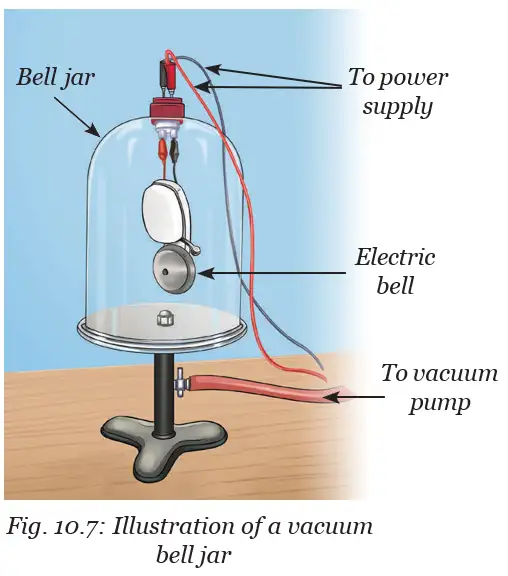
Sound requires a medium to travel. It can propagate through solids, liquids, and gases but cannot travel through a vacuum. This is why astronauts in space cannot hear sounds directly and use special communication devices.
Sound requires a medium to travel because it propagates through the vibration of particles in solids, liquids, or gases. Without a medium, such as in a vacuum, there are no particles to transmit these vibrations, so sound cannot travel. This is why astronauts in space, where there is a near vacuum, cannot hear sounds directly. Instead, they use special communication devices that transmit sound through other means.
Sound Waves
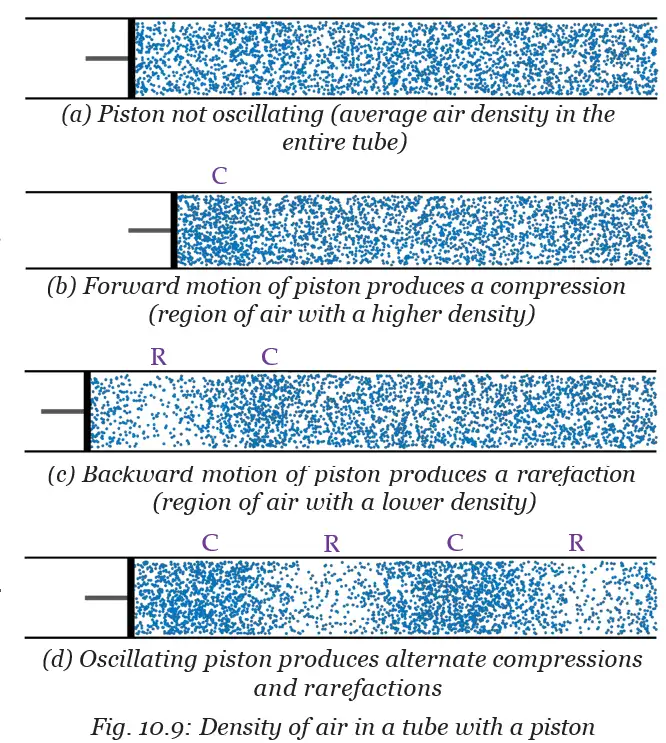
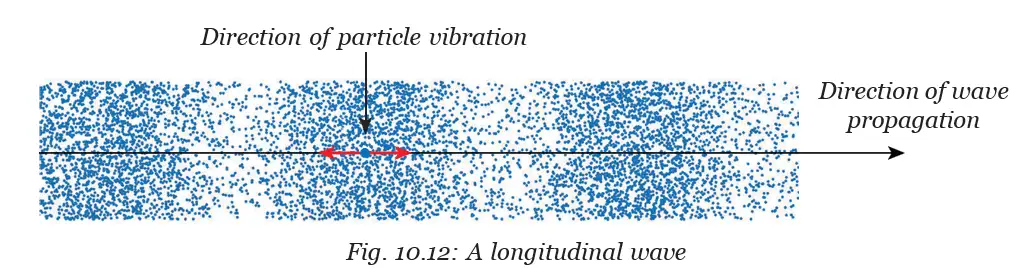
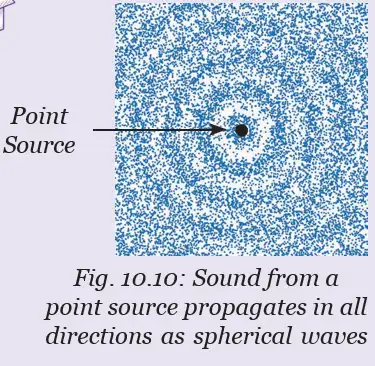
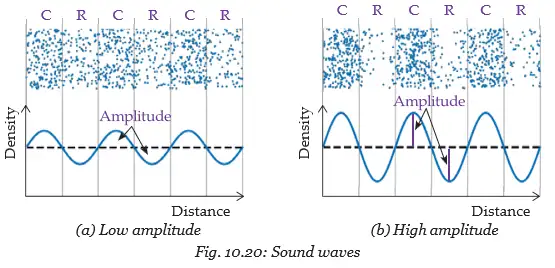
Sound waves are longitudinal mechanical waves consisting of alternating compressions and rarefactions in the medium. Compressions are regions of high particle density, and rarefactions are regions of low particle density. The particles of the medium vibrate back and forth parallel to the direction of wave propagation but do not travel with the wave.
Sound waves are longitudinal mechanical waves that consist of alternating regions called compressions and rarefactions. Compressions are areas where particles of the medium are close together, resulting in high particle density. Rarefactions are areas where particles are spread apart, resulting in low particle density. The particles vibrate back and forth parallel to the direction in which the wave travels, but the particles themselves do not move forward with the wave; only the disturbance travels through the medium.

Sound waves propagate by transferring energy through the medium. The speed of sound depends on the medium and its properties, traveling fastest in solids, slower in liquids, and slowest in gases. The speed also varies with temperature and humidity in air.
Sound waves transfer energy through the medium by causing particles to vibrate and collide with neighboring particles, passing the disturbance along. The speed of sound depends on the type of medium and its properties. Sound travels fastest in solids because particles are closely packed, slower in liquids, and slowest in gases where particles are far apart. Additionally, factors like temperature and humidity affect the speed of sound in air; higher temperature and humidity increase the speed.
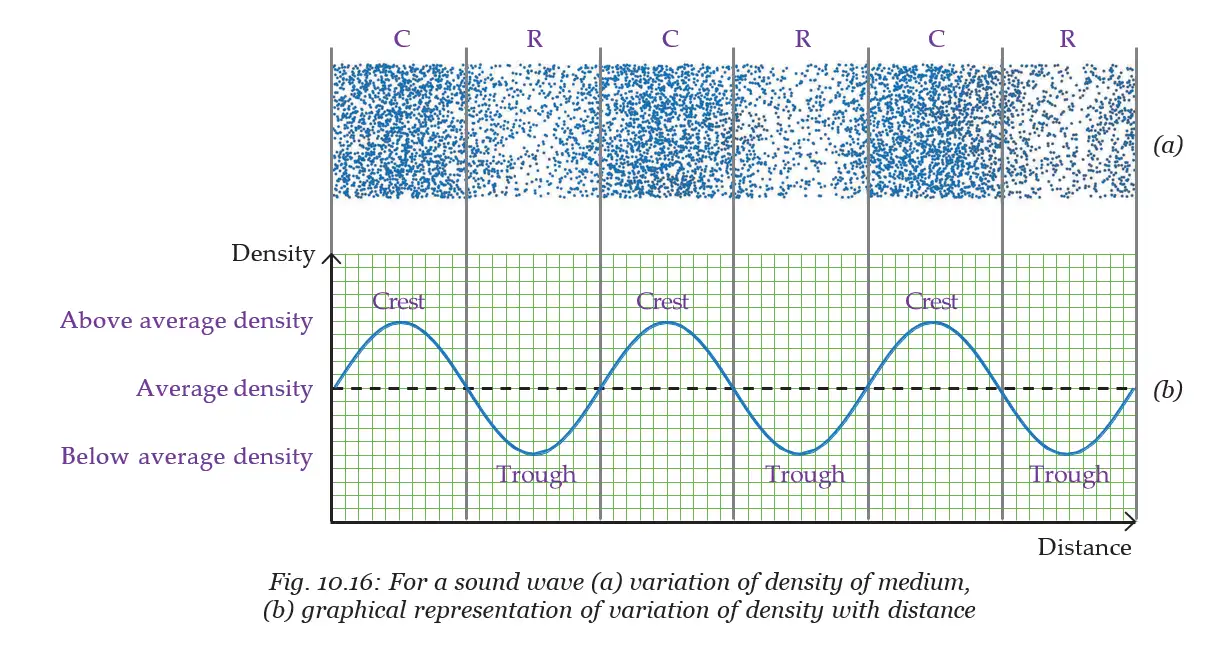
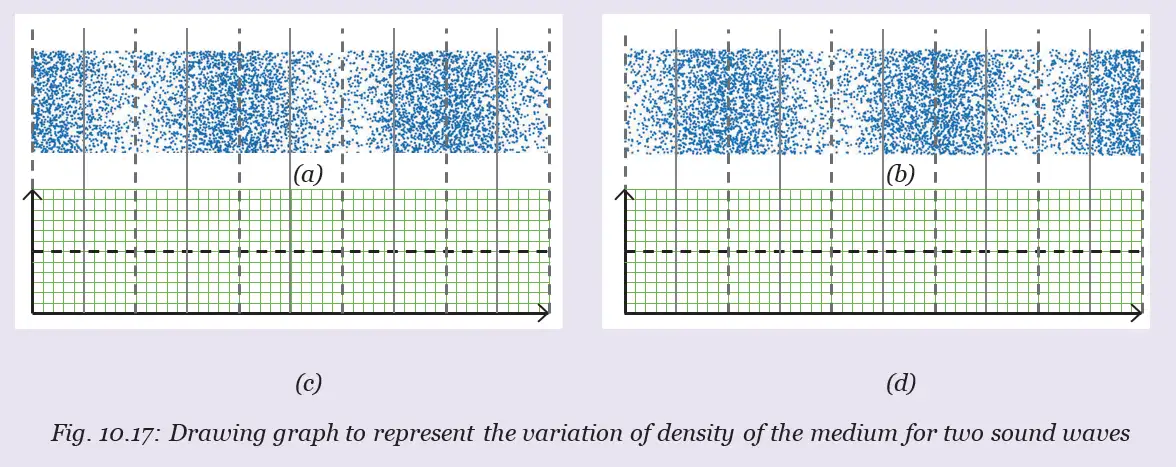
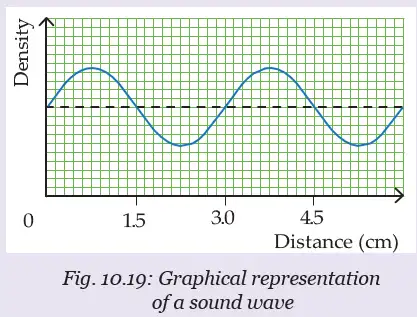
Sound waves can be graphically represented by plotting the variation of air density with distance or time, showing crests (compressions) and troughs (rarefactions).
Sound waves can be represented graphically by plotting the variation of air density with distance or time. In such graphs, crests represent compressions where the density is higher than average, and troughs represent rarefactions where the density is lower than average. This wave-like pattern illustrates how sound propagates through the medium as alternating high and low-density regions.
Sound Characteristics
Key characteristics of sound waves include wavelength, frequency, time period, amplitude, intensity, pitch, and loudness. Wavelength is the distance between two consecutive compressions or rarefactions. Frequency is the number of oscillations per second, measured in hertz (Hz). Time period is the time for one complete oscillation and is the inverse of frequency.
Sound waves have several key characteristics:
- Wavelength: The distance between two consecutive compressions or two consecutive rarefactions. It is usually denoted by the Greek letter λ (lambda) and measured in meters (m).
- Frequency: The number of oscillations or density variations occurring at a point per second. It is denoted by ν (nu) and measured in hertz (Hz).
- Time Period: The time taken for one complete oscillation at a point. It is the inverse of frequency and denoted by T, measured in seconds (s).
- Amplitude: The maximum change in air density in a compression or rarefaction compared to the average density. It relates to the loudness of the sound.
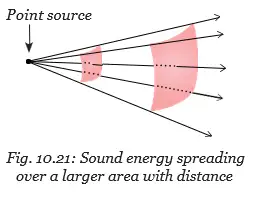
- Intensity: The amount of sound energy passing through a unit area perpendicular to the direction of wave propagation per unit time.
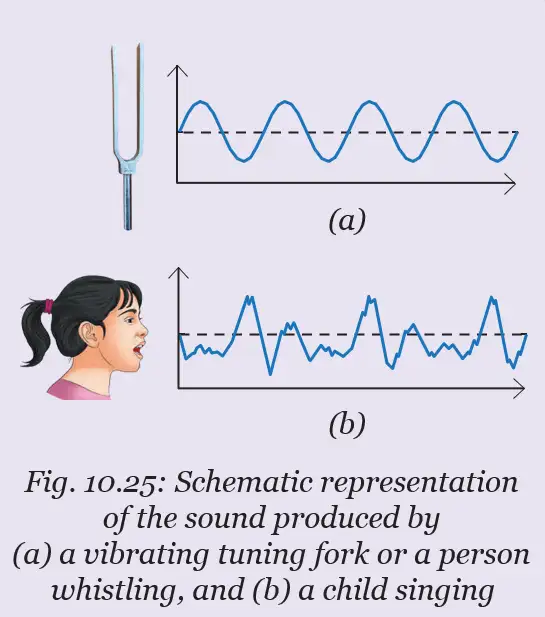
- Pitch: How humans perceive the frequency of sound; higher frequency sounds are perceived as higher pitch.
- Loudness: How humans perceive the amplitude of sound; larger amplitude sounds are heard as louder.
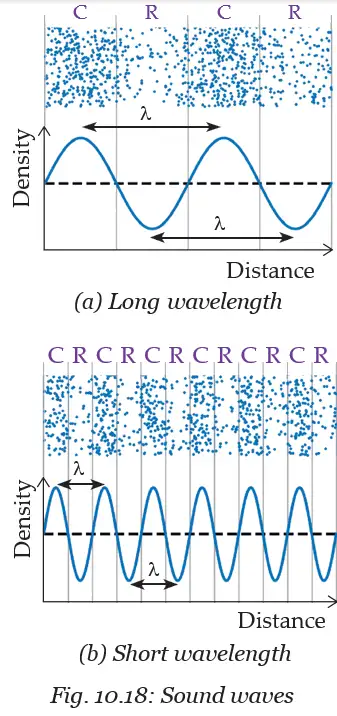
Amplitude relates to the maximum change in air density and determines the loudness of sound. Intensity is the amount of sound energy passing through a unit area per unit time. Pitch is how humans perceive frequency, with higher frequencies perceived as higher pitch.
Amplitude is the maximum variation in air density from its average value during a sound wave's compression or rarefaction. A larger amplitude means the sound wave carries more energy, resulting in a louder sound. Intensity quantifies this energy transfer as the amount of sound energy passing through a unit area perpendicular to the direction of wave propagation per unit time. Pitch is the perceptual attribute of sound that allows us to classify sounds as high or low; it is directly related to the frequency of the sound wave, with higher frequencies perceived as higher pitch.

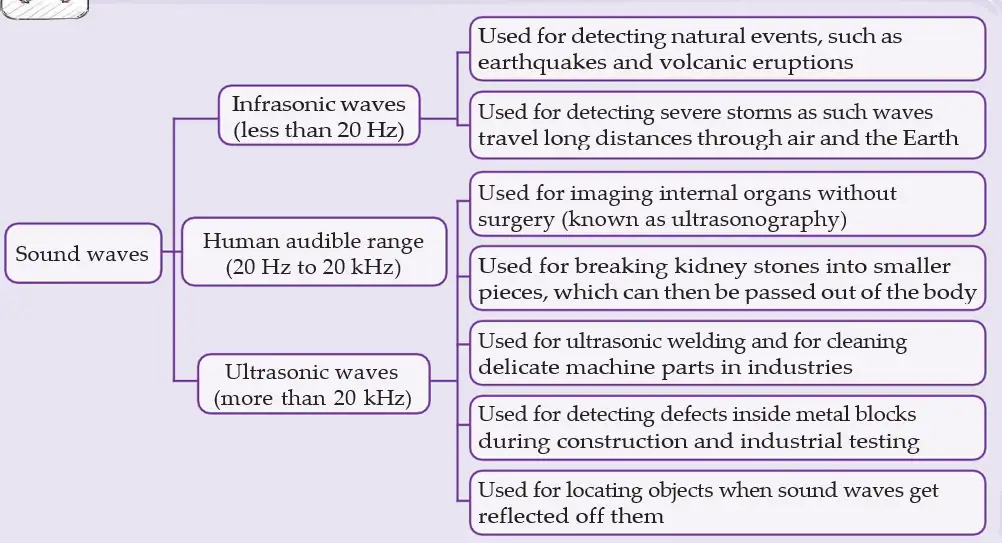
Humans can hear sounds in the frequency range of 20 Hz to 20,000 Hz. Sounds below 20 Hz are infrasonic, and above 20,000 Hz are ultrasonic. Different animals can hear different frequency ranges.
Humans can hear sounds within the frequency range of approximately 20 Hz to 20,000 Hz, known as the audible range. Sounds with frequencies below 20 Hz are called infrasonic waves, which are inaudible to humans but can be detected by some animals and used to monitor natural events like earthquakes. Sounds with frequencies above 20,000 Hz are called ultrasonic waves, which are also inaudible to humans but have important applications in medicine and technology. Different animals have varying hearing ranges; for example, dogs and bats can hear ultrasonic sounds, while elephants can detect infrasonic sounds.
Sound Reflection
Sound waves reflect off surfaces following the laws of reflection, where the angle of incidence equals the angle of reflection. An echo is a reflected sound heard when the reflected wave returns after a delay of at least 0.1 seconds. Reverberation occurs when multiple reflections cause sound to persist after the source stops emitting.
Sound waves reflect off surfaces following the laws of reflection, where the angle of incidence equals the angle of reflection, and all angles lie in the same plane. When sound waves encounter a surface, they bounce back, producing reflected sound. An echo is the distinct reflected sound heard when the reflected wave returns after a delay of at least 0.1 seconds, allowing the listener to perceive it separately from the original sound. Reverberation occurs when multiple reflections of sound waves persist in an enclosed space, causing the sound to continue even after the source has stopped emitting.
Echoes are stronger from hard, smooth surfaces and weaker or absent from soft, rough surfaces that absorb or scatter sound.
Echoes are more pronounced and clearer when sound reflects off hard, smooth surfaces because these surfaces efficiently reflect sound waves. In contrast, soft and rough surfaces tend to absorb or scatter sound waves, reducing the strength and clarity of echoes. Materials like curtains, carpets, and upholstered furniture absorb sound, minimizing echoes and reverberations in a room.
Ultrasonic and Infrasonic Waves
Ultrasonic waves have frequencies above 20,000 Hz and are used in medical imaging, cleaning, welding, and underwater navigation (sonar). Infrasonic waves have frequencies below 20 Hz and are used to detect natural phenomena like earthquakes and storms.
Ultrasonic waves are sound waves with frequencies above 20,000 Hz. They are widely used in medical imaging techniques such as ultrasonography, in industrial cleaning, welding, and in underwater navigation systems like sonar. Infrasonic waves have frequencies below 20 Hz and are used to detect natural phenomena such as earthquakes and severe storms. These waves can travel long distances and are useful in monitoring environmental and geological events.
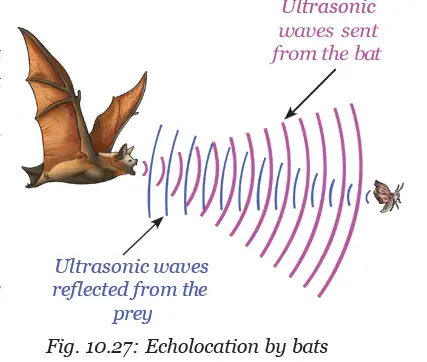
Echolocation is a biological use of ultrasonic waves by animals like bats and dolphins to locate objects by emitting ultrasonic waves and listening to their echoes.
Echolocation is a biological process used by animals such as bats and dolphins to navigate and locate prey in the dark or murky environments. These animals emit ultrasonic waves that travel through the environment and reflect off objects. By listening to the returning echoes, they can determine the distance, size, and shape of objects around them, enabling precise navigation and hunting even without visual cues.
Sonar technology uses ultrasonic waves to detect underwater objects by sending waves and analyzing their reflections.
Sonar technology operates by emitting ultrasonic waves into water. These waves travel through the water until they encounter an object, such as a submarine or underwater terrain, and then reflect back to the source. By measuring the time taken for the echoes to return and analyzing their characteristics, sonar systems can determine the distance, size, shape, and movement of underwater objects. This technology is widely used in navigation, underwater mapping, and detecting obstacles or marine life.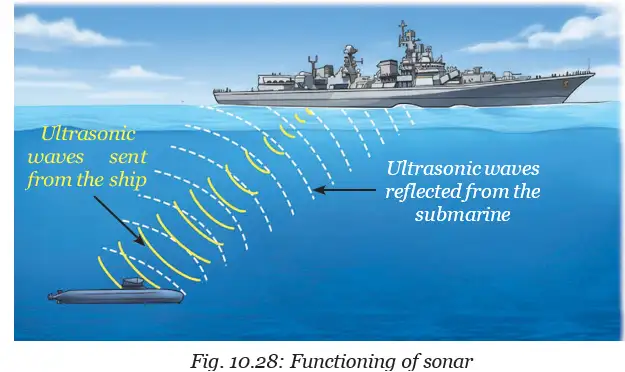
Solved Examples
Example 1: Calculate frequency and time period
If there are 10 density oscillations in 2 seconds at a given position, find the frequency and time period of the sound wave.
Solution:
Frequency = Number of oscillations / Time = 10 / 2 s = 5 Hz
Time period = 1 / Frequency = 1 / 5 Hz = 0.2 s
Example 2: Calculate wavelength for given frequencies
Find the wavelength of sound in air for frequencies 20 Hz and 20,000 Hz. Speed of sound in air = 344 m/s.
Solution:
Wavelength, λ = Speed / Frequency
For 20 Hz: λ = 344 / 20 = 17.2 m
For 20,000 Hz: λ = 344 / 20000 = 0.0172 m = 1.72 cm
Example 3: Distance to lightning strike
Lightning is seen before thunder is heard. If the time delay is 5 seconds and speed of sound is 340 m/s, find the distance to the lightning.
Solution:
Distance = Speed × Time = 340 m/s × 5 s = 1700 m = 1.7 km
Example 4: Frequency and time period from wavelength
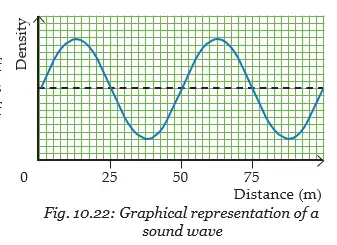
From a sound wave graph in steel, wavelength is 50 m. Speed of sound in steel = 5000 m/s. Find frequency and time period.
Solution:
Frequency = Speed / Wavelength = 5000 / 50 = 100 Hz
Time period = 1 / Frequency = 1 / 100 = 0.01 s
Example 5: Distance from echo time
Echo heard after 0.5 s. Speed of sound = 340 m/s. Find distance from reflecting surface.
Solution:
Distance = (Speed × Time) / 2 = (340 × 0.5) / 2 = 85 m
Example 6: Sonar distance calculation
Sonar signal returns after 0.90 s. Speed of sound in seawater = 1530 m/s. Find distance to object.
Solution:
Time to object = 0.90 / 2 = 0.45 s
Distance = Speed × Time = 1530 × 0.45 = 688.5 m
Practice Set
- Level 1: What causes sound to be produced in a musical instrument?
- Level 1: Why can sound not travel through a vacuum?
- Level 2: Explain how sound waves propagate through air using compressions and rarefactions.
- Level 3: Calculate the frequency of a sound wave if its wavelength is 0.5 m and speed is 340 m/s.
Answer Key
- Level 1: Sound is produced by the vibration of parts of the musical instrument, such as strings or air columns.
- Level 1: Sound cannot travel through a vacuum because there is no medium (particles) to carry the vibrations.
- Level 2: Sound waves propagate as longitudinal waves consisting of compressions (high density) and rarefactions (low density) that move through air by particle vibrations.
- Level 3: Frequency = Speed / Wavelength = 340 / 0.5 = 680 Hz.
Quick Reference Table
- Sound Production: Sound is produced by vibrating objects that cause the surrounding medium to vibrate, creating sound waves.
- Sound Waves: Longitudinal mechanical waves consisting of compressions and rarefactions that propagate through solids, liquids, and gases.
- Wavelength (\(\lambda\)): Distance between two consecutive compressions or rarefactions; measured in meters (m).
- Frequency (\(\nu\)): Number of oscillations per second; measured in hertz (Hz).
- Time Period (\(T\)): Time taken for one complete oscillation; inverse of frequency.
- Amplitude: Maximum change in air density in a sound wave; relates to loudness.
- Intensity: Amount of sound energy passing through a unit area per unit time.
- Speed of Sound: Speed at which sound waves travel through a medium; depends on the medium and temperature.
- Echo: Reflected sound heard after a delay of at least 0.1 seconds.
- Reverberation: Persistence of sound due to multiple reflections in an enclosed space.
- Ultrasonic Waves: Sound waves with frequency above 20,000 Hz; used in medical imaging, cleaning, and sonar.
- Infrasonic Waves: Sound waves with frequency below 20 Hz; used to detect natural phenomena like earthquakes.
- Echolocation: Biological use of ultrasonic waves by animals to locate objects by analyzing echoes.
Common Mistakes and Misconceptions
- Confusing Sound with Light: Sound requires a medium to travel, unlike light which can travel through vacuum.
- Particles Travel with Sound: Particles of the medium vibrate about their mean positions; they do not travel with the sound wave.
- Sound Travels in Vacuum: Sound cannot travel in vacuum as there is no medium to carry vibrations.
- Frequency Equals Pitch Exactly: Pitch is related to frequency but also depends on the listener's perception.
- Echoes Heard Everywhere: Echoes require a minimum distance and time delay to be heard distinctly.
- Ultrasound is Audible: Humans cannot hear ultrasonic waves; only certain animals can.
- Speed of Sound Depends on Frequency: Speed depends on the medium, not on the frequency of the sound wave.
Glossary
- Amplitude: The maximum change in air density in a sound wave; determines loudness.
- Compression: Region in a sound wave where particles are closest together, resulting in high pressure.
- Frequency (\(\nu\)): Number of oscillations per second; measured in hertz (Hz).
- Infrasonic Waves: Sound waves with frequency below 20 Hz, inaudible to humans.
- Intensity: The amount of sound energy passing through a unit area per unit time.
- Longitudinal Wave: A wave in which particles vibrate parallel to the direction of wave propagation.
- Pitch: How humans perceive the frequency of sound; high frequency sounds have high pitch.
- Rarefaction: Region in a sound wave where particles are spread apart, resulting in low pressure.
- Reverberation: Persistence of sound due to multiple reflections in an enclosed space.
- Sound Wave: A longitudinal mechanical wave consisting of compressions and rarefactions that propagates through a medium.
- Time Period (\(T\)): Time taken for one complete oscillation; inverse of frequency.
- Ultrasonic Waves: Sound waves with frequency above 20,000 Hz, inaudible to humans.
- Wavelength (\(\lambda\)): Distance between two consecutive compressions or rarefactions; measured in meters (m).