CLASS 9 . SCIENCE . EXPLORATION . REPRODUCTION HOW-LIFE-CONTINUES
Chapter 11 : Reproduction: How Life Continues
Ch 11
SCIENCE
CLASS 9
Reproduction
Definition and Importance
Reproduction is the biological process by which living organisms produce new individuals of their own kind. It ensures the continuity of life on Earth by allowing species to survive across generations.
Types of Reproduction
There are two main types of reproduction:
- Asexual reproduction: Involves a single parent producing offspring genetically identical to itself.
- Sexual reproduction: Involves two parents contributing genetic material to produce offspring with genetic variation.
Examples of Reproduction
Asexual reproduction examples include budding in yeast and hydra, spore formation in fungi, and vegetative propagation in plants like potato and ginger. Sexual reproduction examples include pollination and fertilisation in flowering plants and fertilisation in animals.
 \n
\nThis image shows different methods of reproduction in living organisms: asexual reproduction (left side), sexual reproduction in plants (middle), and sexual reproduction in animals (right side).
Asexual Reproduction
Overview
Asexual reproduction involves a single parent producing offspring without the involvement of another organism. The offspring are genetically identical to the parent, called clones.
Vegetative Propagation
Many plants reproduce asexually through vegetative propagation, where new plants grow from parts of the parent plant such as stems, roots, or leaves. Examples include potato tubers, ginger rhizomes, sugarcane stem cuttings, and plantlets on Podophyllum leaves.
 \n
\nPodophyllum leaf with tiny plantlets growing along its edges, which can grow into new plants.
Methods of Vegetative Propagation
Common methods include cutting, grafting, layering, and tissue culture.
Cutting
In cutting, a part of a stem or branch is cut and planted in soil to grow a new plant. The cutting develops roots and shoots to become independent.
 \n
\nPlant cutting planted in soil with new leaves and shoots growing from it.
Grafting
Grafting involves joining a stem piece from one plant (scion) to the stem of another plant (rootstock) so they grow together, combining desirable traits.
 \n
\nStep-by-step grafting process showing insertion of a stem cutting into a slit on another plant's stem.
Layering
Layering involves bending a branch to the ground and covering part of it with soil. Roots develop at the buried part, and the branch can be cut to grow as a new plant.
 \n
\nLayering method showing a branch bent to the soil and covered, with roots developing at the buried part.
Tissue Culture
Tissue culture is a modern technique where small pieces of plant tissue are grown in nutrient-rich media under controlled conditions to produce many plants quickly.
 \n
\nPlant tissue culture showing growth of new plantlets from a small piece of tissue in a jar.
Budding and Spore Formation
In organisms like yeast and hydra, a small outgrowth or bud forms on the parent and detaches to become a new individual. Fungi reproduce by releasing spores that grow into new individuals.
 \n
\nYeast cells showing budding with small outgrowths forming new cells.
 \n
\nHydra undergoing budding with a small bud growing on the parent's body.
 \n
\nFungi Rhizopus and Aspergillus showing spore-producing structures.
Solved Examples
Example 1: Vegetative Propagation in Potato
Question: How does a potato plant reproduce asexually through vegetative propagation?
Solution:
- Potato plants have underground stems called tubers.
- Each tuber has buds or "eyes" that can sprout and grow into a new plant.
- When a tuber is planted in soil, the buds grow shoots and roots, developing into a new potato plant genetically identical to the parent.
Example 2: Budding in Hydra
Question: Describe the process of budding in hydra.
Solution:
- A small outgrowth called a bud forms on the body of the hydra due to repeated cell division.
- The bud grows and develops tentacles and a mouth similar to the parent.
- Once mature, the bud detaches and lives independently as a new hydra.
Example 3: Grafting in Plants
Question: Explain the steps involved in grafting and its purpose.
Solution:
- A healthy stem piece (scion) from one plant is cut.
- A slit or wound is made on the stem of another plant (rootstock).
- The scion is inserted into the slit and secured to ensure contact.
- The grafted area is protected until it heals and the two parts grow together.
- Grafting combines desirable traits from two plants, such as disease resistance and fruit quality.
Practice Set
- Level 1: What is vegetative propagation? Give two examples.
- Level 2: Explain the process of grafting and its importance in agriculture.
- Level 3: Describe how tissue culture can be used to produce disease-free plants on a large scale.
Answer Key
- Level 1: Vegetative propagation is a type of asexual reproduction where new plants grow from parts of the parent plant. Examples: potato tubers, sugarcane stem cuttings.
- Level 2: Grafting involves joining a stem from one plant to the stem of another so they grow together. It helps combine desirable traits and improve crop yield.
- Level 3: Tissue culture grows plant tissues in nutrient media under sterile conditions to produce many healthy, disease-free plants quickly.
Sexual Reproduction
Overview
Sexual reproduction involves two parents contributing genetic material to produce offspring with genetic variation. It involves the formation of gametes through meiosis, fertilisation, and development of the zygote.
Meiosis and Gametes
Meiosis is a special cell division that reduces the chromosome number by half to form haploid gametes (sperm and egg in animals; pollen and ovule in plants). This ensures the chromosome number remains constant across generations.
Sexual Reproduction in Flowering Plants
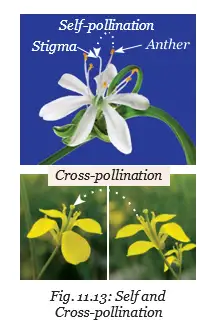
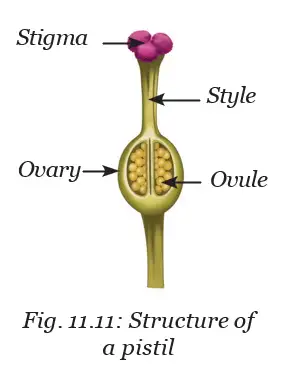
Flowering plants reproduce sexually through flowers, which contain male (stamen) and female (pistil) reproductive organs. Pollination is the transfer of pollen from anther to stigma, which can be self-pollination or cross-pollination.
 \n
\nLongitudinal section of a flower showing sepals, petals, stamen, and pistil.
Pollination and Fertilisation
Pollination leads to fertilisation where the male gamete from pollen fuses with the female gamete in the ovule to form a zygote. The ovule develops into a seed and the ovary into a fruit.
 \n
\nPollen grain germinating on stigma and pollen tube growing towards ovule for fertilisation.
 \n
\nTransformation of flower ovary into fruit after fertilisation.
Sexual Reproduction in Animals
Animals reproduce sexually through internal or external fertilisation. External fertilisation occurs outside the body (e.g., fish, frogs), while internal fertilisation occurs inside the female body (e.g., reptiles, birds, mammals).
 \n
\nComparison of reproductive strategies in fish, frog, lizard, and bird.
Human Reproductive System
The male reproductive system produces sperm in testes and delivers them through the vas deferens and urethra. The female reproductive system produces eggs in ovaries, which travel through fallopian tubes to the uterus where fertilisation and development occur.
 \n
\nMale reproductive system showing testes, vas deferens, seminal vesicles, prostate, and penis.
 \n
\nFemale reproductive system showing ovaries, fallopian tubes, uterus, cervix, and vagina.
Gametogenesis
Gametogenesis is the formation of gametes by meiosis. Males produce many small motile sperm, while females produce fewer large eggs.
 \n
\nComparison of male and female gametes.
Fertilisation and Pregnancy
Fertilisation occurs when sperm meets egg, forming a zygote that implants in the uterus. Pregnancy lasts about nine months, divided into three trimesters, during which the embryo/fetus develops.
 \n
\nFertilisation process showing sperm entering egg to form zygote.
 \n
\nMenstrual cycle stages showing changes in uterus and ovaries over 28 days.
Birth Control and Reproductive Health
Methods to prevent unwanted pregnancies include condoms, oral pills, intrauterine devices (IUDs) like Copper-T, and surgical methods. Safe practices also help prevent sexually transmitted infections (STIs).
 \n
\nCopper-T IUD placed inside the uterus as a contraceptive device.
Solved Examples
Example 1: Pollination Types
Question: Differentiate between self-pollination and cross-pollination with examples.
Solution:
- Self-pollination: Pollen from the anther of a flower lands on the stigma of the same flower or another flower on the same plant. Example: Pea plant.
- Cross-pollination: Pollen from the anther of one flower is transferred to the stigma of a flower on a different plant of the same species. Example: Sunflower.
Example 2: Fertilisation in Flowering Plants
Question: Describe the process of fertilisation in flowering plants.
Solution:
- Pollen grain lands on the stigma and germinates, forming a pollen tube.
- The pollen tube grows down the style towards the ovary.
- Male gametes travel through the pollen tube to the ovule.
- One male gamete fuses with the egg cell in the ovule, forming a zygote.
- The zygote develops into an embryo, the ovule becomes a seed, and the ovary develops into a fruit.
Example 3: Menstrual Cycle Phases
Question: Outline the key phases of the human menstrual cycle.
Solution:
- Menstruation (Days 1-5): Shedding of the uterine lining if fertilisation does not occur.
- Follicular phase (Days 6-14): Uterine lining rebuilds; an egg matures in the ovary.
- Ovulation (Day 14): Release of the mature egg from the ovary.
- Luteal phase (Days 15-28): Uterine lining thickens to prepare for possible pregnancy; if no fertilisation, cycle repeats.
Practice Set
- Level 1: Define pollination and distinguish between self-pollination and cross-pollination.
- Level 2: Explain the process of fertilisation in flowering plants.
- Level 3: Describe the human menstrual cycle and its significance.
Answer Key
- Level 1: Pollination is the transfer of pollen from anther to stigma. Self-pollination occurs within the same flower; cross-pollination occurs between flowers of different plants.
- Level 2: Fertilisation involves pollen tube growth from stigma to ovule, fusion of male and female gametes forming a zygote, which develops into seed.
- Level 3: The menstrual cycle is a monthly process preparing the uterus for pregnancy; if fertilisation does not occur, the lining sheds as menstruation.
Quick Reference Table
Asexual Reproduction
- Definition: Reproduction involving a single parent producing genetically identical offspring.
- Methods: Budding, spore formation, vegetative propagation (cutting, grafting, layering, tissue culture).
- Examples: Yeast budding, hydra budding, potato tubers, ginger rhizomes.
Sexual Reproduction
- Definition: Reproduction involving two parents contributing genetic material to produce genetically varied offspring.
- Key Processes: Meiosis (formation of haploid gametes), pollination, fertilisation, seed and fruit formation.
- Examples: Flowering plants (angiosperms), animals including humans.
Important Terms and Concepts
- Gametes: Haploid reproductive cells (sperm and egg in animals; pollen and ovule in plants).
- Pollination: Transfer of pollen from anther to stigma; can be self or cross-pollination.
- Fertilisation: Fusion of male and female gametes to form a zygote.
- Menstrual Cycle: Monthly cycle preparing the uterus for pregnancy; includes menstruation, ovulation.
- Contraception: Methods to prevent unwanted pregnancy, including condoms, pills, IUDs, surgical methods.
Common Mistakes and Misconceptions
Common Mistakes
- Confusing asexual reproduction with sexual reproduction; asexual involves one parent, sexual involves two.
- Believing that all plants reproduce only sexually; many reproduce asexually through vegetative propagation.
- Assuming pollination and fertilisation are the same; pollination is pollen transfer, fertilisation is gamete fusion.
- Thinking fertilisation always occurs immediately after pollination; pollen tube growth takes time before fertilisation.
- Misunderstanding the menstrual cycle phases and their timing.
- Assuming all animals have internal fertilisation; many aquatic animals have external fertilisation.
Misconceptions
- Offspring from asexual reproduction are always weaker; in fact, they are genetically identical and can be strong.
- Only insects pollinate flowers; wind and water also act as pollinators.
- Menstruation is a disease or something to be ashamed of; it is a normal healthy process.
- Contraceptive pills protect against sexually transmitted infections; only barrier methods like condoms do.
Glossary
- Asexual Reproduction: Reproduction involving a single parent producing genetically identical offspring.
- Budding: A form of asexual reproduction where a new organism grows from an outgrowth or bud on the parent.
- Vegetative Propagation: Asexual reproduction in plants where new plants grow from parts like stems, roots, or leaves.
- Grafting: Joining parts of two plants so they grow as one, combining desirable traits.
- Pollination: Transfer of pollen from anther to stigma in flowering plants.
- Self-pollination: Pollination within the same flower or plant.
- Cross-pollination: Pollination between flowers of different plants of the same species.
- Fertilisation: Fusion of male and female gametes to form a zygote.
- Gametes: Reproductive cells (sperm and egg in animals; pollen and ovule in plants).
- Meiosis: Cell division reducing chromosome number by half to form gametes.
- Zygote: Fertilised egg cell formed after fertilisation.
- Menstrual Cycle: Monthly cycle in females involving ovulation and menstruation.
- Ovulation: Release of a mature egg from the ovary.
- Contraception: Methods to prevent pregnancy, including condoms, pills, IUDs.
- External Fertilisation: Fertilisation occurring outside the female body, common in aquatic animals.
- Internal Fertilisation: Fertilisation occurring inside the female body.
- Embryo: Early stage of development after fertilisation.
- Trimesters: Three stages of pregnancy in humans.