CLASS 9 . SCIENCE . EXPLORATION . JOURNEY INSIDE-THE-ATOM
Chapter 8 : Journey Inside the Atom
Ch 8
SCIENCE
CLASS 9
Atomic Structure
Atoms as Building Blocks
Everything around us, living or non-living, is made up of tiny particles called atoms. Atoms combine to form molecules, which then build up materials and living organisms. For example, atoms form molecules like silicates that make bricks, which build walls and houses. In living beings, atoms form proteins, cells, tissues, organs, and ultimately the whole body.
Historical Development of Atomic Theory
Ancient thinkers like Acharya Kanada in India and Greek philosophers Leucippus and Democritus proposed that matter is made of indivisible particles called parmanus or atomos. John Dalton later gave the first scientific atomic theory stating that atoms are indivisible particles forming matter. Subsequent discoveries revealed that atoms are made of smaller particles.
Discovery of Subatomic Particles
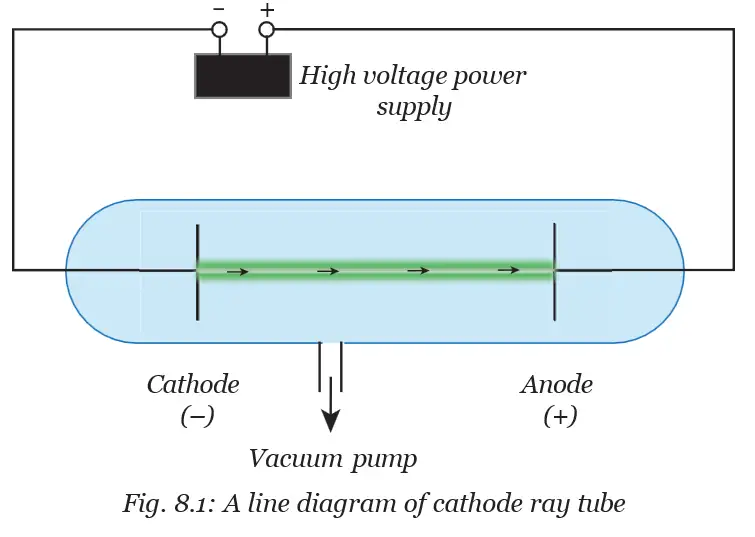
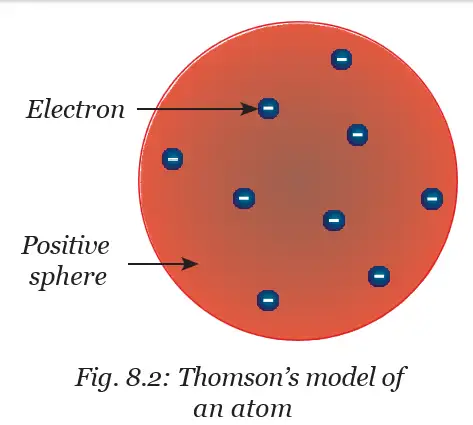
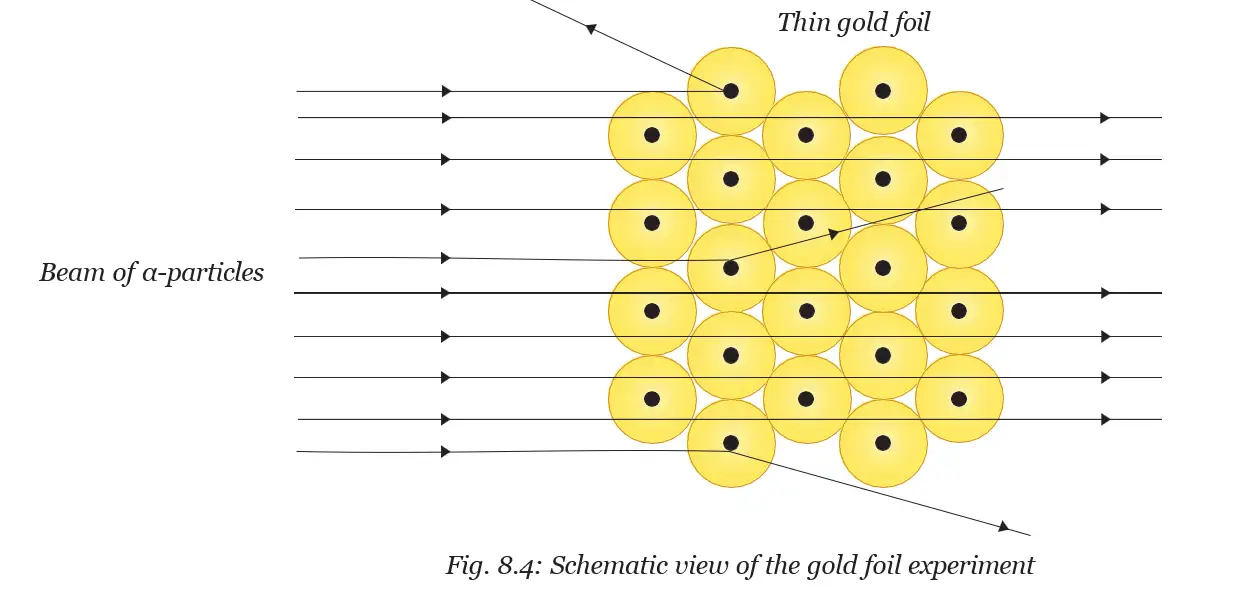
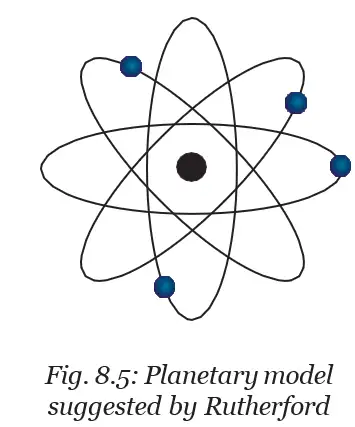
J. J. Thomson discovered electrons through cathode ray experiments, showing atoms contain negatively charged particles. Thomson proposed the plum pudding model where electrons are embedded in a positive sphere. Rutherford’s gold foil experiment revealed a small, dense, positively charged nucleus with electrons orbiting it, leading to the planetary model of the atom. Later, Niels Bohr introduced fixed energy levels or shells where electrons orbit the nucleus without losing energy.
Subatomic Particles and Their Properties
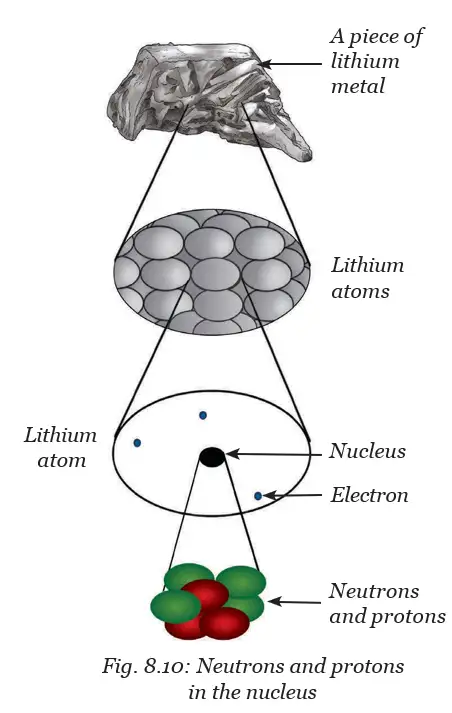
Atoms consist of electrons (negative charge), protons (positive charge), and neutrons (neutral). Protons and neutrons form the nucleus, which contains most of the atom’s mass. Electrons orbit the nucleus in shells. The number of protons defines the atomic number, and the total number of protons and neutrons defines the mass number.
Electron Arrangement and Valency
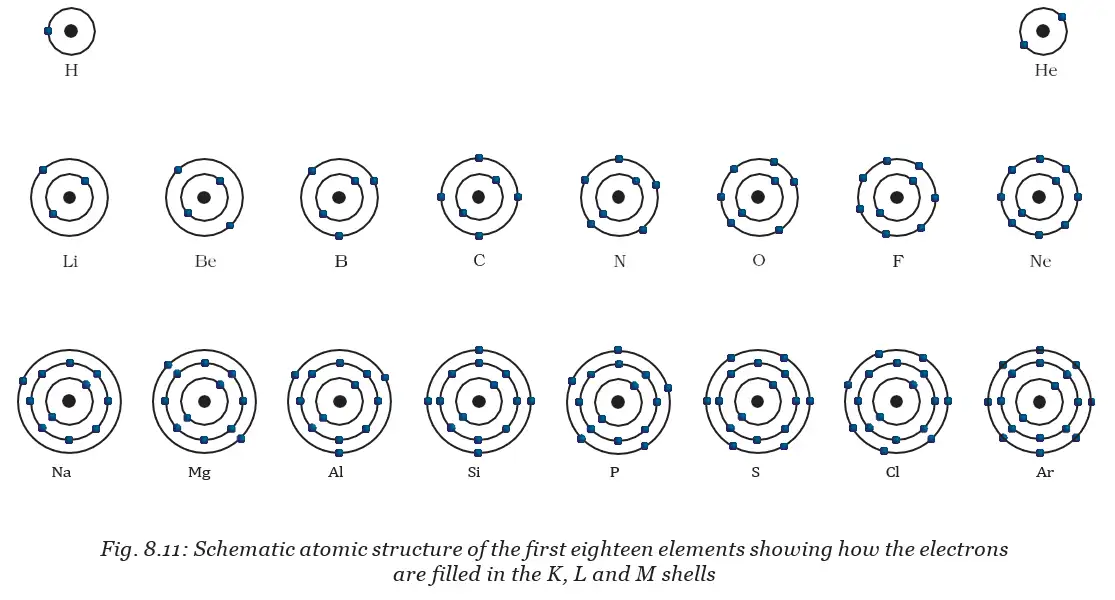
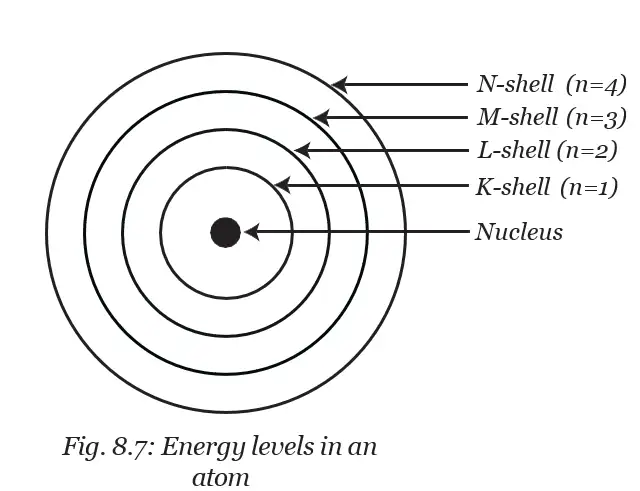
Electrons are arranged in shells around the nucleus, with each shell having a maximum capacity given by 2n², where n is the shell number. The outermost shell is called the valence shell, and the electrons in it are valence electrons. Atoms tend to gain, lose, or share electrons to complete their valence shell, achieving stability. The combining capacity of an atom is called valency.
Isotopes and Isobars
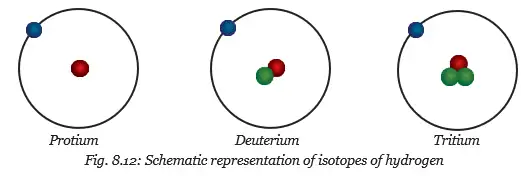
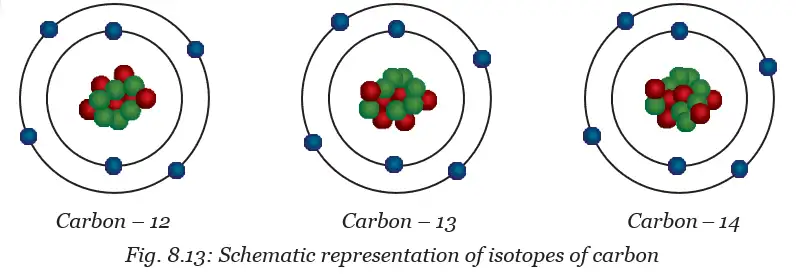
Atoms of the same element with the same atomic number but different mass numbers are called isotopes. They have similar chemical properties but different physical properties. Atoms of different elements with the same mass number but different atomic numbers are called isobars.
Solved Examples
Example 1: Calculate the number of neutrons in an atom with atomic number 11 and mass number 23.
Solution: Number of neutrons = Mass number - Atomic number = 23 - 11 = 12 neutrons.
Example 2: Write the electronic configuration of an element with atomic number 16.
Solution: The maximum electrons in shells are 2, 8, 18, ... For atomic number 16, electrons fill as 2 in K-shell, 8 in L-shell, and 6 in M-shell. So, electronic configuration is 2, 8, 6.
Example 3: Calculate the average atomic mass of chlorine with isotopes 35 u (75%) and 37 u (25%).
Solution: Average atomic mass = (35 × 75/100) + (37 × 25/100) = 26.25 + 9.25 = 35.5 u.
Practice Set
- Level 1: What is the atomic number of an element?
- Level 1: Define valency.
- Level 2: Explain why Rutherford’s model could not explain the stability of the atom.
- Level 3: Calculate the number of electrons, protons, and neutrons in an atom with atomic number 26 and mass number 56.
Answer Key
Level 1: The atomic number is the number of protons in the nucleus of an atom.
Level 1: Valency is the combining capacity of an atom, i.e., the number of electrons an atom can gain, lose, or share to achieve a stable configuration.
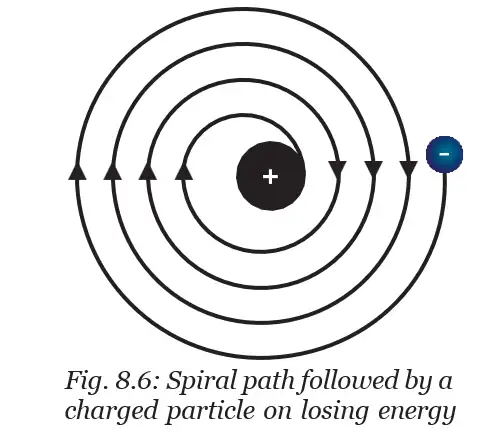
Level 2: Rutherford’s model could not explain the stability of the atom because electrons moving in circular orbits would lose energy and spiral into the nucleus, causing the atom to collapse, which does not happen in reality.
Level 3: Number of protons = 26 (atomic number), number of electrons = 26 (neutral atom), number of neutrons = 56 - 26 = 30.
Quick Reference Table
Atomic Number (Z): Number of protons in an atom.
Mass Number (A): Total number of protons and neutrons in the nucleus.
Electron: Negatively charged subatomic particle.
Proton: Positively charged subatomic particle in the nucleus.
Neutron: Neutral subatomic particle in the nucleus.
Valency: Combining capacity of an atom.
Isotopes: Atoms of the same element with different mass numbers.
Isobars: Atoms of different elements with the same mass number.
Common Mistakes and Misconceptions
1. Atoms are indivisible: Atoms are made of smaller particles (electrons, protons, neutrons).
2. Electrons are embedded in a positive sphere (Thomson’s model) is outdated; electrons orbit the nucleus.
3. Atomic number and mass number are the same: Atomic number is protons; mass number includes neutrons.
4. Isotopes have different chemical properties: Isotopes have similar chemical properties but different physical properties.
5. Electrons lose energy and spiral into the nucleus: Bohr’s model explains electrons remain in fixed orbits without energy loss.
Glossary
Atom: The smallest unit of matter that retains the properties of an element.
Atomic Number (Z): Number of protons in the nucleus of an atom.
Mass Number (A): Total number of protons and neutrons in the nucleus.
Electron: Negatively charged subatomic particle orbiting the nucleus.
Proton: Positively charged subatomic particle in the nucleus.
Neutron: Neutral subatomic particle in the nucleus.
Valency: The combining capacity of an atom.
Isotopes: Atoms of the same element with different mass numbers.
Isobars: Atoms of different elements with the same mass number.