CLASS 8 . SCIENCE . CURIOSITY . THE AMAZING-WORLD-OF-SOLUTES-SOLVENTS-AND-SOLUTIONS
Chapter 9 : The Amazing World of Solutes, Solvents, and Solutions
Ch 9
SCIENCE
CLASS 8
Solutes, Solvents, and Solutions
What is a Solution?
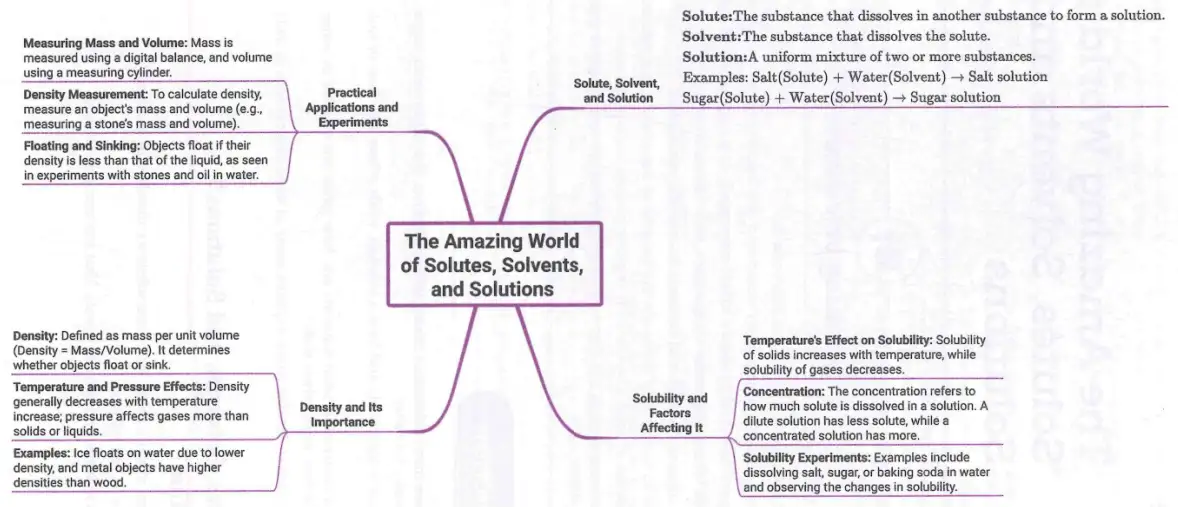
A solution is a uniform mixture formed when one substance dissolves completely in another. For example, when salt dissolves in water, it forms a salt solution where the salt particles spread evenly throughout the water.
What are Solute and Solvent?
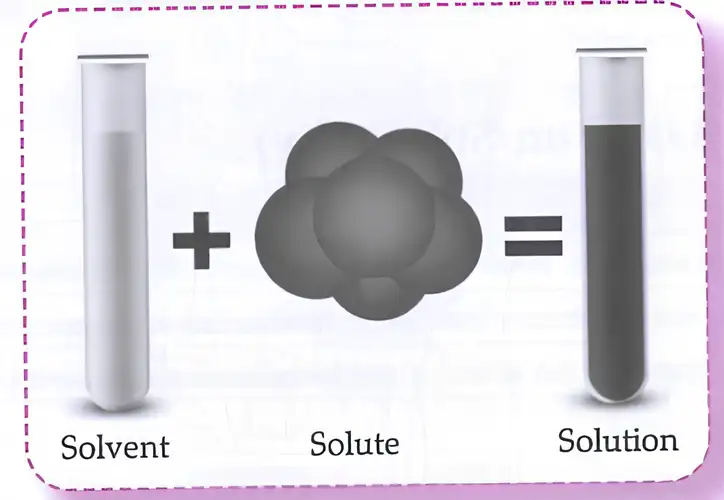
Solute: The substance that dissolves in another substance. It is usually present in smaller amounts. Examples include salt, sugar, and oxygen in air.
Solvent: The substance that dissolves the solute. It is usually present in larger amounts. Examples include water, nitrogen in air, and alcohol.
In a solution, solute and solvent combine as: Solute + Solvent ⟶ Solution.
For example, in air, nitrogen acts as the solvent, while oxygen, carbon dioxide, and argon are solutes.
Special Case: Mixing Liquids
When two liquids mix, the one present in smaller amount is the solute, and the one in larger amount is the solvent. For example, in an alcohol-water mixture, alcohol is the solute and water is the solvent.
Types of Solutions Based on Solubility
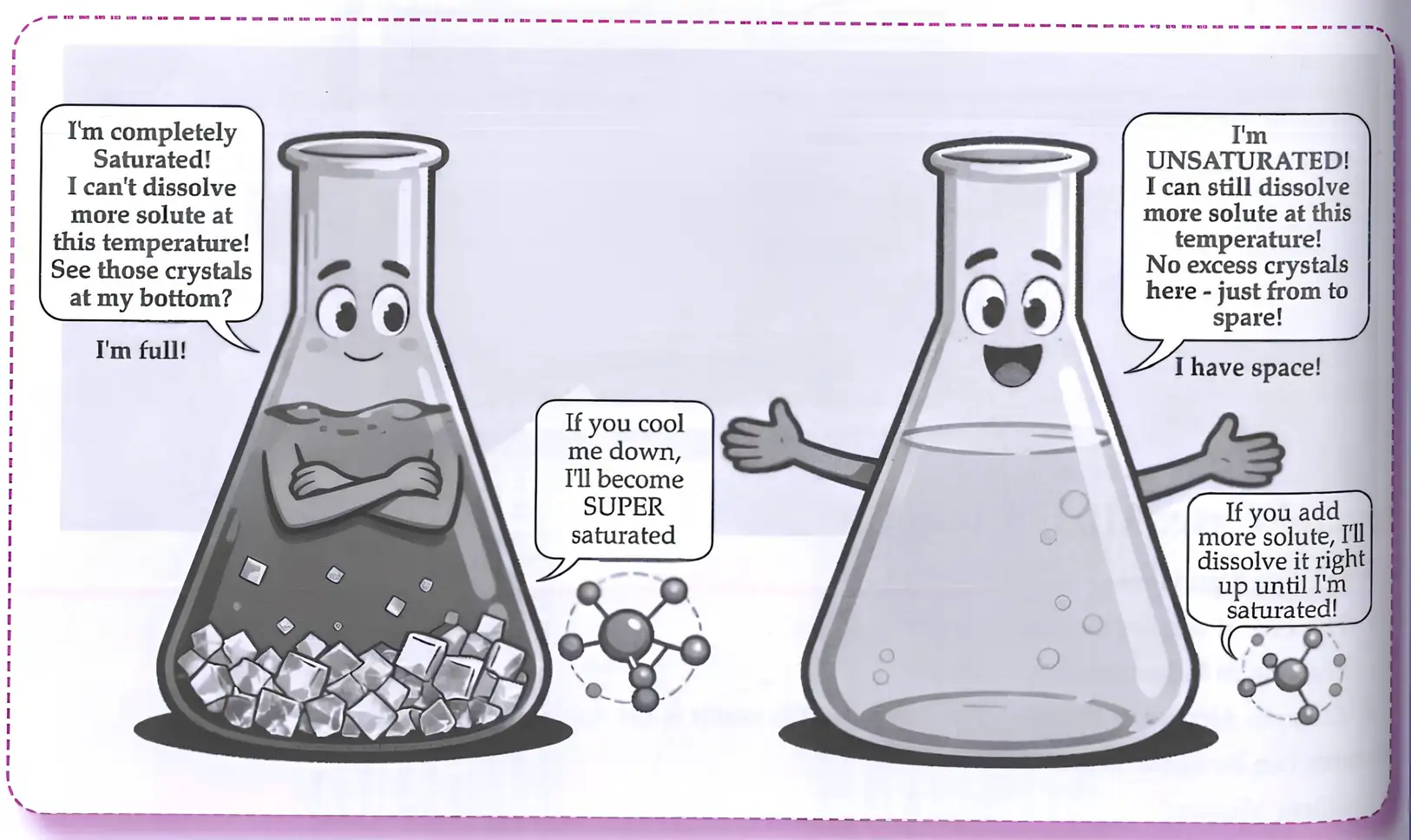
Unsaturated Solution: A solution where more solute can still dissolve. If more solute is added, it dissolves completely. There is no undissolved solute at the bottom. Example: Adding one spoon of sugar to water which dissolves fully.
Saturated Solution: A solution where the maximum amount of solute has dissolved at a given temperature. Additional solute added will not dissolve and settles at the bottom. This state represents a balance between dissolving and crystallization. Example: Adding too much sugar to water where extra sugar remains undissolved.
Concentration of Solution
Concentration refers to the amount of solute present in a fixed amount of solution or solvent.
Dilute Solution: Contains a small amount of solute in a large amount of solvent. Example: A glass of water with a pinch of salt.
Concentrated Solution: Contains a large amount of solute in a small amount of solvent. Example: A glass of water with five spoons of salt.
Solved Examples
Example 1: Identify the solute and solvent in a sugar solution.
Solution: Sugar is the solute as it dissolves, and water is the solvent as it dissolves the sugar.
Example 2: What type of solution is formed when 2 spoons of salt dissolve completely in 100 mL of water?
Solution: Since the salt dissolves completely and no residue remains, it is an unsaturated solution.
Practice Set
- Level 1 (Easy): Define solute and solvent with examples.
- Level 2 (Moderate): Explain the difference between saturated and unsaturated solutions.
- Level 3 (Challenging): If 50 g of sugar dissolves in 100 mL of water at 25°C and no sugar remains undissolved, what type of solution is it? Justify your answer.
Answer Key
Level 1: Solute is the substance that dissolves (e.g., sugar), solvent is the substance that dissolves the solute (e.g., water).
Level 2: Saturated solution contains the maximum solute dissolved and no more can dissolve; unsaturated solution can dissolve more solute.
Level 3: It is an unsaturated solution because all sugar dissolves and no residue remains, indicating more solute can still dissolve.
Solubility and Factors Affecting It
Solubility of Gases
Solubility of a gas is the amount of gas that can dissolve in a liquid under specific temperature and pressure conditions. Gases like oxygen dissolve in water, which is essential for aquatic life.
Effect of Temperature on Solubility
For solids, solubility generally increases with temperature. For gases, solubility decreases as temperature rises. For example, cold water holds more dissolved oxygen than warm water.
Effect of Pressure on Solubility
Increasing pressure increases the solubility of gases in liquids. This is why carbonated drinks are bottled under high pressure to keep carbon dioxide dissolved.
Solved Examples
Example 1: Why do fish come to the surface in warm water?
Solution: Warm water holds less dissolved oxygen, so fish come to the surface to get more oxygen.
Example 2: How does pressure affect the solubility of gases?
Solution: Increasing pressure increases gas solubility in liquids by forcing more gas molecules into the liquid.
Practice Set
- Level 1 (Easy): What happens to the solubility of gases in water when temperature increases?
- Level 2 (Moderate): Explain why carbonated drinks are bottled under high pressure.
- Level 3 (Challenging): Describe the effect of temperature and pressure on the solubility of gases with examples.
Answer Key
Level 1: Solubility of gases decreases as temperature increases.
Level 2: High pressure keeps more carbon dioxide dissolved, making the drink fizzy.
Level 3: Increasing temperature decreases gas solubility (e.g., oxygen in warm water), while increasing pressure increases gas solubility (e.g., carbonated drinks).
Density
What is Density?
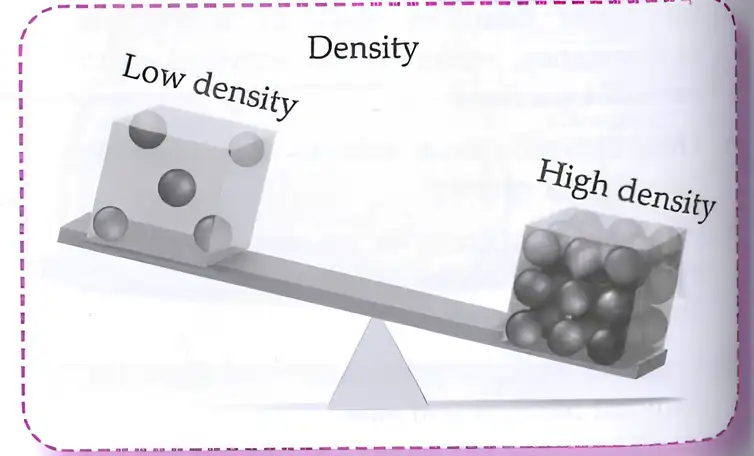
Density is the measure of how much mass is contained in a given volume. It is calculated as:
Density = Mass ÷ Volume
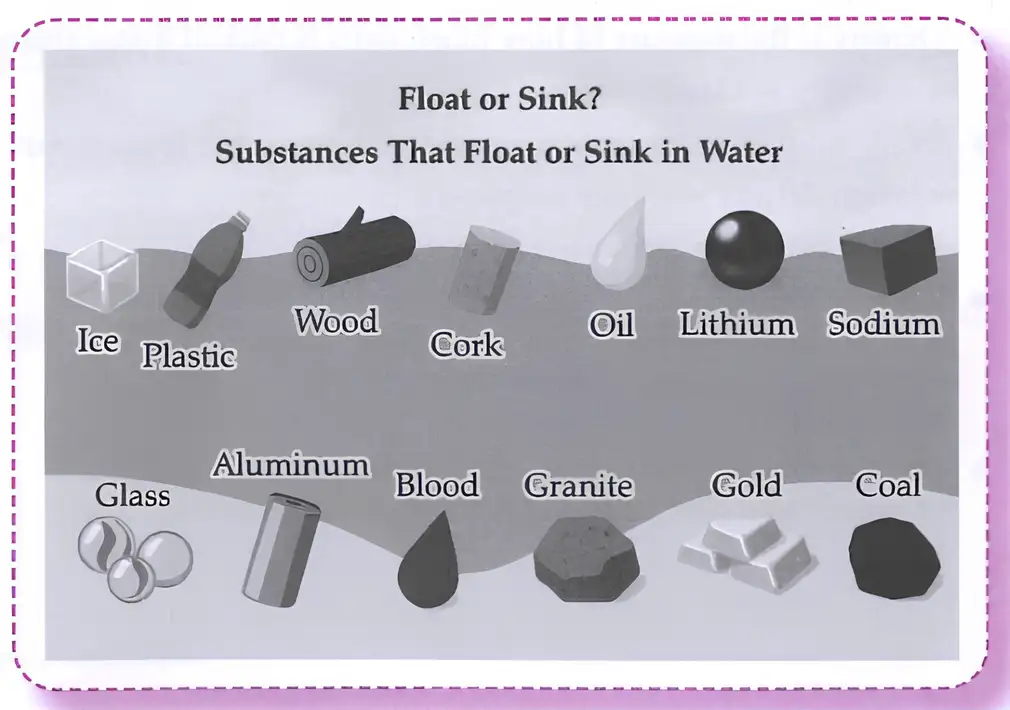
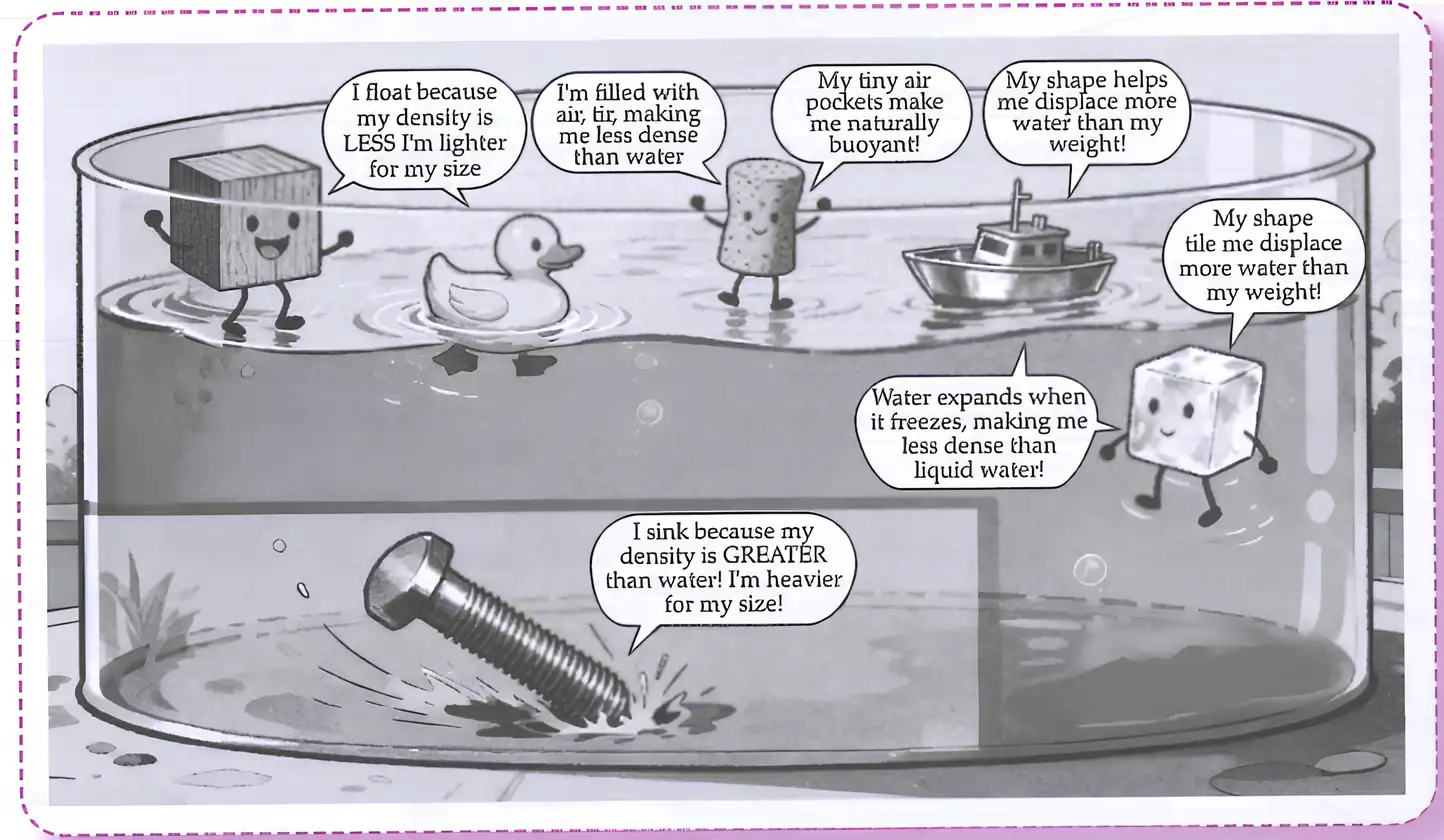
Objects with density less than water (1 g/cm³) float, while those with higher density sink.
Units of Density
The SI unit of density is kilogram per cubic metre (kg/m³). Common units include gram per cubic centimetre (g/cm³) and gram per millilitre (g/mL). For example, water has a density of 1 g/cm³ or 1000 kg/m³.
Relative Density
Relative density (RD) compares the density of a substance to that of water:
RD = Density of substance ÷ Density of water
If RD > 1, the substance sinks; if RD < 1, it floats.
Effect of Temperature and Pressure on Density
Increasing temperature usually decreases density as volume expands. Pressure increases density in gases by compressing particles but has little effect on solids and liquids.
Applications of Density
Density explains why oil floats on water, ships float despite being made of iron, helium balloons rise, and gold purity can be tested.
Solved Examples
Example 1: Calculate the density of an aluminium block with mass 27 g and volume 10 cm³.
Solution: Density = 27 g ÷ 10 cm³ = 2.7 g/cm³. Since this is greater than water's density, aluminium sinks.
Example 2: Why does ice float on water?
Solution: Ice has a lower density than water due to expansion on freezing, so it floats.
Practice Set
- Level 1 (Easy): Define density and state its SI unit.
- Level 2 (Moderate): Explain why oil floats on water.
- Level 3 (Challenging): A liquid has mass 500 g and volume 400 mL. Calculate its density and state whether it will float or sink in water.
Answer Key
Level 1: Density is mass per unit volume; SI unit is kg/m³.
Level 2: Oil floats because its density is less than water.
Level 3: Density = 500 g ÷ 400 mL = 1.25 g/mL. Since this is greater than water's density (1 g/mL), it will sink.
Practical Applications and Experiments
Measuring Mass and Volume
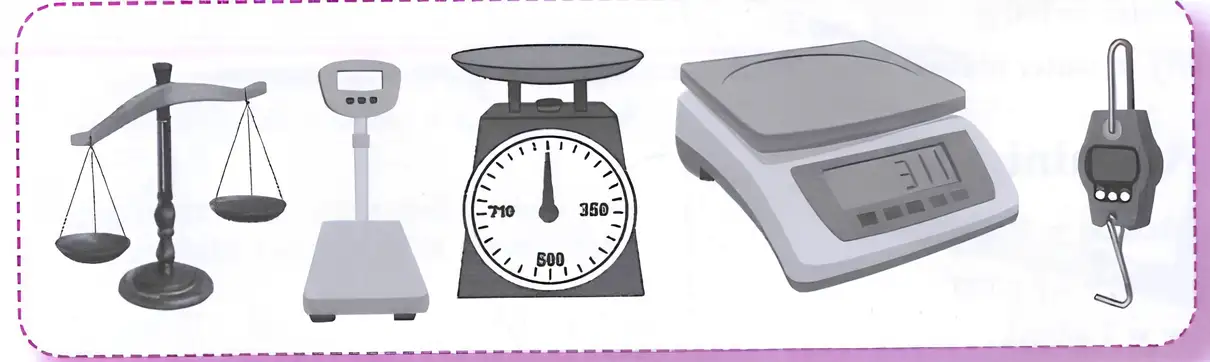
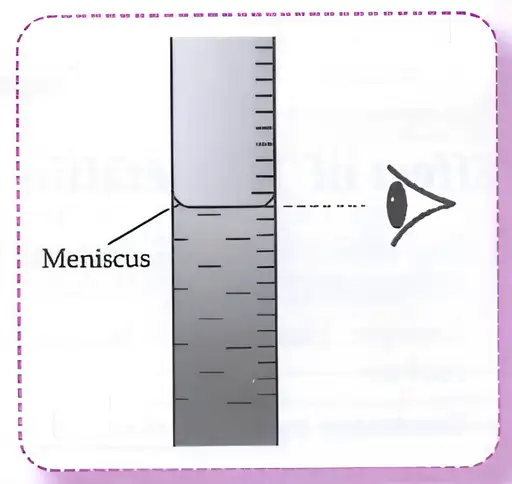
Mass is measured using balances such as beam balance, spring balance, or digital weighing balance. Volume of liquids is measured using a measuring cylinder by reading the meniscus at eye level.
Determining Density
Density is calculated by dividing mass by volume. For solids with regular shapes, volume can be calculated using formulas (e.g., length × breadth × height).
Observing Floating and Sinking
Objects float or sink based on their density relative to water. Experiments can be done by placing different materials in water and observing their behavior.
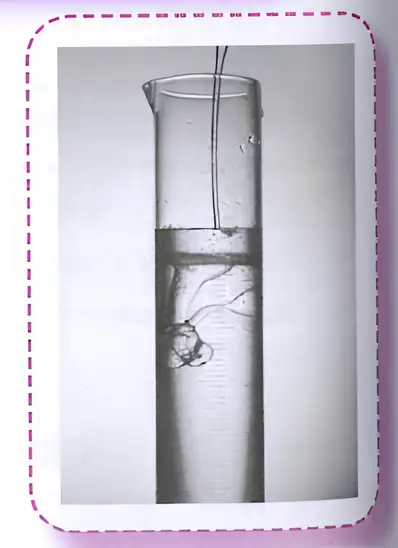
Solubility Experiments
By dissolving substances like salt or sugar in water at different temperatures, students can observe changes in solubility.
Solved Examples
Example 1: How to measure the volume of an irregular solid?
Solution: Use water displacement method in a measuring cylinder to find volume.
Example 2: Describe an experiment to observe solubility changes with temperature.
Solution: Dissolve a fixed amount of solute in water at different temperatures and observe how much dissolves.
Practice Set
- Level 1 (Easy): Name two instruments used to measure mass.
- Level 2 (Moderate): How do you read the volume of a liquid in a measuring cylinder?
- Level 3 (Challenging): Design a simple experiment to show that solubility of solids increases with temperature.
Answer Key
Level 1: Beam balance and digital weighing balance.
Level 2: Read the volume at the bottom of the meniscus at eye level.
Level 3: Add solute to water at different temperatures, stir, and observe that more solute dissolves at higher temperatures.
Quick Reference Table
- Solute: Substance that dissolves in a solvent to form a solution.
- Solvent: Substance that dissolves the solute, usually present in larger amount.
- Solution: A uniform mixture of solute and solvent.
- Unsaturated Solution: Solution that can dissolve more solute at a given temperature.
- Saturated Solution: Solution that contains the maximum amount of solute dissolved at a given temperature.
- Concentration: Amount of solute present in a fixed amount of solution or solvent.
- Density: Mass per unit volume of a substance, expressed as Density = Mass ÷ Volume.
- Relative Density (RD): Ratio of the density of a substance to the density of water.
- Meniscus: The curved surface of a liquid in a measuring cylinder, used for accurate volume measurement.
- Effect of Temperature on Solubility: Solubility of solids increases with temperature; solubility of gases decreases with temperature.
- Effect of Pressure on Solubility: Increasing pressure increases the solubility of gases in liquids.
- Buoyancy: Upward force exerted by a fluid that determines whether an object floats or sinks.
- Water Density: Approximately 1 g/cm³ or 1000 kg/m³ at room temperature, used as a reference for relative density.
Common Mistakes and Misconceptions
- Confusing Solute and Solvent: Remember, the solute is the substance that dissolves, and the solvent is the substance that dissolves the solute.
- Assuming All Mixtures Are Solutions: Not all mixtures are uniform; some are suspensions where particles do not dissolve.
- Misunderstanding Saturated Solutions: A saturated solution has undissolved solute at the bottom; adding more solute does not dissolve.
- Ignoring Temperature Effects on Solubility: Solubility of solids increases with temperature, but gases decrease; this is often overlooked.
- Incorrect Reading of Meniscus: Always read the volume at the bottom of the meniscus at eye level to avoid errors.
- Mixing Units of Density: Use consistent units like g/cm³ or kg/m³; mixing units leads to wrong calculations.
- Assuming Shape Affects Density: Density depends on mass and volume, not on the shape or size of the object.
- Believing All Objects Denser Than Water Sink: Shape and buoyancy also affect floating; for example, ships float despite being made of dense materials.
Glossary
- Solute: Substance that dissolves in a solvent to form a solution.
- Solvent: Substance that dissolves the solute, usually present in larger quantity.
- Solution: A homogeneous mixture of solute and solvent.
- Unsaturated Solution: A solution that can dissolve more solute at a given temperature.
- Saturated Solution: A solution that contains the maximum amount of solute dissolved at a given temperature.
- Concentration: The amount of solute present in a given quantity of solution or solvent.
- Density: Mass per unit volume of a substance, indicating how compact the matter is.
- Relative Density (RD): The ratio of the density of a substance to the density of water.
- Meniscus: The curved surface of a liquid in a measuring cylinder used for accurate volume measurement.
- Buoyancy: The upward force exerted by a fluid that opposes the weight of an object immersed in it.
- Mass: The quantity of matter in an object, measured in grams or kilograms.
- Volume: The amount of space occupied by an object or liquid, measured in cubic centimetres or millilitres.