CLASS 8 . SCIENCE . CURIOSITY . PARTICULATE NATURE-OF-MATTER
Chapter 7 : Particulate Nature of Matter
Ch 7
SCIENCE
CLASS 8
Particulate Nature
Introduction to Matter
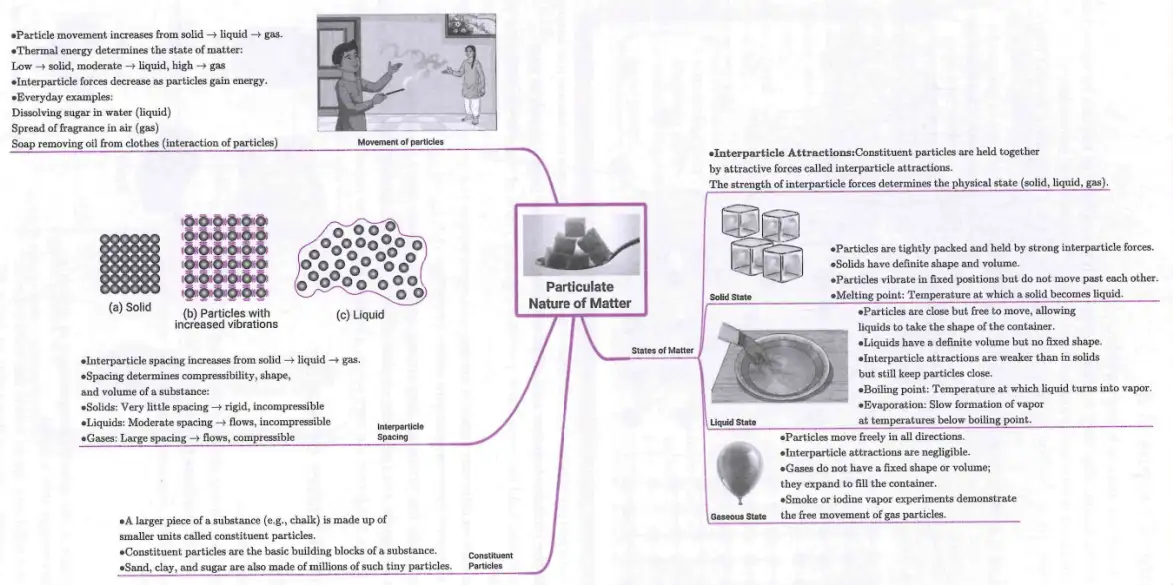
Everything around us is made up of matter such as air, water, stone, wood, sugar, and more. Matter can be broken down into smaller and smaller pieces like chalk, sugar, and salt. When matter is broken down to its smallest form, we reach tiny building blocks called particles of matter. These particles are extremely small and cannot be seen with the naked eye. Matter exists in different states: solid, liquid, and gas. The behavior of matter depends on particle size, interparticle spaces, and interparticle forces of attraction. Matter is anything that occupies space and has mass.
Composition of Matter
Matter consists of millions of extremely tiny particles called constituent particles, which are usually atoms and molecules. These particles are so minute that they cannot be seen with the naked eye but can be viewed under a microscope. Constituent particles are in constant motion, either vibrating in place or moving around freely.
States of Matter and Particle Behavior
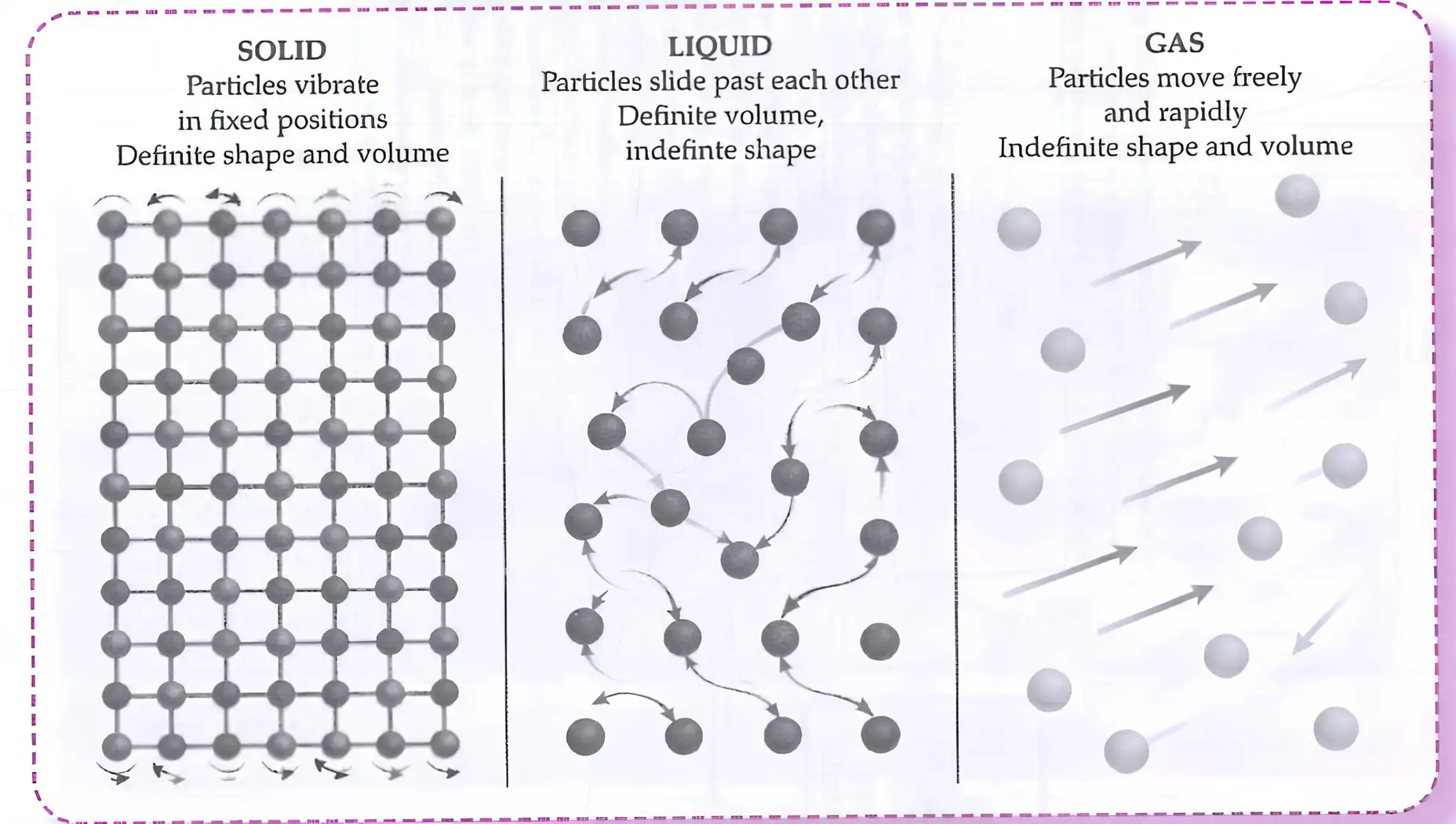
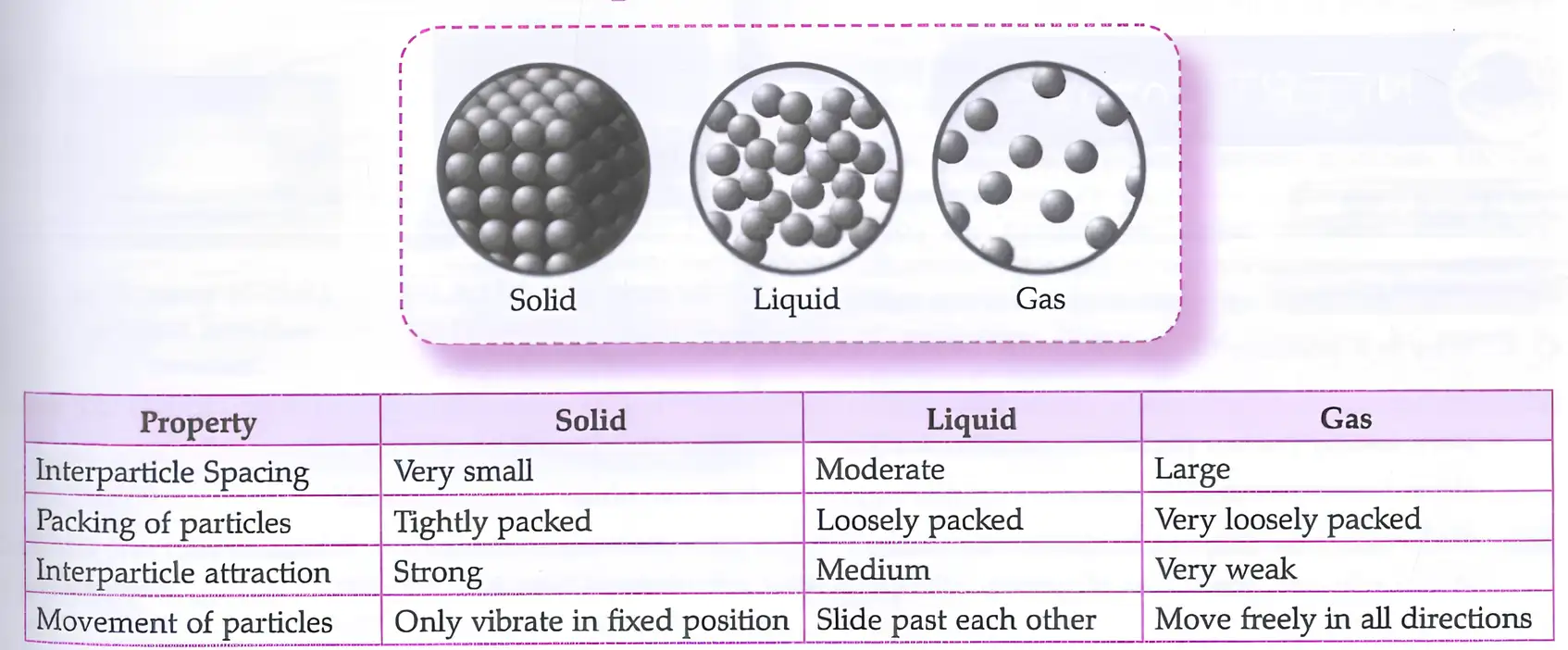
The state of matter depends on the arrangement and movement of particles. In solids, particles are tightly packed in fixed positions and vibrate without moving around. Solids have a definite shape and volume. In liquids, particles are close but can slide past each other, giving liquids a definite volume but no fixed shape. In gases, particles move freely and quickly in all directions, with no fixed shape or volume, and they expand to fill any space.
Interparticle Forces and Spacing
Forces that exist between the tiny particles of a substance are called interparticle attractions. These forces hold the particles together and affect the state of matter. The strength of these forces varies: strong in solids, medium in liquids, and weak in gases. Interparticle spacing also varies: minimum in solids, moderate in liquids, and maximum in gases. This spacing affects properties like shape, volume, and compressibility.
States of Matter
Solid State
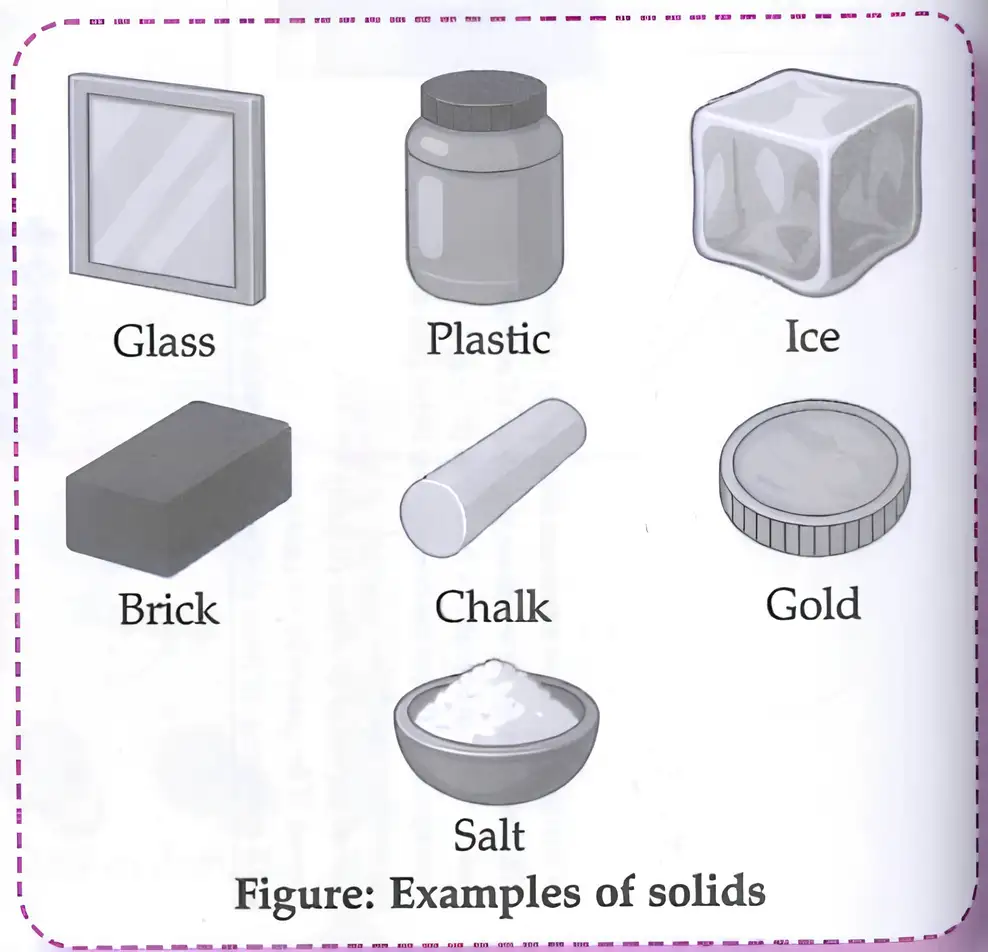
Solids have a definite shape and volume. Their particles are tightly packed with strong interparticle attraction and vibrate at fixed positions without moving freely. When heated, vibrations increase, weakening attractions and causing solids to melt into liquids. The melting point is the temperature at which a solid changes into a liquid, such as ice melting at 0°C.
Liquid State
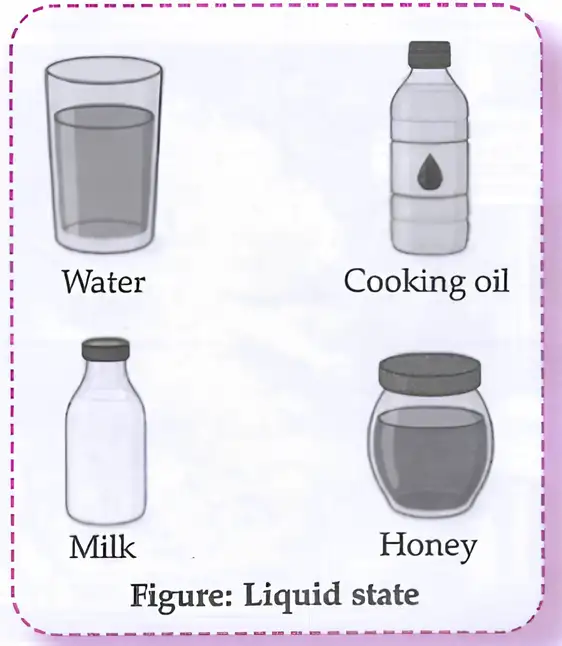
Liquids have a definite volume but no fixed shape, taking the shape of their container. Particles are loosely packed and can move within limited space. Interparticle forces are weaker than in solids but strong enough to keep particles close. Liquids can flow. Boiling occurs throughout the liquid at the boiling point, while evaporation occurs at the surface at all temperatures. The boiling point is the temperature at which a liquid changes into a gas, such as water boiling at 100°C.
Gaseous State
Gases have no fixed shape or volume. Particles are far apart with negligible attraction and move randomly at high speed, occupying the entire available space. Gases are highly compressible. Examples include oxygen, carbon dioxide, helium, and chlorine. Gas particles expand to fill any container and can be compressed easily due to large spaces between them.
Particle Movement and Spacing Summary
In solids, particles vibrate in fixed positions with minimum spacing. In liquids, particles slide past each other with moderate spacing. In gases, particles move freely in all directions with maximum spacing.
Solved Examples
Example 1: Explain why solids have a fixed shape but gases do not.
Solution: In solids, particles are tightly packed in fixed positions and only vibrate, so the solid maintains a fixed shape. In gases, particles move freely and are far apart, so gases take the shape of their container and have no fixed shape.
Example 2: What happens to the particles of a solid when it is heated to its melting point?
Solution: When a solid is heated, the particles vibrate more vigorously. At the melting point, the vibrations are strong enough to overcome the interparticle forces, allowing particles to move past each other and the solid changes into a liquid.
Practice Set
- Level 1 (Easy): What are the three states of matter?
- Level 1 (Easy): Describe the particle arrangement in a liquid.
- Level 2 (Moderate): Why are gases highly compressible compared to solids and liquids?
Answer Key
- Level 1 (Easy): The three states of matter are solid, liquid, and gas.
- Level 1 (Easy): In a liquid, particles are close together but can slide past each other, allowing the liquid to flow.
- Level 2 (Moderate): Gases are highly compressible because their particles are far apart with large spaces between them, allowing them to be pushed closer together.
Quick Reference Table
States of Matter: Solid, Liquid, Gas
Particle Arrangement: Solid - tightly packed; Liquid - close but movable; Gas - far apart
Particle Movement: Solid - vibrate in place; Liquid - slide past each other; Gas - move freely
Interparticle Forces: Strong in solids, medium in liquids, weak in gases
Melting Point: Temperature at which solid changes to liquid
Boiling Point: Temperature at which liquid changes to gas
Common Mistakes and Misconceptions
• Particles in solids do not move freely; they only vibrate in fixed positions.
• Liquids have a fixed volume but no fixed shape, not the other way around.
• Gases do not have a fixed shape or volume and expand to fill their container.
• Interparticle forces are not the same in all states; they decrease from solid to gas.
Glossary
Matter: Anything that occupies space and has mass.
Particle: The smallest unit of matter, such as atoms or molecules.
Interparticle Forces: Forces of attraction between particles of matter.
Melting Point: Temperature at which a solid turns into a liquid.
Boiling Point: Temperature at which a liquid turns into a gas.
Compressibility: The ability of a substance to decrease in volume under pressure.