Rectangle and Squares
To divide a square into 4 parts of equal area, one can use various methods including simple grid division or more creative dissections. For example, dividing a square into four smaller squares by drawing two perpendicular lines through the center creates four equal parts. Alternatively, shapes can be distorted by compressing one edge and expanding another while maintaining equal area in each part.
Consider a square divided into a 2x2 grid, each small square having equal area. By shading one square, we highlight one part of the four equal parts.
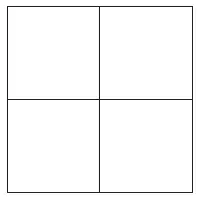
By altering each part with equal compression and expansion along edges, the four parts still maintain equal area, demonstrating the flexibility in dividing a square into equal areas.
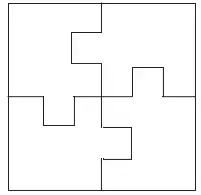
Try exploring different creative ways to divide a square into four parts of equal area, inspired by rangoli art patterns which use symmetrical and repetitive designs.

To compare areas of rectangles, count the number of unit squares (1 cm × 1 cm) that fit inside each rectangle. For example, a rectangle 7 cm by 4 cm contains 28 unit squares, while one 8 cm by 3 cm contains 24 unit squares. Thus, the 7 cm by 4 cm rectangle has a larger area.
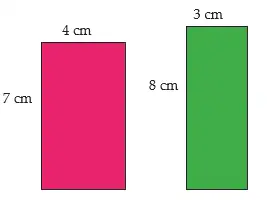
Area of a rectangle is given by the product of its length and width:
Area = length × width
For the rectangle with length 7 cm and width 4 cm, the area is:
\[ 7 \times 4 = 28 \text{ cm}^2 \]
The diagonal divides the rectangle into two congruent right triangles, each having half the area of the rectangle:
Area of each triangle = \( \frac{1}{2} \times 7 \times 4 = 14 \text{ cm}^2 \)
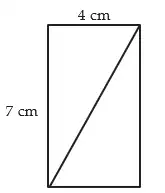
The length of the diagonal \( d \) can be found using the Pythagorean theorem:
\[ d^2 = 7^2 + 4^2 = 49 + 16 = 65 \]
\[ d = \sqrt{65} \approx 8.06 \text{ cm} \]
Why Perimeter Cannot Measure Area
Perimeter measures the length of the boundary of a region, but it does not indicate the area enclosed. Two regions can have the same perimeter but different areas, or one can have a larger perimeter but smaller area than another.
For example, two rectangles with different dimensions can have the same perimeter but different areas. This shows that perimeter is not a reliable measure of area.
Finding Missing Sidelengths in Composite Figures
Use the formula for the area of rectangles (Area = length × width) to find missing side lengths by dividing the given area by the known side length.
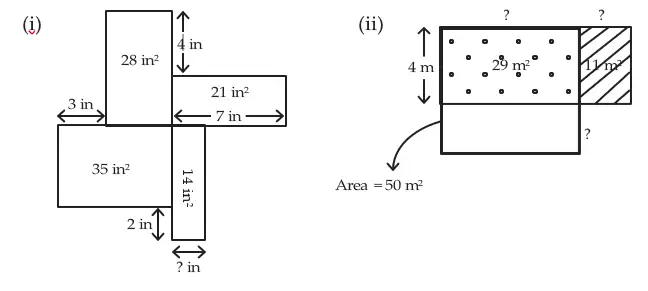
For composite shapes, subtract the areas of known parts from the total area to find the area of the unknown part, then use the area formula to find missing dimensions.
Area of a Path Around a Rectangular Park
Given a rectangular park inside a larger rectangle, the area of the path around the park is the difference between the area of the larger rectangle and the park.
If the width of the path is \( w \), and the park has length \( l \) and width \( b \), then the outer rectangle has dimensions \( l + 2w \) and \( b + 2w \).
Area of the path = Area of outer rectangle - Area of park
\[ = (l + 2w)(b + 2w) - lb = 2w(l + b) + 4w^2 \]
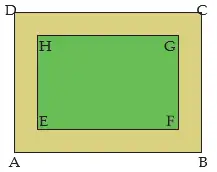
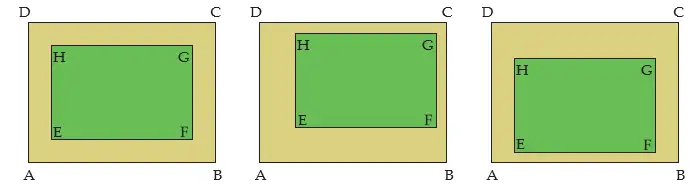
Moving the outer rectangle while keeping the park inside does not change the area of the path.
Area of a Spiral Tube
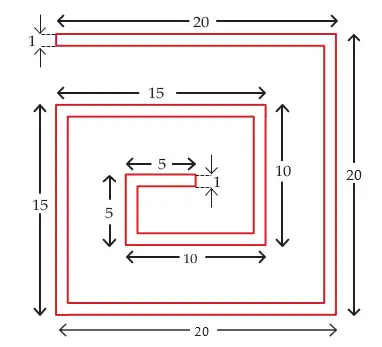
Consider a square spiral made of concentric square paths each of width 1 unit, starting with an outer square of side 20 units and decreasing by 2 units for each inner square.
The area of the spiral tube is the difference between the area of the largest square and the smallest square inside.
Calculate the area of each square and subtract accordingly.
Area of Triangles in Rectangles
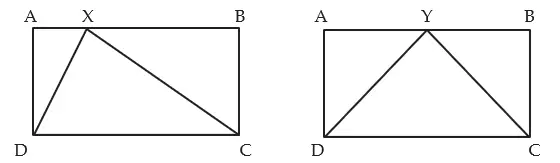
The diagonal of a rectangle divides it into two congruent triangles, each having half the area of the rectangle.
Area of triangle = \( \frac{1}{2} \times \text{length} \times \text{width} \)
For example, in a rectangle with length 10 units and width 4 units, the area of each triangle formed by the diagonal is:
\[ \frac{1}{2} \times 10 \times 4 = 20 \text{ units}^2 \]
Area of a Triangle
The area of a triangle is given by:
\[ \text{Area} = \frac{1}{2} \times \text{base} \times \text{height} \]
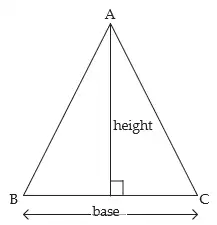
Height is the perpendicular distance from the base to the opposite vertex.
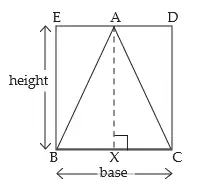
This formula holds for all types of triangles, including those where the height falls outside the triangle.
For such triangles, the area can be found by subtracting areas of right triangles formed by extending the base.
Example: Find the area of triangle \( \triangle ABC \) with base \( BC \) and height \( h \).
\[ \text{Area} = \frac{1}{2} \times BC \times h \]
Practice Set
- Calculate the area of triangles with given bases and heights.
- Find missing altitudes in right triangles using area formulas.
- Transform rectangles into triangles of equal area and vice versa using dissection.
- Compare areas of equilateral triangles and squares with the same side length.
- Find the area of rhombuses using diagonals.
- Calculate the area of trapeziums using the formula derived below.
Area of Parallelograms, Rhombuses, and Trapeziums
Area of a Parallelogram
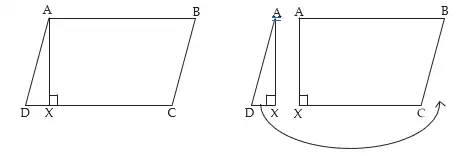
The area of a parallelogram is given by:
\[ \text{Area} = \text{base} \times \text{height} \]
Height is the perpendicular distance from the base to the opposite side.
By dissecting a parallelogram into a rectangle of equal area, we can understand this formula.
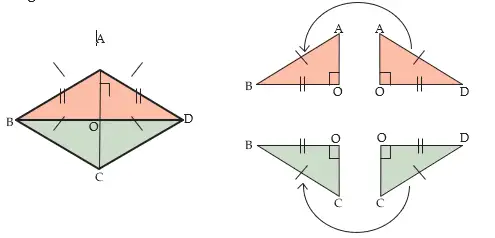
Area of a Rhombus
A rhombus is a parallelogram with all sides equal. Its area can also be found using the lengths of its diagonals:
\[ \text{Area} = \frac{1}{2} \times d_1 \times d_2 \]
where \( d_1 \) and \( d_2 \) are the lengths of the diagonals.
Area of a Trapezium
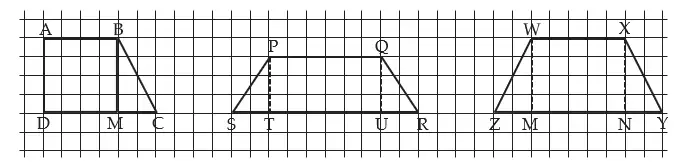
A trapezium has one pair of parallel sides. Its area is given by:
\[ \text{Area} = \frac{1}{2} \times \text{height} \times (\text{sum of parallel sides}) \]
Derivation:
Let the parallel sides be \( a \) and \( b \), and height be \( h \). Then,
\[ \text{Area} = \frac{1}{2} \times h \times (a + b) \]
Practice Set
- Calculate areas of parallelograms with given bases and heights.
- Find areas of rhombuses using diagonal lengths.
- Compute areas of trapeziums using the formula above.
- Convert trapeziums into rectangles of equal area using dissection.
- Compare areas of rectangles and parallelograms with the same base and height.
Area of Any Polygon
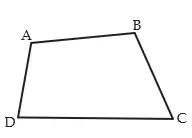
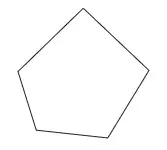
Any polygon can be divided into triangles. By finding the areas of these triangles and summing them, we can find the area of the polygon.
For example, a quadrilateral can be divided into two triangles by drawing a diagonal. The area of the quadrilateral is the sum of the areas of these two triangles.
Similarly, a pentagon can be divided into three triangles by drawing diagonals from one vertex.
Practice Set
- Find the area of polygons by dividing them into triangles.
- Calculate missing side lengths or heights using area formulas.
- Apply the method to composite shapes made of rectangles and triangles.
Units of Area and Conversion
Area is measured in square units such as square centimeters (cm²), square meters (m²), square inches (in²), and square feet (ft²).
Conversion between units:
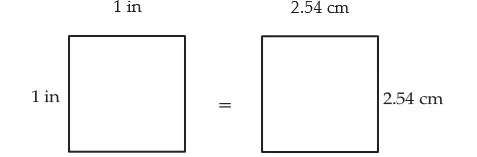
- 1 inch = 2.54 cm
- 1 ft = 12 inches
- 1 in² = (2.54 cm)² = 6.4516 cm²
- 1 ft² = (12 in)² = 144 in²
- 1 acre = 43,560 ft²
- 1 km² = 1,000,000 m²
Use these conversions to switch between units when calculating areas.
Practice Set
- Convert given areas from in² to cm² and vice versa.
- Estimate areas of real-life objects like sheets, tables, and rooms.
- Compare areas of different cities or regions using km² and m².
Summary
- Area of a triangle = \( \frac{1}{2} \times \text{base} \times \text{height} \)
- Area of any polygon can be found by dividing it into triangles and summing their areas.
- Area of a parallelogram = base × height.
- Area of a rhombus = \( \frac{1}{2} \times \text{product of diagonals} \)
- Area of a trapezium = \( \frac{1}{2} \times \text{height} \times (\text{sum of parallel sides}) \)