CLASS 7 . SOCIAL SCIENCE . EXPLORING SOCIETY INDIA AND BEYOND PART I . THE AGE-OF-REORGANISATION
Chapter 6 : The Age of Reorganisation
Ch 6
SOCIAL SCIENCE
CLASS 7
Introduction to the Age of Reorganisation
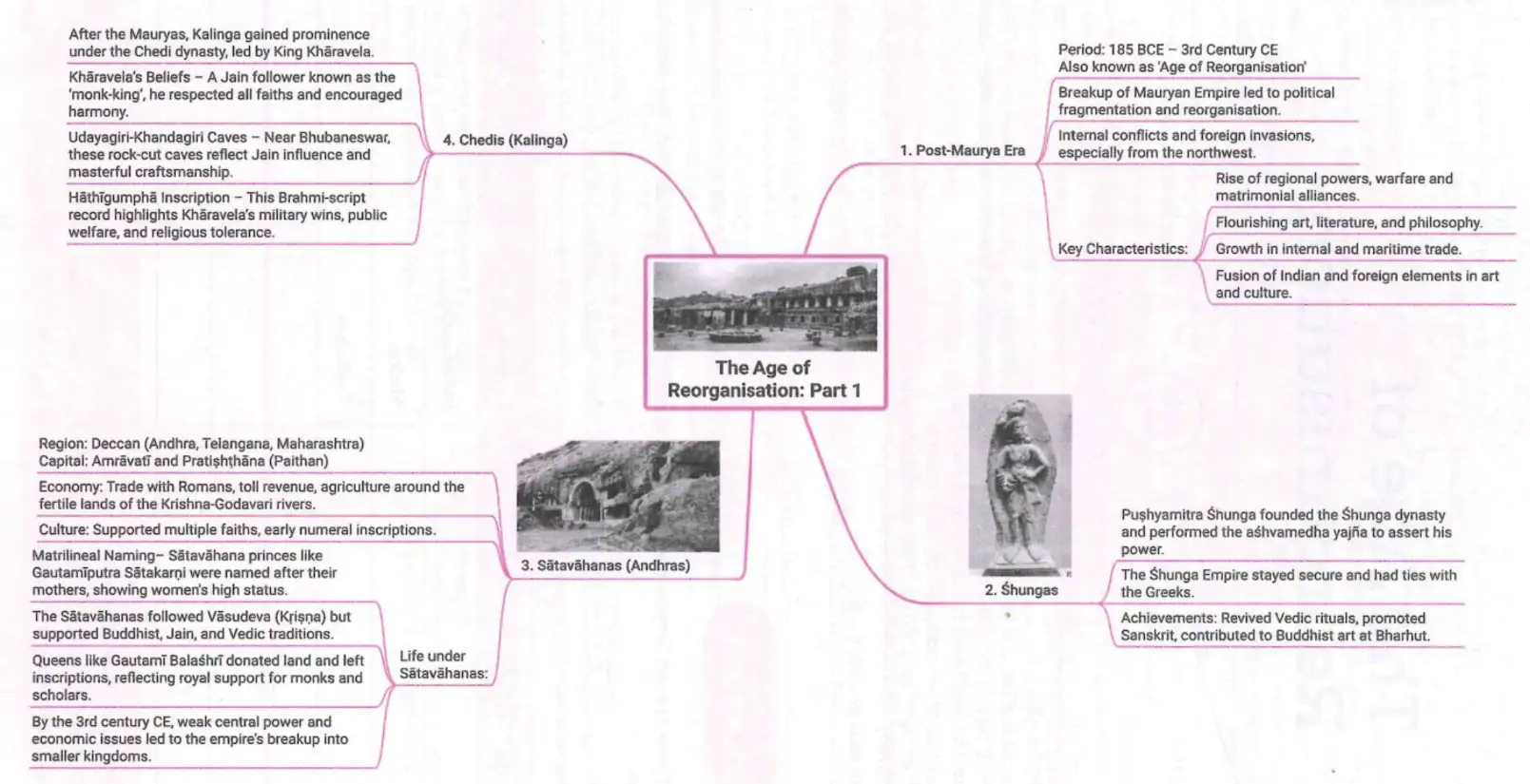
After the death of Emperor Ashoka, the Maurya Empire began to weaken. Around 185 BCE, the last Mauryan ruler was assassinated by Pushyamitra Shunga, marking the end of Mauryan dominance. This period was characterised by internal conflicts and foreign invasions, which led to the reorganisation of political powers across the Indian subcontinent.
The political landscape saw the rise of various dynasties, both indigenous and foreign, which influenced the culture, trade, and social life of the region. The Age of Reorganisation is significant for the blending of local and foreign elements in art, literature, and governance.
Exam Question
Q: What were the main causes that led to the Age of Reorganisation in ancient India?
A: The main causes were the weakening of the Maurya Empire after Ashoka's death, assassination of the last Mauryan ruler by Pushyamitra Shunga, internal conflicts, and foreign invasions that led to the breakup of the empire and rise of new dynasties.
Dynasties of the Age of Reorganisation
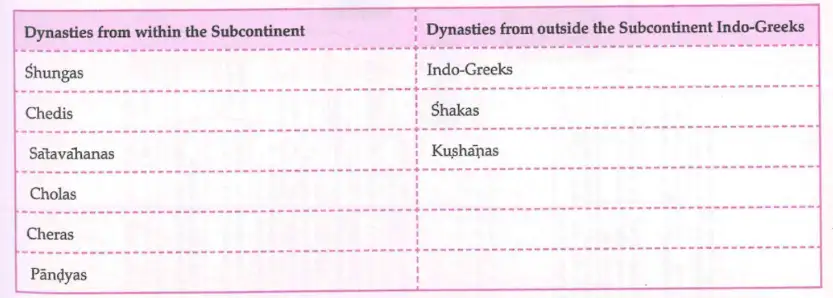
The Age of Reorganisation saw the emergence of several important dynasties, which can be broadly classified into two groups:
- Indigenous Dynasties: Shungas, Chedis, Satavahanas, Cholas, Cheras, and Pandyas.
- Foreign Dynasties: Indo-Greeks, Shakas, and Kushanas.
These dynasties contributed to the political, cultural, and economic development of India during this period.
Mnemonic to Remember Dynasties
P–C3–S2: Pandyas, Cheras, Cholas, Chedis, Shungas, Satavahanas
K–I–S: Kushanas, Indo-Greeks, Shakas
Exam Question
Q: Name two dynasties from the Age of Reorganisation that originated outside the Indian subcontinent.
A: The Indo-Greeks and Kushanas originated outside the Indian subcontinent.
The Shunga Dynasty
The Shunga dynasty was founded by Pushyamitra Shunga after the fall of the Maurya Empire. It was located in north and central India.
- Pushyamitra performed the Aśhvamedha yajña, a grand Vedic horse sacrifice, to assert his power.
- The Shungas promoted literature, art, and architecture, including the famous Bharhut Stupa.
- The dynasty maintained contacts with the Greeks and revived Vedic rituals and Sanskrit language.
Exam Question
Q: What was the significance of the Aśhvamedha yajña performed by Pushyamitra Shunga?
A: The Aśhvamedha yajña was a grand Vedic horse sacrifice performed to prove the king's sovereignty and power over other rulers.
The Satavahana Dynasty
The Satavahanas, also known as the Andhras, ruled large parts of the Deccan region, including present-day Andhra Pradesh, Telangana, and Maharashtra.
- Their capitals were Amrāvatī and Pratishṭhāna.
- The economy was based on trade, including maritime trade with the Romans, and agriculture.
- Satavahana queens like Gautamī Balāśhri made land donations and performed Vedic rituals such as the Aśhvamedha yajña.
- Inscriptions in Brahmi script have been found in caves like Naneghat and Nashik.
- The Satavahanas supported Vedic scholars, Jain monks, Buddhists, and followers of Vāsudeva (Krishna), showing religious tolerance.
- The empire declined by the 3rd century CE due to economic decline and weak central control, leading to fragmentation.
Exam Question
Q: How did the Satavahanas demonstrate religious tolerance?
A: The Satavahanas supported various religious groups including Vedic scholars, Jain monks, Buddhists, and followers of Vāsudeva (Krishna), promoting religious harmony.
The Chedi Dynasty
The Chedis, ruling in the Kalinga region, gained prominence under King Khāravela, a follower of Jainism.
- Khāravela is known for religious tolerance and military victories.
- He built the Udayagiri–Khandagiri caves, which contain inscriptions such as the Hathigumpha inscription written in Brahmi script.
Exam Question
Q: What is the significance of the Hathigumpha inscription?
A: The Hathigumpha inscription provides valuable historical information about King Khāravela’s reign, his military achievements, and religious tolerance.
Kingdoms and Life in South India
During the post-Mauryan period, the southern kingdoms of Cheras, Cholas, and Pāndyas remained independent and became powerful between the 2nd century BCE and 3rd century CE. This period is known as the Sangam Age, famous for rich Tamil literature expressing themes of love, valour, and generosity.
Exam Question
Q: What was the Sangam Age known for?
A: The Sangam Age was known for its rich Tamil literature and culture, highlighting themes such as love, valour, and generosity.
The Chola Kingdom
The Chola king Karikala was a prominent ruler who defeated the Cheras and Pāndyas.
- He built the Kallanai (Grand Anicut) on the Kaveri River near Srirangam to divert water for irrigation, turning the delta into the ‘rice bowl of the South’.
- This irrigation system still supports agriculture in Tamil Nadu today.
Exam Question
Q: What was the importance of the Kallanai built by Karikala?
A: The Kallanai was an ancient dam that helped in irrigation, making the Kaveri delta fertile and supporting agriculture in Tamil Nadu.
The Chera Kingdom
The Cheras, also known as Keralaputra, ruled western Tamil Nadu and Kerala from their capital Vanji (Karur).
- They promoted Sangam literature and were famous for overseas trade with Rome and West Asia.
- Exports included spices, timber, ivory, and pearls.
- The Cheras issued their own coins, indicating a developed economy.
Exam Question
Q: What were the main trade goods exported by the Cheras?
A: The Cheras exported spices, timber, ivory, and pearls through overseas trade.
The Pāṇḍya Kingdom
The Pāṇḍyas were known for strong administration and ruled parts of Tamil Nadu with their capital at Madurai.
- They had active trade relations with Greeks and Romans and possessed naval power.
- They contributed to art, architecture, and the welfare of their people.
- The Pāṇḍyas were famous for their pearls.
Exam Question
Q: What was the significance of the Pāṇḍya kingdom in trade?
A: The Pāṇḍya kingdom had active trade with Greeks and Romans and was known for its naval power and pearl trade.
Invasions of the Indo-Greeks
The Indo-Greeks invaded parts of northwestern India after Alexander the Great’s campaigns.
- They introduced a cultural fusion of Indian and Greek elements, evident in coins and architecture.
- The Heliodorus pillar was built to show respect for Indian beliefs.
- The Shakas (Indo-Scythians) succeeded the Indo-Greeks and started the Shaka Samvat calendar, which is still used as India’s National Calendar.
Exam Question
Q: How did the Indo-Greeks influence Indian culture?
A: The Indo-Greeks introduced a blend of Indian and Greek culture, seen in their coins and monuments like the Heliodorus pillar.
The Kushana Empire
The Kushanas came from Central Asia and ruled a large part of northern India.
- They supported trade, art, and religion, promoting the Silk Route trade.
- Their coins featured both Buddha and Shiva, showing respect for multiple religions.
- The Gāndhāra and Mathurā schools of art flourished under their rule, blending Indian and foreign styles.
- Sanskrit literature, including the Ramayana and Mahābhārata, grew during this period.
Exam Question
Q: What was the cultural significance of the Kushana Empire?
A: The Kushana Empire promoted religious tolerance, trade, and the development of art and Sanskrit literature, blending Indian and foreign influences.
Timeline of Dynasties and Rulers (200 BCE to 300 CE)
| Time Period / Year | Event / Change | Importance |
|---|---|---|
| c. 185 BCE | Pushyamitra Shunga founds the Shunga dynasty | Marks the end of Mauryan Empire and start of Shunga rule |
| c. 100 BCE | Khāravela rules the Chedi dynasty | Known for religious tolerance and inscriptions like Hathigumpha |
| 1st–2nd century CE | Gautamiputra Satakarni rules Satavahanas | Strengthened Satavahana empire and promoted religious harmony |
| c. 100–200 CE | Kanishka rules Kushana dynasty | Promoted Buddhism and cultural fusion |
| 2nd century CE | Karikala rules Chola kingdom | Built Kallanai dam, enhanced irrigation and agriculture |
| 185 BCE – 75 BCE | Shunga dynasty reign | Revival of Vedic culture and art |
| 100 BCE – early centuries CE | Shakas (Indo-Scythians) rule northwest India | Introduced Shaka Samvat calendar |
| 100 BCE – 300 CE | Satavahanas rule Deccan region | Promoted trade, agriculture, and religious tolerance |
| 1st century CE – 300 CE | Kushanas rule northern India | Flourishing of trade, art, and religion |
| 2nd century BCE – 3rd century CE | Cholas, Cheras, Pāṇḍyas active in South India | Known for Tamil literature and trade |
Exam Question
Q: What does the timeline of dynasties from 200 BCE to 300 CE indicate about India’s political scenario?
A: The timeline shows multiple dynasties ruling simultaneously across India, indicating political fragmentation but also cultural and economic growth during the Early Historic Period.
Glossary
- Matrimonial Alliance: An alliance arranged through marriage, usually between royal families to strengthen political ties.
- Aśhvamedha Yajña: A grand Vedic horse sacrifice ritual performed by kings to assert their sovereignty.
- Sangam Age: A golden age of Tamil literature marked by poet gatherings called Sangams, known for rich poetry and culture.
Quick Reference
- Pushyamitra Shunga: Founder of Shunga dynasty, performed Aśhvamedha yajña.
- Satavahanas: Ruled Deccan, promoted trade and religious tolerance.
- Khāravela: Jain ruler of Chedis, known for inscriptions and religious harmony.
- Cholas, Cheras, Pāṇḍyas: Southern kingdoms known for Tamil literature and trade.
- Indo-Greeks and Shakas: Foreign rulers who influenced Indian culture and introduced new calendars.
- Kushanas: Central Asian rulers who promoted trade, art, and religion.
Solved Examples
Example 1: Explain the significance of the Shunga dynasty in post-Mauryan India.
Answer: The Shunga dynasty, founded by Pushyamitra Shunga, marked the revival of Vedic rituals and Sanskrit culture after the Mauryan decline. They promoted art and architecture, such as the Bharhut Stupa, and maintained contacts with foreign powers like the Greeks.
Example 2: Describe the contributions of the Satavahanas to Indian society.
Answer: The Satavahanas ruled the Deccan region and were known for their trade, including maritime commerce with Rome. They supported multiple religions, promoted agriculture, and left inscriptions in Brahmi script. Their queens played important roles in religious and social activities.
Practice Set
Easy
- Who founded the Shunga dynasty?
- Name the three main southern kingdoms during the Sangam Age.
Moderate
- What were the main features of the Satavahana administration?
- Explain the cultural contributions of the Kushana Empire.
Challenging
- Discuss the impact of foreign invasions on the political landscape of post-Mauryan India.
- Analyze the significance of the Sangam literature in understanding ancient South Indian society.
Answer Key
- Easy:
- Pushyamitra Shunga
- Cholas, Cheras, and Pāṇḍyas
- Moderate:
- The Satavahanas had a decentralized administration with strong local governance, supported trade and agriculture, and promoted religious tolerance.
- The Kushana Empire promoted trade on the Silk Route, supported art blending Indian and foreign styles, and encouraged Sanskrit literature and religious diversity.
- Challenging:
- Foreign invasions led to the fragmentation of the Mauryan Empire, introduction of new cultural elements, and the rise of regional powers that shaped India’s political and cultural diversity.
- Sangam literature provides insights into the social values, political structures, and cultural life of ancient South India, highlighting themes of love, valor, and generosity.