CLASS 7 . SOCIAL SCIENCE . EXPLORING SOCIETY INDIA AND BEYOND PART I . FROM BARTER-TO-MONEY
Chapter 11 : From Barter to Money
Ch 11
SOCIAL SCIENCE
CLASS 7
Introduction to Barter System
The barter system is a method of exchange where goods and services are traded directly for other goods and services without using money. For example, if you have apples and need oranges, you find someone who has oranges and needs apples, and you exchange them directly. This was the earliest form of exchange, using commodities such as cowrie shells, salt, tea, tobacco, cloth, cattle, seeds, etc.
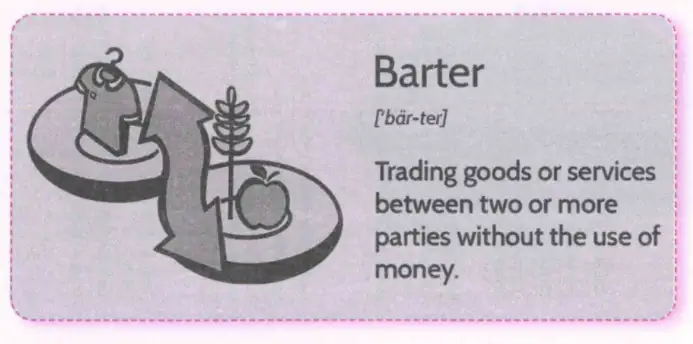
This image shows two people exchanging goods like wheat and an apple directly without using money, illustrating the barter system.
Exam Question
Q: What is the barter system? Give an example.
A: The barter system is a method of exchange where goods and services are traded directly without using money. For example, exchanging apples for oranges directly.
Limitations of the Barter System
The barter system faced several challenges:
- Lack of Double Coincidence of Wants: Both parties must want what the other offers, which is rare.
- Lack of Standard Measure: There is no standard way to compare the value of different goods.
- Storage Issues: Perishable items like fruits or vegetables could not be stored for future use.
- Indivisibility: Some items cannot be divided for exchange.
These limitations made trade cumbersome and inefficient, especially as societies grew larger and more complex.
Exam Question
Q: What are the main limitations of the barter system?
A: The main limitations are lack of double coincidence of wants, lack of standard measure of value, storage problems, and indivisibility of goods.
Evolution of Money
To overcome the limitations of barter, societies developed money as a medium of exchange. The evolution of money includes:
- Commodity Money: Items like salt, rice, or cattle used as money due to their intrinsic value.
- Metal Coins: Durable and easy to carry coins made of gold, silver, and copper.
- Paper Currency: Introduced in the 7th century in China, lighter and more convenient than coins.
- Plastic Money: Debit and credit cards allowing electronic transactions.
- Digital Money: Electronic money including bank transfers, mobile wallets, and UPI.
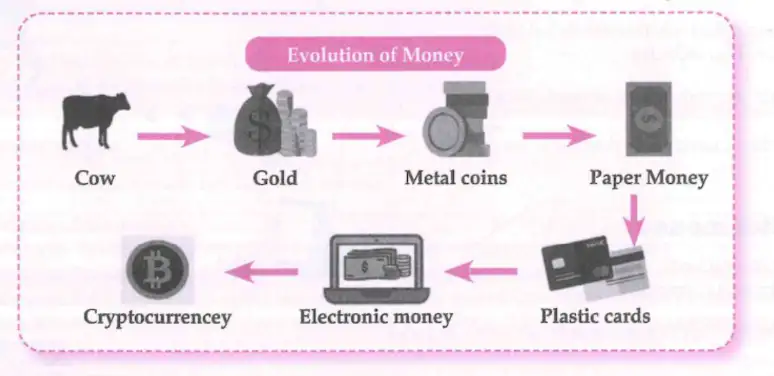
This image shows the progression from cows as wealth to gold, metal coins, paper money, plastic cards, and finally digital money including cryptocurrency.
Exam Question
Q: Describe the evolution of money from barter to digital money.
A: Money evolved from barter to commodity money like salt and cattle, then metal coins, paper currency, plastic cards, and finally digital money such as mobile wallets and UPI.
Functions of Money
Money serves four primary functions:
- Medium of Exchange: Used to buy and sell goods and services, making trade easier.
- Measure of Value: Provides a standard way to measure and compare the value of goods and services.
- Store of Value: Can be saved and used later, preserving value over time.
- Standard of Deferred Payments: Allows payments to be made in the future, facilitating credit and loans.
Exam Question
Q: What are the primary functions of money?
A: The primary functions are medium of exchange, measure of value, store of value, and standard of deferred payments.
Modern Forms of Money
Modern money exists in various forms:
- Currency: Physical paper notes and coins issued by the government.
- Bank Deposits: Money deposited in banks that can be withdrawn or used for payments.
- Plastic Money: Debit and credit cards used for electronic transactions.
- Digital Money: Electronic money including UPI and mobile wallets like Paytm, Google Pay, and PhonePe.
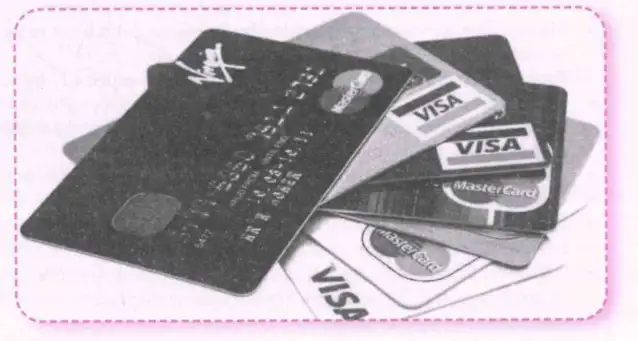
This image shows various credit cards used for borrowing money to make purchases.
Exam Question
Q: What are the different modern forms of money?
A: Modern forms include currency (notes and coins), bank deposits, plastic money (debit and credit cards), and digital money (UPI and mobile wallets).
Importance of Money
Money plays a crucial role in the economy by:
- Facilitating Trade: Simplifies transactions and promotes economic activity.
- Promoting Savings: Allows individuals to save wealth for future use.
- Supporting Economic Development: A stable monetary system is essential for growth.
- Enabling Government Policies: Central banks like the Reserve Bank of India regulate money supply to control inflation and stabilize the economy.
Exam Question
Q: Why is money important for the economy?
A: Money facilitates trade, promotes savings, supports economic development, and helps governments regulate the economy.
Solved Examples
Example 1: Explain why the barter system was inefficient.
Answer: The barter system was inefficient because it required a double coincidence of wants, lacked a standard measure of value, had storage problems for perishable goods, and some goods could not be divided for exchange.
Example 2: List the primary functions of money.
Answer: The primary functions of money are medium of exchange, measure of value, store of value, and standard of deferred payments.
Practice Set
Easy
- What is barter?
- Name two commodities used as money in the past.
Moderate
- Explain the limitation of lack of double coincidence of wants in the barter system.
- What are the advantages of using metal coins over barter?
Challenging
- Describe the evolution of money from commodity money to digital money.
- Discuss the importance of money in economic development.
Answer Key
Easy
- Barter is the direct exchange of goods and services without using money.
- Examples: Cowrie shells, salt.
Moderate
- It is difficult to find someone who wants what you have and has what you want at the same time.
- Metal coins are durable, easy to carry, and have a standard value.
Challenging
- Money evolved from commodity money like salt and cattle, to metal coins, paper currency, plastic cards, and digital money.
- Money facilitates trade, promotes savings, supports economic growth, and helps regulate the economy.
Quick Reference
- Barter System: Direct exchange of goods without money.
- Limitations: Double coincidence of wants, no standard value, storage, indivisibility.
- Evolution of Money: Commodity money → Metal coins → Paper currency → Plastic money → Digital money.
- Functions of Money: Medium of exchange, measure of value, store of value, deferred payments.
- Modern Money: Currency, bank deposits, plastic cards, digital payments.
Glossary
- Money: A common tool accepted for payment of goods and services.
- Transaction: An act of buying or selling.
- Commodities: Goods that can be traded.
- Minting: The process of making coins.
- Alloy: A mixture of metals to make coins stronger.
- Obverse: The front side of a coin with the main design.
- Currency: The system of money used in a country.
- Denominations: Different units of money like coins and notes.
- QR Code: A code readable by smartphones for making payments.
- Contingent: Conditional or dependent on something.
- National Income: Total value of goods and services produced by a nation.