CLASS 7 . SCIENCE . CURIOSITY . THE EVER-EVOLVING-WORLD-OF-SCIENCE
Chapter 1 : The Ever-Evolving World of Science
Ch 1
SCIENCE
CLASS 7
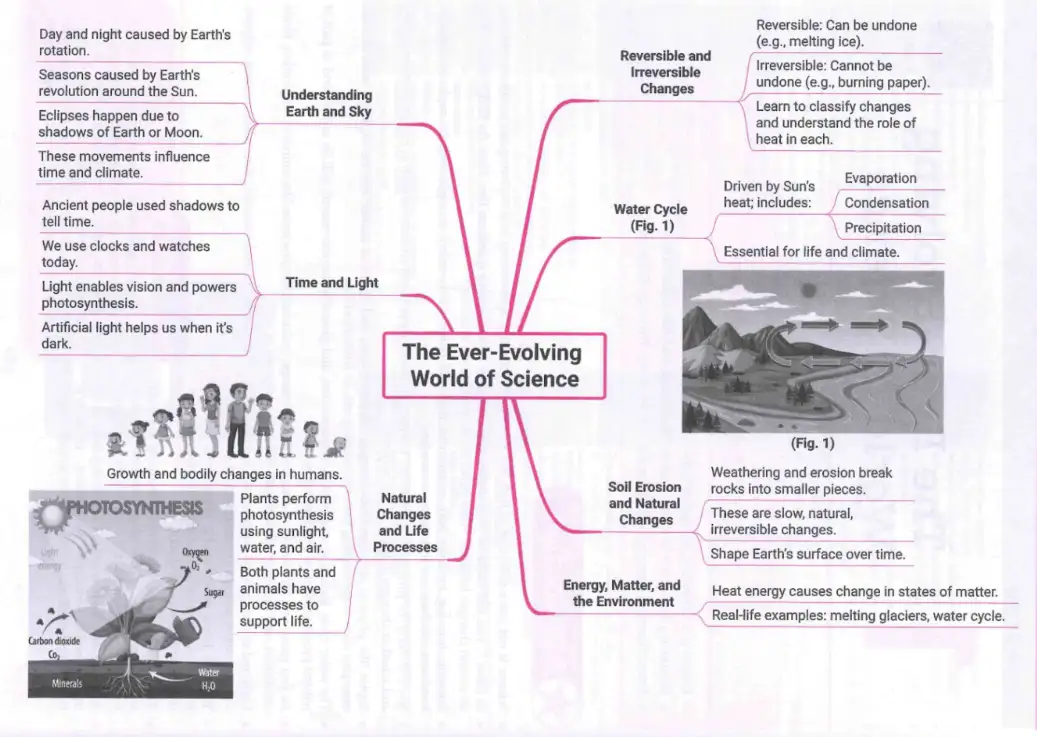
Ever-Evolving World
Introduction to Science
Science is a process of thinking, questioning, and exploring the world around us. It is not just a collection of facts but a way to understand how things work and why changes happen. In Class 7, students build on earlier knowledge by asking deeper questions and exploring concepts through hands-on activities and observations.
Natural Changes and Life Processes
Natural changes include reversible changes like melting ice and irreversible changes like burning paper. Life processes such as nutrition, respiration, blood circulation, and excretion are essential for survival in animals and plants. Plants make their food through photosynthesis using sunlight, water, and air, and they exchange gases with the environment.
Earth and Sky Phenomena
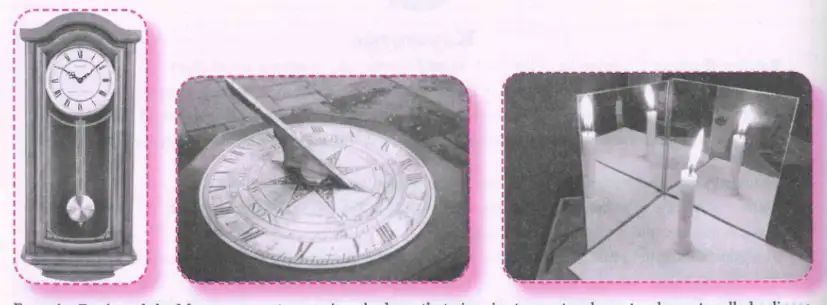
The Earth's rotation causes day and night, while its revolution around the Sun causes seasons. Eclipses occur when one celestial body moves into the shadow of another. Shadows are formed when objects block light, and ancient people used shadows to tell time before clocks were invented.
Water Cycle and Environmental Changes
The water cycle is driven by the Sun's heat and involves evaporation, condensation, precipitation, and collection. Weathering and erosion slowly break down rocks, shaping the Earth's surface. Heat causes matter to change state, such as melting glaciers and water evaporation.
Energy, Matter, and Environment
Energy from the Sun powers many natural processes. Heat causes changes in matter, and these changes affect the environment. Understanding these connections helps us see how the world is always changing and how life is sustained.
Solved Examples
Example 1: Explain why we experience day and night.
Solution: The Earth rotates on its axis once every 24 hours. When a part of the Earth faces the Sun, it experiences daylight. When it faces away, it experiences night. This rotation causes the cycle of day and night.
Example 2: Describe the water cycle.
Solution: The Sun heats water in oceans, lakes, and rivers, causing evaporation (water turns into vapor). The vapor rises and cools to form clouds (condensation). Clouds release water as rain or snow (precipitation). Water collects in water bodies and the cycle repeats.
Example 3: Differentiate between reversible and irreversible changes with examples.
Solution: Reversible changes can be undone, such as ice melting into water and freezing back. Irreversible changes cannot be undone, such as burning paper or fruit ripening.
Practice Set
- Level 1 (Easy): What causes the seasons on Earth?
- Level 2 (Moderate): Explain how shadows can be used to tell time.
- Level 3 (Challenging): Describe the role of heat in the water cycle and how it affects life on Earth.
Answer Key
Level 1: Seasons are caused by the Earth's revolution around the Sun and the tilt of its axis, which changes the angle of sunlight received.
Level 2: Shadows change position and length during the day as the Sun moves across the sky. By observing these changes, ancient people could estimate the time of day.
Level 3: Heat from the Sun causes water to evaporate, forming clouds through condensation. Precipitation returns water to the Earth, supporting plants and animals. This cycle is essential for maintaining life and climate.
Science Connection
Interconnected Nature of Science
Science is like a giant puzzle where every piece fits together. Discoveries in one area often spark ideas in another. For example, understanding acids and bases helps explain why some fruits taste sour and why turmeric stains change color when washed.
Scientific Thinking and Responsibility
Science involves asking questions, experimenting, and learning from results. It also teaches us to be responsible citizens who care about the environment and the impact of human activities on natural systems.
Exploring Light and Shadows
Light travels in straight lines and allows us to see. Shadows form when objects block light. Studying light and shadows helps us understand natural phenomena like eclipses and the measurement of time.
Practice Set
- Level 1 (Easy): What is a shadow and how is it formed?
- Level 2 (Moderate): How do eclipses occur?
- Level 3 (Challenging): Explain how the Earth's movements affect day, night, and seasons.
Answer Key
Level 1: A shadow is a dark shape formed when an object blocks light from a source.
Level 2: Eclipses occur when the Earth, Moon, and Sun align so that one body moves into the shadow of another, causing solar or lunar eclipses.
Level 3: The Earth's rotation causes day and night by changing which part faces the Sun. Its revolution around the Sun, combined with the tilt of its axis, causes seasons by changing the angle of sunlight.
Quick Reference Table
Rotation: Earth's spinning on its axis causing day and night.
Revolution: Earth's orbit around the Sun causing seasons.
Shadow: Dark area formed when light is blocked.
Eclipse: When one celestial body moves into the shadow of another.
Water Cycle: Evaporation, condensation, precipitation, and collection driven by the Sun's heat.
Reversible Change: Change that can be undone (e.g., melting ice).
Irreversible Change: Change that cannot be undone (e.g., burning paper).
Common Mistakes and Misconceptions
1. Confusing rotation and revolution: Rotation is Earth's spin causing day and night; revolution is Earth's orbit causing seasons.
2. Thinking all changes are reversible: Some changes like burning paper are permanent.
3. Believing shadows are objects: Shadows are not objects but dark areas caused by blocked light.
4. Misunderstanding eclipses: Eclipses happen only when the Sun, Earth, and Moon align properly.
Glossary
Rotation: The spinning of Earth on its axis.
Revolution: The movement of Earth around the Sun.
Shadow: Dark shape formed when light is blocked.
Eclipse: Event when one celestial body moves into the shadow of another.
Water Cycle: Continuous movement of water through evaporation, condensation, and precipitation.
Photosynthesis: Process by which plants make food using sunlight, water, and carbon dioxide.
Reversible Change: Change that can be undone.
Irreversible Change: Change that cannot be undone.