CLASS 7 . SCIENCE . CURIOSITY . MEASUREMENT OF-TIME-AND-MOTION
Chapter 8 : Measurement of Time and Motion
Ch 8
SCIENCE
CLASS 7
Measurement of Time and Motion
Introduction
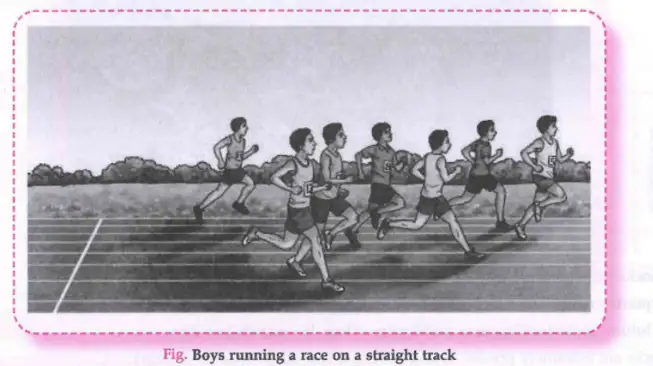
We use measurements to know how far or fast something moves. Motion means a change in the position of an object with time. We use tools like clocks, watches, and stopwatches to measure time. Different objects move in different ways — some in a straight line, some in a circle, or back and forth. Speed is how fast an object moves. Motion can be uniform, meaning equal distances in equal time, or non-uniform, meaning unequal distances in equal time. We explore motion using activities with swings, water clocks, and pendulums.
Measurement of Time
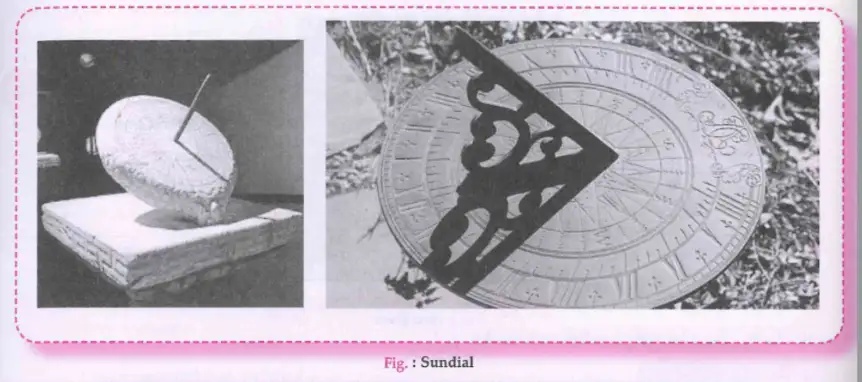
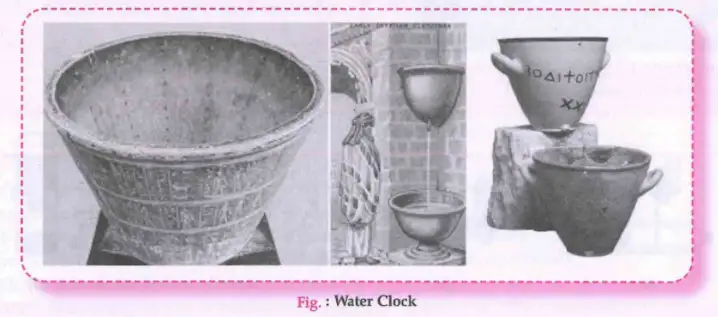
Long ago, people wanted to keep track of time. They noticed that natural events, like sunrise, sunset, and moon phases, happened repeatedly. These events helped them create calendars and measure time. Before clocks and watches, they used simple tools to tell time, such as sundials, water clocks, hourglasses, and candle clocks.
Sundials use the Sun's shadow to tell time. A stick or edge called a gnomon casts a shadow on a flat surface marked with hours. As the sun moves, the shadow moves, showing the current time. Sundials were used before clocks were invented to measure daytime hours.
Water clocks measure time by the flow of water from one container to another. As the water level changes, it marks the passage of time. Ancient civilizations used water clocks before mechanical clocks existed.
Hourglasses use sand flowing from one glass bulb to another through a narrow neck. The time it takes for all the sand to move measures a fixed period. When the sand finishes flowing, the hourglass can be flipped to start timing again.
Candle clocks use burning candles with marks to measure time as the candle burns down.

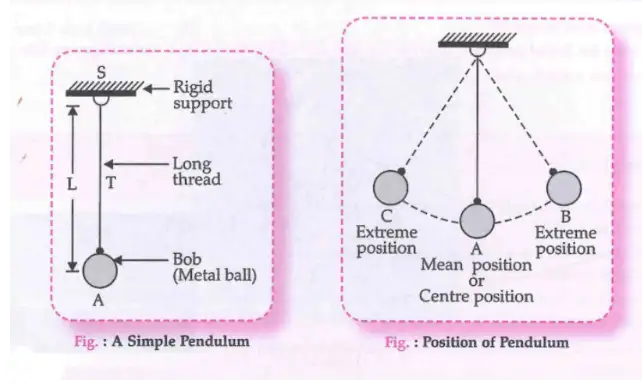
A Simple Pendulum
A simple pendulum consists of a metal ball called the bob hanging from a thread. When at rest, the bob is at the mean position. If moved to one side and released, it swings back and forth in oscillatory motion, which is periodic. One oscillation is completed when the bob moves from the mean position to one side, then to the other side, and back to the mean. The time taken for one oscillation is called the time period of the pendulum.
SI Unit of Time
The SI unit of time is the second (s). Larger units include the minute (min) and hour (h). 60 seconds equal 1 minute, and 60 minutes equal 1 hour.
Speed and Motion
Speed is the distance covered in a given time. To know which object is moving faster, compare how much distance each covers in the same time. Speed can be calculated using the formula: Speed = Total Distance / Total Time. The SI unit of speed is meters per second (m/s), but it can also be expressed in kilometers per hour (km/h).
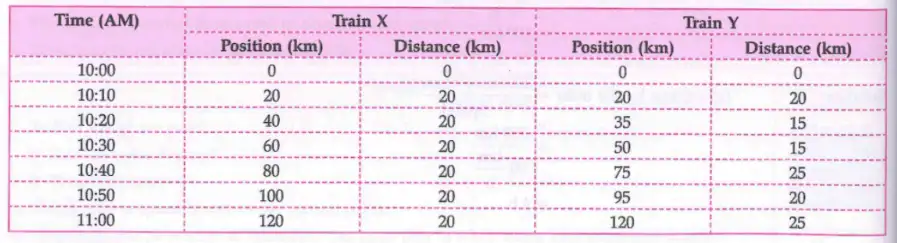
Uniform motion means traveling equal distances in equal times, while non-uniform motion means traveling unequal distances in equal times.
Speedometer and Odometer
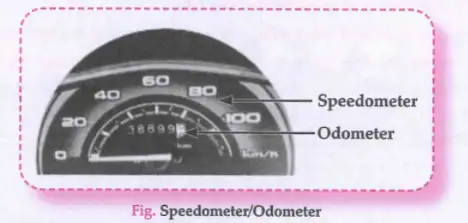
A speedometer is a device in vehicles that shows how fast the vehicle is moving, usually in km/h or mph. An odometer shows the total distance traveled by the vehicle, measured in kilometers or miles.
Uniform and Non-uniform Linear Motion
Linear motion is movement in a straight line. Uniform linear motion means moving at the same speed, covering equal distances in equal time intervals. Non-uniform linear motion means the speed changes, covering unequal distances in equal time intervals.
Solved Examples
Example 1: Swati’s school is 3.6 km from her house. It took her 15 minutes to reach her school riding her bicycle. Calculate the speed of the bicycle in m/s.
Solution:
Speed = Distance / Time
Distance = 3.6 km = 3.6 × 1000 = 3600 m
Time = 15 minutes = 15 × 60 = 900 seconds
Speed = 3600 m / 900 s = 4 m/s
Example 2: Raghav is going to a neighbouring city in a bus moving at a speed of 50 km/h. If it takes him 2 hours to reach the city, how far is the city?
Solution:
Distance = Speed × Time = 50 km/h × 2 h = 100 km
Example 3: A train is travelling at a speed of 90 km/h. How much time will it take to cover a distance of 360 km?
Solution:
Time = Distance / Speed = 360 km / 90 km/h = 4 hours
Practice Set
- Level 1 (Easy): What is the SI unit of time? Name two ancient devices used to measure time.
- Level 2 (Moderate): Explain the difference between uniform and non-uniform motion with examples.
- Level 3 (Challenging): A car travels 150 km in 3 hours. Calculate its speed in km/h and m/s.
Answer Key
- Level 1: The SI unit of time is the second (s). Two ancient devices used to measure time are sundials and water clocks.
- Level 2: Uniform motion is when an object covers equal distances in equal time intervals, e.g., a train moving at a constant speed. Non-uniform motion is when an object covers unequal distances in equal time intervals, e.g., a car slowing down or speeding up.
- Level 3: Speed = Distance / Time = 150 km / 3 h = 50 km/h. To convert to m/s: 50 km/h = (50 × 1000) m / (60 × 60) s = 13.89 m/s.
Quick Reference Table
Time Measurement: Second (s) is the SI unit of time. 60 seconds = 1 minute, 60 minutes = 1 hour.
Speed Formula: Speed = Distance / Time
Units of Speed: meters per second (m/s), kilometers per hour (km/h)
Motion Types: Uniform motion (equal distances in equal times), Non-uniform motion (unequal distances in equal times)
Time Period of Pendulum: Time taken for one complete oscillation; depends on length of string, not mass of bob.
Common Mistakes and Misconceptions
- Confusing speed with velocity; speed is scalar, velocity is vector.
- Assuming pendulum time period depends on mass of bob; it depends only on length and gravity.
- Mixing units of speed; always convert units properly before calculations.
- Thinking that all motion is uniform; many motions are non-uniform.
Glossary
- Speed: Distance covered per unit time.
- Uniform Motion: Motion with constant speed covering equal distances in equal time intervals.
- Non-uniform Motion: Motion with changing speed covering unequal distances in equal time intervals.
- Pendulum: A weight suspended from a fixed point that swings back and forth.
- Time Period: Time taken for one complete oscillation of a pendulum.
- Speedometer: Device showing current speed of a vehicle.
- Odometer: Device showing total distance traveled by a vehicle.