CLASS 7 . SCIENCE . CURIOSITY . LIFE PROCESSES-IN-PLANTS
Chapter 10 : Life Processes in Plants
Ch 10
SCIENCE
CLASS 7
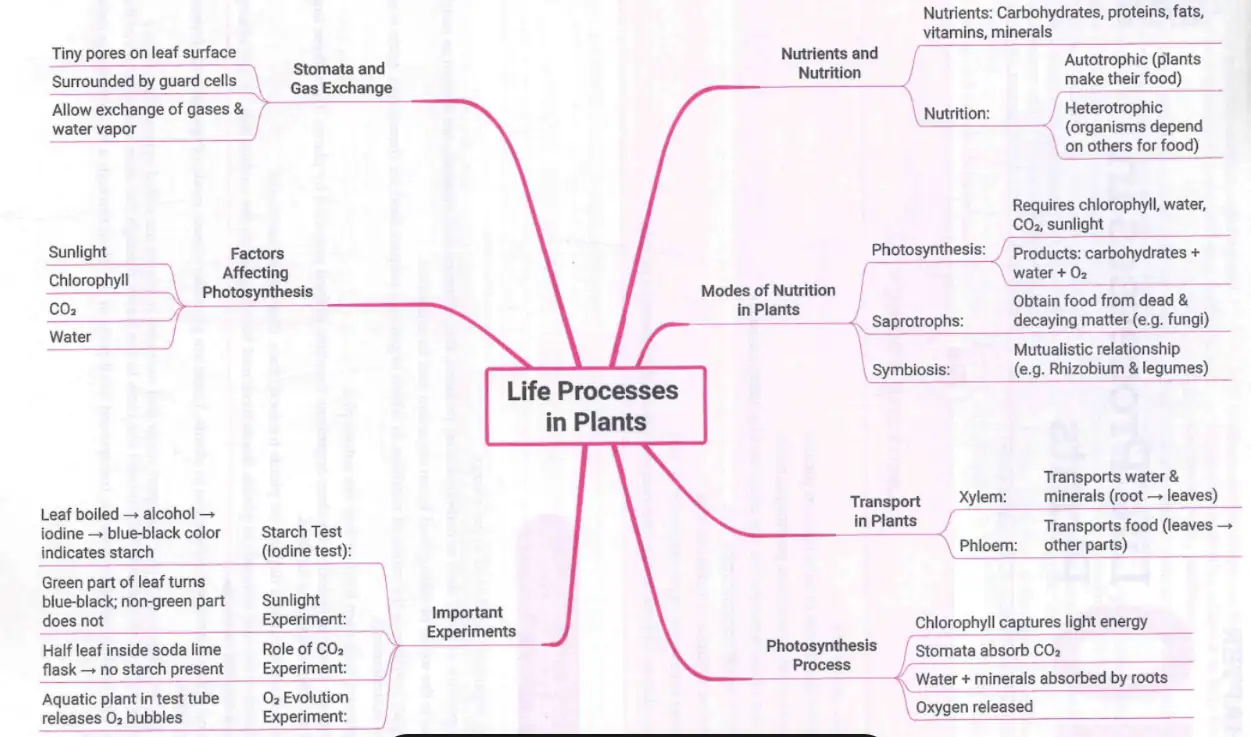
Nutrition in Plants
Introduction to Nutrition
All living organisms require food to obtain energy necessary for their survival. The components of food include carbohydrates, proteins, fats, vitamins, and minerals, collectively known as nutrients. Nutrition is the process by which organisms take in food and utilize it for growth and energy.
Plants exhibit two main modes of nutrition: autotrophic and heterotrophic. Autotrophic nutrition is the process where organisms prepare their own food, as seen in plants. Heterotrophic nutrition involves organisms that depend on other organisms for food.
Transport of Nutrients
Roots absorb water and minerals from the soil, aided by root hairs that increase surface area for absorption. The vascular tissues, xylem and phloem, transport substances within the plant. Xylem carries water and minerals from roots to leaves, while phloem transports food from leaves to other parts of the plant. Some transported food is stored in seeds and roots.
Solved Examples
Example: Explain the difference between xylem and phloem.
Solution:
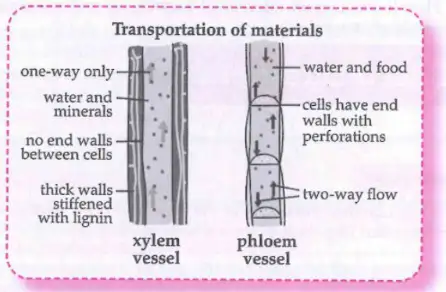
- Xylem: Transports water and minerals from roots to leaves; flow is one-way; vessels have thick walls with lignin and no end walls between cells.
- Phloem: Transports food (sugars) from leaves to other parts; flow is two-way; vessels have perforated end walls allowing movement of food.
Practice Set
- Level 1: What is the role of root hairs in plants?
- Level 2: Describe the function of phloem in plants.
- Level 3: Explain how xylem and phloem work together to support plant life.
Answer Key
- Level 1: Root hairs increase the surface area of roots to absorb more water and minerals from the soil.
- Level 2: Phloem transports food made in the leaves to all parts of the plant for growth and storage.
- Level 3: Xylem transports water and minerals upward from roots to leaves, while phloem distributes food from leaves to other parts, ensuring the plant receives necessary nutrients and water for survival.
Photosynthesis
Process of Photosynthesis
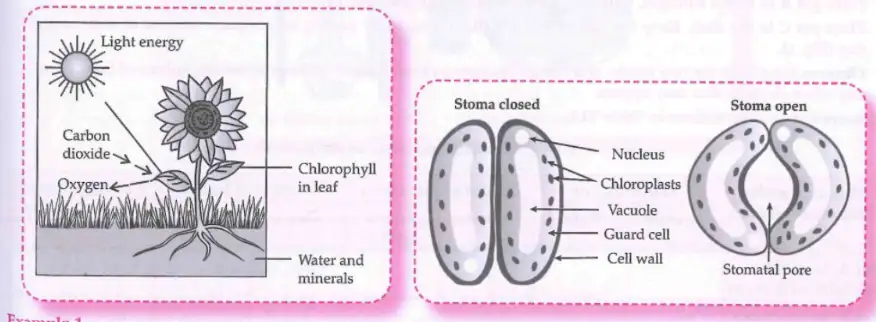
Photosynthesis is the process by which green plants prepare food using carbon dioxide, water, and sunlight. Leaves, containing chlorophyll, act as food factories. Roots absorb water and minerals, while stomata on leaves absorb carbon dioxide. Chlorophyll captures sunlight energy to convert carbon dioxide and water into carbohydrates and oxygen.
The chemical equation for photosynthesis is:
6CO2 + 6H2O + light energy → C6H12O6 + 6O2
Role of Stomata and Chlorophyll
Stomata are tiny pores on leaves surrounded by guard cells that regulate gas exchange and water vapor release. Chlorophyll is the green pigment that captures sunlight necessary for photosynthesis. Even leaves with other colors contain chlorophyll beneath their pigments.
Solved Examples
Example: Why do some plants with red or violet leaves still perform photosynthesis?
Solution: These leaves contain chlorophyll beneath the colored pigments, allowing them to capture sunlight and perform photosynthesis effectively.
Practice Set
- Level 1: What is the main site of photosynthesis in plants?
- Level 2: Explain the role of guard cells in photosynthesis.
- Level 3: Describe the importance of chlorophyll in photosynthesis.
Answer Key
- Level 1: Leaves are the main site of photosynthesis.
- Level 2: Guard cells control the opening and closing of stomata, regulating gas exchange and preventing water loss during photosynthesis.
- Level 3: Chlorophyll captures sunlight energy, which is essential to convert carbon dioxide and water into food during photosynthesis.
Experiments in Photosynthesis
Starch Test
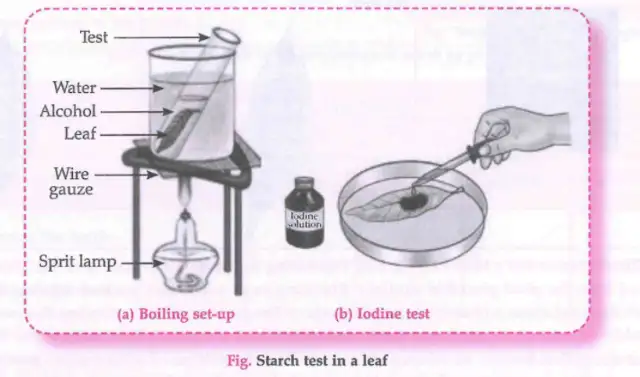
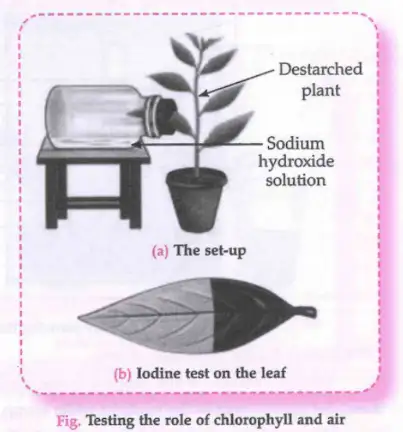
To confirm photosynthesis, a leaf is boiled in water, then in alcohol to remove chlorophyll, and finally treated with iodine solution. A blue-black color indicates the presence of starch, confirming food production.
Effect of Light and Carbon Dioxide
Experiments show that leaves kept in sunlight produce starch, while those kept in the dark do not. Similarly, removing carbon dioxide prevents starch formation, demonstrating the necessity of light and carbon dioxide for photosynthesis.
Oxygen Evolution
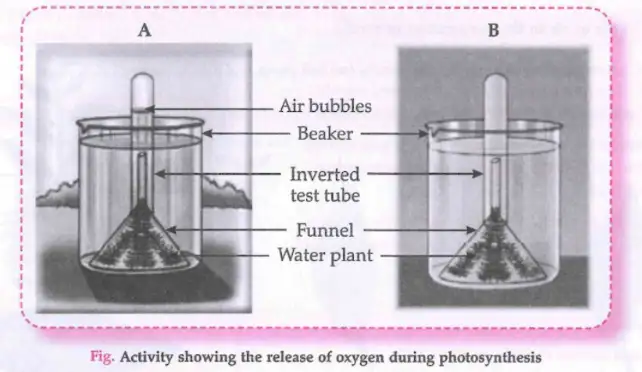
Using aquatic plants submerged in water, oxygen bubbles released during photosynthesis can be collected and observed, confirming oxygen production.
Solved Examples
Example: How does the iodine test confirm photosynthesis?
Solution: The iodine test turns blue-black in the presence of starch, which is produced during photosynthesis, confirming that the plant has synthesized food.
Practice Set
- Level 1: What does a blue-black color in the iodine test indicate?
- Level 2: Why do leaves kept in the dark not show starch in the iodine test?
- Level 3: Describe an experiment to demonstrate oxygen release during photosynthesis.
Answer Key
- Level 1: It indicates the presence of starch, confirming photosynthesis.
- Level 2: Because photosynthesis requires light, leaves kept in the dark cannot produce starch.
- Level 3: Place an aquatic plant in water under sunlight with an inverted test tube to collect gas bubbles. The gas collected is oxygen released during photosynthesis.
Gas Exchange
Role of Stomata
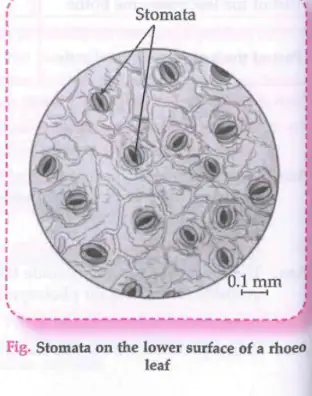
Stomata are small pores mainly on the underside of leaves, surrounded by guard cells. They regulate the exchange of gases: carbon dioxide enters for photosynthesis, and oxygen and water vapor exit. Guard cells control stomatal opening to balance gas exchange and water conservation.
Observation of Stomata
Under a microscope, stomata appear as tiny openings with two kidney-shaped guard cells. They play a vital role in plant respiration and transpiration.
Solved Examples
Example: How do guard cells regulate gas exchange?
Solution: Guard cells swell or shrink to open or close stomata, controlling the entry of carbon dioxide and exit of oxygen and water vapor, thus regulating gas exchange and water loss.
Practice Set
- Level 1: What are stomata?
- Level 2: Explain the function of guard cells.
- Level 3: Why is stomatal regulation important for plants?
Answer Key
- Level 1: Stomata are tiny pores on leaves that allow gas exchange.
- Level 2: Guard cells control the opening and closing of stomata to regulate gas exchange and prevent excessive water loss.
- Level 3: Regulation prevents water loss while allowing carbon dioxide in for photosynthesis, maintaining plant health.
Transport in Plants
Xylem and Phloem
Xylem vessels transport water and minerals from roots to leaves in one direction. They have thick walls strengthened by lignin and lack end walls between cells, forming continuous tubes.
Phloem vessels transport food (mainly sugars) from leaves to other parts of the plant in both directions. They have perforated end walls allowing movement of substances.
Water Transport Experiment
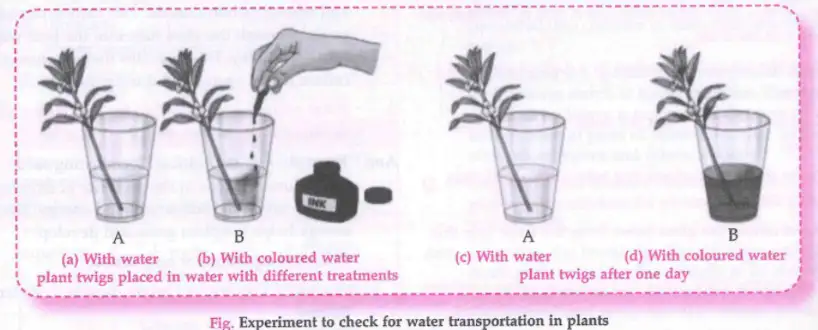
By placing plant twigs in colored water, the movement of water through xylem can be observed as the color appears in leaves, demonstrating water transport.
Solved Examples
Example: How can you demonstrate water transport in plants?
Solution: Place a plant twig in colored water and observe the color moving up to the leaves, showing water transport through xylem.
Practice Set
- Level 1: What is the function of xylem?
- Level 2: How does phloem differ from xylem in structure and function?
- Level 3: Describe an experiment to observe water transport in plants.
Answer Key
- Level 1: Xylem transports water and minerals from roots to leaves.
- Level 2: Xylem has thick walls and transports water one-way; phloem has perforated walls and transports food two-way.
- Level 3: Place plant twigs in colored water and observe the color moving to leaves, indicating water transport through xylem.
Respiration in Plants
Process of Respiration
Respiration is the process by which plants break down food to release energy. Germinating seeds show respiration by producing carbon dioxide, which can be detected using lime water turning milky.
Respiration Experiment
Soaked seeds placed in a flask with damp cotton and connected to lime water tubes show lime water turning milky due to carbon dioxide released during respiration.
Solved Examples
Example: How can you demonstrate respiration in germinating seeds?
Solution: Place soaked seeds in a flask connected to lime water. The lime water turns milky due to carbon dioxide released during respiration.
Practice Set
- Level 1: What gas is released during respiration?
- Level 2: How does lime water help detect respiration?
- Level 3: Describe the setup to observe respiration in seeds.
Answer Key
- Level 1: Carbon dioxide is released during respiration.
- Level 2: Lime water turns milky in the presence of carbon dioxide, indicating respiration.
- Level 3: Soaked seeds are placed in a flask with damp cotton, connected to lime water tubes; the lime water turns milky due to carbon dioxide from respiration.
Quick Reference Table
Nutrition: Autotrophic (self-food making) and heterotrophic (dependent on others).
Photosynthesis: 6CO2 + 6H2O + light → C6H12O6 + 6O2; requires chlorophyll, sunlight, CO2, water.
Transport: Xylem transports water and minerals upward; phloem transports food in both directions.
Gas Exchange: Stomata regulate CO2 intake and O2 release; guard cells control stomatal opening.
Respiration: Breakdown of food releasing energy; CO2 released.
Common Mistakes and Misconceptions
• Photosynthesis occurs only in green parts of plants due to chlorophyll presence.
• Stomata are not always open; guard cells regulate their opening to prevent water loss.
• Xylem transports only water and minerals, not food.
• Phloem transports food but not water.
• Plants do not perform photosynthesis in the dark.
Glossary
Autotrophs: Organisms that make their own food.
Heterotrophs: Organisms that depend on others for food.
Chlorophyll: Green pigment in plants that captures sunlight.
Stomata: Tiny pores on leaves for gas exchange.
Guard Cells: Cells surrounding stomata controlling their opening.
Xylem: Vascular tissue transporting water and minerals.
Phloem: Vascular tissue transporting food.
Photosynthesis: Process of making food using sunlight.
Respiration: Process of breaking down food to release energy.