CLASS 7 . SCIENCE . CURIOSITY . ELECTRICITY CIRCUITS-AND-THEIR-COMPONENTS
Chapter 3 : Electricity: Circuits and their Components
Ch 3
SCIENCE
CLASS 7
Electricity Circuits Components
Components of an Electric Circuit
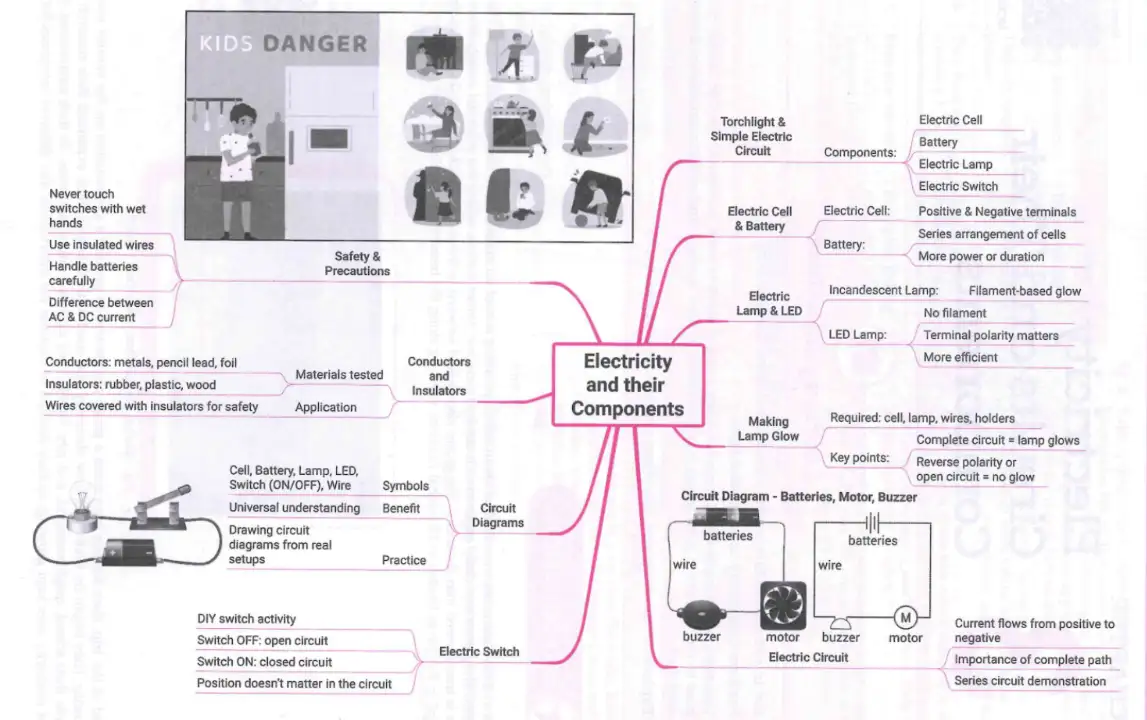
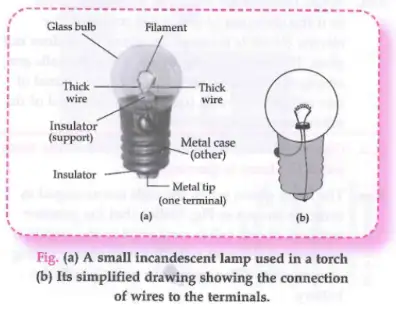
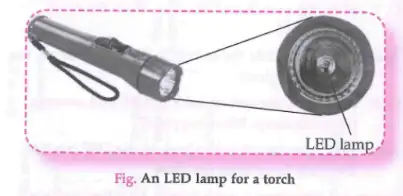
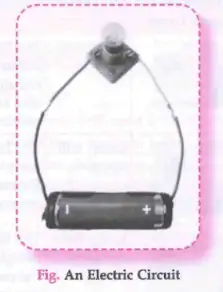
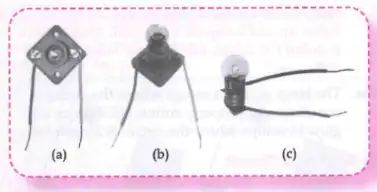
An electric circuit consists of several key components that work together to allow the flow of electric current. These include electric cells or batteries which provide the electrical energy, lamps (incandescent or LED) that convert electrical energy into light, switches that control the flow of current by opening or closing the circuit, and wires that connect all components and allow current to flow.
Conductors and Insulators
Conductors are materials that allow electric current to pass through them easily, such as metals and graphite (pencil lead). Insulators, like rubber and plastic, do not allow current to flow and are used to cover wires for safety to prevent electric shocks.
Safety Precautions
When handling electrical devices, it is important to avoid touching switches or wires with wet hands, use insulated wires, and handle batteries carefully to prevent accidents and electric shocks.
Making a Lamp Glow
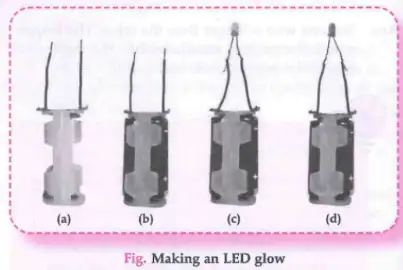
To make a lamp glow, a complete electric circuit must be formed by connecting the lamp terminals to the positive and negative terminals of a cell or battery using wires. The circuit must be closed, allowing current to flow through the lamp's filament or LED, causing it to emit light.
Circuit Diagrams and Symbols
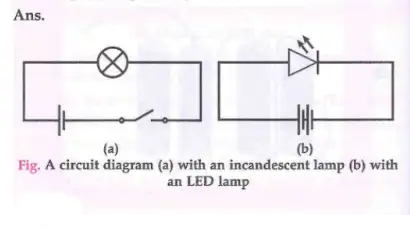
Circuit diagrams use standard symbols to represent components like cells, batteries, lamps, switches, and wires. These symbols help in understanding and designing circuits. For example, a cell is shown as a pair of lines (long for positive, short for negative), a battery as multiple such pairs, a lamp as a circle with a cross, and switches as breaks or connections in a line.
Electric Switch
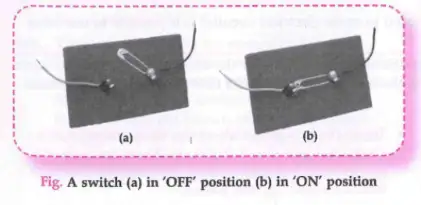
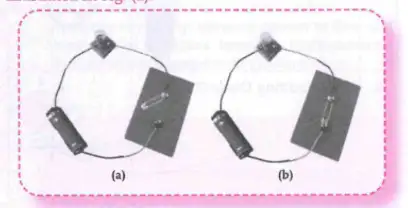
A switch controls the flow of electricity in a circuit by opening (OFF) or closing (ON) the circuit. When the switch is closed, current flows and the lamp glows; when open, the circuit is broken and the lamp goes off.
Electric Circuits
Electric current flows from the positive terminal to the negative terminal of a cell through a complete path. If the circuit is incomplete or the connections are reversed improperly (especially for LEDs), the lamp will not glow.
Solved Examples
Example 1: Connect a single electric cell to an incandescent lamp using wires. Will the lamp glow if the circuit is complete?
Solution: When the wires connect both terminals of the cell to the lamp terminals forming a closed loop, electric current flows through the filament of the lamp. This causes the filament to heat up and emit light, so the lamp glows.
Example 2: An LED has two legs: a longer positive leg (anode) and a shorter negative leg (cathode). If connected in reverse to a battery, will it glow?
Solution: LEDs allow current to flow only in one direction—from anode to cathode. If connected in reverse, no current flows and the LED will not glow. Correct polarity must be observed.
Example 3: A switch is connected in series with a lamp and a battery. What happens when the switch is opened and closed?
Solution: When the switch is closed, it completes the circuit allowing current to flow and the lamp glows. When the switch is opened, the circuit is broken, current stops flowing, and the lamp goes off.
Practice Set
- Level 1 (Easy): What is the role of a switch in an electric circuit?
- Level 2 (Moderate): Why are wires covered with plastic or rubber insulation?
- Level 3 (Challenging): Draw the circuit diagram for a torchlight using two cells, a switch, and an LED lamp. Explain the flow of current when the switch is ON.
Answer Key
- Level 1: A switch controls the flow of electric current by opening or closing the circuit, turning devices ON or OFF.
- Level 2: Wires are covered with plastic or rubber insulation because these materials are insulators that prevent electric shocks and protect users from accidental contact with live wires.
- Level 3: The circuit diagram shows two cells connected in series to a switch and an LED lamp. When the switch is ON (closed), current flows from the positive terminal of the first cell through the switch, then through the LED (from anode to cathode), and back to the negative terminal of the second cell, completing the circuit and lighting the LED.
Quick Reference Table
Key Terms and Symbols:
- Electric Cell: Source of electrical energy with positive (+) and negative (-) terminals.
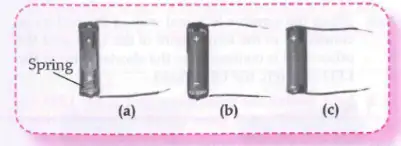
- Battery: Two or more cells connected in series to provide higher voltage.
- Electric Circuit: A closed path through which electric current flows.
- Conductor: Material that allows electric current to pass (e.g., copper wire).
- Insulator: Material that blocks electric current (e.g., rubber, plastic).
- Switch: Device to open or close a circuit.
- Incandescent Lamp Symbol: Circle with a cross inside.
- LED Symbol: Triangle pointing to a line with arrows indicating light emission.
- Cell Symbol: Pair of lines, long for positive, short for negative terminal.
- Battery Symbol: Multiple pairs of cell symbols connected.
Common Mistakes and Misconceptions
- Connecting LED in reverse polarity prevents it from glowing.
- Assuming a circuit is complete without checking all connections can lead to no current flow.
- Touching electrical components with wet hands can cause electric shock.
- Confusing the positive and negative terminals of cells or batteries can cause circuit malfunction.
- Believing that all materials conduct electricity; many materials like rubber and plastic are insulators.
Glossary
- Electricity: Energy resulting from the flow of electric charge.
- Electric Cell: A device that converts chemical energy into electrical energy.
- Battery: A set of two or more electric cells connected together.
- Electric Circuit: A closed loop that allows current to flow.
- Conductor: Material that permits the flow of electric current.
- Insulator: Material that resists the flow of electric current.
- Switch: A device that can open or close an electric circuit.
- Incandescent Lamp: A lamp that produces light by heating a filament.
- LED (Light Emitting Diode): A semiconductor device that emits light when current flows through it.
- Polarity: The direction of current flow determined by positive and negative terminals.