CLASS 6 . SOCIAL SCIENCE . EXPLORING SOCIETY INDIA AND BEYOND . UNITY IN-DIVERSITY-OR-MANY-IN-THE-ONE
Chapter 8 : UNITY IN DIVERSITY, OR MANY IN THE ONE
Ch 8
SOCIAL SCIENCE
CLASS 6
Unity in Diversity or Many in the One
Introduction
The chapter "Unity in Diversity", or "Many in the One" explores how India’s vast cultural and social differences come together in harmony. It starts by looking at the concept of unity within diversity, inspired by thinkers like Rabindranath Tagore and Sri Aurobindo. The chapter highlights different parts of Indian culture, such as languages, food, clothing, festivals, and literature, showing how these diverse elements share common roots. Through various examples, it illustrates how India’s diversity strengthens its unity, rather than creating division.
Fundamental Facts
Pt. Jawaharlal Nehru, India’s first Prime Minister, coined the phrase “Unity in Diversity” in his book “The Discovery of India” in 1946.
A Rich Diversity
Diversity generally means difference among different people on the basis of lifestyle, culture, tradition and food habits, etc. We are describing the other positive aspects of diversity in this chapter. We try to find how India is such a very diverse nation since its independence.
When travelling by rail across India, you’ll observe not just the country’s shifting landscapes but also a wide variety of clothing and cuisine; you’ll also hear several languages, including one’s own, and observe various scripts along the route. Even in your local area, you will frequently encounter individuals from other Indian regions with distinct customs and customs. This is the great diversity of India, and typically the first thing that foreigners notice about our nation.
With more over 1.4 billion people living there—roughly 18% of the global population—such diversity is hardly shocking! The Anthropological Survey of India, a national organisation, surveyed 4,635 groups in all the nation’s states as part of the huge ‘People of India project’ in the latter half of the 20th century. It counted 325 languages using 25 different scripts and noted that many Indians could be considered migrants as they no longer reside in the same area as their birthplace or native village.
What does the phrase ‘unity in diversity’ mean? How are we going to understand and communicate this togetherness, this ‘Many in the One’? We shall investigate a few facets of Indian life in order to respond to this query.
Food for All
There must be thousands, if not millions, of distinct cuisines and preparations to sample in India!
However, some food grains are found practically everywhere in the nation. Pulses like different types of dals and grams; cereals like rice, barley, and wheat; and millets including pearl millet (bajra), sorghum (jowar), and finger millet (ragi).
Since the majority of Indians eat these as their staple diet, they are collectively referred to as ‘staple grains’.
In a similar vein, common spices like ginger, cardamom, cumin and turmeric are also utilised all over the nation. We could add some common foods, common oils, etc. to this list.
We may thus observe how the same components (unity) can be employed in a multitude of ways (diversity) to create an infinite number of different cuisines.
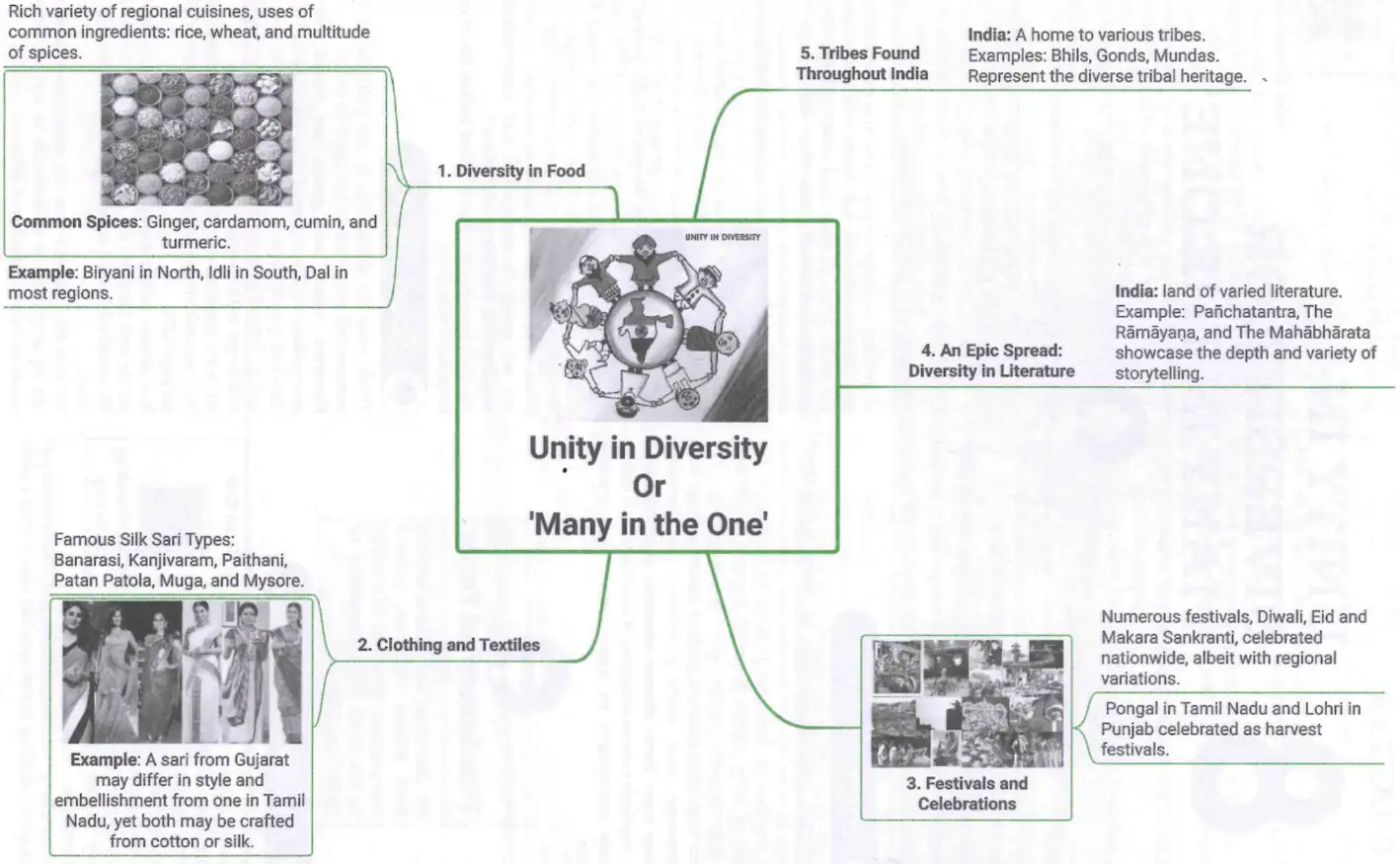
The image is a mind map titled "Unity in Diversity or 'Many in the One'," showing how India is united through its diverse culture. It highlights five areas: food, clothing, festivals, literature, and tribes. Step-by-step explanation: 1. Diversity in Food: India has many regional cuisines using common ingredients like rice, wheat, ginger, and spices. Examples are Biryani in the North and Idli in the South. 2. Clothing and Textiles: Different silk sari types represent regions, like Banarasi and Mysore saris. Styles differ but often use cotton or silk. 3. Festivals and Celebrations: Various festivals like Diwali and Eid are celebrated across India, with special regional harvest festivals like Pongal and Lohri. 4. Diversity in Literature: Indian literature is rich and varied, with famous epics like the Rāmāyaṇa and Mahābhārata showcasing storytelling traditions. 5. Tribes: India is home to many tribes such as Bhils and Gonds, reflecting its tribal heritage.
Textiles and Clothing
In India, every culture and region has created its own distinct dress and dressing codes. Regardless of the material, there is a commonality among various classic Indian costumes. One prominent example is the simple length of cloth known as the sari, which is used as a sort of apparel in most of India and is made primarily of cotton or silk, but synthetic fabrics are sometimes used these days. Famous silk sari types include Banarasi, Kanjivaram, Paithani, Patan Patola, Muga, and Mysore. Cotton saris come in an abundance of varieties. This piece of unstitched fabric is available in hundreds of variations overall.
They are made using various weaving and designing techniques. While some designs are printed on the cloth after it has been woven, others are woven into the fabric. Last but not least, the colours, which are created using a variety of pigments, are infinitely varied.
The sari has a long history. Since sari styles differ from one area or group to another, there are numerous ways to wear them.
In fact, creative new ways to drape it are always being developed. However, the sari is ultimately only one outfit.
Festivals Galore
India hosts a staggering array of festivities. Though they go by different names, you may have noticed that a few common ones are observed virtually simultaneously throughout India. We shall use only one example, Makara Sankranti, which falls on or around 14 January and signifies the start of the harvest season in many parts of India.
An Epic Spread
Another excellent example of unity in diversity may be found in literature. Indian literatures are among the most varied and prolific in the world. Despite variations in language, style and other aspects, they have shared significant themes and concerns for millennia.
The fascinating stories of Pañchatantra, which feature animals as the primary characters, impart valuable life skills to us. Though the stories in the Sanskrit book are at least 2,200 years old, they have been translated into nearly every Indian language. They have actually travelled far beyond India, touching down in Southeast Asia, the Arab world, and Europe, serving as inspiration for other story collections along the way.
India’s two epics — the Rāmāyaṇa and the Mahābhārata. These two epics have been translated or altered for use in Indian and other regional languages. There are also countless folk renditions of these.
Tribes found throughout India, including the Bhils, Gonds, Mundas, and many others. The majority of tribes in the northeastern and Himalayan regions of India, including Kashmir, have their own interpretations of both or either of the two epics. These versions are passed down orally among the tribes, along with stories of how the heroes of the Ramayana and the Mahabharata came to visit their respective locations.
Indian culture values diversity as a source of enrichment, but it never loses sight of the fundamental oneness that is the foundation for that diversity.
Keywords
- Relief: A design that stands out from the surface of a panel (which may be of stone, wood, ceramic or another material).
- Diversity: The wide variety of something.
- Epic: A long poem generally narrating the adventures of heroes and other great figures of the past.
- Anthropological: The study of human beings and their ancestors.
- Staple food: A food eaten frequently and make up of large part of a person’s diet.
- Tradition: A belief or custom handed down from one generation to another.
• India is incredibly diverse in terms of its people, places, attire, cuisine, holidays, festivals, and customs.
• In many domains, diversity is evident, yet there is also a fundamental commonality.
• India’s unity honours diversity because it enhances rather than divides.
• The anthropologist K.S. Singh directed the ‘People of India’ project.
• The sari has a long history.
Solved Examples
Example 1: Explain the meaning of "Unity in Diversity" in the context of India.
Answer: "Unity in Diversity" means that despite the vast differences in culture, language, food, clothing, and traditions across India, there is a fundamental unity that binds the country together. This unity is reflected in shared values, common ingredients in food, and the celebration of festivals across regions, showing harmony among diversity.
Example 2: Name some staple grains common across India and explain their significance.
Answer: Staple grains common across India include pulses like dals and grams; cereals like rice, barley, and wheat; and millets such as pearl millet (bajra), sorghum (jowar), and finger millet (ragi). These grains form the basic diet for most Indians and represent unity in the diversity of Indian cuisine.
Practice Set
Easy
- What does the phrase "Unity in Diversity" mean?
- Name two famous silk sari types from India.
- Which festival marks the start of the harvest season in many parts of India?
Moderate
- Describe how Indian literature reflects unity in diversity.
- List three common spices used throughout India.
- Explain the significance of the ‘People of India’ project.
Challenging
- Discuss how the diversity of food in India demonstrates unity.
- Explain the role of tribal interpretations of epics in Indian culture.
- Analyze how clothing styles across India reflect both diversity and unity.
Answer Key
Easy
- It means that India is a country where many different cultures, languages, and traditions exist together in harmony.
- Banarasi and Mysore saris.
- Makara Sankranti.
Moderate
- Indian literature includes many languages and styles but shares common themes and stories like the Ramayana and Mahabharata, showing unity in diversity.
- Ginger, cardamom, cumin, turmeric.
- The ‘People of India’ project surveyed thousands of groups to document India’s vast cultural diversity.
Challenging
- Though ingredients like rice and spices are common, they are used in many different ways to create diverse regional cuisines, showing unity in diversity.
- Tribal versions of epics are passed down orally and connect tribal cultures to the larger Indian cultural heritage.
- Different regions have unique clothing styles and fabrics, but common elements like the sari show cultural unity.
Quick Reference
- Unity in Diversity: Concept that India’s diverse cultures coexist harmoniously.
- Staple Grains: Common food grains like rice, wheat, and millets eaten across India.
- Sari: Traditional Indian garment worn in many styles across regions.
- Makara Sankranti: Harvest festival celebrated widely in India.
- People of India Project: Anthropological survey documenting India’s cultural diversity.
Glossary
- Relief
- A design that stands out from the surface of a panel (stone, wood, ceramic, etc.).
- Diversity
- The wide variety of something.
- Epic
- A long poem narrating adventures of heroes and great figures of the past.
- Anthropological
- The study of human beings and their ancestors.
- Staple Food
- A food eaten frequently and making up a large part of a person’s diet.
- Tradition
- A belief or custom handed down from one generation to another.
| Time Period / Year | Event / Change | Importance |
|---|---|---|
| 1946 | Pt. Jawaharlal Nehru coins the phrase "Unity in Diversity" in "The Discovery of India" | Popularized the concept of India’s cultural unity despite diversity. |
| Late 20th Century | ‘People of India’ project conducted by Anthropological Survey of India | Documented India’s vast cultural and linguistic diversity. |
| Ancient Times | Creation of epics Ramayana and Mahabharata | Shared literary heritage uniting diverse cultures. |