CLASS 6 . SOCIAL SCIENCE . EXPLORING SOCIETY INDIA AND BEYOND . TIMELINE AND-SOURCES-OF-HISTORY
Chapter 4 : TIMELINE AND SOURCES OF HISTORY
Ch 4
SOCIAL SCIENCE
CLASS 6
Introduction to History
Understanding the past helps us make sense of the present and shape the future. To know our history is necessary to improve our present and future. Learning about the past makes us aware of the mistakes our ancestors made, their achievements, and various significant events. However, learning about the past is not straightforward; it requires a systematic approach and the use of various sources. Let’s explore how we learn about the past in history.
How Is Time Measured in History?
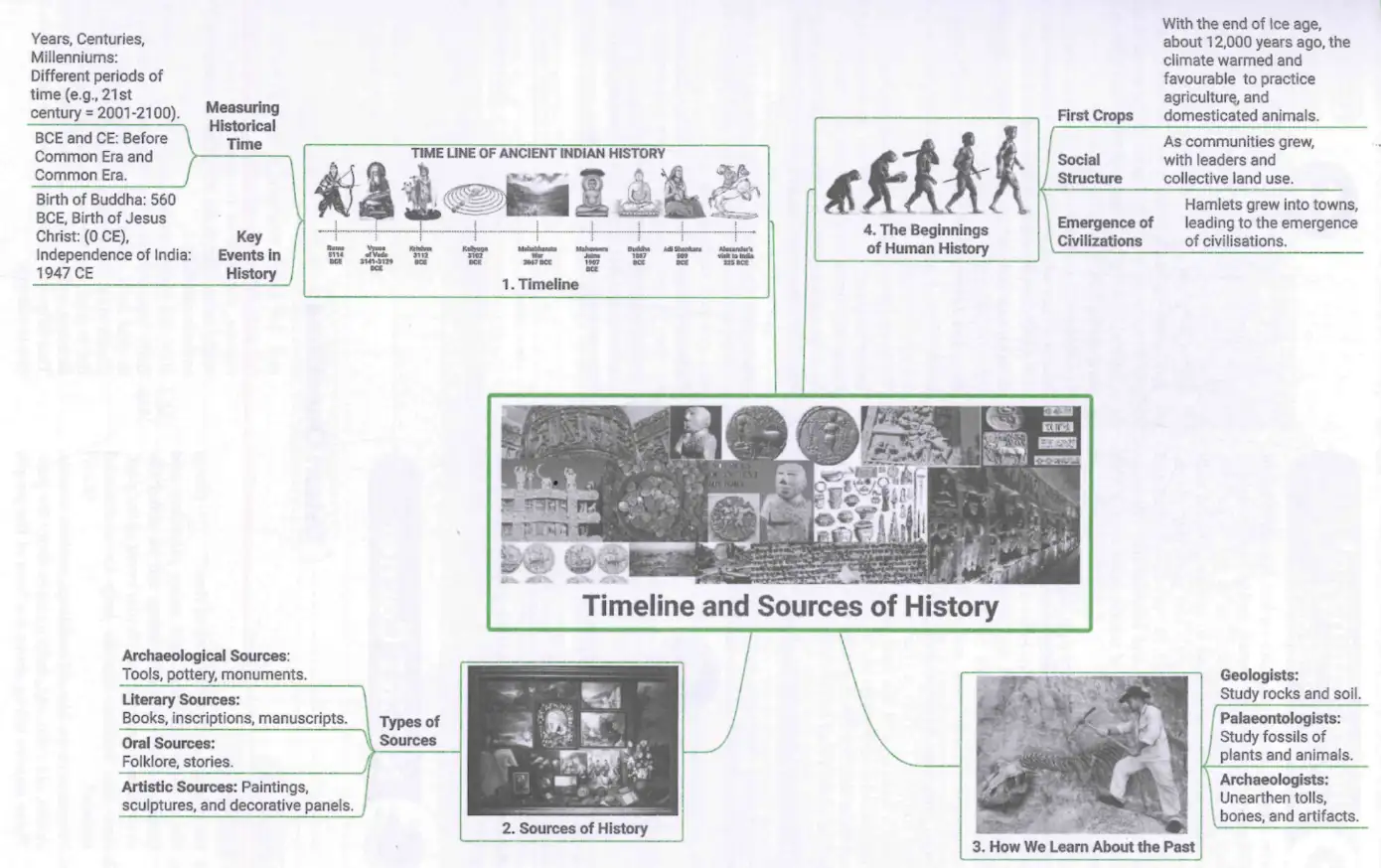
Different cultures have used their own methods to measure time, often starting new eras with significant events. Today, the Gregorian calendar is widely used, but other calendars like Hindu, Muslim, and Chinese calendars are also important for festivals and special events. This calendar is based on the Western understanding of time, where the birth of Jesus Christ is taken as the starting point.
- Common Era (CE) and Before Common Era (BCE):
CE refers to years after the birth of Jesus, previously marked as “AD”.
BCE refers to years before Jesus’ birth, previously marked as “BC”.
Example: India’s independence in 1947 is written as 1947 CE. - Timelines: These help visualise the order of historical events, showing sequences from ancient times to the present.
Sources of History
Every object or structure tells a story and can be seen as a piece of a puzzle that helps us understand history. However, some pieces of the historical puzzle may be missing. Altogether, these objects and structures are great sources that help us know about our past.
- Types of Sources: Historians use sources like monuments, inscriptions, trade items, and written records to study the past. Sometimes these sources are very useful, but sometimes they can be misleading. Therefore, historians must decide which to trust.
Exam Question
Q: Why do historians need to be careful when using historical sources?
A: Because some sources can be misleading, historians must critically evaluate and decide which sources are trustworthy to accurately understand the past.
Categories of Sources of History
The sources of history can be divided into four broad categories:
- Oral Sources: Passed down through speech, such as folklore, legends, and genealogies.
- Archaeological Sources: Structures like monuments and mounds, inscriptions, and artifacts excavated over time, such as tools, weapons, pottery, and remains of humans, animals, and plants (fossils).
- Artistic Sources: Reflect the artistic skills of the past and include paintings, sculptures, and decorative panels.
- Literary Sources: All written literature, whether by native writers or foreigners, produced over time.
Exam Question
Q: Name the four broad categories of sources of history.
A: Oral sources, archaeological sources, artistic sources, and literary sources.
Who Studies History?
Historians work with experts like archaeologists, epigraphists, and anthropologists. Scientific studies and technology such as television and the internet also provide valuable insights, especially for recent history.
Exam Question
Q: Which experts assist historians in studying history?
A: Archaeologists, epigraphists, anthropologists, and scientists assist historians in studying history.
The Beginnings of Human History
Modern humans, known as Homo sapiens, have existed for approximately 300,000 years, which is a small part of Earth’s history. To trace history before them, we look back to early humans who lived in groups, helped each other survive by hunting animals and gathering plants. They lived in temporary shelters like caves, used fire, and made tools such as stone axes and arrowheads. They also created rock paintings depicting animals and humans.
- First Crops: After the last Ice Age, about 12,000 years ago, the climate warmed, making life easier. Favorable conditions helped humans settle down, practice agriculture, and domesticate animals like cattle and goats. They often lived near rivers because the soil was fertile, making farming easier.
- Social Structure: As communities grew, they became more complex. Leaders or chieftains took care of the group’s welfare, and land was used collectively. Villages exchanged goods like food, clothing, and tools, and new technologies such as pottery and metalworking developed.
- Emergence of Civilisations: Over time, hamlets grew into towns, leading to the emergence of civilisations. Despite many challenges, early humans’ courage and persistence allowed them to survive and progress.
Exam Question
Q: How did the end of the Ice Age influence human history?
A: The end of the Ice Age brought warmer climate conditions that allowed humans to settle, practice agriculture, domesticate animals, and develop complex social structures, leading to the emergence of civilisations.
Key Dates in Human History
| Time Period / Year | Event / Change | Importance |
|---|---|---|
| About 300,000 years ago | Emergence of modern humans (Homo sapiens) | Beginning of anatomically modern humans who are ancestors of present-day humans |
| Around 10,000 to 12,000 years ago | End of the last Ice Age | Climate warming enabled agriculture, animal domestication, and growth of human settlements |
Glossary
- Afterlife: A life that begins after death.
- Archaeologist: A person who studies human history and prehistory through excavation and analysis of physical remains.
- Era: A distinct period of time.
- Folklore: Traditional beliefs, customs, and stories passed down orally through generations.
- Gregorian calendar: The calendar now used internationally.
- Hamlet: A small settlement or village.
- Historian: A person who studies and writes about the past.
- History: The study of the human past.
- Inscriptions: Words or texts written or cut into materials such as stone or metal.
- Source of history: A place, person, text, or object from which information about past events or periods is gathered.
- Geologist: A scientist who studies the Earth and its features like soil, hills, rivers, seas, oceans, and mountains.
- Paleontologist: A scientist who studies remains of plants, animals, and humans preserved as fossils.
- Anthropologist: A scientist who studies human societies and cultures.
Solved Examples
Example 1
Question: What are the main types of sources historians use to study the past?
Answer: Historians use oral sources (like folklore), archaeological sources (like monuments and artifacts), artistic sources (like paintings and sculptures), and literary sources (like written records).
Example 2
Question: Why is the Gregorian calendar widely used in history?
Answer: The Gregorian calendar is widely used because it is internationally accepted and based on the birth of Jesus Christ, which serves as a common reference point for measuring historical time.
Practice Set
Easy
- What does BCE stand for in historical dating?
- Name one example of an oral source of history.
Moderate
- Explain why historians need to evaluate sources carefully.
- Describe the significance of the end of the Ice Age in human history.
Challenging
- Discuss the role of different experts who assist historians in studying history.
- Explain how the emergence of agriculture influenced social structures in early human communities.
Answer Key
- Easy 1: Before Common Era
- Easy 2: Folklore
- Moderate 1: Because some sources can be misleading, historians must critically evaluate and decide which sources are trustworthy to accurately understand the past.
- Moderate 2: The end of the Ice Age brought warmer climate conditions that allowed humans to settle, practice agriculture, domesticate animals, and develop complex social structures.
- Challenging 1: Experts such as archaeologists, epigraphists, anthropologists, and scientists assist historians by providing specialized knowledge and techniques to study artifacts, inscriptions, human societies, and scientific data.
- Challenging 2: Agriculture allowed humans to settle in one place, leading to larger communities, the development of leadership roles, collective land use, trade, and technological advancements like pottery and metalworking.
Quick Reference
- History is the study of the human past using various sources.
- Time in history is measured using calendars like the Gregorian calendar, with CE and BCE as key markers.
- Sources of history include oral, archaeological, artistic, and literary types.
- Experts such as archaeologists and anthropologists help historians interpret the past.
- The end of the Ice Age was a turning point leading to agriculture and the rise of civilisations.