CLASS 6 . SOCIAL SCIENCE . EXPLORING SOCIETY INDIA AND BEYOND . THE VALUE-OF-WORK
Chapter 13 : THE VALUE OF WORK
Ch 13
SOCIAL SCIENCE
CLASS 6
THE VALUE OF WORK
Introduction
In our daily lives, we perform various activities that can be broadly classified into two categories: economic activities and non-economic activities.
Economic activities
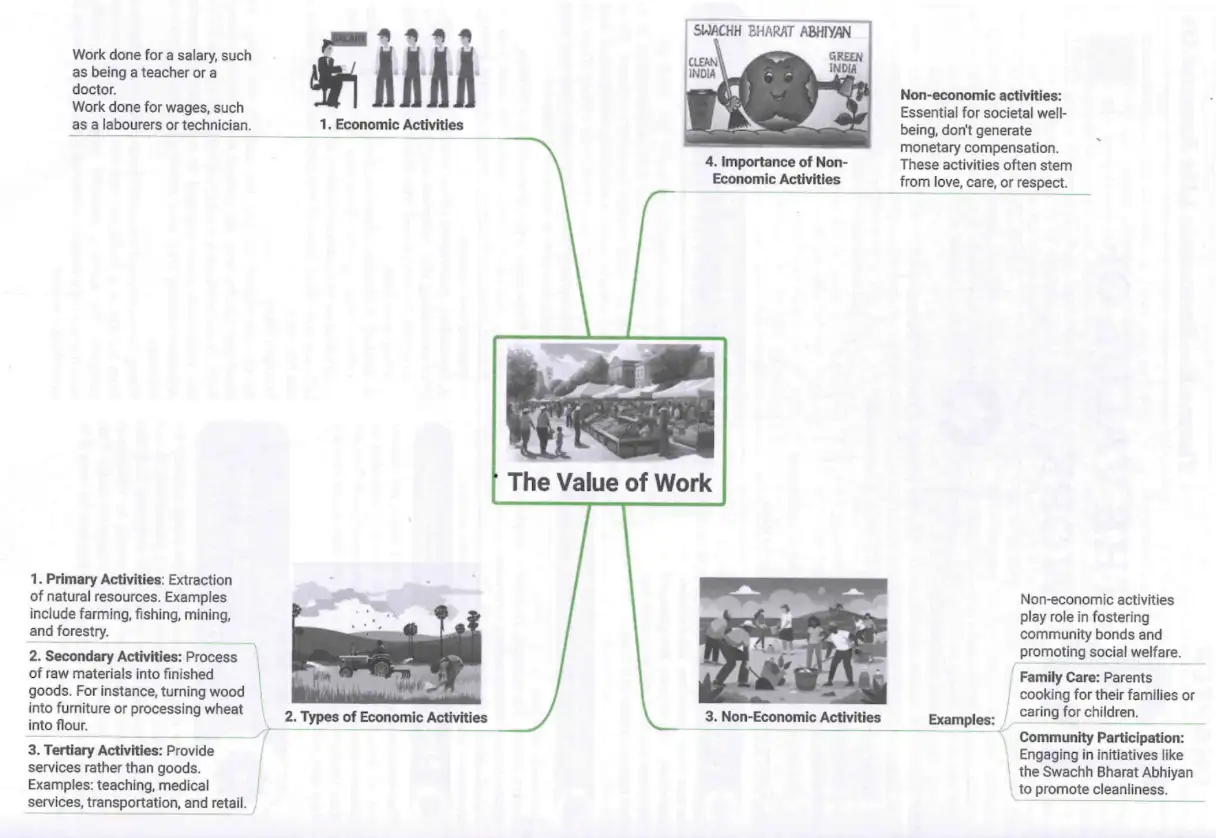
Economic activities are those in which people work to earn money. Examples include a shopkeeper selling school bags, a farmer selling vegetables at the market, or a truck driver delivering goods. These activities involve earning wages or salaries in exchange for services or goods provided.
Non-economic activities
Non-economic activities are performed out of love, care, or respect and are not intended to generate income. For example, parents cooking food for their family or helping children with homework do so without expecting payment.
Example to understand economic and non-economic activities
Geeta Aunty is an Air Force pilot who earns a salary for her job, which is an economic activity. Anu’s brother Rohan works for a software company and receives a salary. However, on weekends, he volunteers to teach computer skills at a youth programme. This teaching is a non-economic activity because it is done to help others without payment.
Types of Economic Activities
Economic activities involve actions undertaken to earn money or payment and contribute to the production, distribution, and consumption of goods and services. They help people meet their needs and wants through exchange.
There are three main types of economic activities:
- Primary Activities: These involve extraction of natural resources such as farming, fishing, mining, and forestry.
- Secondary Activities: These involve manufacturing or processing raw materials into finished goods, for example, turning wood into furniture or processing wheat into flour.
- Tertiary Activities: These involve providing services rather than goods, such as teaching, medical services, transportation, and retail.
Example Story Illustrating Economic Activities
Kavya visited her aunt in the village of Kamlapur and observed a new highway being built. The construction workers operating machines like bulldozers were engaged in secondary economic activities as they were creating infrastructure.
Kavya’s uncle works as a bulldozer operator for a construction company and earns a monthly salary, which is a tertiary economic activity since it involves providing a service.
Kavya’s aunt works at the village post office and conducts online classes charging fees, both examples of tertiary economic activities.
At a mango orchard, a farm labourer named Sahil uses a tractor to till the land, which is a primary economic activity. He earns wages and sometimes receives payment in kind, such as mangoes.
The Importance of Non-Economic Activities
Non-economic activities are performed not for money but out of love, care, or duty. Though they do not involve financial transactions, they are vital for social cohesion and community well-being.
Examples of Non-Economic Activities
- Seva (Selfless Service): Seen in religious places like temples, gurudwaras, mosques, and churches. For example, the langar at a gurudwara serves free food to all, fostering community spirit.
- Community Participation: Initiatives like the Swachh Bharat Abhiyan (Clean India Mission) involve citizens cleaning public spaces without expecting payment.
- Environmental Awareness: The Van Mahotsav (Festival of Forests) encourages tree plantation drives to conserve forests and build unity.
Keywords
- Money’s Worth: The value of something based on its usefulness or benefit to a person.
- Market: A place where goods and services are bought and sold, usually using money but sometimes by barter.
- Fee: Payment given for professional services, such as to a doctor or lawyer.
- Salary: Regular monthly payment to an employee for their work.
- Payment in Kind: Compensation given in goods or services instead of money.
- Wage: Payment to a worker calculated by hour, day, or week.
Solved Examples
Example 1:
Question: Identify whether the following activities are economic or non-economic: (a) A teacher receiving salary, (b) A mother cooking food for her family.
Answer: (a) Economic activity because the teacher earns a salary. (b) Non-economic activity because the mother cooks out of care, not for payment.
Example 2:
Question: Classify the following as primary, secondary, or tertiary economic activities: (a) Fishing, (b) Making furniture, (c) Transporting goods.
Answer: (a) Primary activity (extracting natural resources), (b) Secondary activity (manufacturing), (c) Tertiary activity (providing services).
Practice Set
Easy
- Define economic activities.
- Give two examples of non-economic activities.
Moderate
- Explain the three types of economic activities with examples.
- Why are non-economic activities important for society?
Challenging
- Describe a day in the life of a person involved in all three types of economic activities.
- Discuss how payment in kind differs from wages and salary.
Answer Key
- Economic activities are work done to earn money or payment.
- Examples of non-economic activities: helping family members, volunteering in community service.
- Primary activities involve natural resource extraction (farming, fishing). Secondary activities involve manufacturing (making furniture). Tertiary activities involve services (teaching, transportation).
- Non-economic activities build social bonds, promote care and respect, and support community welfare.
- A person might farm in the morning (primary), work in a factory in the afternoon (secondary), and provide tutoring in the evening (tertiary).
- Payment in kind is compensation with goods or services, while wages and salary are monetary payments.
Quick Reference
- Economic Activities: Work done for earning money.
- Non-Economic Activities: Work done out of love or duty without payment.
- Primary Activities: Extracting natural resources.
- Secondary Activities: Manufacturing goods.
- Tertiary Activities: Providing services.
- Payment in Kind: Compensation in goods or services.
Glossary
- Economic Activities
- Activities performed to earn money or payment.
- Non-Economic Activities
- Activities done without expectation of payment, often out of care or duty.
- Primary Activities
- Activities involving extraction of natural resources.
- Secondary Activities
- Activities involving manufacturing or processing raw materials.
- Tertiary Activities
- Activities involving provision of services.
- Payment in Kind
- Compensation given in goods or services instead of money.