CLASS 6 . SOCIAL SCIENCE . EXPLORING SOCIETY INDIA AND BEYOND . THE BEGINNINGS-OF-INDIAN-CIVILISATION
Chapter 6 : THE BEGINNINGS OF INDIAN CIVILISATION
Ch 6
SOCIAL SCIENCE
CLASS 6
THE BEGINNINGS OF INDIAN CIVILISATION
Introduction
Civilisation marks the transition of early humans from nomadic lifestyles to settled communities. Ancient history witnessed many such civilisations, one of which flourished in the Indian subcontinent. This chapter explores the characteristics that define a civilisation and traces its evolution in the Indian subcontinent.
What is a Civilisation?
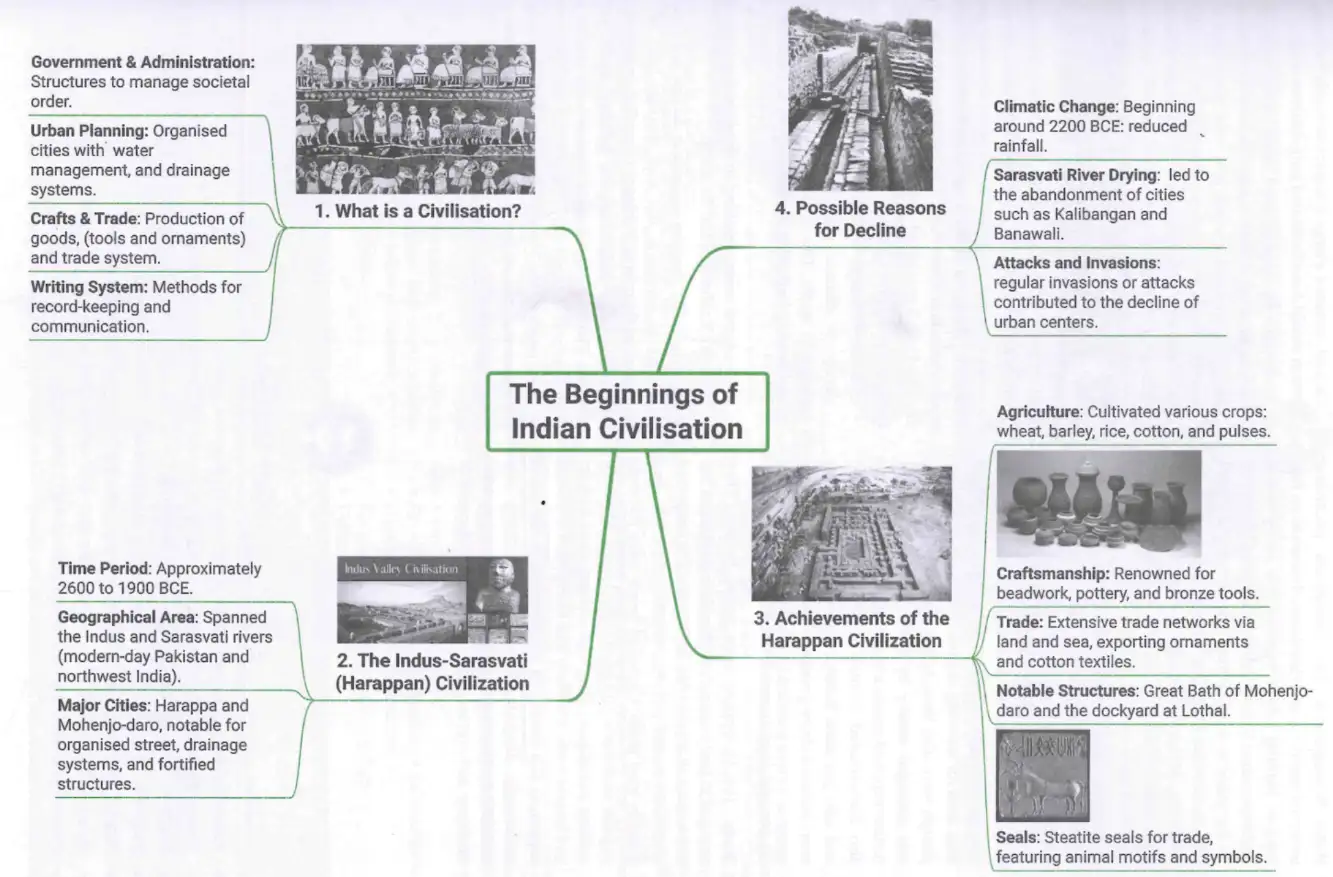
A civilisation is an advanced stage of human societies characterised by several key features:
- Government and administration: To manage complex societies.
- Urbanism: Town planning, growth, and management of cities.
- Variety of crafts: Management of raw materials and production of finished goods.
- Trade: Internal and external exchange of goods.
- Writings: Essential for record keeping and communication.
- Cultural ideas: Expressed through art, architecture, literature, oral traditions, and social customs.
- Productive agriculture system: To sustain villages and cities.
Civilisations began at different times and places. Notable early examples include the Mesopotamian civilisation around 6,000 years ago and ancient Egypt. The study of civilisation in the Indian subcontinent begins with its northwest region.
Exam Question
Q: What are the key features that define a civilisation?
A: Key features include government and administration, urbanism, variety of crafts, trade, writings, cultural ideas, and a productive agriculture system.
The Harappan Civilisation
The plains of Punjab and Sindh, nourished by the Indus River and its tributaries, were fertile and suitable for agriculture. The Sarasvati River also supported early settlements. Around 3500 BCE, villages grew into towns, and by 2600 BCE, towns developed into cities, marking the beginning of one of the world’s oldest civilisations, known as the Indus, Harappan, Indus–Sarasvati, or Sindhu–Sarasvati civilisation. Its inhabitants are called Harappans, named after the city of Harappa.
Town Planning
The Harappan cities, including Harappa and Mohenjo-daro, were carefully planned with wide streets aligned with cardinal directions. Cities were fortified and divided into the 'upper town' for the elite and the 'lower town' for common people. Large buildings like warehouses and the Great Bath served collective purposes. Construction quality was uniform, and buildings were made of bricks.
Water Management
Water management and cleanliness were priorities. Homes had separate bathing areas connected to a drainage system below the streets. Water sources included wells, ponds, streams, and reservoirs. Mohenjo-daro used brick wells, while Dholavira had large reservoirs.
Agriculture and Eating Habits
Harappans cultivated cereals like barley, wheat, millets, and rice, along with pulses and vegetables. They were the first in Eurasia to grow cotton for weaving clothes. Farming tools like the plough were used. They domesticated animals, practiced fishing, and consumed dairy products, turmeric, ginger, and bananas.
Trade
Harappans engaged in internal and external trade, exporting ornaments, timber, daily-use objects, gold, cotton, and possibly food items. Carnelian beads and shell bangles were popular ornaments. Copper was likely imported. Trade routes included land, rivers, and maritime paths. Lothal had a large dockyard facilitating long-distance trade.
Seals
Small seals made of steatite depicted animal figures and symbols, likely used to identify goods and traders. Their exact meanings remain unclear but are linked to trade activities.
Exam Question
Q: Describe the town planning and water management features of the Harappan civilisation.
A: Harappan cities were carefully planned with wide streets aligned to cardinal directions, fortified with upper and lower towns. Water management included separate bathing areas, drainage systems, and use of wells and reservoirs.
The End or a New Beginning?
Around 1900 BCE, the Sindhu–Sarasvati civilisation began to decline. Cities were abandoned, and inhabitants shifted to rural lifestyles without central government or administration, dispersing into small settlements.
Possible Reasons for Decline
- Climatic Change: From 2200 BCE, reduced rainfall and drier spells made agriculture difficult, impacting food supply.
- Sarasvati River Drying: The drying of the Sarasvati River led to abandonment of cities like Kalibangan and Banawali.
Earlier theories of warfare or invasions have been disproven due to lack of evidence. The decline is attributed mainly to environmental changes. Despite city abandonment, Harappan culture and technology influenced subsequent Indian civilisation phases.
Exam Question
Q: What were the main reasons for the decline of the Harappan civilisation?
A: The main reasons were climatic changes causing reduced rainfall and drying of the Sarasvati River, leading to agricultural challenges and city abandonment.
Key Dates
| Time Period / Year | Event / Change | Importance |
|---|---|---|
| About 6,000 years ago | Mesopotamian Civilisation began | One of the earliest known civilisations |
| Around 2600 BCE | Harappan or Sindhu–Sarasvati Civilisation began | Start of first urbanisation in Indian subcontinent |
| 1920–21 | Excavation of Harappa | Discovery of ancient city |
| 1921–22 | Excavation of Mohenjo-daro | Uncovering of major Harappan city |
| 1924 | Identification of Harappa and Mohenjo-daro | Recognition of Indus Valley Civilisation |
| Around 1900 BCE | Decline of Harappan Civilisation | Transition to rural settlements |
| From 2200 BCE | Climatic change | Environmental impact on civilisation |
Keywords
- Cardinal direction: One of the four main directions: north, south, east, and west.
- Elite: Higher layers of society such as rulers, officials, and priests.
- Excavate: To dig out.
- Fortification: A massive wall surrounding a settlement or city for protection.
- Metallurgy: The technique of extracting and studying metals.
- Reservoir: A large natural or artificial lake used as a water source.
- Settlement: A place where people establish a community.
- Tributary: A river that flows into a larger river or lake.
- Warehouse: A large building used for storing products.
Solved Examples
Example 1
Question: Explain the significance of the Great Bath found in Mohenjo-daro.
Answer: The Great Bath is believed to have been used for ritual bathing or social purposes, indicating the importance of water management and cleanliness in Harappan society.
Example 2
Question: What evidence suggests that the Harappans were engaged in trade?
Answer: The presence of seals with animal figures, crafted ornaments like carnelian beads, and the dockyard at Lothal indicate active trade within and beyond the civilisation.
Practice Set
Easy
- Define civilisation.
- Name two major cities of the Harappan civilisation.
Moderate
- Describe the town planning features of Harappan cities.
- List the main agricultural products cultivated by the Harappans.
Challenging
- Explain the possible reasons for the decline of the Harappan civilisation.
- Discuss the role of trade in the Harappan civilisation.
Answer Key
Easy
- Civilisation is an advanced stage of human society with features like government, urbanism, crafts, trade, writings, culture, and agriculture.
- Harappa and Mohenjo-daro.
Moderate
- Harappan cities had wide streets aligned to cardinal directions, were fortified, divided into upper and lower towns, and had uniform brick buildings.
- Barley, wheat, millets, rice, pulses, vegetables, and cotton.
Challenging
- Climatic changes causing reduced rainfall, drying of the Sarasvati River, and environmental challenges led to decline.
- Trade involved exchange of goods like ornaments, timber, cotton, and use of seals and dockyards, facilitating economic growth.
Quick Reference
- Harappan Civilisation: One of the world’s earliest urban civilisations located in the Indus Valley.
- Urban Planning: Cities with planned streets, drainage, and fortifications.
- Agriculture: Cultivation of cereals, pulses, and cotton.
- Trade: Internal and external trade supported by seals and dockyards.
- Decline: Due to climatic changes and drying of rivers.
Glossary
- Cardinal direction
- One of the four main directions: north, south, east, and west.
- Elite
- Higher layers of society such as rulers, officials, and priests.
- Excavate
- To dig out.
- Fortification
- A massive wall surrounding a settlement or city for protection.
- Metallurgy
- The technique of extracting and studying metals.
- Reservoir
- A large natural or artificial lake used as a water source.
- Settlement
- A place where people establish a community.
- Tributary
- A river that flows into a larger river or lake.
- Warehouse
- A large building used for storing products.