CLASS 6 . SOCIAL SCIENCE . EXPLORING SOCIETY INDIA AND BEYOND . OCEANS AND-CONTINENTS
Chapter 2 : Oceans and Continents
Ch 2
SOCIAL SCIENCE
CLASS 6
Oceans and Continents
Everything on Earth revolves around the ocean, which covers nearly seven-tenths of the Earth's surface. This vast coverage of water is why Earth is often called the "blue planet." The continents and oceans together shape the Earth's climate and support all forms of life.
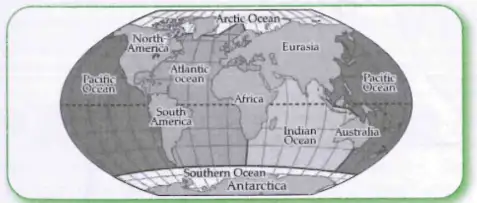
Oceans
Oceans are the largest bodies of water on the globe. The five main oceans are the Pacific Ocean, Atlantic Ocean, Indian Ocean, Southern Ocean, and Arctic Ocean.
- Pacific Ocean: The largest ocean, covering one-third of the Earth's surface. It is round in shape and surrounded by North America, South America, Australia, and Asia. The Mariana Trench, the lowest point on Earth, lies beneath it.
- Atlantic Ocean: The second largest ocean, shaped like an 'S', bordered by North and South America to the west, and Europe and Africa to the east.
- Indian Ocean: Named after India, it is trapezoidal in shape, bordered by Australia to the east, Africa to the west, and Asia to the north.
- Southern Ocean: Also called the Antarctic Ocean, it surrounds Antarctica from the south.
- Arctic Ocean: Located around the North Pole inside the Arctic Circle, separated from the Pacific Ocean by the Bering Strait, and surrounded by the northern shores of Eurasia and North America.
Exam Question
Q: Name the five main oceans of the world and mention one unique feature of the Pacific Ocean.
A: The five main oceans are the Pacific Ocean, Atlantic Ocean, Indian Ocean, Southern Ocean, and Arctic Ocean. The Pacific Ocean is the largest ocean and contains the Mariana Trench, the lowest point on Earth.
Continents
Continents are large continuous masses of land above the Earth's surface. The seven major continents are Asia, Europe, North America, South America, Africa, Australia, and Antarctica.
- Most of the landmass lies in the Northern Hemisphere.
- Asia is the largest continent; Europe and Asia together form Eurasia.
- Africa is the second largest continent and the only one through which the Tropic of Cancer, Equator, and Tropic of Capricorn pass. It has the Sahara Desert, the world's largest hot desert, and the Nile, the longest river.
- North America is the third largest continent. South America and North America are connected by the Isthmus of Panama.
- The Andes is the world's longest mountain range, and the Amazon is the largest river.
- Australia is the smallest continent and is also called an island continent.
- Antarctica is permanently covered with thick ice sheets. India has research stations named Maitri and Dakshin Gangotri there.
Exam Question
Q: Which continent is the largest, and what is the combined landmass of Europe and Asia called?
A: Asia is the largest continent, and the combined landmass of Europe and Asia is called Eurasia.
The Distribution of Water and Land on the Earth
Oceans contain the majority of Earth's water, but this seawater is salty and not suitable for drinking by most terrestrial animals, including humans. Freshwater, found in glaciers, rivers, lakes, the atmosphere, and underground, makes up a small fraction of Earth's water resources.
Oceans and Disasters
Oceans influence weather patterns, such as the monsoon rains in India, which are vital for agriculture and life. However, oceans can also cause natural disasters like cyclones, which bring intense rainfall and strong winds, damaging coastal areas.
Exam Question
Q: How do oceans affect the climate and cause natural disasters?
A: Oceans regulate climate by controlling water and air currents and bring rainfall like monsoons. They can also cause natural disasters such as cyclones, which bring heavy rain and strong winds.
Tsunami
A tsunami is a massive, violent wave usually caused by an intense earthquake or underwater volcanic eruption. Tsunamis can travel thousands of kilometers and cause widespread destruction by flooding coastal areas.
Exam Question
Q: What is a tsunami and what causes it?
A: A tsunami is a large, powerful wave caused by underwater earthquakes or volcanic eruptions that can flood coastal areas and cause destruction.
Islands
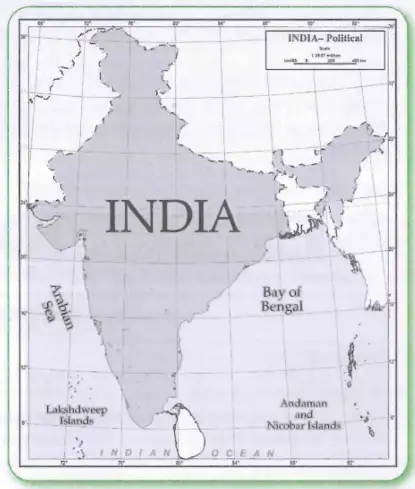
Islands are smaller land masses surrounded by water on all sides. Unlike continents, islands are smaller in size. The world's largest island is Greenland. India has about 1,300 islands, including the Andaman and Nicobar Islands in the Bay of Bengal and the Lakshadweep Islands in the Arabian Sea.
Exam Question
Q: What is the difference between a continent and an island? Name two island groups of India.
A: Continents are large land masses, while islands are smaller land masses surrounded by water. Two island groups of India are the Andaman and Nicobar Islands and the Lakshadweep Islands.
Importance of Oceans and Continents
- Oceans produce nearly half of the oxygen in the atmosphere and are essential for life and climate control.
- The Northern Hemisphere has more land than the Southern Hemisphere.
- Oceans support diverse marine life and influence global climate.
- The United Nations observes June 8 as World Oceans Day to highlight the ocean's importance.
- On December 26, 2004, a powerful tsunami caused by an earthquake in Indonesia affected India and 13 other countries around the Indian Ocean.
- Sea water is salty and unsuitable for drinking by most land animals.
- Disaster management, including the National Disaster Management Authority in India, handles events like tsunamis and cyclones.
Exam Question
Q: Why are oceans important for life on Earth and what measures are taken to manage ocean-related disasters?
A: Oceans produce oxygen, regulate climate, and support marine life. Disaster management authorities, like India's National Disaster Management Authority, handle ocean-related disasters such as tsunamis and cyclones.
Solved Examples
Example 1: Identify the ocean that surrounds Antarctica.
Solution: The Southern Ocean, also called the Antarctic Ocean, surrounds Antarctica.
Example 2: Name the largest continent and the largest ocean on Earth.
Solution: Asia is the largest continent, and the Pacific Ocean is the largest ocean.
Practice Set
Easy
- List the five main oceans of the world.
- Name the seven continents of the Earth.
Moderate
- Explain the significance of the Pacific Ocean.
- Describe the difference between continents and islands.
Challenging
- Discuss how oceans influence the climate and human life.
- Explain the causes and effects of tsunamis.
Answer Key
- Five main oceans: Pacific, Atlantic, Indian, Southern, Arctic.
- Seven continents: Asia, Europe, North America, South America, Africa, Australia, Antarctica.
- Pacific Ocean significance: Largest ocean, contains Mariana Trench, influences climate and marine life.
- Continents are large land masses; islands are smaller land masses surrounded by water.
- Oceans regulate climate, provide oxygen, support marine life, and affect weather patterns.
- Tsunamis are caused by underwater earthquakes or volcanic eruptions and cause flooding and destruction.
Quick Reference
- Oceans: Pacific, Atlantic, Indian, Southern, Arctic.
- Continents: Asia, Europe, North America, South America, Africa, Australia, Antarctica.
- Largest Ocean: Pacific Ocean.
- Largest Continent: Asia.
- Largest Island: Greenland.
- Important Features: Mariana Trench (Pacific Ocean), Sahara Desert (Africa), Nile River (Africa), Andes Mountains (South America), Amazon River (South America).
- Disasters: Cyclones, tsunamis.
Glossary
- Continents: Large continuous land masses on Earth.
- Oceans: Vast bodies of saltwater covering most of Earth's surface.
- Flora: Plant life of a region.
- Fauna: Animal life of a region.
- Marine: Related to the sea or ocean.
- Bay: A broad inlet of the sea where the land curves inward.
- Gulf: A part of the sea nearly surrounded by land.
- Sea: A large body of salty water smaller than an ocean, partly or completely surrounded by land.
- Tsunami: A large sea wave caused by underwater earthquakes or volcanic eruptions.
- Isthmus: A narrow strip of land connecting two larger land areas.
| Time Period / Year | Event / Change | Importance |
|---|---|---|
| 26 December 2004 | Powerful tsunami caused by earthquake in Indonesia | Devastated India and 13 other countries around the Indian Ocean |
| June 8 (Annual) | World Oceans Day | Raises awareness about the importance of oceans |