CLASS 6 . SOCIAL SCIENCE . EXPLORING SOCIETY INDIA AND BEYOND . INDIA THAT-IS-BHARAT
Chapter 5 : INDIA, THAT IS BHARAT
Ch 5
SOCIAL SCIENCE
CLASS 6
India, That Is Bharat
India's history is marked by its evolving names and boundaries, reflecting its rich cultural and historical heritage. The various names used for India over time reveal much about its past and the perceptions of different peoples and cultures.
Introduction to India Names
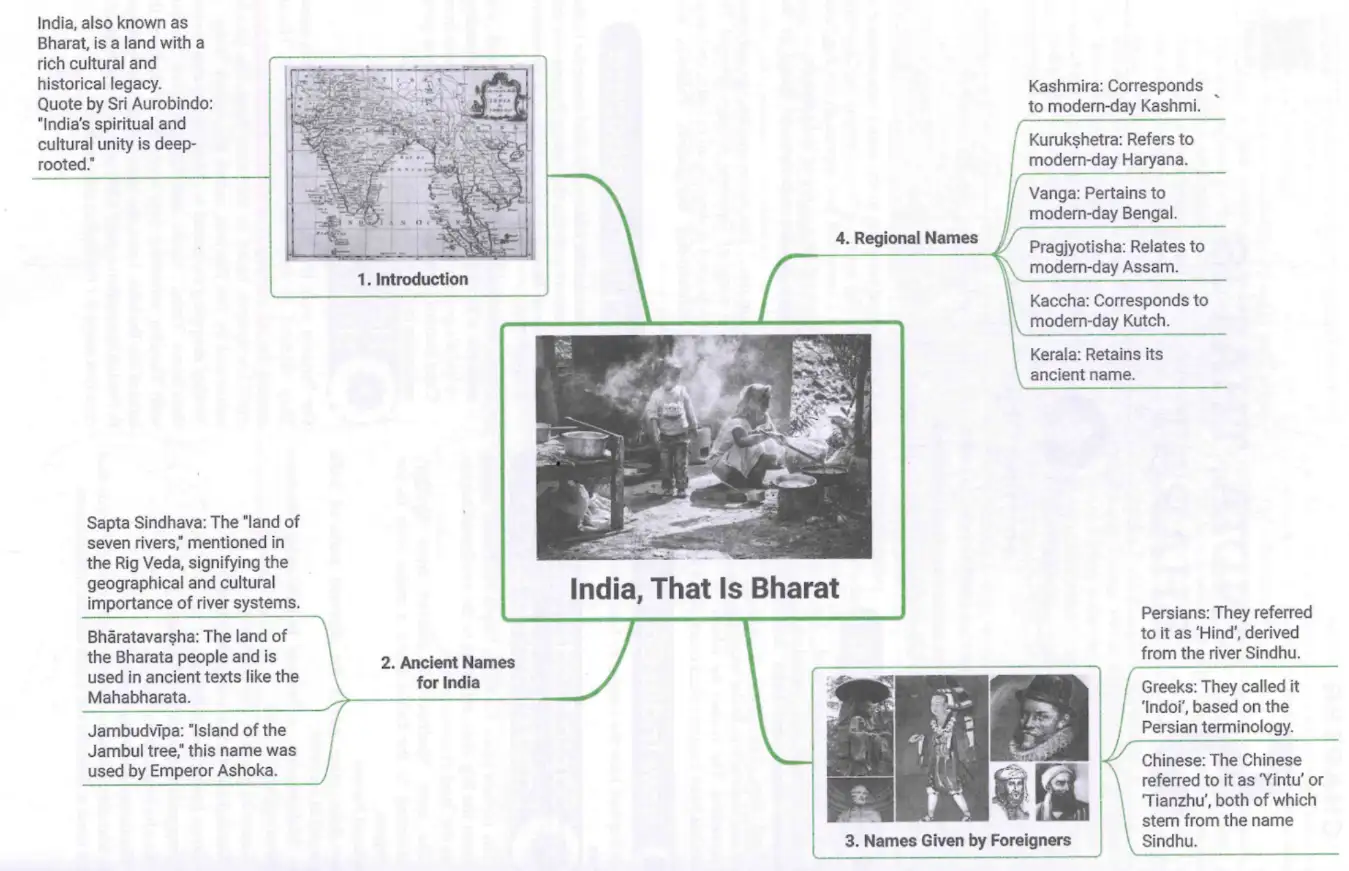
India has been known by different names throughout history, derived from ancient texts, inscriptions, and accounts of travellers. These names provide insights into the geography, culture, and political history of the region.
Exam Question
Q: Why is the study of different names of India important in understanding its history?
A: The different names of India reflect its cultural diversity, historical changes, and the perspectives of various peoples, helping us understand the country's past and identity.
How India Got Its Name
The names for India have evolved over the years, originating from ancient scriptures and foreign influences.
Sapta Sindhava: The Land of Seven Rivers
The earliest name for India is ‘Sapta Sindhava’, mentioned in the Rig Veda, referring to the northwest region as the ‘land of seven rivers’. The term ‘Sindhava’ is derived from ‘Sindhu’, the Indus River, a major river in the region.
Regional Names in Ancient Texts
The Mahabharata, a famous Indian epic, mentions various regions such as Kashmir (modern-day Kashmir), Kurukshetra (modern-day Haryana), Vanga (modern-day Bengal), Pragjyotisha (modern-day Assam), Kaccha (modern-day Kutch), and Kerala (modern-day Kerala). It also refers to the entire subcontinent using terms like ‘Bharatavarsha’ and ‘Jambudvipa’.
Exam Question
Q: What does the term ‘Sapta Sindhava’ signify?
A: ‘Sapta Sindhava’ means the land of seven rivers, referring to the northwest region of India as mentioned in the Rig Veda.
Adoption of Bharata
‘Bharata’ became the widely accepted name for India, appearing in ancient texts like the Vishnu Purana. It is still used today as ‘Bharat’ in North India and ‘Bharatam’ in South India. Other definitions also existed, such as a Tamil poem describing India’s geography from Cape Kumari in the south to the Himalayas in the north.
Exam Question
Q: How is the name ‘Bharata’ significant in Indian history?
A: ‘Bharata’ refers to a group of Vedic people and became the accepted name for India, symbolizing its cultural and historical identity.
How Foreigners Named India
The Persians were the first foreigners to mention India, calling it ‘Hind’, ‘Hidu’, or ‘Hindu’ around the 6th century BCE, based on the Indus River. The Greeks called it ‘Indoi’ or ‘Indike’, dropping the initial ‘h’. The Chinese used terms like ‘Yintu’, ‘Yindu’, and ‘Tianzhu’, the latter reflecting reverence for India as the land of the Buddha. The term ‘Hindustan’ appeared in Persian inscriptions about 1,800 years ago and became a common name for the Indian subcontinent.
Exam Question
Q: What are some of the names given to India by foreign cultures?
A: Persians called it ‘Hind’, Greeks called it ‘Indoi’, and Chinese used ‘Yintu’ or ‘Tianzhu’. The term ‘Hindustan’ was also used in Persian inscriptions.
Key Dates in Indian Naming History
| Time Period / Year | Event / Change | Importance |
|---|---|---|
| 6th century BCE | Persian military campaign mentioning India | First foreign records referring to India as ‘Hind’ |
| 7th century CE | Chinese scholar Xuanzang travels to India | Chinese terms for India like ‘Yindu’ and ‘Tianzhu’ emerge |
| Around 1,800 years ago | First use of ‘Hindustan’ in Persian inscriptions | ‘Hindustan’ becomes a common name for the Indian subcontinent |
Exam Question
Q: When was the term ‘Hindustan’ first used?
A: The term ‘Hindustan’ was first used about 1,800 years ago in Persian inscriptions.
Keywords
- Constitution: A document that spells out the basic principles and laws of a nation.
- Inhabitants: People who live in a particular place.
- Subcontinent: A large landmass that is part of a continent and usually consists of a number of countries.
Solved Examples
Example 1: Explain the significance of the name ‘Bharatavarsha’.
Answer: ‘Bharatavarsha’ means the country of the Bharatas, a group of Vedic people. It was one of the earliest names used to describe the entire Indian subcontinent, highlighting the cultural and historical identity of the region.
Example 2: Describe how the name ‘Hindustan’ came into use.
Answer: The term ‘Hindustan’ originated from Persian inscriptions about 1,800 years ago. It was derived from ‘Hind’, the Persian name for India based on the Indus River, and became a common name for the Indian subcontinent.
Practice Set
Easy
- What is the meaning of ‘Sapta Sindhava’?
- Name two regions mentioned in the Mahabharata.
Moderate
- Explain the significance of the name ‘Jambudvipa’.
- How did the Greeks refer to India and why?
Challenging
- Discuss the evolution of the name ‘Bharat’ and its importance in Indian history.
- Analyze the impact of foreign names on the perception of India in ancient times.
Answer Key
- Easy 1: ‘Sapta Sindhava’ means the land of seven rivers.
- Easy 2: Kashmir and Kurukshetra are two regions mentioned in the Mahabharata.
- Moderate 1: ‘Jambudvipa’ means the island of the Jamun tree and was used to describe the Indian subcontinent.
- Moderate 2: The Greeks called India ‘Indoi’ or ‘Indike’, dropping the initial ‘h’ from the Persian ‘Hind’.
- Challenging 1: ‘Bharat’ originated from the name of a Vedic tribe and became the accepted name for India, symbolizing its cultural unity and identity.
- Challenging 2: Foreign names like ‘Hind’, ‘Indoi’, and ‘Tianzhu’ influenced how India was viewed internationally, highlighting its geographical and cultural significance.
Quick Reference
- Sapta Sindhava: Land of seven rivers, earliest name from Rig Veda.
- Bharatavarsha: Country of the Bharatas, ancient name for India.
- Jambudvipa: Island of the Jamun tree, used during Emperor Ashoka’s reign.
- Hindustan: Persian-origin name for India, used about 1,800 years ago.
Glossary
- Rig Veda
- One of the oldest sacred texts of India, containing hymns and references to early Indian geography.
- Mahabharata
- An ancient Indian epic that mentions various regions and names of India.
- Persians
- People from ancient Persia who were among the first foreigners to refer to India in their records.
- Vishnu Purana
- An ancient Indian text that mentions the name ‘Bharata’ for India.