CLASS 6 . SOCIAL SCIENCE . EXPLORING SOCIETY INDIA AND BEYOND . INDIA S-CULTURAL-ROOTS
Chapter 7 : INDIA’S CULTURAL ROOTS
Ch 7
SOCIAL SCIENCE
CLASS 6
India's Cultural Roots Introduction
Indian culture is several millennia old and has many roots and branches, much like an ancient tree. A shared trunk nourished by roots supports several branches representing distinct expressions of Indian culture, all connected by a single skeleton. These fields include literature, science, religion, medicine, art, governance, martial arts, and more. Additionally, there are schools of thought, which are associations of intellectuals or spiritual aspirants sharing similar perspectives on life, the universe, and existence.
What are the Vedas?
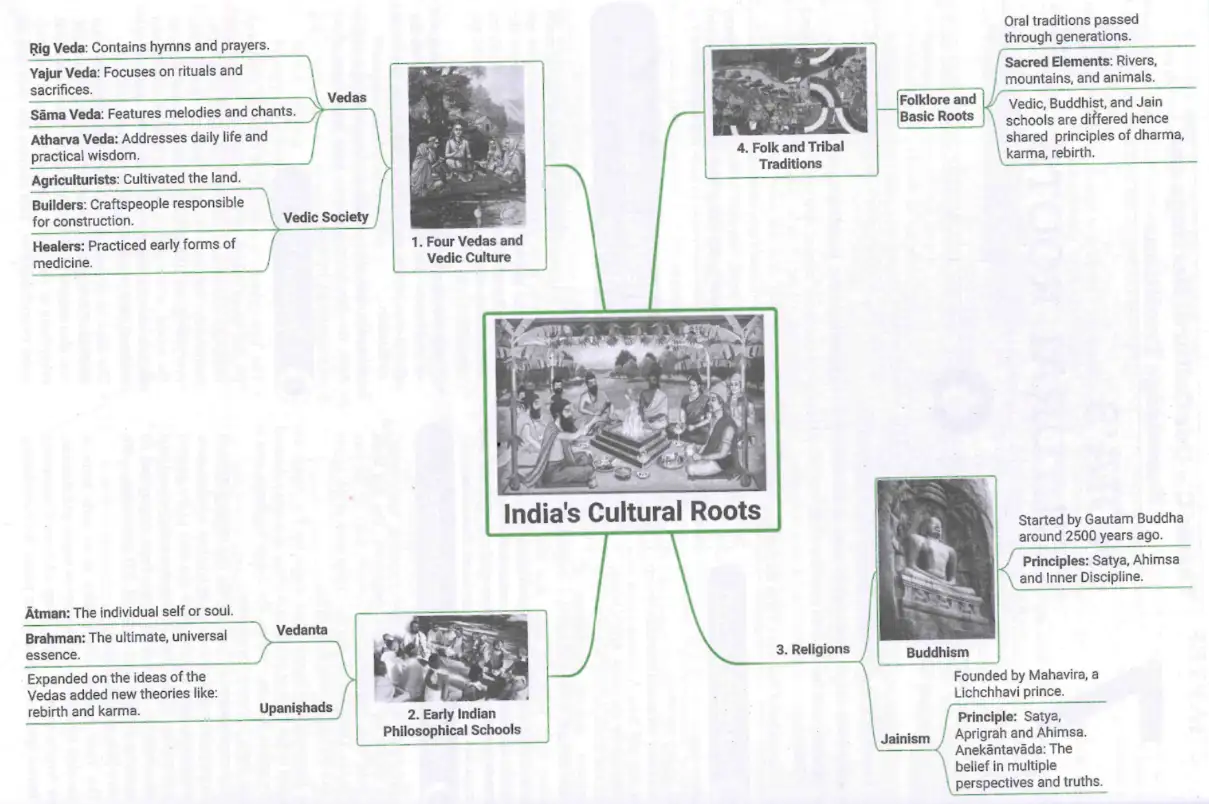
The word "Veda" originates from the Sanskrit root vid, meaning 'knowledge'. The four Vedas are the Rig Veda, Yajur Veda, Sāma Veda, and Atharva Veda. These are among the oldest texts in the world and the oldest from India.
The Vedas consist of thousands of hymns, prayers in poetic form, chanted orally rather than written initially. These hymns were composed in the Sapta Sindhava region.
The Rig Veda, the most ancient of the four, has uncertain dating, with scholars suggesting anywhere from the fifth to the second millennium BCE. These texts were preserved through oral transmission for 100 to 200 generations with minimal changes.
The hymns were composed in an early form of Sanskrit by rishis (male seers) and rishikas (female seers). They addressed many deities such as Sarasvatī, Agni, Varuṇa, Mitra, Indra, among others. These gods and seers preserved ṛtam, meaning truth and order, in the cosmos and human life.
The Vedas and Vedic Culture
Vedic Society
Early Vedic society was composed of larger social groups called janas or clans. Over 30 janas are mentioned in the Rig Veda, including Bharatas, Purus, Kurus, Yadus, and Turvāśas. Each clan was associated with a specific area in the northwest Indian subcontinent.
Vedic civilization developed numerous rituals dedicated to various deities for the welfare of individuals and the community. Daily rites traditionally involved prayers and sacrifices to Agni, the fire deity, which became increasingly complex over time.
Exam Questions
Q1: What are the Vedas and why are they important?
A1: The Vedas are ancient sacred texts of India composed of hymns and prayers. They are important as they are among the oldest texts in the world and form the foundation of Vedic culture and religion.
Q2: Describe the social structure of early Vedic society.
A2: Early Vedic society was organized into clans called janas, each linked to a specific region. These clans formed the basic social units and performed rituals for their welfare.
Upanishads
The Upanishads are a collection of writings that expand on Vedic ideas and introduce new concepts such as rebirth and karma. The Vedanta school of philosophy teaches that everything, including nature and human existence, is one divine essence called brahman (not to be confused with the deity Brahmā), sometimes referred to as tat ('that').
The Upanishads also teach the concept of ātman, the Self, which is the divine essence present in all beings and ultimately one with brahman. This highlights the interconnectedness of all life and the universe.
Exam Questions
Q1: What is the significance of the Upanishads in Indian philosophy?
A1: The Upanishads introduce key philosophical ideas such as brahman (universal essence) and ātman (Self), emphasizing the unity of all existence and concepts like rebirth and karma.
Q2: Explain the relationship between ātman and brahman according to the Upanishads.
A2: The Upanishads teach that ātman, the individual Self, is ultimately one with brahman, the universal divine essence, indicating that all beings are interconnected.
Buddhism
Buddhism is a school of thought that challenged Vedic authority and developed its own system. Founded by Gautam Buddha about 2500 years ago, Buddha was born as Prince Siddhartha. He renounced his royal life to seek the true meaning of life through meditation and discussion.
After attaining enlightenment under a peepal tree at Bodh Gaya, he became known as Buddha, the Wise One. He taught principles including ahimsa (non-hurting or non-injury) and emphasized sincere inner discipline.
Buddha established the Sangha, a community of monks and later nuns, to practice and spread his teachings. Buddhism has had a lasting impact on India and Asia.
Exam Questions
Q1: Who was Gautam Buddha and what did he teach?
A1: Gautam Buddha was the founder of Buddhism who taught the path to enlightenment, emphasizing non-violence (ahimsa) and inner discipline.
Q2: What is the Sangha in Buddhism?
A2: The Sangha is the community of monks and nuns established by Buddha to practice and propagate his teachings.
Jainism
Jainism was founded by Mahavira, a Kshatriya prince from the Lichchhavi clan. He left home at age 30 to live in the forest and practiced austerity for 12 years before attaining enlightenment.
Jain teachings emphasize ahimsa (non-violence), anekāntavāda (many-sidedness or multiple perspectives), and aparigraha (non-possession or detachment from material things). These principles have deeply influenced Indian culture and are also found in Buddhism and Vedantic philosophy.
Jainism stresses the interdependence of all species, including humans and unseen organisms, highlighting the interconnectedness of life.
Exam Questions
Q1: Who was Mahavira and what are the key teachings of Jainism?
A1: Mahavira was the founder of Jainism. Key teachings include ahimsa (non-violence), anekāntavāda (multiple perspectives), and aparigraha (non-possession).
Q2: How does Jainism view the relationship between living beings?
A2: Jainism teaches that all living beings are interconnected and interdependent, relying on each other for existence.
Folk and Tribal Roots
India has a rich oral heritage where teachings and practices are passed down through daily practice rather than written texts. Folk traditions are transmitted by ordinary people, while tribal traditions are preserved by specific tribes.
Religious ideas and rituals have been shared between classes and tribes since ancient times. Hinduism has influenced tribal faiths and has also been influenced by them.
Buddhist and Jain monks and nuns traveled to spread their beliefs, establishing monasteries in remote areas and living ascetic lives in caves. Archaeological evidence shows remains of such monasteries and rock-cut caverns.
The Charvaka school, also known as Lokayata, held a materialistic view that only the material world is real and denied any afterlife.
Despite differences, Vedic, Buddhist, and Jain schools shared fundamental principles such as dharma (duty), karma (actions), rebirth, and the goal of alleviating suffering and ignorance.
Exam Questions
Q1: What role do folk and tribal traditions play in Indian culture?
A1: Folk and tribal traditions preserve oral heritage and religious practices, influencing and being influenced by major religions like Hinduism.
Q2: What is the Charvaka school and its main belief?
A2: The Charvaka school is a materialistic philosophy that believes only the material world is real and denies the existence of an afterlife.
Keywords
- Spiritual: Concerned with the spirit or soul (ātman).
- Spirituality: Search for a deeper or higher dimension beyond personality.
- Seeker: One who seeks truths of the world, such as sages or philosophers.
- Cosmos: The universe as an ordered and harmonious system.
- Worldview: A particular understanding of the world and its origin.
- Healer: One who uses traditional practices to cure diseases.
- Consciousness: Awareness of something within oneself.
- Ascetic: One who practices rigorous discipline for higher consciousness.
- Attachment: Bond with someone or something through habit or sentiment.
- Monk: A man who renounces worldly life for spiritual pursuits.
- Nun: Female equivalent of a monk.
- Tribe: A group sharing common descent, culture, language, living closely without private property.
- Upanishad: Texts containing teacher-student conversations.
- Anekāntavāda: The doctrine that truth has many aspects and cannot be fully described by one statement.
- Aparigraha: Non-possession; detachment from material things.
Solved Examples
Example 1: Explain the significance of the Rig Veda.
Answer: The Rig Veda is the oldest of the four Vedas, containing hymns and prayers that form the foundation of Vedic religion and culture. It preserves early Sanskrit and reflects the beliefs and social structure of early Vedic society.
Example 2: Describe the main teachings of Buddhism.
Answer: Buddhism teaches the path to enlightenment through non-violence (ahimsa), inner discipline, and the Four Noble Truths. It emphasizes compassion and the community of monks and nuns (Sangha).
Practice Set
Easy
- What are the four Vedas?
- Who founded Jainism?
Moderate
- Explain the concept of ātman and brahman in the Upanishads.
- Describe the social structure of early Vedic society.
Challenging
- Compare and contrast the teachings of Buddhism and Jainism.
- Discuss the influence of folk and tribal traditions on Indian culture.
Answer Key
- Easy:
1. Rig Veda, Yajur Veda, Sāma Veda, Atharva Veda.
2. Mahavira. - Moderate:
1. Ātman is the individual Self; brahman is the universal essence; they are ultimately one.
2. Early Vedic society was organized into clans called janas, each linked to a region. - Challenging:
1. Both emphasize non-violence and liberation but differ in doctrines like anekāntavāda in Jainism and the Middle Path in Buddhism.
2. Folk and tribal traditions have influenced religious practices and beliefs, contributing to the diversity of Indian culture.
Quick Reference
- Vedas: Ancient sacred texts with hymns and rituals.
- Upanishads: Philosophical texts teaching brahman and ātman.
- Buddhism: Founded by Buddha; teaches non-violence and enlightenment.
- Jainism: Founded by Mahavira; emphasizes non-violence and multiple perspectives.
- Folk and Tribal Traditions: Oral heritage influencing Indian culture.
Glossary
- Ahimsa
- Non-violence or non-injury.
- Anekāntavāda
- Doctrine of multiple perspectives.
- Aparigraha
- Non-possession or detachment from material things.
- Brahman
- The universal divine essence in Vedanta philosophy.
- Clans (Janas)
- Social groups in early Vedic society.
- Rishis and Rishikas
- Male and female seers who composed the Vedas.
- Sangha
- Community of Buddhist monks and nuns.
- Upanishads
- Philosophical texts expanding on Vedic ideas.
| Time Period / Year | Event / Change | Importance |
|---|---|---|
| c. 1500–1200 BCE | Composition of the Rig Veda | Foundation of Vedic religion and culture |
| c. 800–500 BCE | Upanishads composed | Introduction of key philosophical concepts like brahman and ātman |
| c. 6th century BCE | Founding of Buddhism by Gautam Buddha | New religious philosophy emphasizing non-violence and enlightenment |
| c. 6th century BCE | Founding of Jainism by Mahavira | Emphasis on non-violence, multiple perspectives, and detachment |