CLASS 6 . SOCIAL SCIENCE . EXPLORING SOCIETY INDIA AND BEYOND . GRASSROOTS DEMOCRACY-PART-3-LOCAL-GOVERNMENT-IN-URBAN-AREAS
Chapter 12 : GRASSROOTS DEMOCRACY – PART 3 LOCAL GOVERNMENT IN URBAN AREAS
Ch 12
SOCIAL SCIENCE
CLASS 6
Grassroots Democracy - Part 3: Local Government in Urban Areas
Introduction
In a democracy, good governance means ensuring that citizens actively participate in decision-making processes. This principle is called participatory democracy, where people shape their communities, whether in rural villages or urban cities.
Urban areas have unique challenges due to their diversity and complexity. Therefore, their governance systems must be well-structured to manage these complexities effectively. This section explores the principles of urban governance and its role within India’s broader governance framework, from villages to the national level.
Exam Questions
Q1. What is participatory democracy?
Answer: Participatory democracy is a system where citizens actively participate in decision-making processes to shape their communities.
Q2. Why do urban areas require different governance systems compared to rural areas?
Answer: Urban areas are more diverse and complex, requiring well-structured governance systems to manage their unique challenges effectively.
Urban Local Bodies
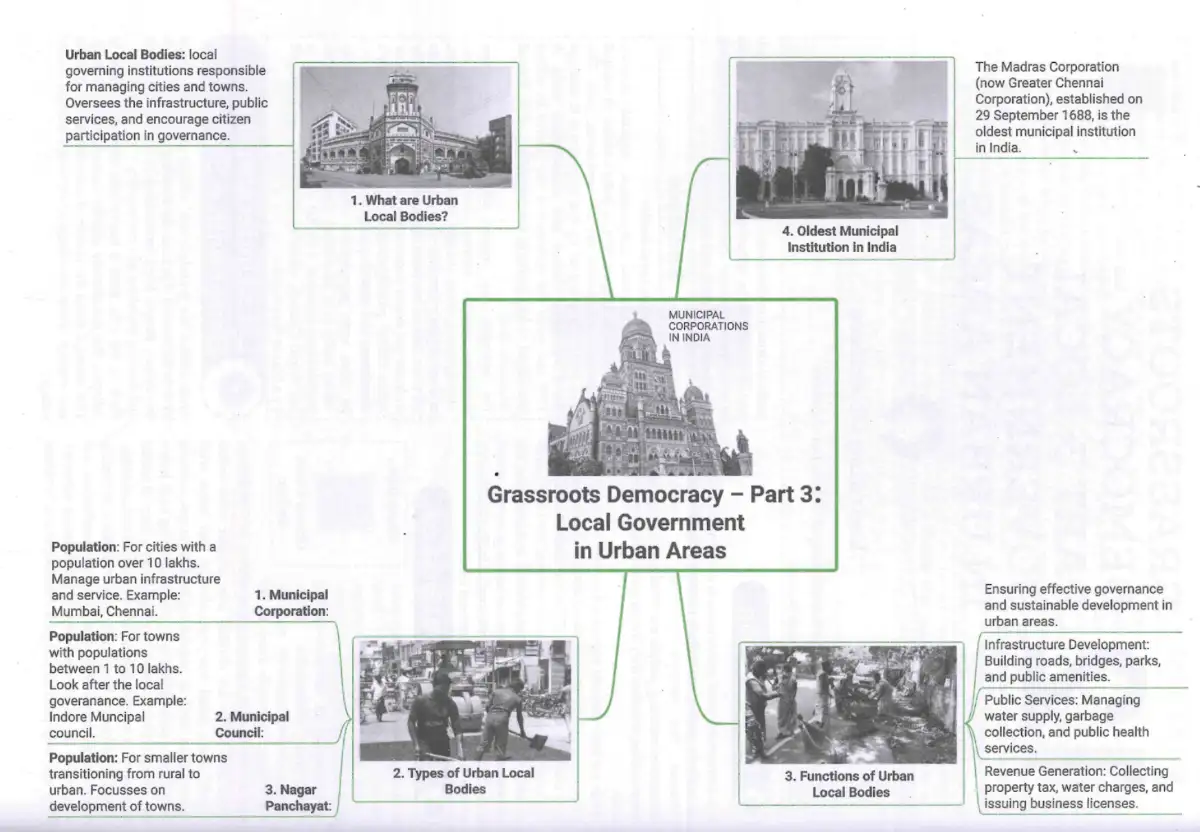
Urban local bodies (ULBs) are local government institutions managing cities and towns. They enable residents to participate in decision-making about their community rather than relying on a central authority.
Cities and towns are divided into smaller units called wards. Each ward has a committee responsible for tasks such as organising health camps, running campaigns against plastic use, and addressing local issues like water leaks or blocked drains. The operation of wards varies by state according to local regulations.
ULBs have responsibilities including maintaining infrastructure, managing waste collection, and implementing government schemes. They also plan for the area’s development. Residents contribute by following rules like waste segregation and reporting local problems to keep their community clean and functional.
Exam Questions
Q1. What are urban local bodies?
Answer: Urban local bodies are local government institutions that manage cities and towns by involving residents in decision-making and managing local services.
Q2. What is the role of wards in urban governance?
Answer: Wards are subdivisions of cities or towns with committees that address local issues and help manage community services.
Example of Urban Local Bodies
The Greater Chennai Corporation, established in 1688 as the Madras Corporation by the East India Company, is India’s oldest municipal institution. It was empowered in 1792 to collect municipal taxes, marking the start of formal urban administration.
The Indore Municipal Corporation manages services such as property tax, water charges, solid waste management, and emergency services like ambulances and fire services. Indore has been recognised as the cleanest city in India for seven consecutive years, demonstrating the impact of active citizen participation.
Urban local bodies are classified based on population size: Municipal Corporations govern cities with over 1 million people, Municipal Councils manage towns with populations between 100,000 and 1 million, and Nagar Panchayats govern smaller towns transitioning from rural to urban.
Exam Questions
Q1. What is the significance of the Greater Chennai Corporation?
Answer: It is India’s oldest municipal institution, established in 1688, marking the beginning of formal urban local governance.
Q2. How are urban local bodies classified in India?
Answer: They are classified as Municipal Corporations for cities over 1 million, Municipal Councils for towns between 100,000 and 1 million, and Nagar Panchayats for smaller towns.
Let’s Understand it Better with a Story
Anita visited her grandparents’ village and noticed the close-knit community where decisions were made collectively. In contrast, in her city, after a house collapsed due to heavy rain, the community quickly came together to help.
She learned that in villages, the Panchayat, an elected body, handles local issues with active participation from all residents, including children. In cities, local governments aim to ensure everyone’s voice is heard and problems are addressed, reflecting the essence of democracy.
Exam Questions
Q1. What did Anita learn about local governance in villages and cities?
Answer: Anita learned that both village Panchayats and urban local governments aim to involve citizens in decision-making and address community problems, reflecting democratic principles.
Keywords
- Urban Local Bodies: Local government institutions responsible for managing city infrastructure, services, and development.
- Wards: Subdivisions within cities or towns managed by committees to address local issues and ensure decentralised governance.
Solved Examples
Example 1: Explain the role of wards in urban local governance.
Solution: Wards are smaller units within cities or towns, each managed by a committee that addresses local issues such as sanitation, infrastructure maintenance, and community welfare. This decentralises governance and allows residents to participate directly in managing their local area.
Example 2: Describe the classification of urban local bodies based on population.
Solution: Urban local bodies are classified as Municipal Corporations for cities with populations over 1 million, Municipal Councils for towns with populations between 100,000 and 1 million, and Nagar Panchayats for smaller towns transitioning from rural to urban.
Practice Set
Easy:
- What is an urban local body?
- Define a ward in the context of urban governance.
Moderate:
- Explain the responsibilities of urban local bodies.
- Describe the significance of the Greater Chennai Corporation.
Challenging:
- Compare the governance structure of urban local bodies with village Panchayats.
- Discuss how citizen participation impacts the effectiveness of urban local bodies.
Answer Key
- Easy:
- Urban local bodies are local government institutions managing cities and towns.
- A ward is a subdivision of a city or town managed by a committee to address local issues.
- Moderate:
- Urban local bodies maintain infrastructure, manage waste, implement government schemes, and plan development.
- The Greater Chennai Corporation is India’s oldest municipal institution, established in 1688, marking formal urban governance.
- Challenging:
- Urban local bodies are structured to manage complex urban needs with wards and committees, while village Panchayats focus on community-based decision-making in rural areas.
- Active citizen participation helps urban local bodies function effectively by ensuring local problems are reported and addressed promptly.
Quick Reference
- Participatory Democracy: Citizen involvement in decision-making.
- Urban Local Bodies: Local government institutions managing urban areas.
- Wards: Subdivisions within cities for local governance.
- Municipal Corporation: Governs cities with over 1 million people.
- Municipal Council: Governs towns with 100,000 to 1 million people.
- Nagar Panchayat: Governs smaller towns transitioning from rural to urban.
- Greater Chennai Corporation: Oldest municipal institution in India, established in 1688.
Glossary
- Participatory Democracy: A system where citizens actively participate in governance.
- Urban Local Bodies (ULBs): Local government institutions responsible for urban administration.
- Ward: A local area within a city or town managed by a committee.
- Municipal Corporation: Urban local body for large cities.
- Municipal Council: Urban local body for medium-sized towns.
- Nagar Panchayat: Urban local body for small towns.