CLASS 6 . SOCIAL SCIENCE . EXPLORING SOCIETY INDIA AND BEYOND . GRASSROOTS DEMOCRACY-PART-2-LOCAL-GOVERNMENT-IN-RURAL-AREAS
Chapter 11 : GRASSROOTS DEMOCRACY – PART 2 LOCAL GOVERNMENT IN RURAL AREAS
Ch 11
SOCIAL SCIENCE
CLASS 6
Introduction
Local governments play a crucial role in managing everyday affairs within communities, especially in rural areas. In India, with its vast number of villages, local governance ensures that the specific needs and challenges faced by these communities are addressed effectively. Panchayati Raj institutions are central to this system, functioning as the grassroots level of government. They handle various aspects of village life, such as infrastructure maintenance, resource management, and resolving local disputes.
Take the example of Lakshmanpur, a small village in the foothills of the Himalayas. With a population of about 700 people, most of whom are farmers, the village relies on Panchayati Raj institutions to manage essential tasks like maintaining roads, managing water resources for farming, and supporting the local school. These institutions empower villagers to make decisions on issues directly affecting their daily lives, thereby ensuring that their needs are met efficiently. By bringing governance closer to the people, Panchayati Raj institutions play a vital role in effective administration and democracy, helping communities like Lakshmanpur thrive and address their unique challenges.
Panchayati Raj System
In every village in India, including Lakshmanpur, there is a system of local government called the ‘Panchayat’, which is like a village council. The Panchayat system, also known as Panchayati Raj, brings governance closer to the people and allows them to take part in making important decisions. This system helps manage local issues, supports development, and ensures that government benefits reach the villagers.
The Panchayati Raj system operates at three levels: the village level with the Gram Panchayat, the block level with the Panchayat Samiti and the district level with the Zila Parishad. This three-tier system handles nearly all aspects of life in the district, including agriculture, road maintenance, water management, education, healthcare, and more. By working from the village up to the district, Panchayati Raj helps address local needs and promotes community well-being.
Gram Panchayat
Gram Panchayat is the most local level of government in rural areas. It is closest to the people and its members are directly elected by the Gram Sabha, which consists of all adults in the village or neighbouring villages who are registered voters. In the Gram Sabha, both men and women discuss and decide on local matters. Each Gram Panchayat elects a head, known as the ‘Sarpanch’ or Pradhan, and recently, more women have entered into this leadership role. Additionally, each Gram Panchayat is supported by a Panchayat Secretary, who handles administrative tasks, and often a Patwari, who manages land records.
Example 1
Notable Examples of Exemplary Sarpanchs:
Dnyaneshwar Kamble became the Sarpanch of Tarangan village in Maharashtra in 2017. As a transgender person, Kamble broke barriers and promoted the idea that “Service to the village is service to the public.” By defeating six other candidates, Kamble demonstrated the power of dedication and service in local governance.
Vandana Bahadur Maida made history as the first female Sarpanch of Khankhari village in Madhya Pradesh. Despite facing societal challenges, she successfully encouraged women to participate in Gram Sabha meetings and addressed important issues such as education and sanitation, showcasing how women can lead and transform rural communities.
Popatrao Baguji Pawar served as the Sarpanch of Hiware Bazar in Maharashtra and implemented effective rainwater harvesting, watershed conservation, and extensive tree planting. His efforts rejuvenated the village’s environment and agriculture, leading to Hiware Bazar’s recognition as a green and prosperous village. For his achievements, Pawar was honoured with the Padma Shri in 2020.
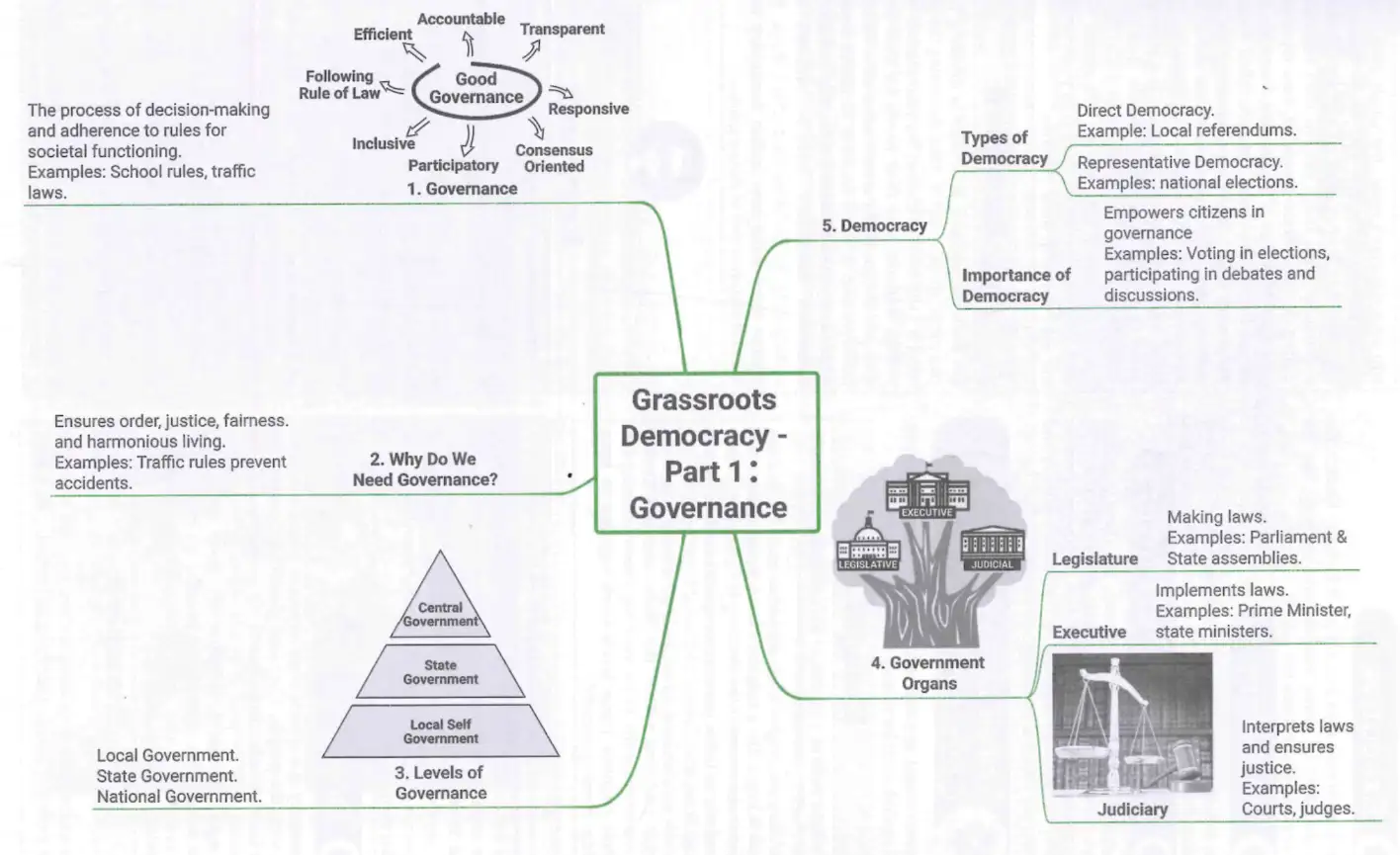
The image is a mind map explaining "Grassroots Democracy - Part 1: Governance." It outlines key ideas about governance, including what it means, why we need it, the levels of governance, government organs, and democracy types. Step-by-step explanation for students: 1. Governance means making decisions and following rules that help society work smoothly, like school and traffic rules. 2. We need governance to keep order, fairness, and justice, for example, to prevent accidents through traffic laws. 3. Governance happens at three levels: local government, state government, and central (national) government. 4. The government has three main parts called organs: - Legislature makes laws (like Parliament). - Executive enforces laws (like Prime Minister). - Judiciary interprets laws and ensures justice (like courts). 5. Democracy means people participate in governing: - Direct democracy where people vote on issues directly (e.g., local referendums). - Representative democracy where people elect representatives to make decisions (e.g., national elections). Participating in democracy allows citizens to have a say in how they are governed.
Child-Friendly Panchayat Initiative
Panchayats are local government groups that listen to everyone’s concerns, including children’s. The Child-Friendly Panchayat Initiative helps children share their ideas and worries about their well-being. In many states, children are invited to join Bal Sabhas and Bal Panchayats, where they can speak up about issues affecting them.
Example 2
Notable Examples of Child-Friendly Panchayat Initiative:
• In Maharashtra, Bal Panchayats have made a big difference by working to end child labour and child marriages. They help bring children back to school and convince parents to let their children study instead of arranging early marriages.
• In Sikkim, the Sangkhau Radhu Khandu Gram Panchayat has made schools safer by building walls around them and adding kitchens to provide healthy meals. Because of these efforts, it was named a child-friendly Panchayat.
• In Rajasthan, the ‘Children’s Parliament’ created by Bunker Roy’s Barefoot College helps underprivileged kids learn about democracy and leadership. Children aged 8 to 14 participate in mock elections, manage school activities, and work on issues like education and sanitation. This initiative has been praised worldwide and won awards for empowering children including the World’s Children’s Honorary Award in 2001.
Panchayat Samiti and Zila Parishad
Apart from village-level Panchayats, there are also institutions at the block and district levels. These include the Panchayat Samiti at the block level and the Zila Parishad at the district level. The Panchayat Samiti connects the Gram Panchayat (village level) with the Zila Parishad. Members of these institutions are elected by local people and may also include village Sarpanchs and local State Legislative Assembly members.
Each State has slightly different rules for the Panchayat Samiti, but its main role is to bring together plans from different Gram Panchayats and present them at higher levels. This helps in obtaining funds for development projects and government schemes like the Pradhan Mantri Gram Sadak Yojana, which promotes the construction of all-weather roads in rural areas.
To ensure everyone’s voice is heard, especially those from disadvantaged groups, special rules are in place. There is also a rule that one-third of the seats in these institutions are reserved for women by the 73rd and 74th Amendment Acts of the Constitution.
Keywords
- Local Governance: Local governance involves the management and decision-making of community affairs at the village, town, or city level, aiming to address local needs and implement policies effectively.
- Panchayat: A Panchayat is a village-level governing body in India that manages local issues, resources, and development activities through elected representatives.
- Gram Sabha: The Gram Sabha is a village assembly consisting of all registered voters, which meets to discuss and make decisions on local matters and development issues.
- Panchayat Samiti: The Panchayat Samiti is a block-level institution that coordinates and supports the activities of Gram Panchayats and implements district-level development projects.
- Zila Parishad: The Zila Parishad is a district-level governing body that oversees and supports the work of Panchayat Samitis, manages district-wide development projects, and ensures effective implementation of policies at the district level.
Solved Examples
Example 1: Role of Gram Panchayat in Village Development
Question: How does the Gram Panchayat contribute to the development of a village like Lakshmanpur?
Answer: The Gram Panchayat manages local issues such as maintaining roads, managing water resources, supporting schools, and resolving disputes. It is elected by the Gram Sabha and led by a Sarpanch, ensuring that villagers have a say in decisions affecting their daily lives.
Example 2: Importance of Panchayat Samiti
Question: What is the role of the Panchayat Samiti in rural governance?
Answer: The Panchayat Samiti operates at the block level, coordinating plans from various Gram Panchayats and presenting them at higher levels. It helps in securing funds for development projects and government schemes, ensuring effective implementation at the block level.
Practice Set
Easy
- What is a Gram Panchayat?
- Who elects the Sarpanch?
Moderate
- Explain the three levels of the Panchayati Raj system.
- What are the roles of the Panchayat Samiti and Zila Parishad?
Challenging
- Discuss the significance of the Child-Friendly Panchayat Initiative in promoting children's participation in local governance.
- How do reservation policies in Panchayati Raj institutions promote inclusivity?
Answer Key
Easy
- A Gram Panchayat is the village-level local government body responsible for managing local affairs.
- The Sarpanch is elected by the Gram Sabha, which includes all registered voters in the village.
Moderate
- The Panchayati Raj system has three levels: Gram Panchayat (village), Panchayat Samiti (block), and Zila Parishad (district), each handling governance and development at their respective levels.
- The Panchayat Samiti coordinates plans from Gram Panchayats and secures funds, while the Zila Parishad oversees district-wide development and supports Panchayat Samitis.
Challenging
- The Child-Friendly Panchayat Initiative allows children to participate in governance through Bal Sabhas and Bal Panchayats, addressing issues like education and child labour, thus empowering young voices in decision-making.
- Reservation policies ensure that women and disadvantaged groups have representation in Panchayati Raj institutions, promoting inclusivity and equitable governance.
Quick Reference
- Gram Panchayat: Village-level elected body managing local affairs.
- Panchayat Samiti: Block-level institution coordinating Gram Panchayats.
- Zila Parishad: District-level body overseeing development projects.
- Sarpanch: Elected head of the Gram Panchayat.
- Gram Sabha: Assembly of all registered voters in a village.
- Child-Friendly Panchayat: Initiative to involve children in local governance.
- Reservation: One-third seats reserved for women in Panchayati Raj institutions.
Glossary
- Local Governance
- Management and decision-making of community affairs at the local level.
- Panchayat
- Village-level governing body managing local issues and development.
- Gram Sabha
- Village assembly of all registered voters discussing local matters.
- Panchayat Samiti
- Block-level institution coordinating Gram Panchayats and development projects.
- Zila Parishad
- District-level governing body overseeing Panchayat Samitis and district development.
- Sarpanch
- Elected head of the Gram Panchayat.
- Child-Friendly Panchayat
- Initiative to include children’s voices in local governance.
Chronology of Panchayati Raj System
| Time Period / Year | Event / Change | Importance |
|---|---|---|
| 1950s | Initial establishment of Panchayati Raj institutions | Foundation of local self-government in rural India |
| 1992 | 73rd Constitutional Amendment Act | Provided constitutional status to Panchayati Raj institutions and mandated reservation for women and disadvantaged groups |
| 2001 | Children’s Parliament initiative by Barefoot College | Promoted children’s participation in local governance |
| 2020 | Padma Shri awarded to Popatrao Baguji Pawar | Recognition of exemplary leadership in rural development |