CLASS 6 . SOCIAL SCIENCE . EXPLORING SOCIETY INDIA AND BEYOND . FAMILY AND-COMMUNITY
Chapter 9 : FAMILY AND COMMUNITY
Ch 9
SOCIAL SCIENCE
CLASS 6
Family and Community
Introduction
Almost everyone lives in a family. Families are the oldest and most important part of any society. In India, there are different types of families, such as joint families and nuclear families. In a joint family, many generations live together, including grandparents, parents, uncles, aunts, brothers, sisters, and cousins. On the other hand, a nuclear family includes just a couple and their children or sometimes one parent and children.
In English, we have few words to describe family relationships, but Indian languages have many. For example, Hindi has special terms like bua, tau, chacha, and nana, while Tamil has different words for elder and younger siblings. Interestingly, there isn’t a specific word for ‘cousin’ in most Indian languages because cousins are considered just like brothers and sisters, showing how close family ties are.
Exam Question
Q: What are the two main types of families found in India? Explain briefly.
A: The two main types of families in India are joint families and nuclear families. A joint family includes many generations living together such as grandparents, parents, uncles, aunts, and cousins. A nuclear family consists of a couple and their children or sometimes one parent and children.
What are the roles and responsibilities in the family?
In a family, relationships are built on love, care, cooperation, and interdependence. Cooperation means working together, and each family member has roles and responsibilities towards others. For example, parents raise their children to become responsible members of society, while children help out at home as they grow up, learning important values through daily activities.
In Indian culture, following one’s dharma, or duty, is essential. Families teach values like ahimsa (non-violence), dāna (giving), seva (service), and tyaga (sacrifice). Family members often put the family’s needs before their own.
Exam Question
Q: What values do families in India teach their members? Why are these important?
A: Families in India teach values such as ahimsa (non-violence), dāna (giving), seva (service), and tyaga (sacrifice). These values are important because they promote cooperation, care, and putting the family’s needs before individual desires, which helps maintain harmony and responsibility within the family and society.
Let’s understand better with some stories
Story 1: Shalini’s Family
Shalini lives in Kerala with her parents, younger brother, grandmother, uncle (Chittappa), aunt (Chitti), and cousin. When Shalini’s uncle faced financial difficulties, her parents bought new clothes for everyone during the Onam festival, even though it meant Shalini had to settle for a simpler dress. This act of sharing shows how family members support each other and share ups and downs together.
Story 2: Tenzing’s Family
Tenzing lives in Meghalaya with his parents and grandparents. His father runs a grocery store and helps with household chores, while his mother works in a handicraft cooperative. Tenzing’s grandparents assist with his homework and contribute to the community. The family discusses and plans for future needs together, emphasising the importance of saving for unexpected expenses. Tenzing’s family teaches him the value of cooperation, sharing responsibilities, and planning for the future.
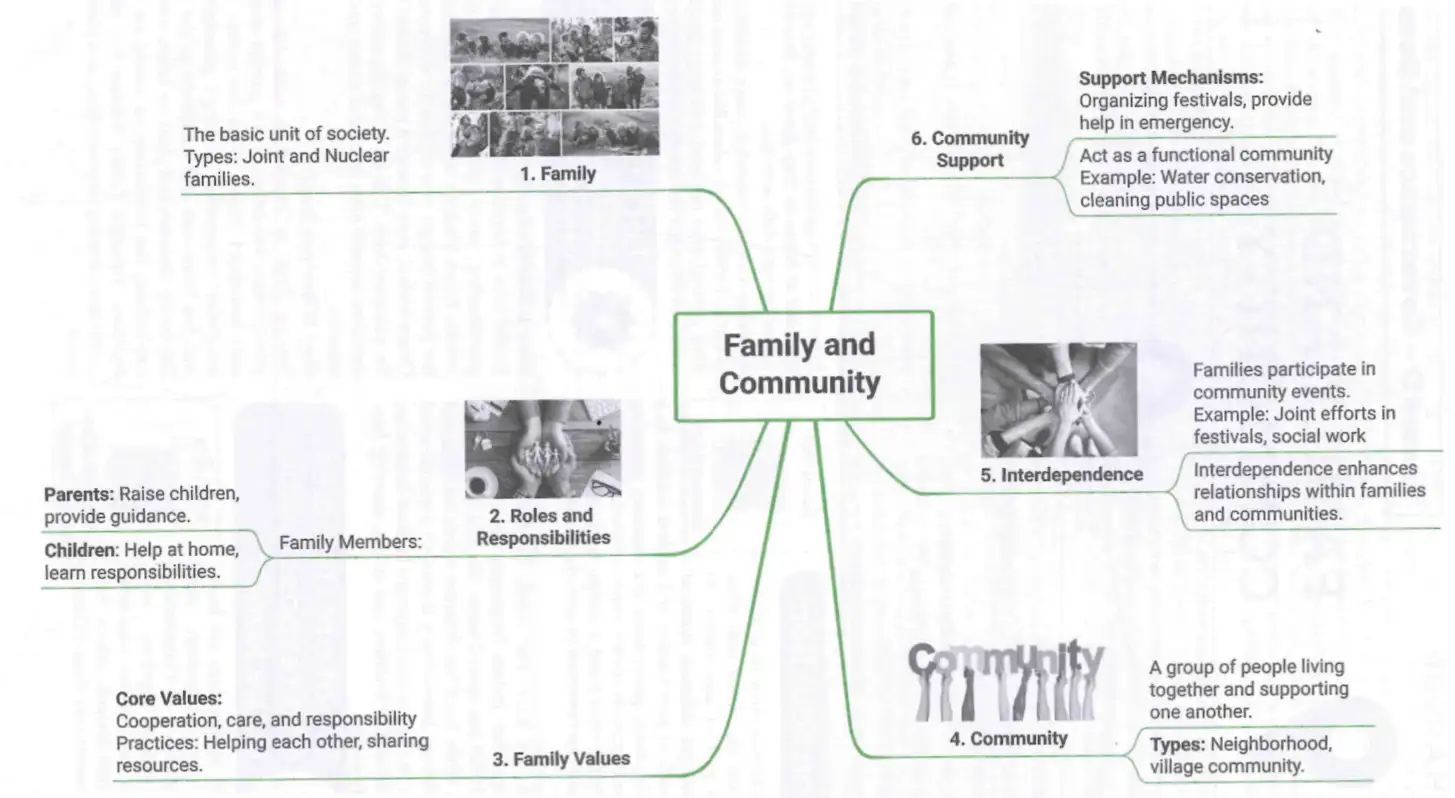
This image is a mind map showing the relationship between family and community. It explains different aspects like family types, roles, values, community types, interdependence, and support.
Exam Question
Q: How do the stories of Shalini’s and Tenzing’s families illustrate the importance of family values?
A: Shalini’s family shows support and sharing during difficult times, such as buying clothes for everyone despite financial difficulties. Tenzing’s family demonstrates cooperation, shared responsibilities, and planning for the future. Both stories highlight love, care, and cooperation as key family values.
What is Community?
A family is not just connected within itself, but also with other families and people around them. When many people and families are connected, we call this group a community. There are other meanings for the word ‘community’, but in this case, it refers to a group of people who come together for common reasons.
Exam Question
Q: Define community in the context of family and society.
A: A community is a group of people and families connected together who come together for common reasons such as festivals, social work, or shared resources.
Examples of Community in Action
Members of a community might gather to celebrate festivals, organise feasts, weddings, and other special events. In some villages, people work together to help each other in farming tasks, such as preparing the land, planting seeds, and harvesting crops. Communities also agree on certain practices for using shared natural resources, like water, grazing lands, and forest produce. These practices, often unwritten rules, help ensure everyone has access to resources and that each family fulfills duties to keep the community functioning smoothly.
Example 1: Bhil Community in Madhya Pradesh
In the region around Jhabua, Madhya Pradesh, the Bhil community faced severe water shortage. Following their tradition of coming together in times of crisis called ‘halma’, they planted thousands of trees, dug trenches to conserve rainwater, and built water-harvesting structures. They did this as a duty to their community and environment without expecting payment. Mahesh Sharma, leader of the Shivganga movement with the Bhil communities, was honoured with the Padma Shri award in 2019 for this work.
Example 2: Chennai Floods of 2015
During the Chennai floods, many shops and services were disrupted. Private groups, especially spiritual and religious organisations, cooked and distributed food to those in need. This shows how communities come together to help each other without expecting anything in return.
Exam Question
Q: Describe two examples that show how communities help each other.
A: The Bhil community planted trees and conserved water during a drought as a community duty. During the Chennai floods, spiritual groups cooked and distributed food to affected people. Both examples show communities supporting each other in times of need.
Community in Urban Areas
Community is also present in cities, although it may function differently.
Example 3: Ahmedabad, Gujarat
Kamal Parmar, an auto-fabrication workshop owner, noticed underprivileged children who had dropped out or never attended school. He started teaching them daily after work and provided free dinner. Soon, 150 children attended regularly. Local teachers joined to help, and older students volunteered to teach. This experience showed how urban communities can come together to support education and learning.
Exam Question
Q: How did Kamal Parmar contribute to the community in Ahmedabad?
A: Kamal Parmar started teaching underprivileged children after work hours and provided free dinner. His efforts encouraged others to join, creating a supportive learning community in the city.
Modern Communities
New types of communities have emerged over the last few decades. For example, in many urban areas, Residents’ Welfare Associations (RWAs) are formed. These associations create their own rules about waste management, cleanliness of common areas, and pet care. People living in these communities participate in making these rules.
Communities are interdependent. For example, RWAs rely on traders for supplies and on municipal workers to handle waste. In our complex societies, everyone depends on many other people and communities.
Exam Question
Q: What are Residents’ Welfare Associations and why are they important?
A: Residents’ Welfare Associations (RWAs) are groups formed in urban areas where residents make rules about waste management, cleanliness, and other community issues. They are important because they help maintain order and cooperation in urban communities.
Exploring Different Communities
‘Community’ can mean different things. Examples include groups based on religion, region, job, or interest such as the Parsi community of Mumbai, Sikh community of Chennai, Indian community in America, scientific community of Kerala, or a school’s art community. In schools, students may belong to various communities like class groups, sports teams, National Service Scheme, National Cadet Corps, science clubs, or drama clubs.
Communities are found everywhere and play an important role in our lives.
Exam Question
Q: Give examples of different types of communities people can belong to.
A: People can belong to communities based on religion, region, profession, or interests such as the Parsi community, Sikh community, scientific community, or school clubs like sports or drama.
Keywords
Family: The first group of people we belong to, where members help each other with different things.
Community: A larger group of people connected together who support one another and depend on each other to function well.
Solved Examples
Example 1: Explain the difference between a joint family and a nuclear family.
Answer: A joint family consists of many generations living together, including grandparents, parents, uncles, aunts, and cousins. A nuclear family consists of only a couple and their children or sometimes one parent and children.
Example 2: How do communities help during natural disasters?
Answer: Communities come together to provide support such as distributing food, helping with rescue operations, and sharing resources, as seen during the Chennai floods of 2015.
Practice Set
Easy
- What is a nuclear family?
- Name two values taught by families in India.
Moderate
- Describe the role of cooperation in family life.
- Give an example of how a community helps its members.
Challenging
- Explain how traditional communities manage shared natural resources.
- Discuss the importance of Residents’ Welfare Associations in urban areas.
Answer Key
- What is a nuclear family? A family consisting of a couple and their children or sometimes one parent and children.
- Name two values taught by families in India. Ahimsa (non-violence) and dāna (giving).
- Describe the role of cooperation in family life. Cooperation involves family members working together, sharing responsibilities, and supporting each other.
- Give an example of how a community helps its members. During the Chennai floods, communities distributed food and helped those in need.
- Explain how traditional communities manage shared natural resources. They create unwritten rules to ensure fair access and responsibilities for using resources like water and grazing lands.
- Discuss the importance of Residents’ Welfare Associations in urban areas. RWAs help maintain cleanliness, manage waste, and create rules for community living, promoting cooperation among residents.
Quick Reference
- Family Types: Joint family, Nuclear family
- Family Values: Cooperation, Ahimsa, Dāna, Seva, Tyaga
- Community: Group of families or people connected for common reasons
- Community Examples: Bhil community water conservation, Chennai flood relief, Urban RWAs
- Modern Communities: Residents’ Welfare Associations in cities
Glossary
- Ahimsa
- Non-violence; a value taught in Indian families.
- Dāna
- Giving; generosity towards others.
- Dharma
- Duty or moral responsibility.
- Joint Family
- A family where many generations live together.
- Nuclear Family
- A family consisting of parents and their children only.
- Residents’ Welfare Association (RWA)
- A group of residents in urban areas who manage community rules and activities.
- Seva
- Service to others.
- Tyaga
- Sacrifice for the benefit of others.