CLASS 6 . SOCIAL SCIENCE . EXPLORING SOCIETY INDIA AND BEYOND . ECONOMIC ACTIVITIES-AROUND-US
Chapter 14 : ECONOMIC ACTIVITIES AROUND US
Ch 14
SOCIAL SCIENCE
CLASS 6
Economic Activities Around Us
Introduction
Economic activities are actions that generate money, such as working or running a business, while non-economic activities, like taking care of family, do not directly make money. Economic activities are categorised into three types: primary (e.g., farming, mining), secondary (e.g., manufacturing goods), and tertiary (e.g., providing services).
As societies evolve, the range of economic activities has grown significantly. From traditional activities like farming and weaving to modern ones such as manufacturing technology and providing services, each sector plays a crucial role in our economy. By classifying these activities, we gain insight into how they function and their relationships with one another, helping us better understand the economic life around us.
The Classification of Economic Activities into Economic Sectors
In the world of economics, we group similar activities into three main categories called economic sectors. These sectors help us understand how different activities fit into the bigger picture of our economy. The three main economic sectors are primary, secondary, and tertiary.
Primary Activities
Primary activities are those where people directly use nature to produce goods. These activities rely on natural resources and include things like growing crops, collecting wood, mining for coal, fishing, and gathering eggs from poultry farms. In simple terms, primary activities are all about working directly with nature.
Example 1
Farming, mining, fishing, raising animals, and forestry.
Secondary Activities
Secondary activities take the raw materials from primary activities and transform them into finished products. This sector involves things like building construction, making goods in factories, and providing essential services such as water and electricity.
Example 2
Turning wheat into flour, extracting oil from peanuts, or processing tea leaves into tea are all secondary activities. Similarly, making furniture from wood, clothes from cotton, or cars from steel are also part of the secondary sector.
Tertiary Activities
Tertiary activities are those that support both primary and secondary activities. They involve services rather than producing goods. This sector includes things like driving trucks to transport goods, selling products at markets, and providing professional services such as medical care, teaching, and legal advice.
Example 3
Technicians who fix electronics, mechanics who repair vehicles, and electricians who ensure we have electricity. Tertiary activities also include services like communication through phones and the internet, working in hotels and restaurants, and helping out in banks, schools, hospitals, and other places. This sector is also known as the service sector.
By understanding these three sectors—primary, secondary, and tertiary—we get a clearer picture of how different types of work contribute to our economy and everyday life.
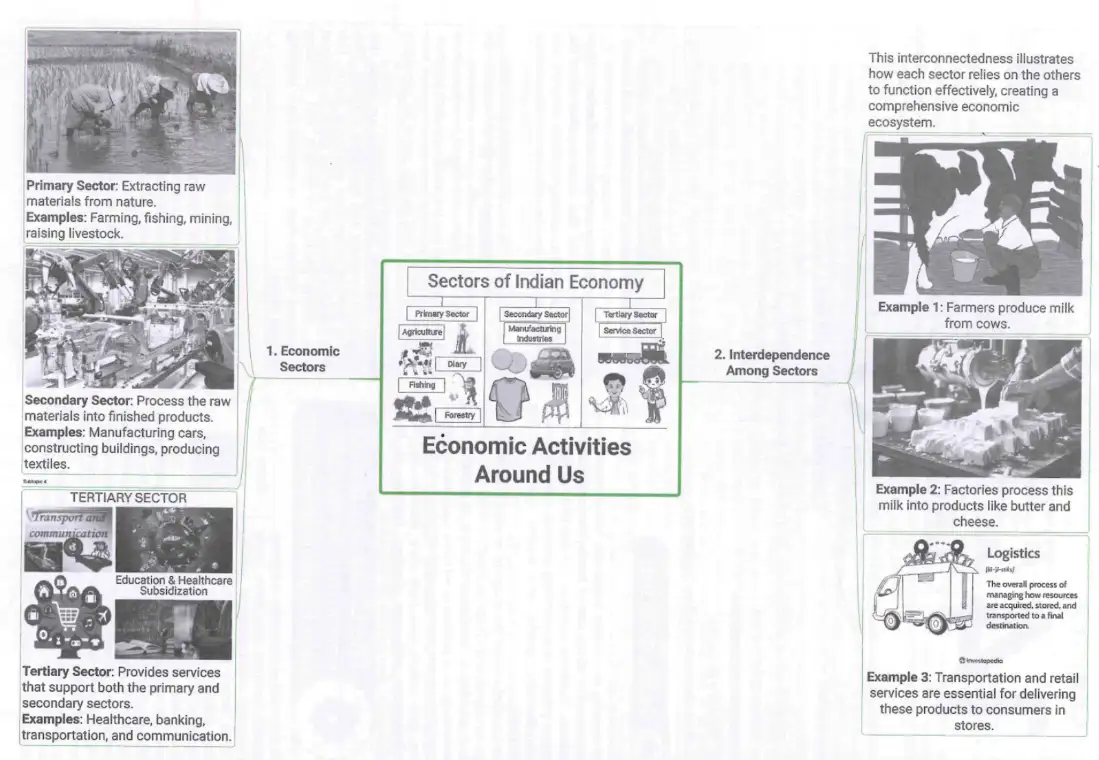
The image explains the three main economic sectors in India: Primary, Secondary, and Tertiary. It also shows how these sectors depend on each other through examples involving farming, manufacturing, and services. Step-by-step explanation: 1. Primary Sector: This involves collecting raw materials from nature, like farming, fishing, mining, and raising animals. 2. Secondary Sector: This sector takes raw materials and turns them into finished goods, such as making cars, buildings, or clothes. 3. Tertiary Sector: This provides services like healthcare, banking, and transportation that help the other two sectors work well. 4. Interdependence: The sectors are connected. For example, farmers (primary sector) produce milk, factories (secondary sector) turn milk into butter and cheese, and transportation services (tertiary sector) deliver these products to stores. This cooperation creates a strong economic system.
Interdependence Among Sectors
In any economy, the three main sectors—primary, secondary, and tertiary—are interdependent. The primary sector involves the extraction and harvesting of natural resources, such as agriculture and mining. These raw materials are then processed by the secondary sector into finished goods, including manufacturing and construction. Finally, the tertiary sector provides services like retail, transportation, and banking to distribute and sell these products to consumers. Each sector relies on the others to complete the process, creating a seamless flow from raw materials to finished products.
Example 1
In Gujarat, farmers milk their cows (primary sector) and sell the milk to a cooperative. This milk is processed into butter and cheese in factories (secondary sector). These products are then transported and sold in stores (tertiary sector). This cooperation among the sectors illustrates how each part of the economy depends on the others to deliver goods to consumers.
Keywords
- Monetary Value: This means how much something is worth in terms of money.
- Economic Sectors: These are big groups of different activities that help a country do well economically.
- Primary Sector: This includes activities that involve getting raw materials directly from nature, like farming, fishing, and forestry.
- Secondary Sector: This involves taking raw materials from the primary sector and turning them into products that can be sold or used.
- Warehouses: These are large buildings where products are kept before they are sold or sent to stores.
- Tertiary Sector: This includes services that support both the primary and secondary sectors, such as transportation, banking, and business management.
- Dairy: A place where milk is collected and kept.
- Cooperative: A group of people who come together to meet their needs in a formal way and make decisions together.
- Middlemen: People who buy goods from producers and sell them to customers, earning a fee for their service.
- Pasteurisation: Heating milk to a certain temperature to kill harmful bacteria and keep it safe.
- Factory: A building or group of buildings where products are made or assembled.
- Retail: Selling goods in small amounts directly to customers for their own use.
- Export: Goods and services made in one country and sold to people in another country.
Solved Examples
Example 1
Question: What are primary economic activities? Give examples.
Answer: Primary economic activities involve using natural resources directly to produce goods. Examples include farming, fishing, mining, and forestry.
Example 2
Question: How do secondary activities differ from primary activities?
Answer: Secondary activities take raw materials from primary activities and process them into finished goods, such as making furniture from wood or clothes from cotton.
Example 3
Question: What role does the tertiary sector play in the economy?
Answer: The tertiary sector provides services that support the primary and secondary sectors, including transportation, banking, education, and healthcare.
Practice Set
Easy
- Define economic activities.
- List three examples of primary economic activities.
Moderate
- Explain the difference between secondary and tertiary economic activities.
- Describe how the three economic sectors depend on each other.
Challenging
- Discuss the importance of the tertiary sector in modern economies with examples.
- Explain the process of how raw materials move from the primary to the tertiary sector using an example.
Answer Key
- Easy 1: Economic activities are actions that generate money by producing goods or services.
- Easy 2: Examples of primary economic activities include farming, fishing, and mining.
- Moderate 1: Secondary activities process raw materials into finished goods, while tertiary activities provide services supporting both sectors.
- Moderate 2: The primary sector provides raw materials, the secondary sector processes them, and the tertiary sector distributes and sells the products.
- Challenging 1: The tertiary sector is important because it provides essential services like healthcare, education, and transportation that support the economy's functioning.
- Challenging 2: For example, farmers (primary) produce milk, factories (secondary) make butter and cheese, and transport services (tertiary) deliver these products to consumers.
Quick Reference
- Primary Sector: Direct use of natural resources (farming, fishing).
- Secondary Sector: Manufacturing and construction (factories, building).
- Tertiary Sector: Services supporting other sectors (transport, banking).
- Interdependence: All sectors rely on each other to function effectively.
Glossary
- Monetary Value: Worth of something in terms of money.
- Economic Sectors: Categories of economic activities: primary, secondary, tertiary.
- Cooperative: Group working together to meet common needs.
- Pasteurisation: Heating milk to kill bacteria.
- Retail: Selling goods directly to consumers.
- Export: Selling goods to other countries.