CLASS 6 . SCIENCE . CURIOSITY . THE WONDERFUL-WORLD-OF-SCIENCE
Chapter 1 : THE WONDERFUL WORLD OF SCIENCE
Ch 1
SCIENCE
CLASS 6
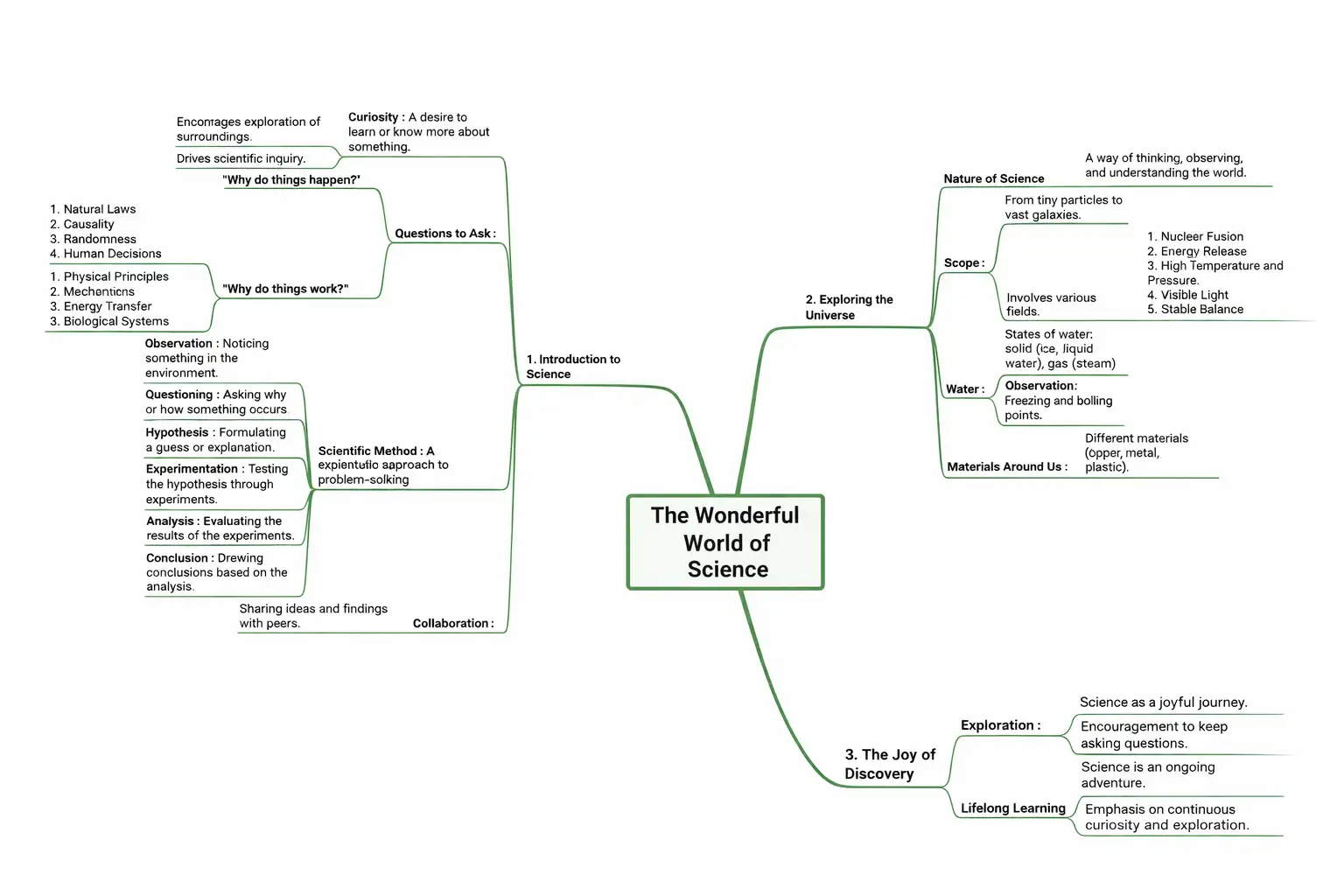
Introduction
Curiosity and Exploration
As humans, we are naturally curious about our surroundings. This curiosity begins in childhood, when we start exploring and questioning the world around us.
In the Preparatory Stage of school, you likely enjoyed discovering and exploring the world around you. This joy comes from learning about new things, asking questions, and making sense of the world.
As you enter the Middle Stage of your education, this journey of exploration continues with a focus on understanding the beautiful world we live in.
Science is introduced as a new subject that helps us think, observe, and do things in a way that helps us understand the world and uncover the universe's secrets.
Understanding
Understanding science means recognizing it as a way to explore and explain the world around us. It involves observing carefully, asking questions, and seeking evidence to find answers. Science helps us make sense of natural events and phenomena by using logical thinking and experiments.
Definition and Approach
Science is a systematic way of thinking, observing, and experimenting to understand our surroundings.
It is an adventure where we ask questions, explore, and try to understand how things work.
Curiosity is important because it drives us to ask questions and seek answers, which is the foundation of scientific inquiry.
Exploring Nature and the World Around Us
Science helps us unravel the mysteries of the natural world.
For example, stars shine because of nuclear reactions in their cores, where hydrogen is converted into helium, releasing energy in the form of light.
Flowers bloom due to environmental cues like temperature, light, and internal plant hormones that signal the right time to open.
Science is everywhere—from the depths of the ocean to the vastness of space.
Examples of science in daily life include cooking, where chemical reactions occur while preparing food, and playing, where laws of physics apply while throwing a ball.
Key Scientific Concepts and Daily Life Applications
Understanding Life on Earth
Plants and animals grow through complex biological processes such as photosynthesis in plants and cellular division.
They grow to develop, reproduce, and sustain life. Growth is essential for survival.
Importance of Food and Water
Food provides the energy and nutrients needed for growth, while water is crucial for maintaining bodily functions.
Indian cuisines are fascinating due to the diversity of ingredients, spices, and cooking methods used across India, creating a wide variety of delicious dishes.
Science as a Puzzle
Science is like a jigsaw puzzle where each discovery adds a new piece to the puzzle of knowledge.
There is no limit to what we can discover; science is an unending journey of discovery, where each answer leads to more questions.
Protecting Earth's environment is important to ensure the survival of life by maintaining ecosystems and natural resources.
The Scientific Method in Daily Life
The scientific method can be applied in daily life to solve problems systematically.
For example, if a pen stops writing, one might hypothesize that the ink is finished, test this by checking the ink refill, observe the result, and draw a conclusion.
Everyday problems can be solved by identifying the problem, asking why it occurred, performing tests to find the cause, and applying solutions based on the test results.
We are all scientists because we apply the scientific method in daily life to solve problems.
Learning Science: The Journey Ahead
Curiosity leads to observation, questioning, and exploration, which are essential for scientific learning.
The journey of science is ongoing because it is about continuous discovery, where each new piece of knowledge leads to further exploration.
Conclusion: Embrace the Adventure of Science
Science is a journey of joyful exploration. The more you discover, the more connected ideas become.
Never stop wondering about the amazing mysteries of the universe, and always ask questions!
Solved Examples
Example 1: Observing Plant Growth
Step 1: Observation - Notice that a plant grows taller over time.
Step 2: Question - Why does the plant grow?
Step 3: Hypothesis - The plant grows because it gets sunlight and water.
Step 4: Experiment - Provide one plant with sunlight and water, and another without.
Step 5: Observation - The plant with sunlight and water grows, the other does not.
Step 6: Conclusion - Plants need sunlight and water to grow.
Example 2: Investigating Why a Ball Rolls Down a Slope
Step 1: Observation - A ball placed on a slope rolls down.
Step 2: Question - Why does the ball roll down the slope?
Step 3: Hypothesis - The ball rolls down because of gravity pulling it downwards.
Step 4: Experiment - Place balls of different sizes on slopes of different steepness.
Step 5: Observation - All balls roll down, and steeper slopes make them roll faster.
Step 6: Conclusion - Gravity causes the ball to roll down, and slope steepness affects speed.
Practice Set
- Level 1 – Easy: What is curiosity and why is it important in science?
- Level 2 – Moderate: Explain how the scientific method can be used to solve a problem in daily life.
- Level 3 – Challenging: Describe how science helps us understand natural phenomena like why stars shine or why flowers bloom.
Answer Key
- Level 1: Curiosity is the desire to learn and ask questions. It is important because it drives scientific inquiry and helps us understand the world.
- Level 2: The scientific method involves observing a problem, forming a hypothesis, testing it, observing results, and drawing conclusions. For example, if a pen stops writing, one might check if the ink is finished and replace it if needed.
- Level 3: Science explains natural phenomena by studying processes such as nuclear reactions in stars that produce light, and environmental cues and hormones in plants that trigger blooming.
Quick Reference Table
- Curiosity: The desire to learn and ask questions about the world.
- Scientific Method: A step-by-step process of observing, hypothesizing, testing, and concluding.
- Photosynthesis: The process by which plants make food using sunlight.
- Cell Division: The process by which cells multiply to help growth.
- Hypothesis: An educated guess that can be tested.
- Experiment: A test to check if the hypothesis is correct.
- Observation: Carefully watching and noting what happens.
- Conclusion: The final understanding after testing.
- Environment: The natural world around us that supports life.
- Energy: The ability to do work or cause change.
Common Mistakes and Misconceptions
- Confusing Hypothesis with Fact: Remember, a hypothesis is a guess that needs testing, not a proven fact.
- Skipping Steps in the Scientific Method: Always follow all steps: observe, hypothesize, test, and conclude.
- Assuming Science Has All the Answers: Science is ongoing; new discoveries can change what we know.
- Mixing Science with Personal Beliefs: Science relies on evidence, not opinions or beliefs.
- Ignoring the Role of Curiosity: Curiosity is essential for asking questions and learning.
Glossary
- Observation: Noticing and describing events or problems carefully.
- Hypothesis: A possible explanation or guess that can be tested.
- Experiment: A test or procedure to check if the hypothesis is true.
- Conclusion: The result or decision made after testing the hypothesis.
- Scientific Method: The process of learning through observation, hypothesis, testing, and conclusion.
- Photosynthesis: The process by which green plants make their own food using sunlight.
- Cell Division: The process by which cells multiply to help organisms grow.
- Curiosity: The desire to learn and understand new things.
- Environment: The natural surroundings where plants, animals, and humans live.
- Energy: The ability to do work or cause change, such as light or heat.