CLASS 6 . SCIENCE . CURIOSITY . METHODS OF-SEPARATION-IN-EVERYDAY-LIFE
Chapter 9 : METHODS OF SEPARATION IN EVERYDAY LIFE
Ch 9
SCIENCE
CLASS 6
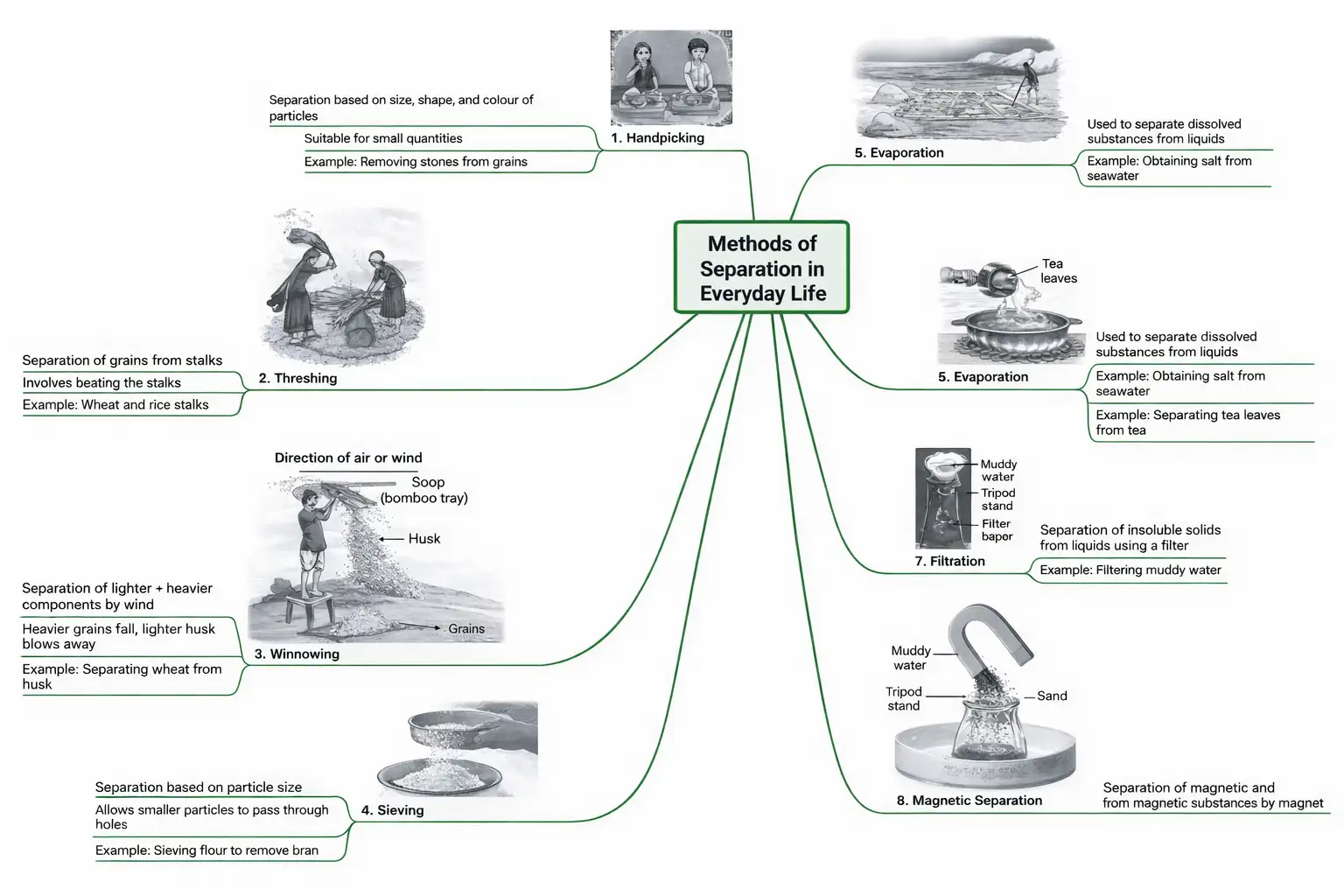
Hand Picking
Description
Hand picking is the manual separation of visible impurities or unwanted materials from a mixture using hands. It relies on differences in size, colour, and shape to distinguish particles.
Principle
The principle of hand picking is based on the physical differences such as size, colour, and shape of the components in the mixture.
Example
Removing stones from rice or wheat by picking them out by hand.
Advantages
It is a simple and cost-effective method suitable for small quantities.
Limitations
Not suitable for large quantities or when particles are very similar in size.
Everyday Life Example
Hand-picking stones from a mixture of grains by spreading the grains and picking out stones manually.
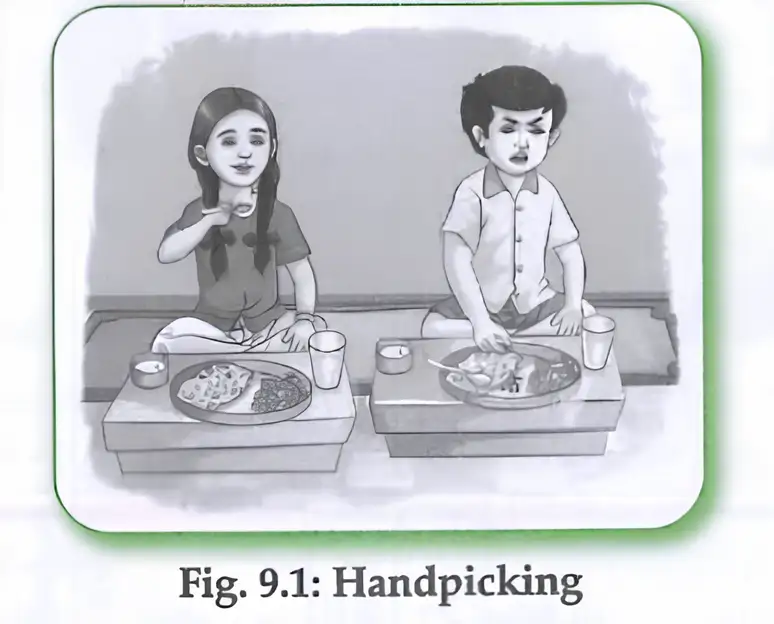
In the image, a boy is selecting food items by hand, demonstrating the concept of hand picking as a method of separation.
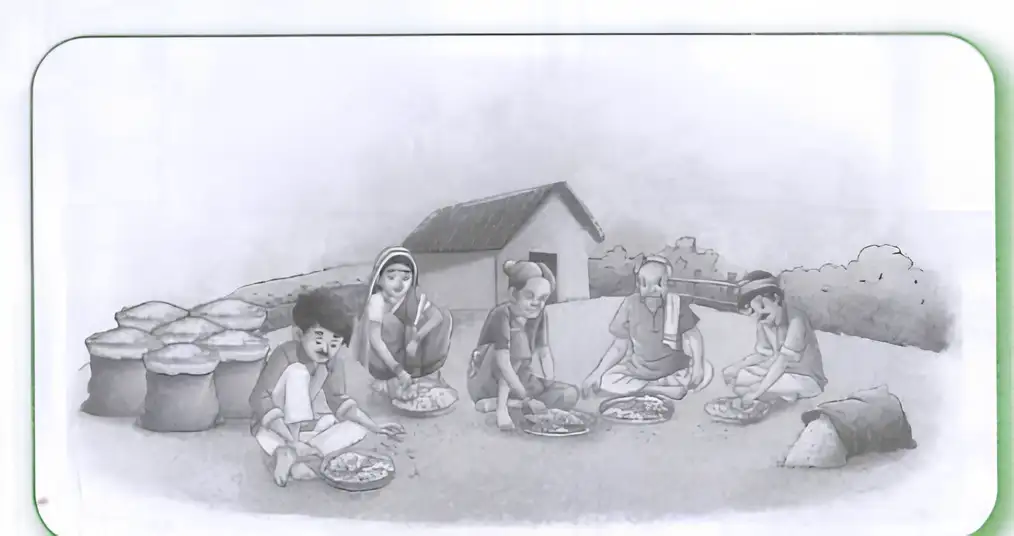
The image shows a group of people working together to clean or sort grains manually, illustrating teamwork in hand picking.
Solved Examples
Example: How would you separate stones from a mixture of rice and stones?
Solution: Spread the mixture on a flat surface and pick out the stones manually by hand. This method is effective because stones are larger and different in appearance from rice grains.
Practice Set
- Level 1: What physical differences allow hand picking to separate components?
- Level 2: Why is hand picking not suitable for large quantities?
- Level 3: Suggest a scenario where hand picking would be the best method of separation and explain why.
Answer Key
- Level 1: Differences in size, colour, and shape allow hand picking to separate components.
- Level 2: Hand picking is time-consuming and inefficient for large quantities, making it unsuitable.
- Level 3: Hand picking is best for small quantities with clearly visible impurities, such as removing stones from grains, because it is simple and cost-effective.
Threshing
Description
Threshing is a physical process used to separate grains from stalks by beating or rubbing.
Principle
It is based on the difference in texture and rigidity between grains and stalks.
Example
Beating wheat stalks to release the grains.
Advantages
Efficient for large-scale grain processing.
Limitations
Labour and space-intensive.
Everyday Life Example
Beating stalks against a hard surface or using a threshing machine to separate grains.
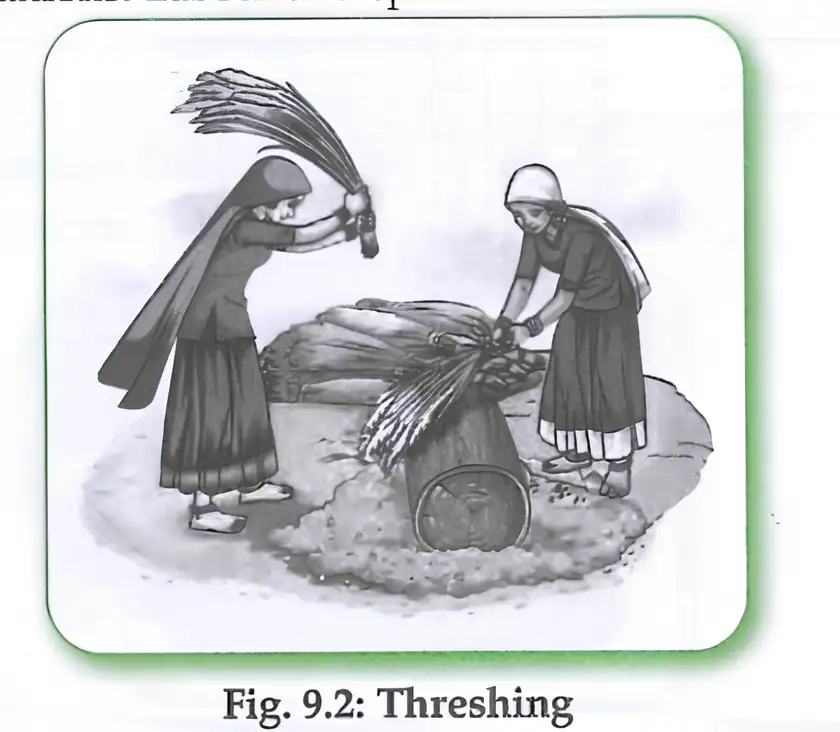
The image shows two women threshing wheat by beating stalks to separate grains.
Solved Examples
Example: How does threshing help in grain processing?
Solution: Threshing loosens grains from stalks by beating, making it easier to collect grains for further processing.
Practice Set
- Level 1: What physical property difference is used in threshing?
- Level 2: Why is threshing considered labour-intensive?
- Level 3: Explain how threshing is important in agriculture.
Answer Key
- Level 1: Difference in texture and rigidity between grains and stalks.
- Level 2: It requires manual beating and space, making it labour-intensive.
- Level 3: Threshing separates grains from stalks efficiently, enabling collection and storage of grains after harvest.
Winnowing
Description
Winnowing uses air to separate lighter particles like husk from heavier particles like grains.
Principle
It is based on differences in weight, using wind or air as a tool.
Example
Separating husk from grains using a winnowing basket.
Advantages
Effective for separating light impurities from heavier grains.
Limitations
Requires wind or a fan.
Everyday Life Example
Farmers use a bamboo tray (soop) to throw threshed grains in the wind, allowing lighter husk to blow away while heavier grains fall down.
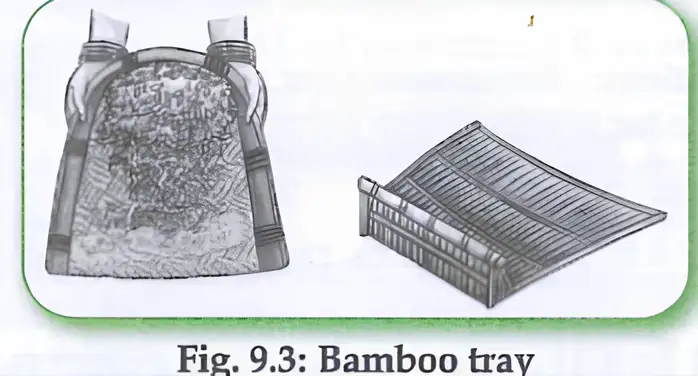
The image shows a bamboo tray used for winnowing, made from woven bamboo strips.
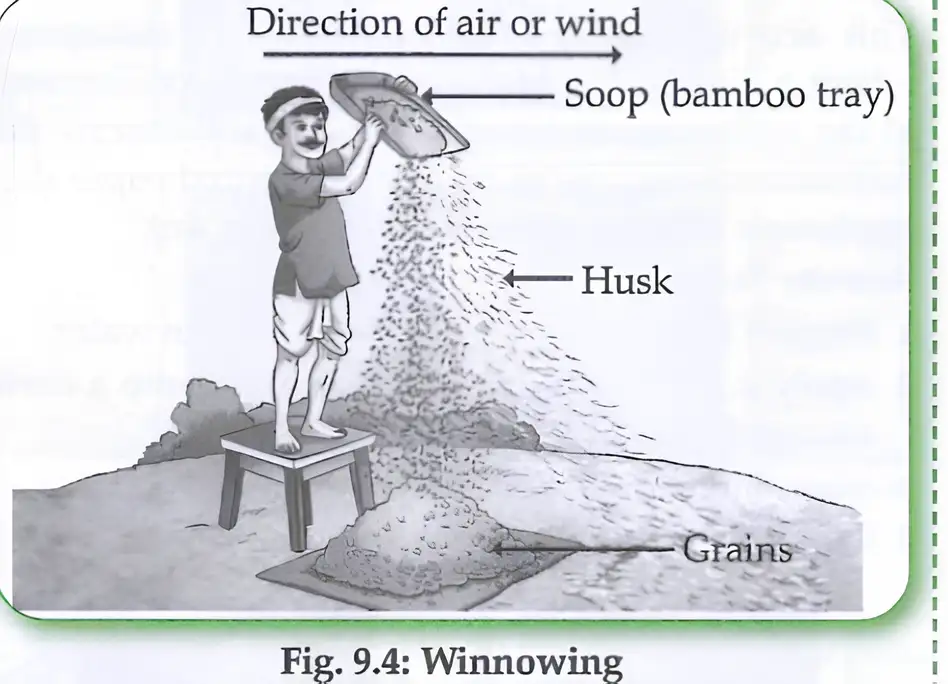
A person is winnowing by throwing grains and husk mixture into the air, allowing wind to separate them.
Solved Examples
Example: How does winnowing separate husk from grains?
Solution: When the mixture is thrown into the air, wind blows away the lighter husk while heavier grains fall down, separating the two.
Practice Set
- Level 1: What physical property is used in winnowing?
- Level 2: Why is wind necessary for winnowing?
- Level 3: Describe the traditional method of winnowing used by farmers.
Answer Key
- Level 1: Difference in weight between husk and grains.
- Level 2: Wind blows away lighter husk particles, enabling separation.
- Level 3: Farmers use a bamboo tray to throw the mixture in the wind; lighter husk is blown away while heavier grains fall back.
Sieving
Description
Sieving uses a sieve to separate particles based on size.
Principle
It relies on differences in particle size.
Example
Sifting flour to remove bran.
Advantages
Precise separation based on size.
Limitations
Limited to particle size differences.
Everyday Life Example
Passing flour through a sieve to separate fine flour from bran.
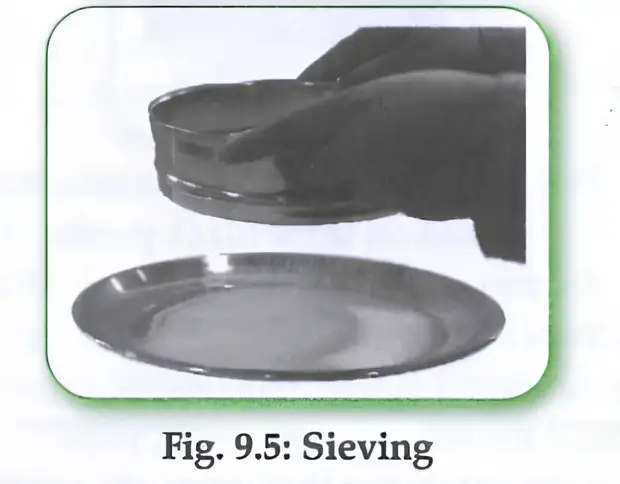
A person is holding a sieve over a plate, shaking it to separate fine particles from coarse ones.
Solved Examples
Example: How does sieving separate flour and bran?
Solution: Flour passes through the sieve holes as fine particles, while bran remains on the sieve due to larger size.
Practice Set
- Level 1: What property does sieving use to separate mixtures?
- Level 2: Why can sieving not separate substances with similar particle sizes?
- Level 3: Suggest a household mixture that can be separated by sieving and explain.
Answer Key
- Level 1: Difference in particle size.
- Level 2: Because particles of similar size pass through or remain together, making separation ineffective.
- Level 3: Example: Separating sand and gravel; gravel remains on sieve while sand passes through.
Evaporation
Description
Evaporation is the process of removing a liquid by heating to obtain the dissolved solute.
Principle
Based on differences in boiling points of components.
Example
Extracting salt from seawater by evaporating water.
Advantages
Simple and effective for obtaining solid solutes.
Limitations
Requires heat and time; not suitable for heat-sensitive substances.
Everyday Life Example
Heating salt solution to evaporate water and collect salt crystals.
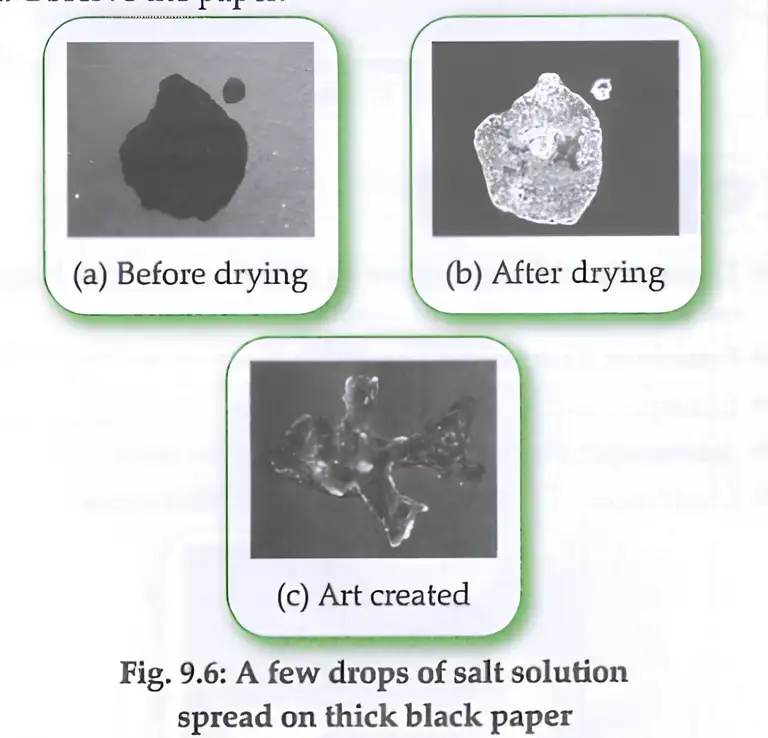
Salt solution drops on black paper before and after drying show salt crystal formation.
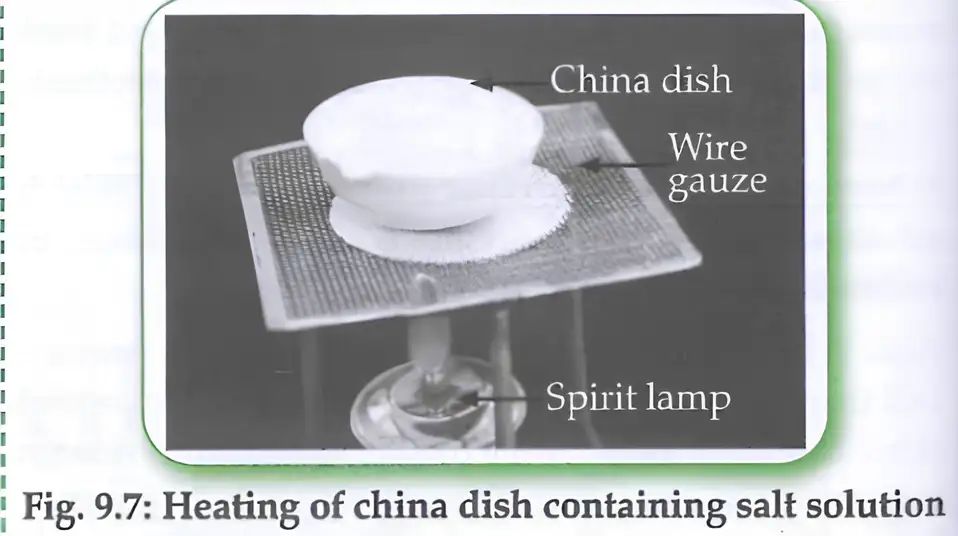
Setup for heating salt solution using a china dish and spirit lamp to evaporate water.
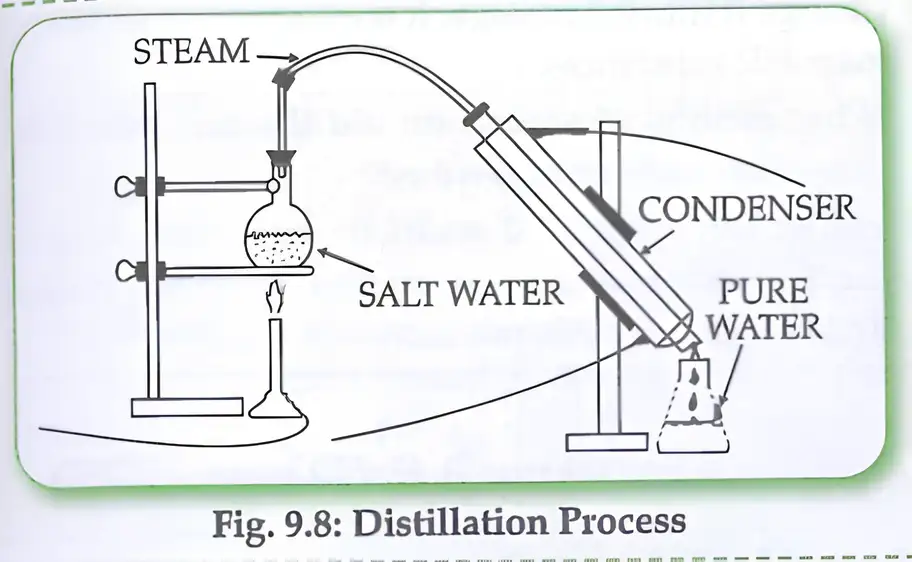
Distillation apparatus used to separate pure water from salt water by evaporation and condensation.
Solved Examples
Example: How can salt be obtained from salt water?
Solution: Heat the salt water to evaporate water, leaving salt crystals behind. Alternatively, use distillation to collect both salt and pure water.
Practice Set
- Level 1: What happens to salt when salt water is evaporated?
- Level 2: Why is evaporation not suitable for heat-sensitive substances?
- Level 3: Explain how distillation can separate salt and water from salt water.
Answer Key
- Level 1: Salt remains as solid crystals after water evaporates.
- Level 2: Heat can damage or change heat-sensitive substances, making evaporation unsuitable.
- Level 3: Salt water is heated; water evaporates and condenses in a separate container, leaving salt behind.
Sedimentation and Decantation
Description
Sedimentation allows solids to settle at the bottom of a liquid, and decantation involves pouring off the clear liquid.
Principle
Based on differences in density between solid and liquid.
Example
Separating tea leaves from brewed tea by letting leaves settle and pouring off clear tea.
Advantages
Simple method for separating large solids from liquids.
Limitations
Not effective for very fine particles.
Everyday Life Example
Allow tea leaves to settle and then decant the clear tea.
Solved Examples
Example: How can tea leaves be separated from tea?
Solution: Let the tea leaves settle at the bottom and carefully pour off the clear tea liquid.
Practice Set
- Level 1: What causes solids to settle in sedimentation?
- Level 2: Why is decantation not suitable for very fine particles?
- Level 3: Describe a situation where sedimentation and decantation can be used.
Answer Key
- Level 1: Difference in density causes solids to settle.
- Level 2: Fine particles remain suspended and do not settle easily.
- Level 3: Separating muddy water by letting mud settle and pouring off clear water.
Filtration
Description
Filtration uses a filter to separate solid particles from liquids.
Principle
Based on differences in particle size.
Example
Filtering muddy water using filter paper.
Advantages
Precise separation of particles based on size.
Limitations
Filter paper can get clogged with large amounts of solid.
Everyday Life Example
Using filter paper in a funnel to separate mud from water.
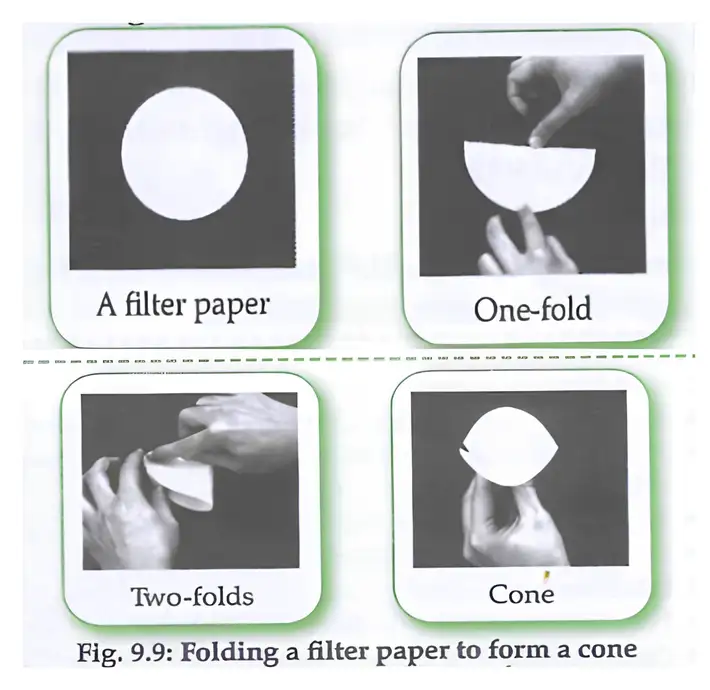
Folding filter paper into a cone shape for filtration.
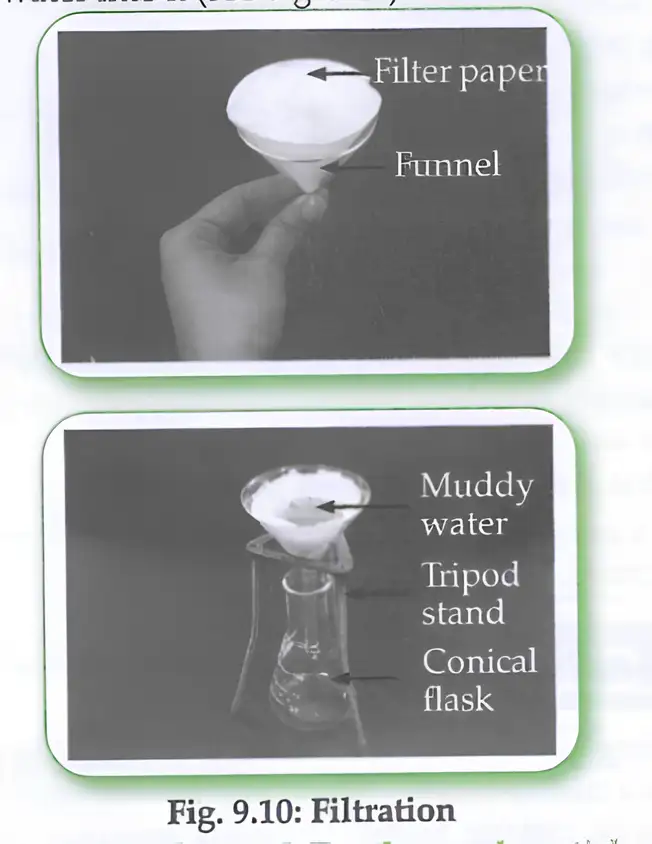
Setup for filtration with filter paper in funnel over conical flask, filtering muddy water.
Solved Examples
Example: How does filtration clean muddy water?
Solution: Filter paper traps solid particles like mud, allowing clear water to pass through.
Practice Set
- Level 1: What is trapped by the filter paper during filtration?
- Level 2: Why does filter paper get clogged?
- Level 3: Design a simple water filter using household materials.
Answer Key
- Level 1: Solid particles like mud are trapped.
- Level 2: Large amounts of solid particles block the pores of the filter paper.
- Level 3: Use layers of cotton, charcoal, sand, and gravel in a bottle to filter water.
Churning
Description
Churning is stirring or agitating a liquid like curd to separate its components, such as butterfat from buttermilk.
Principle
Mechanical agitation causes fat molecules to clump together, separating from the liquid.
Example
Making butter by churning curd.
Advantages
Separates components without chemicals.
Limitations
Requires manual or mechanical effort.
Everyday Life Example
Using an electric blender to churn curd and make buttermilk.
Solved Examples
Example: How is butter separated from curd?
Solution: By churning curd, fat molecules clump together forming butter, separating from buttermilk.
Practice Set
- Level 1: What happens to fat molecules during churning?
- Level 2: Name an appliance used for churning at home.
- Level 3: Explain the importance of churning in dairy processing.
Answer Key
- Level 1: Fat molecules clump together to form butter.
- Level 2: Electric blender or mixer grinder.
- Level 3: Churning separates butter from buttermilk, enabling production of dairy products.
Magnetic Separation
Description
Magnetic separation uses a magnet to attract magnetic materials away from non-magnetic materials.
Principle
Based on magnetic properties of substances.
Example
Separating iron nails from sawdust using a magnet.
Advantages
Quick and efficient for magnetic materials.
Limitations
Only applicable to magnetic substances.
Everyday Life Example
Using a magnet to separate iron nails from sawdust.
Solved Examples
Example: How can iron nails be separated from sawdust?
Solution: Move a magnet through the sawdust; iron nails are attracted and separated.
Practice Set
- Level 1: What property allows magnetic separation?
- Level 2: Why can magnetic separation not be used for non-magnetic materials?
- Level 3: Describe a situation where magnetic separation is useful.
Answer Key
- Level 1: Magnetic properties of substances.
- Level 2: Non-magnetic materials are not attracted by magnets, so they cannot be separated this way.
- Level 3: Separating iron nails from sawdust in a workshop to recycle nails.
Quick Reference Table
- Hand Picking: Separation based on size, colour, and shape differences; used for removing visible impurities like stones from grains.
- Threshing: Beating stalks to separate grains; relies on texture and rigidity differences.
- Winnowing: Using wind or air to separate lighter husk from heavier grains based on weight differences.
- Sieving: Passing mixture through a sieve to separate particles by size.
- Evaporation: Heating a solution to evaporate liquid and obtain dissolved solids.
- Sedimentation and Decantation: Allowing solids to settle by density difference and pouring off clear liquid.
- Filtration: Using filter paper to separate solid particles from liquids based on particle size.
- Churning: Agitating a liquid like curd to separate fat (butter) from liquid (buttermilk).
- Magnetic Separation: Using a magnet to attract magnetic materials from non-magnetic substances.
Common Mistakes and Misconceptions
- Confusing hand picking with sieving: Hand picking involves manual selection, while sieving uses a mesh to separate by size.
- Using winnowing without wind: Winnowing requires air movement; without wind or fan, separation is ineffective.
- Assuming evaporation recovers both solute and solvent: Evaporation only recovers solute; distillation is needed to recover solvent.
- Filtering muddy water without proper filter paper: Using inappropriate filters can clog or fail to separate solids effectively.
- Magnetic separation applied to non-magnetic materials: Only magnetic substances can be separated using magnets.
- Mixing sedimentation and filtration: Sedimentation relies on settling by density, filtration uses a physical barrier to separate particles.
- Churning without agitation: Churning requires mechanical stirring; without it, separation of butterfat does not occur.
Glossary
- Hand Picking: Manual separation of visible impurities based on physical differences.
- Threshing: Process of beating stalks to separate grains.
- Winnowing: Separation of lighter husk from grains using wind or air.
- Sieving: Separation of particles by size using a sieve.
- Evaporation: Removal of liquid by heating to obtain dissolved solids.
- Sedimentation: Settling of solid particles due to density differences.
- Decantation: Pouring off clear liquid after sedimentation.
- Filtration: Separation of solids from liquids using filter paper.
- Churning: Agitation of curd to separate butter from buttermilk.
- Magnetic Separation: Using a magnet to separate magnetic materials from mixtures.