CLASS 6 . SCIENCE . CURIOSITY . MEASUREMENT OF-LENGTH-AND-MOTION
Chapter 5 : MEASUREMENT OF LENGTH AND MOTION
Ch 5
SCIENCE
CLASS 6
Measurement
Definition and Importance
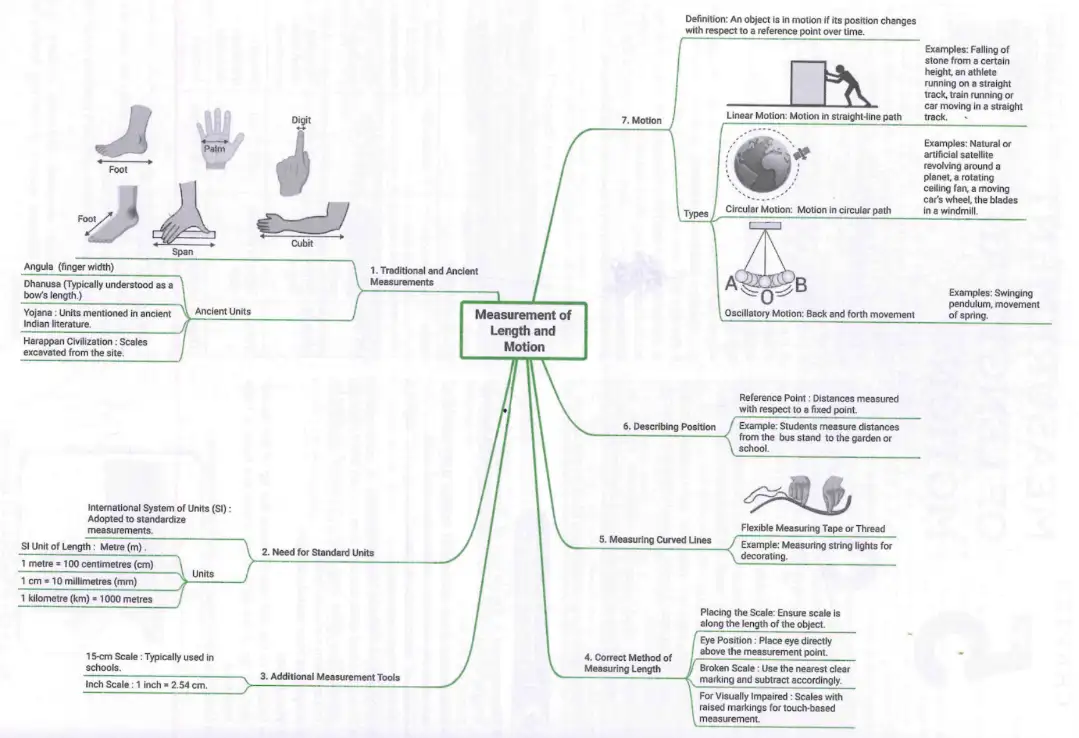
Measurement is the process of determining the size, length, or quantity of something using standard or non-standard units. It is essential in daily activities, scientific experiments, construction, and many other fields to ensure accuracy and consistency.
Non-Standard Units
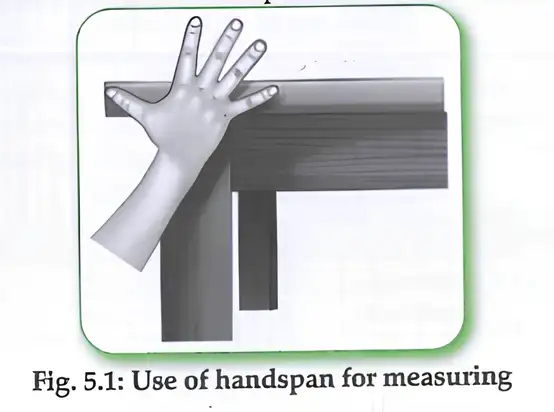
Non-standard units are based on human body parts or familiar objects. These units vary from person to person, leading to inconsistent and inaccurate measurements. Examples include handspan, foot, cubit, angula, pace, and dhanusa.
Limitations of Non-Standard Units
- Inconsistency: Different sizes of body parts cause unreliable measurements.
- Inaccuracy: Lack of precision leads to errors.
- Not Universally Accepted: Different cultures use different units, causing confusion.
Need for Standard Units
Standard units provide uniformity and allow comparison of measurements worldwide. They are essential in trade, science, and engineering to avoid discrepancies.
The International System of Units (SI)
The SI system is globally accepted for scientific and everyday measurements. The base unit for length is the metre (m).
- Centimetre (cm): 1 metre = 100 centimetres.
- Millimetre (mm): 1 centimetre = 10 millimetres.
- Kilometre (km): 1 kilometre = 1000 metres.
Historical Development of the Metre
The metre was originally defined as one ten-millionth of the distance from the equator to the North Pole. It is now defined as the distance light travels in a vacuum in 1/299,792,458 seconds.
Tools for Measuring Length
- Metre Scale: A rigid scale 1 metre long, marked in centimetres and millimetres, used for measuring large objects.
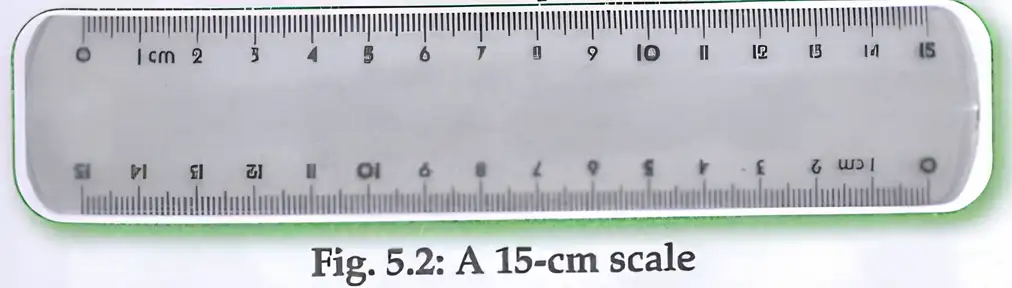
- 15-cm Scale: A smaller scale ideal for measuring small objects like books and pens.
- Measuring Tape: A flexible tape marked in centimetres and millimetres, used for measuring curved surfaces or large areas.
Correct Methods of Measurement
To measure length accurately:
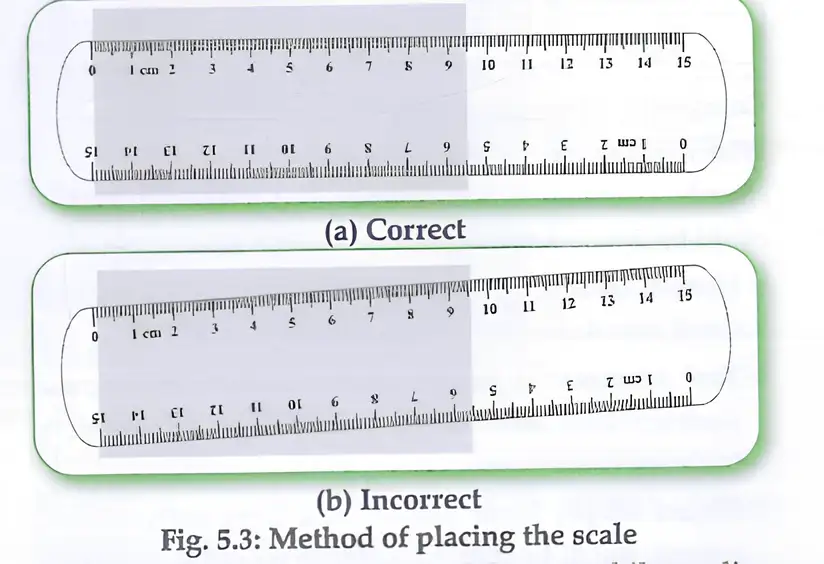
- Align the zero mark of the scale with the start of the object.
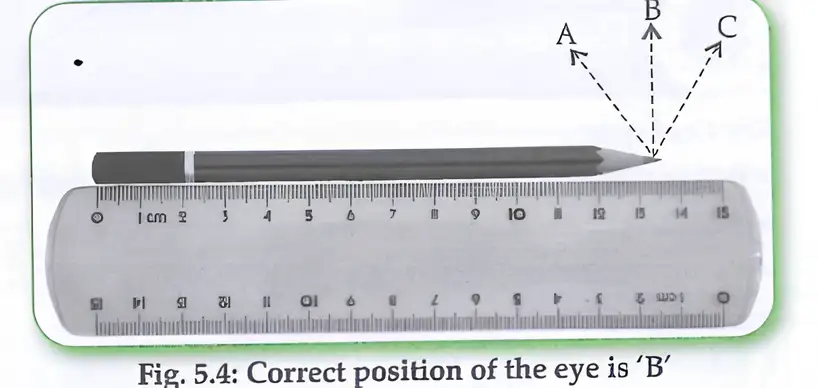
- Place your eye directly above the point being measured to avoid parallax error.
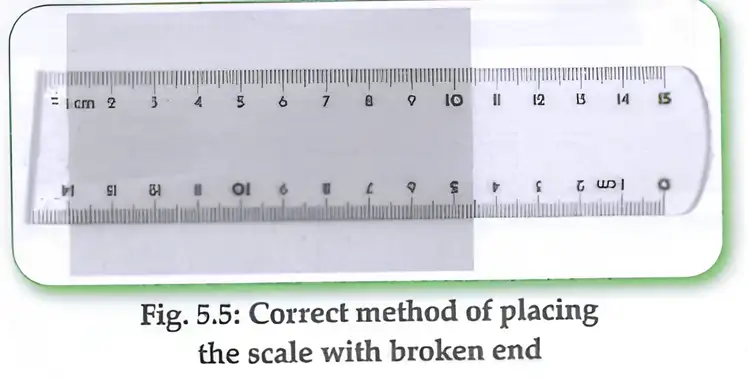
- If the scale's zero end is broken, use a known mark and subtract accordingly.
Solved Examples
Example 1: Measure the length of a pencil using a 15-cm scale.
Solution:
1. Place the pencil on a flat surface.
2. Align the zero mark of the scale with one end of the pencil.
3. Read the scale at the other end of the pencil; suppose it reads 12.5 cm.
4. The length of the pencil is 12.5 cm.
Example 2: Using a broken scale where the zero mark is missing, the reading at one end of the object is 1.0 cm and at the other end is 10.4 cm. Find the length of the object.
Solution:
Length = 10.4 cm - 1.0 cm = 9.4 cm.
Practice Set
Conceptual Questions:
- Level 1: Why are non-standard units not reliable for measurement?
- Level 2: Explain why the metre is considered a standard unit of length.
Application-based Question:
- Level 3: You have a broken ruler with the zero mark missing. The 2 cm mark aligns with one end of a book, and the other end aligns with the 15 cm mark. Calculate the length of the book.
Answer Key
Conceptual Questions:
- Level 1: Non-standard units vary from person to person, causing inconsistent and inaccurate measurements.
- Level 2: The metre is a fixed, universally accepted unit defined by a physical constant, ensuring uniformity and accuracy.
Application-based Question:
- Level 3: Length = 15 cm - 2 cm = 13 cm. The book is 13 cm long.
Measuring Curved Lines
Challenges in Measuring Curved Lines
Curved lines cannot be measured directly with a straight scale because the scale cannot follow the curve.
Methods to Measure Curved Lines
- Using a String: Place a string along the curve, mark the start and end points, then straighten the string and measure its length with a scale.
- Using a Flexible Measuring Tape: Use a flexible tape that can conform to the curve to measure its length directly.
Solved Examples
Example: Measure the length of a curved garden path using a string.
Solution:
1. Place the string along the path, following its curve.
2. Mark the start and end points on the string.
3. Straighten the string and measure its length with a metre scale; suppose it measures 25 m.
4. The length of the curved path is 25 metres.
Practice Set
Conceptual Questions:
- Level 1: Why can't a straight scale be used to measure curved lines?
- Level 2: Describe how a string can be used to measure a curved line.
Application-based Question:
- Level 3: A flexible tape measures a curved fence line as 40 m. If the tape was stretched straight, what is the length of the fence?
Answer Key
Conceptual Questions:
- Level 1: Because a straight scale cannot bend, it cannot follow the curve accurately.
- Level 2: A string is placed along the curve, marked at start and end, then straightened and measured with a scale.
Application-based Question:
- Level 3: The length of the fence is 40 m, as measured by the flexible tape.
Reference Points
Definition and Use
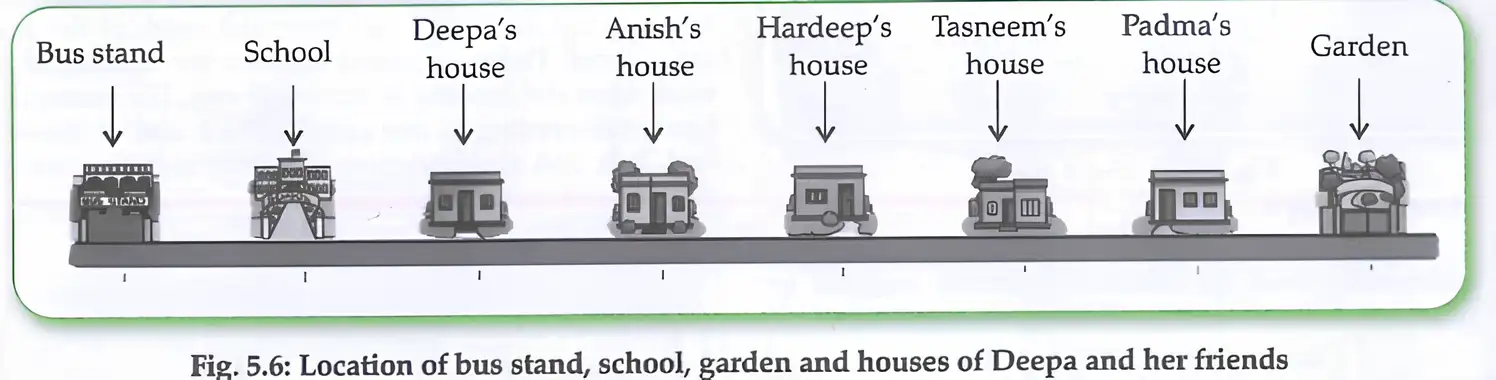
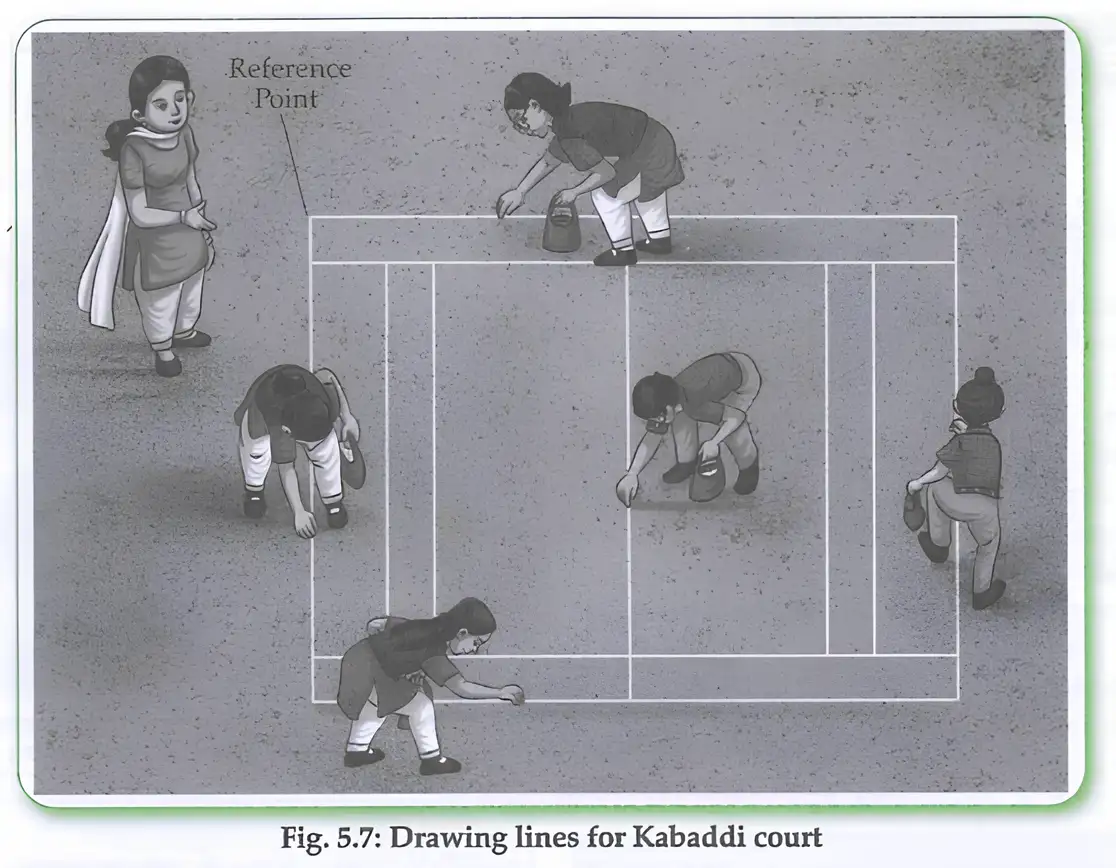
A reference point is a fixed object or location used as a starting point to measure distances or describe positions.
Distance Measurement
Distance is the length between two points measured from a reference point.
Examples of Reference Points
- Kilometre stones along roads indicate distance from a specific location.
- Landmarks like bus stands or schools serve as reference points for measuring distances.
Solved Examples
Example: A bus stand is 5 km from a school. If a house is 3 km from the bus stand towards the school, find the distance between the house and the school.
Solution:
Distance between house and school = 5 km - 3 km = 2 km.
Practice Set
Conceptual Questions:
- Level 1: What is a reference point?
- Level 2: Why is a reference point important in measuring motion?
Application-based Question:
- Level 3: If a kilometre stone shows 10 km at a point and 7 km at another point closer to the city, what is the distance between these two points?
Answer Key
Conceptual Questions:
- Level 1: A fixed object or location used as a starting point for measurement.
- Level 2: It helps determine if an object has moved by comparing positions relative to it.
Application-based Question:
- Level 3: Distance = 10 km - 7 km = 3 km.
Motion
Definition
Motion is the change in position of an object with respect to a reference point over time.
Rest
An object is at rest if its position does not change relative to a reference point over time.
Determining Motion or Rest
By observing an object's position relative to a reference point, if the position changes, the object is in motion; if not, it is at rest.
Solved Examples
Example: A car parked beside a tree is observed from a house. Is the car in motion or at rest?
Solution:
The car's position relative to the house does not change; hence, it is at rest.
Practice Set
Conceptual Questions:
- Level 1: What is motion?
- Level 2: How do you decide if an object is at rest?
Application-based Question:
- Level 3: A person sitting on a moving train looks at a tree outside. Is the tree in motion or at rest relative to the person?
Answer Key
Conceptual Questions:
- Level 1: Motion is the change in position of an object relative to a reference point over time.
- Level 2: If the object's position does not change relative to a reference point, it is at rest.
Application-based Question:
- Level 3: The tree is in motion relative to the person on the train because the person's position changes relative to the tree.
Types of Motion
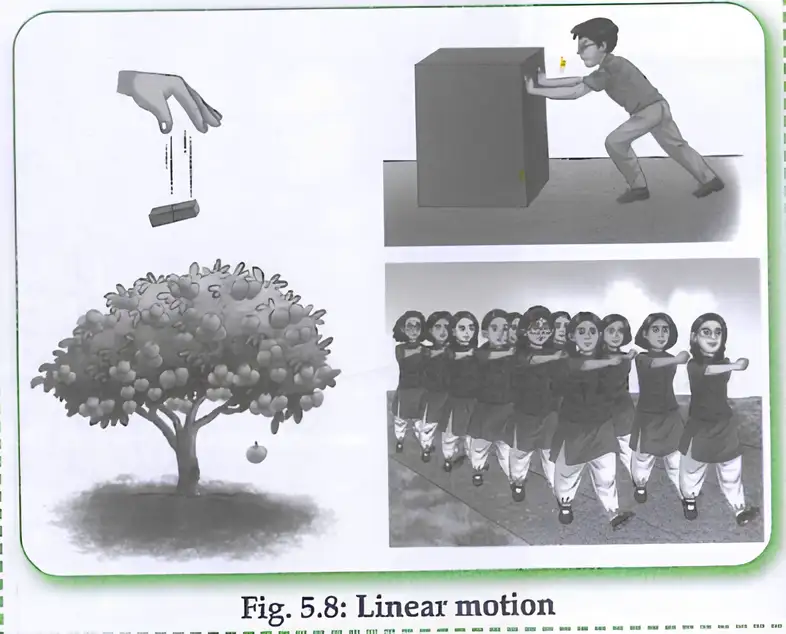
Linear Motion
Movement of an object in a straight line.
Example: A car moving on a straight road.
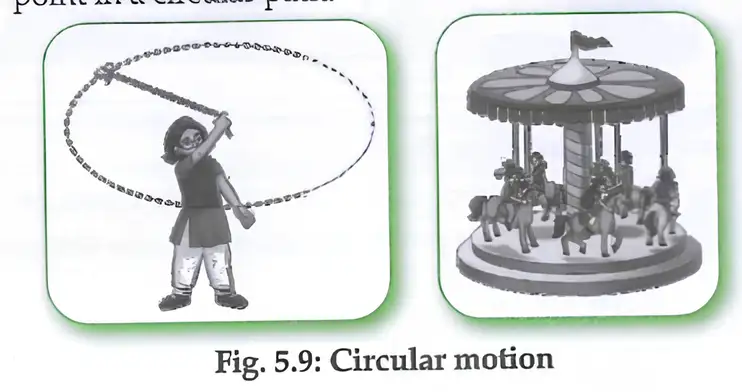
Circular Motion
Movement of an object along a circular path.
Example: Rotation of a fan blade.
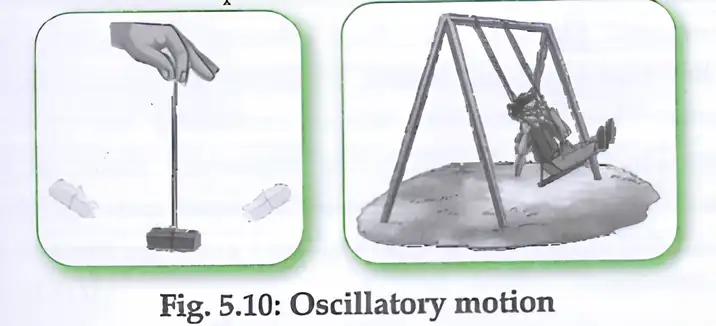
Oscillatory Motion
Back-and-forth movement about a fixed point.
Example: Swinging of a pendulum.
Solved Examples
Example 1: Identify the type of motion of a child swinging on a swing.
Solution: The child moves back and forth about a fixed point, so the motion is oscillatory.
Example 2: A car moving straight on a highway exhibits which type of motion?
Solution: The car moves in a straight line, so it exhibits linear motion.
Practice Set
Conceptual Questions:
- Level 1: Define linear motion.
- Level 2: What is oscillatory motion?
Application-based Question:
- Level 3: A stone tied to a string is whirled in a circle. Identify the type of motion and explain.
Answer Key
Conceptual Questions:
- Level 1: Linear motion is movement in a straight line.
- Level 2: Oscillatory motion is back-and-forth movement about a fixed point.
Application-based Question:
- Level 3: The stone exhibits circular motion as it moves along a circular path around the hand.
Quick Reference Table
Measurement
- Process of determining size, length, or quantity using units.
- Essential for accuracy in daily life and science.
Non-Standard Units
- Based on body parts or familiar objects.
- Examples: Handspan, Foot, Cubit, Angula, Pace, Dhanusa.
- Vary between individuals, causing inconsistency.
Standard Units
- Uniform and universally accepted units.
- SI unit of length is the metre (m).
- Subunits: centimetre (cm), millimetre (mm).
- Multiples: kilometre (km).
Historical Development of Metre
- Originally defined as one ten-millionth of the distance from equator to North Pole.
- Currently defined by the distance light travels in vacuum in 1/299,792,458 seconds.
Measuring Tools
- Metre Scale: rigid, 1 metre long, marked in cm and mm.
- 15-cm Scale: smaller, for small objects.
- Measuring Tape: flexible, for curved surfaces.
Correct Measurement Methods
- Align zero mark with object start.
- Keep eye directly above measurement point.
- Use subtraction method if scale zero is broken.
Measuring Curved Lines
- Use string or flexible tape to follow curve.
- Mark string ends, then measure straightened string.
Reference Points and Distance
- Fixed objects used to measure position and distance.
- Kilometre stones and landmarks serve as reference points.
Motion
- Change in position relative to a reference point over time.
- Rest means no change in position relative to reference point.
Types of Motion
- Linear: movement in a straight line.
- Circular: movement along a circular path.
- Oscillatory: back-and-forth movement about a fixed point.
Common Mistakes and Misconceptions
Measurement Errors
- Starting measurement from a point other than zero on the scale causes incorrect length readings.
- Not placing the eye directly above the measurement point leads to parallax error.
- Using non-standard units without conversion causes inconsistency.
Motion Misconceptions
- Assuming an object is at rest without considering the reference point.
- Confusing types of motion, such as calling circular motion linear.
Glossary
- Measurement: Determining the size or quantity of something using units.
- Standard Unit: A fixed, universally accepted unit of measurement.
- Metre (m): The SI base unit of length.
- Reference Point: A fixed location used to observe motion or measure distance.
- Motion: Change in position of an object relative to a reference point over time.
- Linear Motion: Movement in a straight line.
- Circular Motion: Movement along a circular path.
- Oscillatory Motion: Repetitive back-and-forth movement about a fixed point.