Introduction
Magnets and Their Importance
Magnets have unique properties that make them essential in various applications, from navigation to everyday items like purses, pencil boxes, and refrigerator magnets. Understanding magnets involves exploring their materials, shapes, and behaviours.
Types of Magnets
Natural Magnets
Lodestones: Naturally occurring magnets found in nature, primarily composed of magnetite. They have been used since ancient times for their magnetic properties.
Artificial Magnets
Soft Magnets: Made from materials like iron that can be easily magnetised but lose their magnetism quickly when the external magnetic field is removed.
Hard Magnets: Made from materials like neodymium and samarium-cobalt, which retain their magnetism for a long time and are used in various applications, including electronics and motors.

This image shows six everyday items that have magnets attached to them. Examples include a container holding paper clips, an eraser with a magnet inside, a wallet or case with a magnetic clasp, a jewelry box with a magnetic lid closure, a refrigerator door with a magnet to keep it shut, and small magnetic decorations on a fridge. These examples demonstrate how magnets are used in daily life to hold, close, or stick things.
Magnetic vs. Non-Magnetic Materials
Identifying Magnetic Materials
Objective: Determine which materials are attracted to a magnet.
Materials Needed: Magnet (bar magnet or any shape), various objects such as pencil, eraser, paperclip, plastic toy.
Procedure
1. Prediction: Guess which objects will be attracted to the magnet based on their material (e.g., metal objects are more likely to be attracted).
2. Observation: Bring the magnet close to each object and note if the object sticks to the magnet.
This image shows a table listing four objects, their materials, and whether each is attracted by a magnet based on prediction and observation. Iron is attracted, while wood, rubber, and plastic are not.
Conclusion
Magnetic Materials: Materials like iron, nickel, and cobalt are attracted to magnets because they contain magnetic domains that align with the magnetic field.
Non-Magnetic Materials: Materials like wood, rubber, and plastic are not attracted to magnets because they do not have magnetic properties.
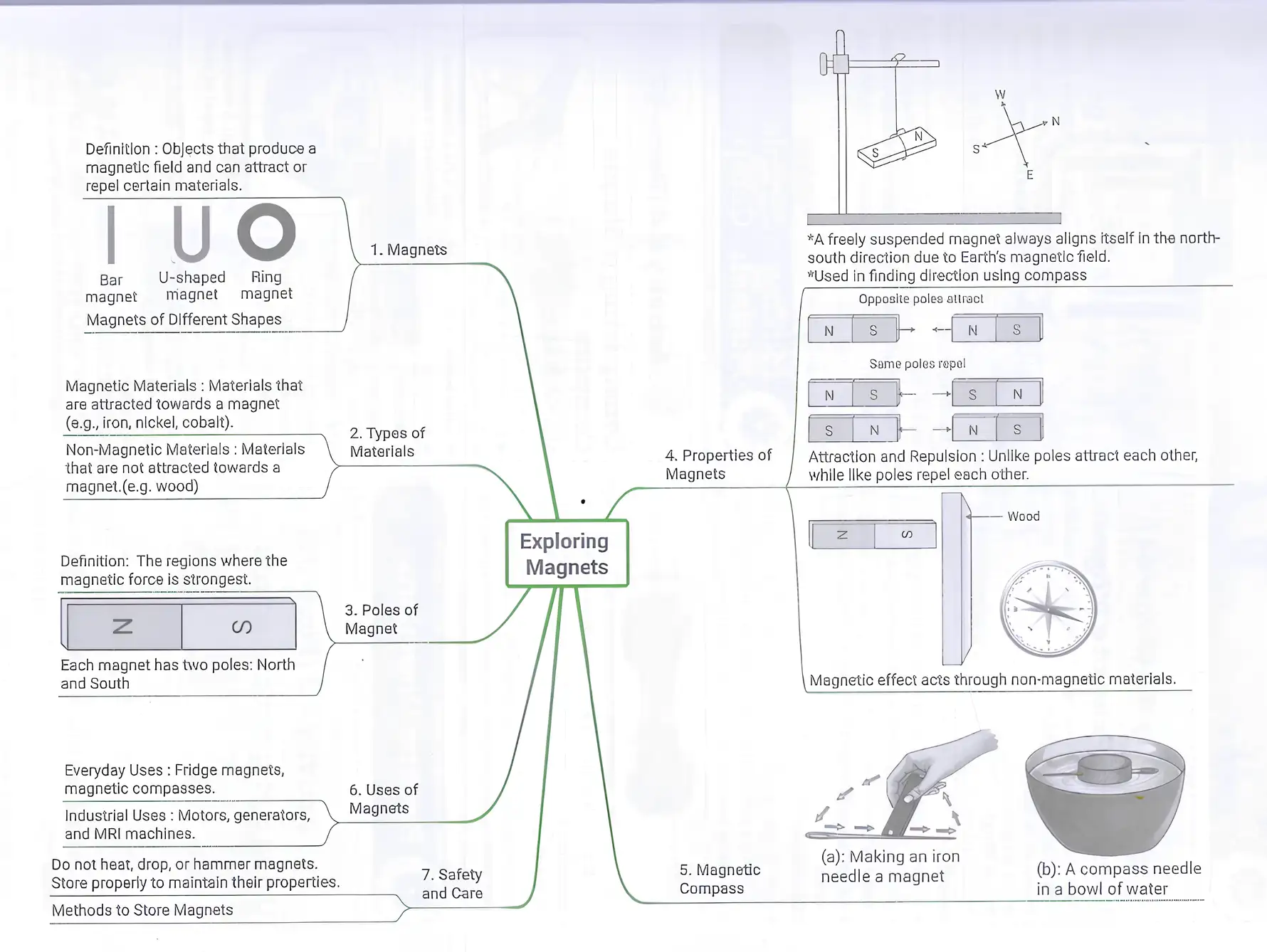
This mind map explains key concepts about magnets including shapes, types of materials, poles, properties, magnetic compass, uses, and safety tips.
Poles of a Magnet
Identifying Poles of a Magnet
Objective: Observe how iron filings align around a magnet to identify its poles.
Materials Needed: Bar magnet, iron filings, sheet of paper.
Procedure
Spread iron filings evenly on the paper. Place the bar magnet on top of the iron filings. Gently tap the paper to make the filings settle.
Observation
Iron filings cluster around the ends of the magnet, creating a pattern that shows magnetic field lines extending from the North to the South pole.
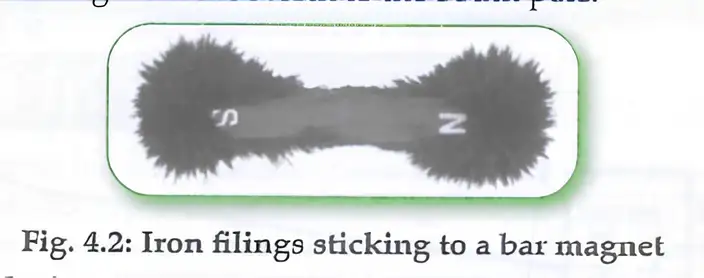
The filings arrange themselves along the magnetic field lines, making the invisible magnetic field visible. Most filings stick closely at the poles where the magnetic force is strongest.
Conclusion
The ends of the magnet where the magnetic force is strongest are called poles. A bar magnet has a North pole and a South pole. The magnetic force is strongest at these poles.
Finding Directions
Using a Magnetic Compass
Objective: Demonstrate how a magnetic compass aligns with Earth's magnetic field to show directions.
Materials Needed: Bar magnet, thread, compass.
Procedure
1. Suspend Magnet: Tie the magnet to a thread and let it hang freely.
2. Alignment: Allow the magnet to come to rest and observe its alignment.
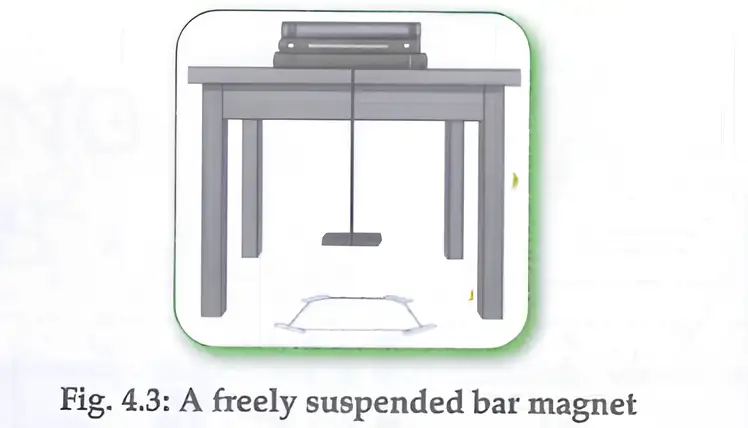
The suspended magnet will align itself in the North-South direction due to Earth's magnetic field.
Conclusion
A freely suspended magnet aligns with Earth's magnetic field, showing the North-South direction. This principle is used in magnetic compasses for navigation.
Simple Magnetic Compass
Constructing a Simple Compass
Materials Needed: Cork piece, iron sewing needle, permanent bar magnet, glass bowl, water.
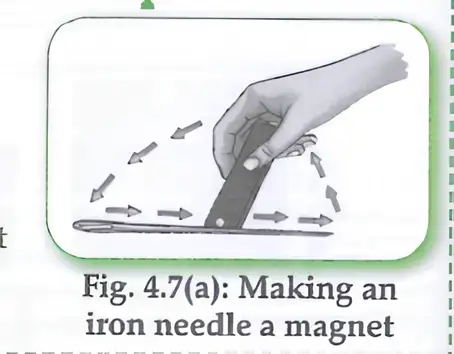
Rub the iron needle with the magnet in one direction to magnetise it. This aligns the tiny magnetic regions inside the needle, making it a magnet.
Procedure
1. Magnetise the needle by stroking it with the magnet multiple times.
2. Float the needle by placing it through a cork and placing it on water in a glass bowl.
Observation
The needle aligns itself along the North-South direction when it settles.
Conclusion
This homemade compass demonstrates the same principle as modern compasses, using a magnetised needle to find directions.
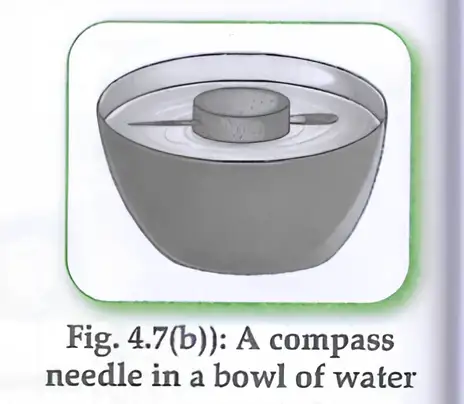
The needle floating on cork in water can rotate freely and aligns with Earth's magnetic field, pointing towards magnetic north.
Attraction and Repulsion
Testing Magnetic Attraction and Repulsion
Objective: Observe how different poles of magnets interact with each other.
Materials Needed: Two bar magnets.
Procedure
1. Test Attraction: Bring opposite poles of the magnets close and observe attraction.
2. Test Repulsion: Bring like poles close and observe repulsion.
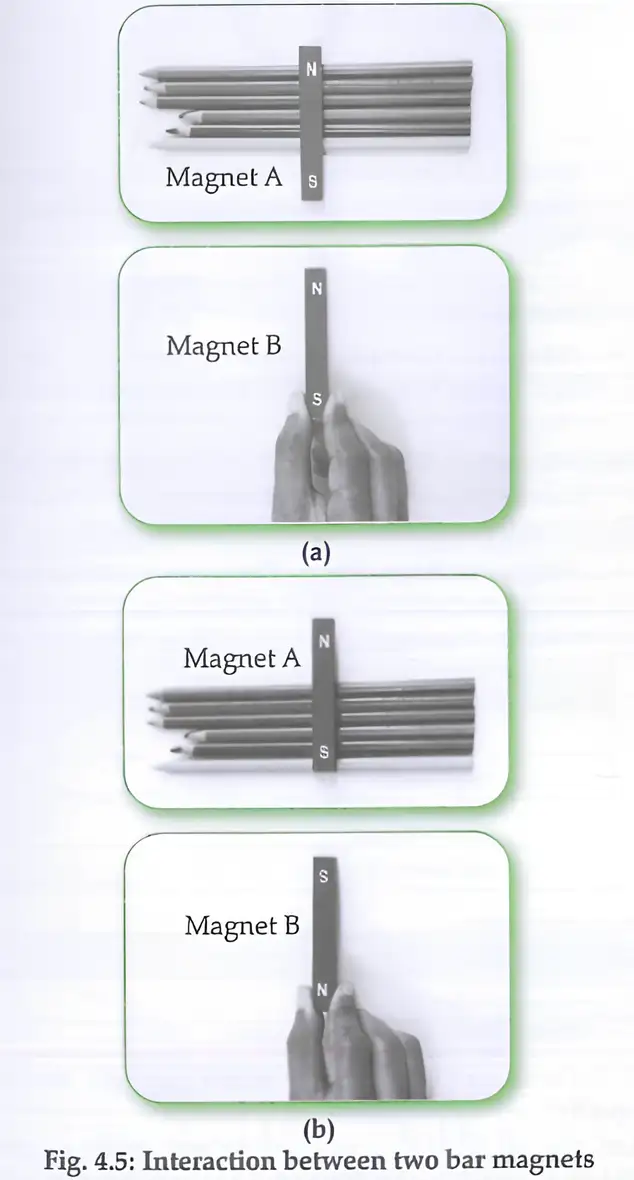
Opposite poles attract each other, while like poles repel each other.
Conclusion
Magnets exhibit attraction between opposite poles (North-South) and repulsion between like poles (North-North or South-South).
Magnetic Interaction with Compass
Objective: Observe the effect of a bar magnet on a magnetic compass needle.
Materials: Magnetic compass, bar magnet.
Procedure
1. Place the compass on a flat surface and wait for the needle to stabilise pointing North.
2. Bring the North pole of the bar magnet close to the North pole of the compass needle and observe deflection.
3. Repeat with the South pole of the bar magnet.
Observation
The compass needle deflects away from the North pole of the bar magnet (repulsion) and towards the South pole (attraction).
Conclusion
The compass needle deflects away from like poles and towards opposite poles due to magnetic forces.
Effect of Non-Magnetic Materials
Effect on Magnetic Field
Objective: Determine if non-magnetic materials affect the magnetic field.
Materials Needed: Magnetic compass, various non-magnetic materials (wood, cardboard, plastic, glass).
Procedure
1. Place a non-magnetic material between the compass and a magnet.
2. Observe if the deflection of the compass needle changes.
Non-magnetic materials like wood, cardboard, plastic, and glass cause no appreciable change in compass needle deflection.
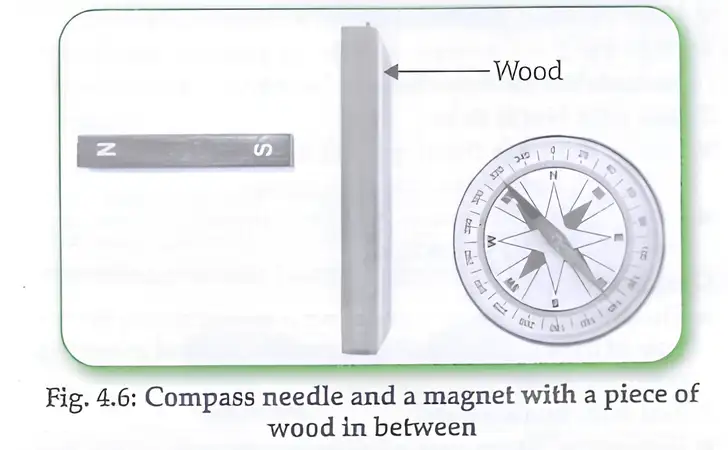
Magnetic fields can pass through non-magnetic materials, as shown by the compass needle deflecting even with wood placed between the magnet and compass.
Conclusion
Non-magnetic materials do not affect the deflection of the compass needle, showing that magnetic fields pass through these materials.
Fun with Magnets
Magnetic Activities
1. Magnetic Garland: Create decorative garlands using magnets by attaching magnets to decorative items and arranging them on a string.
2. Magnetic Maze: Move steel balls through a maze using a magnet from underneath without touching the balls.
3. Paperclip Picker: Retrieve paper clips from water using a magnet without getting wet.
Solved Examples
Example 1: Identifying Magnetic Materials
Problem: You have four objects: a pencil, an eraser, a paperclip, and a plastic toy. Which of these will be attracted by a magnet?
Solution:
- Pencil: Made of wood, which is non-magnetic. So, it will not be attracted.
- Eraser: Made of rubber, which is non-magnetic. So, it will not be attracted.
- Paperclip: Made of iron or steel, which are magnetic materials. So, it will be attracted.
- Plastic toy: Made of plastic, which is non-magnetic. So, it will not be attracted.
Answer: Only the paperclip will be attracted by the magnet.
Example 2: Magnetic Poles Interaction
Problem: What will happen if the North pole of one magnet is brought near the South pole of another magnet?
Solution: Opposite poles attract each other. So, the two magnets will attract and stick together.
Answer: The magnets will attract each other.
Example 3: Using a Simple Magnetic Compass
Problem: How does a simple magnetic compass help in finding directions?
Solution: A needle magnetised by rubbing with a bar magnet is floated on water using a cork. The needle aligns itself along the Earth's magnetic field, pointing towards the North-South direction. This helps in finding directions.
Answer: The compass needle points North-South, helping to find directions.
Practice Set
- Level 1 – Easy: Name two natural magnets and two artificial magnets.
- Level 2 – Moderate: Explain why iron is attracted to magnets but plastic is not.
- Level 3 – Challenging: Describe how a simple magnetic compass works and why it points North-South.
Answer Key
- Level 1: Natural magnets: lodestones; Artificial magnets: soft magnets (iron), hard magnets (neodymium, samarium-cobalt).
- Level 2: Iron is attracted to magnets because it has magnetic domains that align with the magnetic field. Plastic does not have these domains and is not magnetic.
- Level 3: A simple magnetic compass uses a magnetised needle that aligns with Earth's magnetic field. The needle points North-South because it aligns with the magnetic poles of the Earth.
Quick Reference Table
- Magnetic Materials: Substances like iron, nickel, and cobalt that are attracted to magnets due to the alignment of magnetic domains.
- Types of Magnets: Natural magnets (lodestones) and artificial magnets (soft and hard magnets).
- Magnetic Poles: Every magnet has two poles, North and South, where magnetic forces are strongest.
- Magnetic Field: The invisible area around a magnet where magnetic forces act, visualised by iron filings.
- Magnetic Compass: A device with a magnetised needle that aligns with Earth's magnetic field to show directions.
- Magnetic Interaction: Opposite poles attract each other, while like poles repel each other.
- Effect of Non-Magnetic Materials: Magnetic fields can pass through non-magnetic materials like wood, plastic, and glass without affecting compass needle deflection.
- Uses of Magnets: Everyday items like refrigerator magnets, magnetic clasps, and industrial applications such as motors and generators.
Common Mistakes and Misconceptions
- Confusing Magnetic and Non-Magnetic Materials: Not all metals are magnetic; for example, aluminum and copper are non-magnetic.
- Assuming Magnets Have Only One Pole: Every magnet has two poles; a magnet cannot have only a North or only a South pole.
- Believing Magnetic Force Works Through All Materials Equally: Magnetic fields pass through non-magnetic materials but are blocked or weakened by magnetic materials.
- Mixing Up Magnetic Poles: The North pole of a magnet is attracted to the Earth's magnetic South pole, which is near the geographic North.
- Thinking Magnets Lose Strength Quickly Without Cause: Hard magnets retain magnetism for a long time unless physically damaged or heated.
- Assuming Compass Always Points to Geographic North: A compass points to the magnetic North, which is slightly different from geographic North.
Glossary
- Magnet: An object that produces a magnetic field and attracts magnetic materials.
- Magnetic Domain: Small regions within magnetic materials where magnetic moments are aligned.
- North Pole: The end of a magnet that points towards the Earth's geographic North when freely suspended.
- South Pole: The end of a magnet opposite to the North pole.
- Magnetic Field Lines: Invisible lines that represent the direction and strength of a magnetic field, emerging from the North pole and entering the South pole.
- Compass Needle: A small magnetised needle that aligns with Earth's magnetic field to indicate direction.
- Soft Magnet: A magnet made from materials that can be easily magnetised and demagnetised.
- Hard Magnet: A magnet made from materials that retain their magnetism for a long time.
- Magnetic Attraction: The force that pulls opposite magnetic poles or magnetic materials together.
- Magnetic Repulsion: The force that pushes like magnetic poles away from each other.
- Non-Magnetic Material: Materials that are not attracted by magnets and do not affect magnetic fields, such as wood, plastic, and glass.