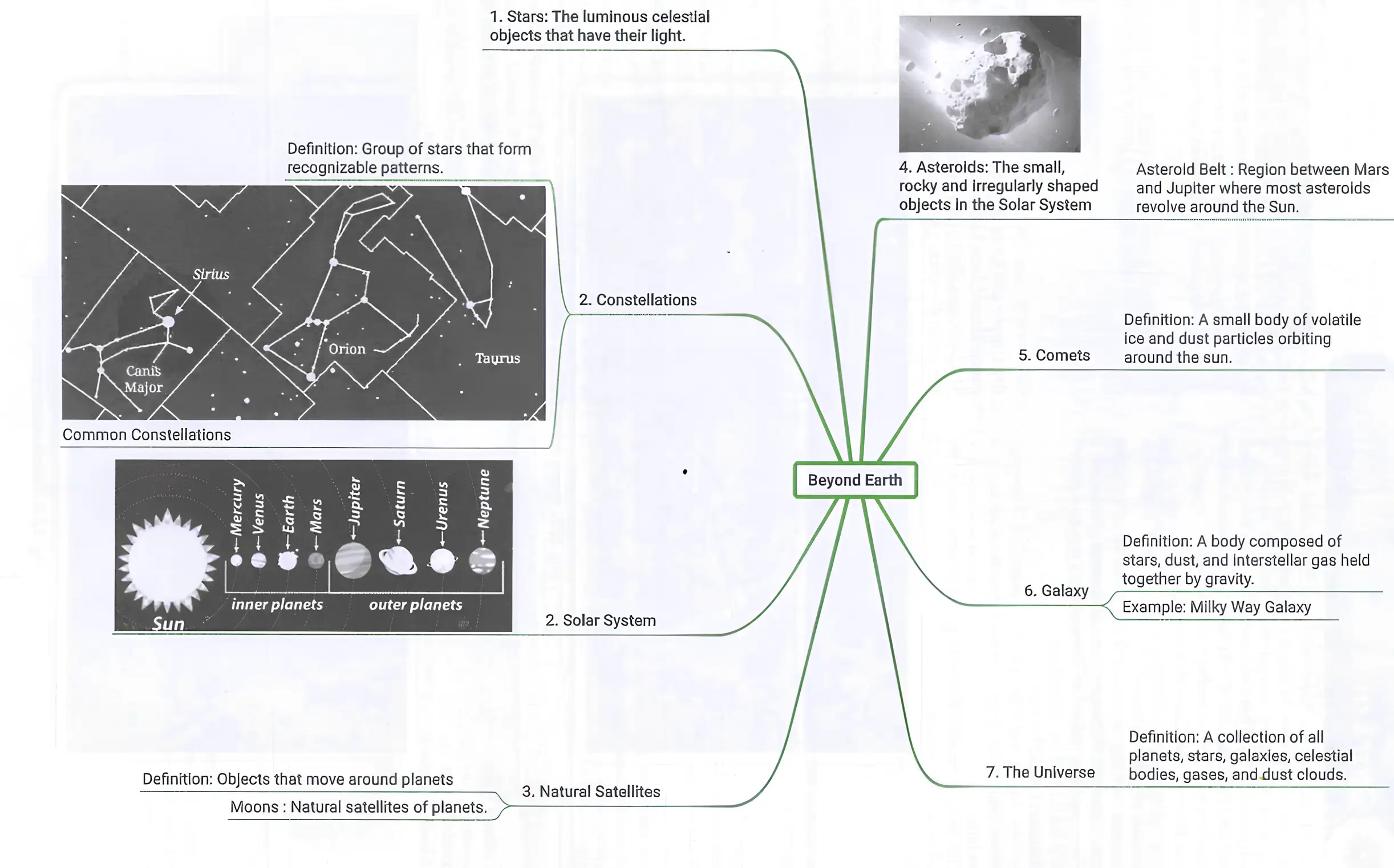
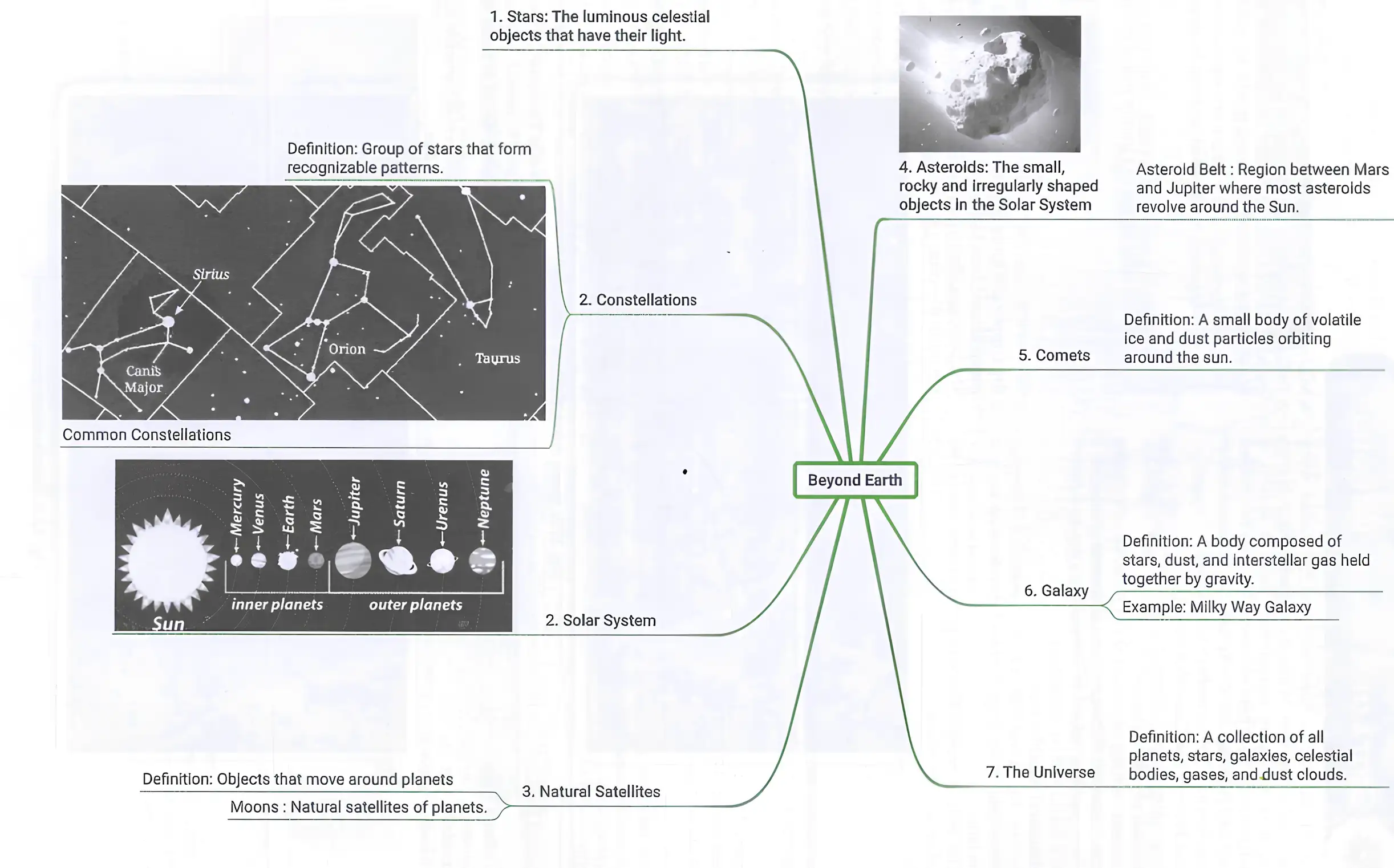
Stars and Constellations
Star Patterns and Constellations
Stars in the night sky often form patterns that resemble familiar objects or shapes. These patterns, called constellations, were identified and named by ancient cultures based on their stories and characters. Recognising these patterns helped people navigate and remember star positions.
Historical Significance
Before the magnetic compass was invented, sailors and travellers used constellations to find directions on land and at sea. The ability to identify star patterns was an essential navigation skill.
Modern Understanding
Today, the International Astronomical Union (IAU) has officially divided the sky into 88 constellations. While the focus on patterns has lessened, the term 'constellation' still refers to these star groups.
Examples of Constellations
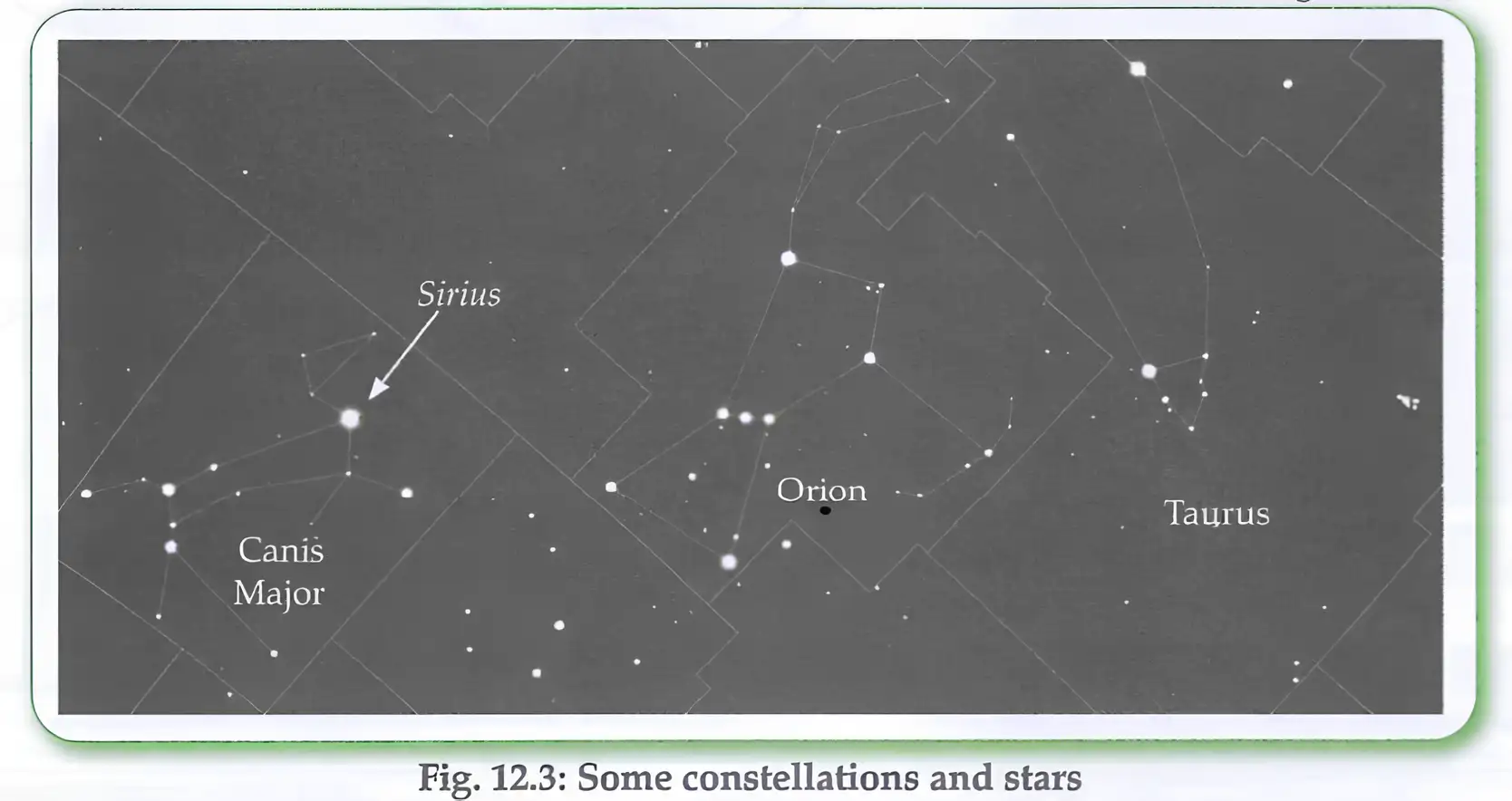
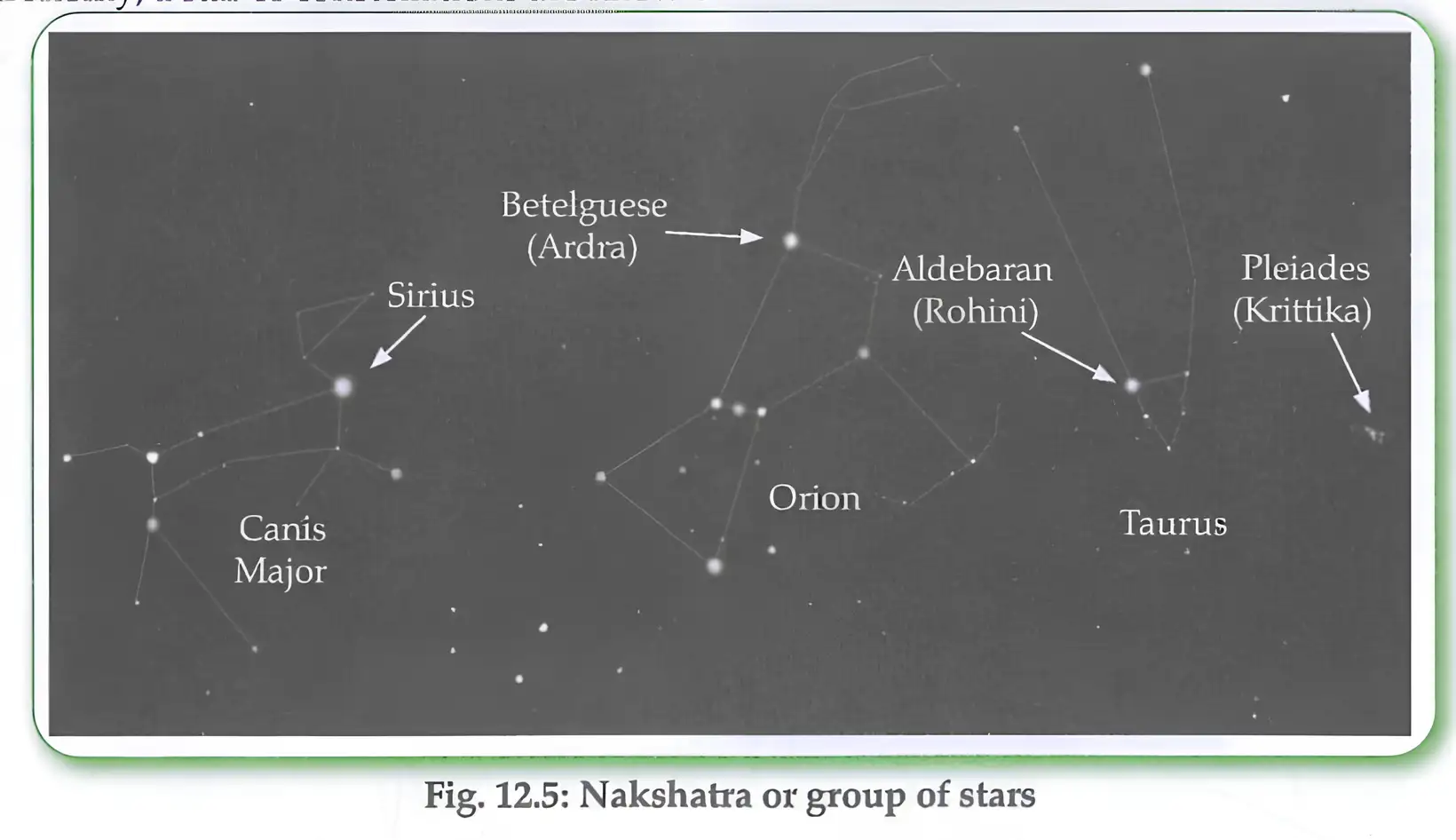
Orion: Depicted as a hunter with a distinctive belt of three stars.
Canis Major: Contains Sirius, the brightest star in the night sky, imagined as the hunter's dog.
Taurus: Often shown as a bull engaged in battle with the hunter.
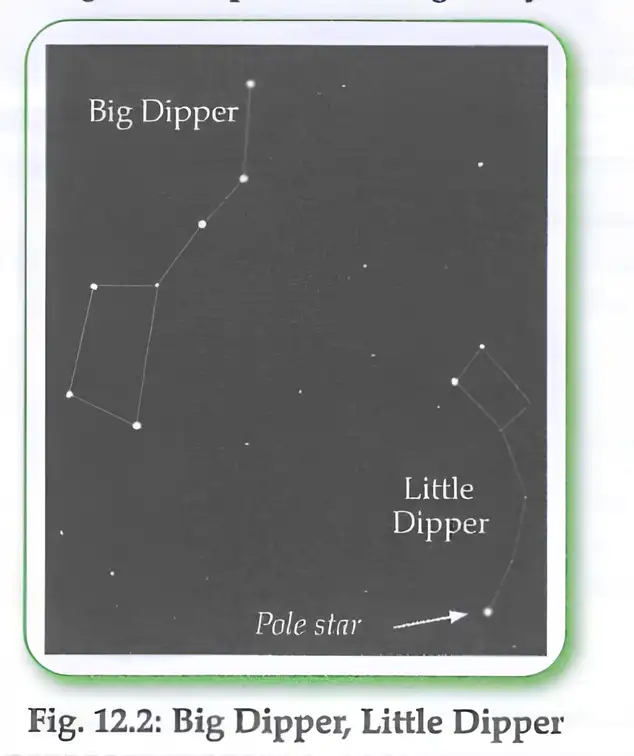
Big Dipper and Little Dipper: Part of Ursa Major and Ursa Minor respectively; the Little Dipper contains the Pole Star (Polaris), which helps locate north.
Cultural Variations
Different cultures have unique names and stories for constellations. In Indian astronomy, constellations are called nakshatras, with stars like Betelgeuse and Aldebaran having specific names. The Big Dipper is known as Saptarishi and the Pole Star as Dhruva tara in India.
Regional Stories
Various communities, including forest tribes in India, have their own interpretations and stories related to constellations, reflecting cultural diversity in star lore.
Solved Examples
Example 1: How can the Pole Star be located using the Big Dipper?
Solution: Identify the two stars at the end of the Big Dipper's cup. Draw an imaginary straight line through these stars and extend it about five times the distance between them. This line points to the Pole Star, which is part of the Little Dipper.
Example 2: Why is the Pole Star important for navigation?
Solution: The Pole Star remains nearly fixed in the sky above the North Pole, providing a reliable reference point to determine the north direction, essential for navigation before modern instruments.
Practice Set
Conceptual Questions
- Level 1: What is a constellation?
- Level 2: Why were constellations important for ancient sailors?
Application-based Question
- Level 3: Describe how you would find the Pole Star using the Big Dipper on a clear night.
Answer Key
Conceptual Questions
- Level 1: A constellation is a group of stars forming a recognizable pattern in the night sky.
- Level 2: Constellations helped ancient sailors find directions by providing fixed patterns in the sky to navigate by.
Application-based Question
- Level 3: Locate the Big Dipper in the northern sky, identify the two stars at the end of its cup, draw an imaginary line through them, and extend it about five times the distance between these stars to find the Pole Star.
Our Solar System
The Sun
The Sun is a star closest to Earth, a hot spherical ball of gases emitting light and heat. It is the main source of energy for Earth, supporting life by driving climate, seasons, weather, and the water cycle. The distance between the Sun and Earth is about 150 million kilometers, known as one astronomical unit (au).
Planets
A planet is a large, nearly spherical object that revolves around the Sun. The eight planets in order from the Sun are Mercury, Venus, Earth, Mars, Jupiter, Saturn, Uranus, and Neptune. Earth takes about one year to revolve around the Sun and about 24 hours to rotate on its axis. Inner planets (Mercury to Mars) are rocky and smaller, while outer planets (Jupiter to Neptune) are gaseous and larger with ring systems.
Natural Satellites
Natural satellites, or moons, orbit planets. Earth has one moon, Mars has two, and the gas giants have many. The Moon takes about 27 days to revolve around Earth and has a surface marked by craters formed by asteroid impacts. It lacks atmosphere and water.
Asteroids
Asteroids are small, rocky, irregularly shaped objects mostly found in the asteroid belt between Mars and Jupiter. Their sizes range from 10 meters to 500 kilometers. Occasionally, some asteroids pass close to Earth.
Comets
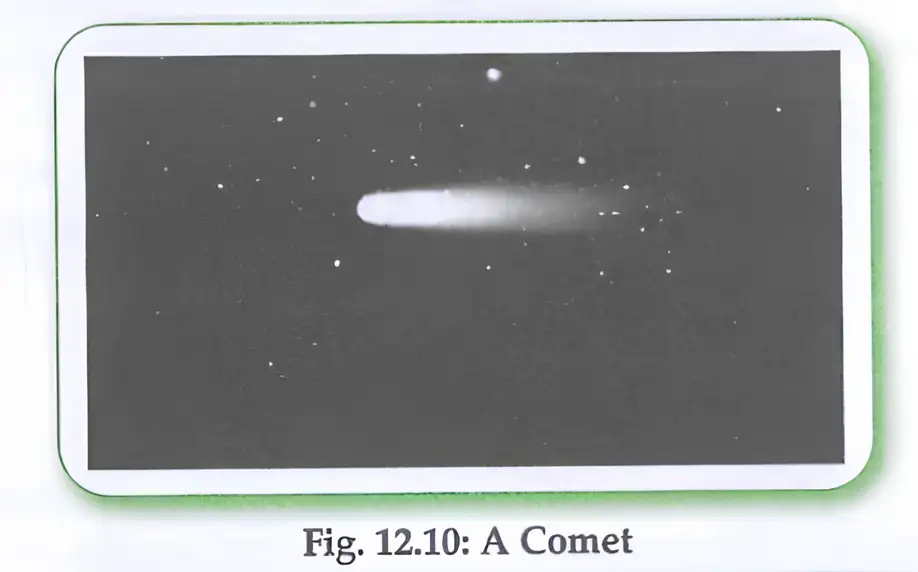
Comets are icy, rocky objects from the outer Solar System with glowing tails formed when they approach the Sun and their frozen material evaporates. Halley's Comet is a famous example, appearing every 76 years. Historically, comets were feared as bad omens, but they are natural celestial objects.
The Milky Way Galaxy
The Milky Way is our home galaxy, visible as a faint band of light across the night sky. It contains billions of stars, including our Solar System. Beyond it lie countless other galaxies. Currently, no evidence of life beyond Earth has been found, though the search continues.
Solved Examples
Example 1: What is the difference between inner and outer planets?
Solution: Inner planets (Mercury, Venus, Earth, Mars) are smaller, rocky, and have solid surfaces. Outer planets (Jupiter, Saturn, Uranus, Neptune) are larger, gaseous, and have ring systems.
Example 2: How long does the Moon take to revolve around Earth?
Solution: The Moon takes about 27 days to complete one revolution around Earth.
Practice Set
Conceptual Questions
- Level 1: What is a natural satellite?
- Level 2: Name the planets in our Solar System in order from the Sun.
Application-based Question
- Level 3: Explain why Venus is called the Morning Star or Evening Star.
Answer Key
Conceptual Questions
- Level 1: A natural satellite is an object that orbits a planet, such as the Moon orbiting Earth.
- Level 2: Mercury, Venus, Earth, Mars, Jupiter, Saturn, Uranus, Neptune.
Application-based Question
- Level 3: Venus is called the Morning Star or Evening Star because it is visible near the eastern horizon before sunrise or near the western horizon after sunset, depending on its position relative to Earth and the Sun.
Quick Reference Table
Stars and Constellations
- Stars are luminous spheres of gas that emit light and heat through nuclear fusion.
- Constellations are groups of stars forming recognizable patterns in the night sky, officially divided into 88 regions by the IAU.
- The Pole Star (Polaris) is located in the Little Dipper constellation and is used for navigation as it remains nearly fixed in the northern sky.
Solar System
- The Sun is a hot, glowing star at the center of the Solar System, approximately 150 million km from Earth (1 astronomical unit).
- Planets are large, nearly spherical objects orbiting the Sun; there are eight planets arranged from Mercury to Neptune.
- Inner planets (Mercury, Venus, Earth, Mars) are rocky and smaller; outer planets (Jupiter, Saturn, Uranus, Neptune) are gaseous and larger with ring systems.
- Natural satellites or moons orbit planets; Earth has one moon, Mars has two, and gas giants have many.
- The Moon takes about 27 days to revolve around Earth and has a cratered surface with no atmosphere.
- Asteroids are small, rocky objects mostly found in the asteroid belt between Mars and Jupiter, ranging from 10 m to 500 km in size.
- Comets are icy, rocky bodies from the outer Solar System that develop glowing tails when near the Sun; Halley's Comet appears every 76 years.
Milky Way Galaxy and Beyond
- The Milky Way is a spiral galaxy containing billions of stars, including our Solar System.
- Beyond the Milky Way, there are countless other galaxies, each with millions to billions of stars.
- Currently, no evidence of life beyond Earth has been found despite ongoing searches on exoplanets.
Common Mistakes and Misconceptions
• Confusing constellations with individual stars; constellations are groups of stars forming patterns.
• Believing the Pole Star moves significantly; it remains nearly fixed in the northern sky.
• Thinking all planets are similar; inner planets are rocky, outer planets are gaseous.
• Assuming comets are permanent fixtures; they are temporary visitors with elliptical orbits.
Glossary
Asteroid: Small rocky object orbiting the Sun, mostly in the asteroid belt.
Constellation: A group of stars forming a recognizable pattern in the sky.
Natural Satellite: A moon or object orbiting a planet.
Planet: A large spherical object orbiting the Sun.
Revolution: Movement of an object around another, such as Earth around the Sun.
Solar System: The Sun and all objects orbiting it, including planets and moons.
Star: A luminous sphere of gas producing light and heat.
Sun: The star at the center of our Solar System.