CLASS 12-PCM . PHYSICS . PHYSICS PART II . DUAL NATURE-OF-RADIATION-AND-MATTER
Chapter 3 : Dual Nature Of Radiation And Matter
Ch 3
PHYSICS
CLASS 12-PCM
Photoelectric Effect
Electron Emission and Work Function
Electrons in metals are bound by the attractive force of positive ions and cannot escape the surface unless they gain sufficient energy. The minimum energy required to remove an electron from the metal surface is called the work function, measured in electron volts (eV).
Photoelectric Effect
When light of suitable frequency falls on a metal surface, it can cause electrons to be emitted. These emitted electrons are called photoelectrons. The energy from the incident light is absorbed by free electrons, and if this energy exceeds the work function, electrons escape from the metal.
Experimental Observations
Hertz observed that ultraviolet light enhances spark production, indicating electron emission. Lenard found that ultraviolet light causes zinc to become positively charged due to electron emission, producing a photoelectric current. The frequency below which no electrons are emitted is called the threshold frequency.
Key experimental outcomes include:
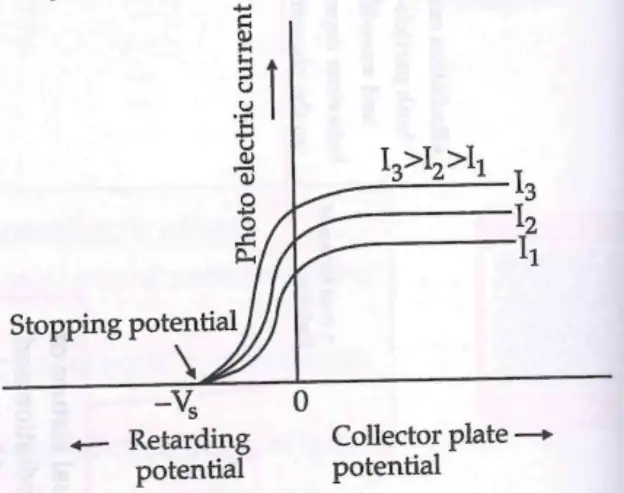
- Photoelectric current increases linearly with light intensity at potentials above the stopping potential.
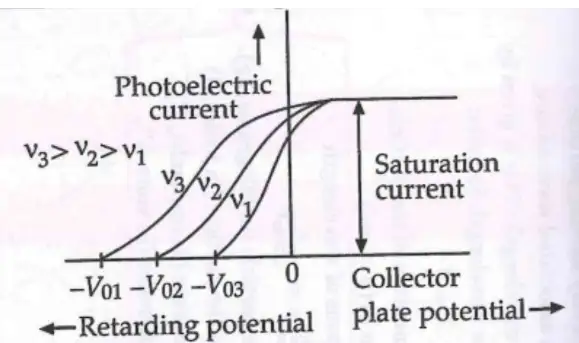
- Stopping potential is independent of light intensity for a given frequency.
- Photoemission occurs only above the threshold frequency, regardless of light intensity.
Graphs and Characteristics
Graphs of photoelectric current versus collector plate potential show that current increases with potential until saturation, and decreases to zero at the stopping potential. Higher light intensity increases saturation current, while higher frequency light increases stopping potential.
Failure of Wave Theory
- Wave theory predicts energy depends on amplitude, but photoelectric effect depends on frequency.
- Wave theory cannot explain instantaneous electron emission.
- Wave theory cannot explain threshold frequency.
Quantum Explanation
Max Planck proposed that electromagnetic energy is quantized as packets called photons, each with energy \( E = h \nu \), where \( h \) is Planck's constant and \( \nu \) is frequency.
Einstein explained the photoelectric effect by stating that electrons absorb a photon’s energy. If this energy exceeds the work function \( \Phi_0 \), electrons are emitted with kinetic energy:
\[ K.E._{max} = h \nu - \Phi_0 \]
At stopping potential \( V_0 \), kinetic energy is zero, so:
\[ K.E._{max} = e V_0 \]
where \( e \) is the electron charge.
Photon Characteristics
- Photons of a given frequency have equal energy.
- Photons are electrically neutral and have momentum \( p = \frac{h \nu}{c} \).
- Light exhibits dual nature: wave behavior in propagation and particle behavior in interaction.
Solved Examples
Example 1: Calculate the maximum kinetic energy of photoelectrons emitted when light of frequency \( 1.5 \times 10^{15} \) Hz falls on a metal with work function \( 2.0 \) eV.
Solution:
Given:
- Frequency, \( \nu = 1.5 \times 10^{15} \) Hz
- Work function, \( \Phi_0 = 2.0 \) eV = \( 2.0 \times 1.6 \times 10^{-19} = 3.2 \times 10^{-19} \) J
- Planck's constant, \( h = 6.626 \times 10^{-34} \) Js
Energy of photon:
\[ E = h \nu = 6.626 \times 10^{-34} \times 1.5 \times 10^{15} = 9.939 \times 10^{-19} \text{ J} \]
Maximum kinetic energy:
\[ K.E._{max} = E - \Phi_0 = 9.939 \times 10^{-19} - 3.2 \times 10^{-19} = 6.739 \times 10^{-19} \text{ J} \]
Convert to eV:
\[ \frac{6.739 \times 10^{-19}}{1.6 \times 10^{-19}} = 4.21 \text{ eV} \]
Answer: Maximum kinetic energy is 4.21 eV.
Practice Set
- Level 1: What is the minimum frequency of light required to eject electrons from a metal with work function 3 eV?
- Level 2: Explain why increasing the intensity of light below threshold frequency does not cause photoemission.
- Level 3: Calculate the stopping potential for photoelectrons emitted from a metal with work function 2.5 eV when illuminated by light of wavelength 400 nm.
Answer Key
- Level 1: \( \nu_0 = \frac{\Phi_0}{h} = \frac{3 \times 1.6 \times 10^{-19}}{6.626 \times 10^{-34}} = 7.25 \times 10^{14} \text{ Hz} \)
- Level 2: Below threshold frequency, photons do not have enough energy to overcome the work function, so no electrons are emitted regardless of intensity.
- Level 3: Energy of photon \( E = \frac{hc}{\lambda} = \frac{6.626 \times 10^{-34} \times 3 \times 10^{8}}{400 \times 10^{-9}} = 4.97 \times 10^{-19} \text{ J} = 3.1 \text{ eV} \).
- Maximum kinetic energy \( K.E._{max} = E - \Phi_0 = 3.1 - 2.5 = 0.6 \text{ eV} \).
- Stopping potential \( V_0 = \frac{K.E._{max}}{e} = 0.6 \text{ V} \).
Dual Nature of Matter
de Broglie Hypothesis
de Broglie proposed that if radiation has dual nature, matter should also exhibit wave-particle duality. Moving particles have wave properties called matter waves, distinct from mechanical and electromagnetic waves.
Matter Waves and Wavelength
Each moving particle is associated with a matter wave that influences its motion. The wavelength \( \lambda \) of this wave is related to the particle's momentum \( p \) by:
\[ \lambda = \frac{h}{p} = \frac{h}{mv} \]
where \( m \) is mass and \( v \) is velocity.
Properties of Matter Waves
- Lighter particles have larger wavelengths.
- Faster particles have smaller wavelengths.
- Wavelength is independent of the particle's charge.
Calculation of Electron Wavelength
For an electron accelerated through potential \( V \), kinetic energy \( K = eV \). The de Broglie wavelength is:
\[ \lambda_e = \frac{h}{\sqrt{2 m e V}} \]
Numerically, \( \lambda_e = \frac{1.227}{\sqrt{V}} \) nm, where \( V \) is in volts.
Solved Examples
Example 1: Calculate the de Broglie wavelength of an electron accelerated through 100 V.
Solution:
Using \( \lambda_e = \frac{1.227}{\sqrt{V}} \):
\[ \lambda_e = \frac{1.227}{\sqrt{100}} = \frac{1.227}{10} = 0.1227 \text{ nm} \]
Answer: The de Broglie wavelength is 0.1227 nm.
Practice Set
- Level 1: State the de Broglie wavelength formula for a particle.
- Level 2: Explain how the wavelength of a particle changes with its velocity.
- Level 3: Calculate the de Broglie wavelength of a proton moving with momentum \( 3.3 \times 10^{-24} \) kg·m/s.
Answer Key
- Level 1: \( \lambda = \frac{h}{p} \)
- Level 2: As velocity increases, momentum increases, so wavelength decreases.
- Level 3: \( \lambda = \frac{6.626 \times 10^{-34}}{3.3 \times 10^{-24}} = 2.01 \times 10^{-10} \text{ m} = 0.201 \text{ nm} \)
Quick Reference Table
Photoelectric Effect:
- Energy of photon: \( E = h \nu = \frac{hc}{\lambda} \)
- Work function: Minimum energy to eject electron \( \Phi_0 \)
- Einstein’s photoelectric equation: \( K.E._{max} = h \nu - \Phi_0 \)
- Stopping potential: \( K.E._{max} = e V_0 \)
de Broglie Wavelength:
- Wavelength: \( \lambda = \frac{h}{p} = \frac{h}{mv} \)
- Electron wavelength: \( \lambda_e = \frac{h}{\sqrt{2 m e V}} \)
Common Mistakes and Misconceptions
- Confusing intensity with frequency in photoelectric effect; energy depends on frequency, not intensity.
- Assuming electrons are emitted below threshold frequency regardless of intensity.
- Forgetting that stopping potential is independent of light intensity.
- Misapplying de Broglie wavelength formula without considering particle momentum.
Glossary
- Photon: A quantum of light energy with particle-like properties.
- Work Function: Minimum energy required to remove an electron from a metal surface.
- Threshold Frequency: Minimum frequency of light needed to emit electrons from a metal.
- Stopping Potential: The voltage needed to stop photoelectrons from reaching the anode.
- de Broglie Wavelength: The wavelength associated with a moving particle, showing its wave nature.