CLASS 12-PCM . PHYSICS . PHYSICS PART I . CURRENT ELECTRICITY
Chapter 3 : Current Electricity
Ch 3
PHYSICS
CLASS 12-PCM
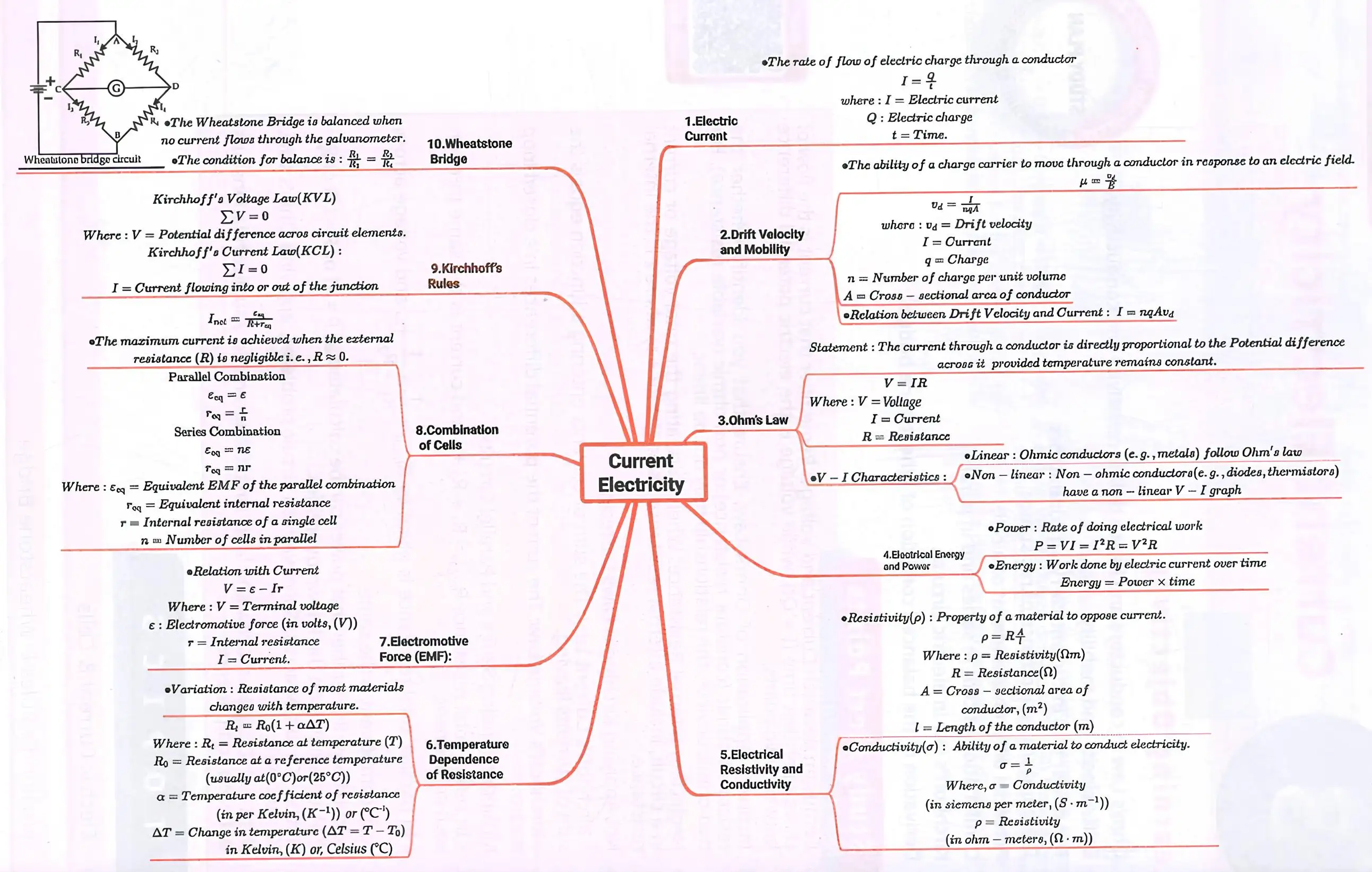
Current Electricity
Electric Current and Cells
Electric current is the rate of flow of electric charge through a conductor, defined as \(I = \frac{dq}{dt}\). In metallic conductors, free electrons move under the influence of an electric field, resulting in a drift velocity \(v_d\), which is the average velocity of these electrons.
The drift velocity \(v_d\) is related to the current \(I\) by the formula \(I = n e A v_d\), where \(n\) is the number of free electrons per unit volume, \(e\) is the charge of an electron, and \(A\) is the cross-sectional area of the conductor.
Mobility \(\mu\) is defined as the drift velocity per unit electric field, \(\mu = \frac{v_d}{E} = \frac{e \tau}{m}\), where \(\tau\) is the relaxation time (average time between collisions), and \(m\) is the mass of the electron.
Ohm's law states that the current through a conductor is directly proportional to the potential difference across it, provided temperature and other physical conditions remain constant. Mathematically, \(V = IR\), where \(R\) is the resistance.
Resistance is a measure of opposition to current flow, with SI unit ohm (\(\Omega\)). Conductors with constant resistance obey Ohm's law and have linear V-I characteristics, while non-ohmic devices like diodes have non-linear characteristics.
Resistivity \(\rho\) is a material property defined as \(\rho = R \frac{A}{L}\), where \(R\) is resistance, \(A\) is cross-sectional area, and \(L\) is length. Conductivity \(\sigma\) is the reciprocal of resistivity.
Electrical energy \(E\) consumed is given by \(E = V I t = I^2 R t = \frac{V^2}{R} t\), and power \(P\) is the rate of energy consumption, \(P = VI = I^2 R = \frac{V^2}{R}\), measured in watts (W).
Resistance and resistivity vary with temperature as \(R = R_0 (1 + \alpha \Delta T)\) and \(\rho = \rho_0 (1 + \alpha \Delta T)\), where \(\alpha\) is the temperature coefficient.
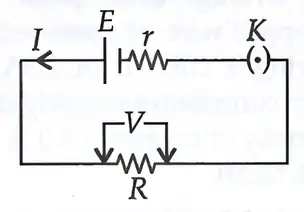
Cells maintain potential difference through chemical reactions. The electromotive force (emf) \(E\) is the potential difference when no current flows. Internal resistance \(r\) opposes current flow inside the cell. The terminal voltage \(V\) when current \(I\) flows is \(V = E - Ir\).
Cells can be combined in series or parallel to change voltage or current. For series, total emf is \(nE\) and total internal resistance is \(nr\). For parallel, the effective emf and resistance depend on the number of cells and their arrangement.
Kirchhoff's Rules and Wheatstone Bridge
Kirchhoff's first rule (junction rule) states that the algebraic sum of currents entering a junction equals zero, reflecting conservation of charge.
Kirchhoff's second rule (loop rule) states that the sum of emfs and potential differences around any closed loop is zero, reflecting conservation of energy.
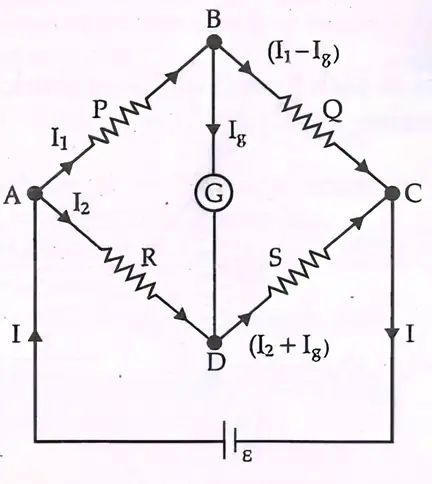
The Wheatstone bridge is a circuit with four resistors arranged in a diamond shape, used to measure unknown resistance by balancing the bridge so that no current flows through the galvanometer. The balance condition is \(\frac{P}{Q} = \frac{R}{S}\).
Solved Examples
Example 1: Calculate the drift velocity of electrons in a copper wire carrying a current of 3 A. The wire has a cross-sectional area of 1 mm² and the number density of free electrons is \(8.5 \times 10^{28} \text{ m}^{-3}\).
Solution:
Given: \(I = 3 \text{ A}\), \(A = 1 \text{ mm}^2 = 1 \times 10^{-6} \text{ m}^2\), \(n = 8.5 \times 10^{28} \text{ m}^{-3}\), \(e = 1.6 \times 10^{-19} \text{ C}\).
Using \(I = n e A v_d\), solve for \(v_d\):
\[ v_d = \frac{I}{n e A} = \frac{3}{8.5 \times 10^{28} \times 1.6 \times 10^{-19} \times 1 \times 10^{-6}} \]
\[ v_d = 2.2 \times 10^{-4} \text{ m/s} \]
The drift velocity is approximately \(2.2 \times 10^{-4} \text{ m/s}\).
Example 2: The resistance of a platinum wire at 0°C is 5 \(\Omega\) and at 100°C is 5.23 \(\Omega\). Calculate the temperature coefficient of resistance \(\alpha\).
Solution:
Given: \(R_0 = 5 \Omega\), \(R_{100} = 5.23 \Omega\), \(T = 100^{\circ}C\).
Using \(R = R_0 (1 + \alpha T)\),
\[ 5.23 = 5 (1 + 100 \alpha) \Rightarrow 1 + 100 \alpha = \frac{5.23}{5} = 1.046 \]
\[ 100 \alpha = 0.046 \Rightarrow \alpha = 4.6 \times 10^{-4} \text{ per } ^{\circ}C \]
The temperature coefficient of resistance is \(4.6 \times 10^{-4} \text{ per } ^{\circ}C\).
Example 3: In a Wheatstone bridge, resistors \(P = 100 \Omega\), \(Q = 150 \Omega\), and \(R = 200 \Omega\) are known. Find the value of \(S\) for the bridge to be balanced.
Solution:
Balance condition: \(\frac{P}{Q} = \frac{R}{S}\)
\[ S = \frac{Q \times R}{P} = \frac{150 \times 200}{100} = 300 \Omega \]
The value of \(S\) should be 300 \(\Omega\) for balance.
Practice Set
- Level 1 (Easy): Define electric current and state its SI unit.
- Level 2 (Moderate): A wire of length 2 m and cross-sectional area 1 mm² has a resistance of 5 \(\Omega\). Calculate the resistivity of the material.
- Level 3 (Challenging): In a Wheatstone bridge, resistors \(P = 120 \Omega\), \(Q = 80 \Omega\), and \(R = 60 \Omega\) are connected. Find the value of \(S\) for the bridge to be balanced. Also, explain the principle behind the Wheatstone bridge.
Answer Key
- Level 1: Electric current is the rate of flow of electric charge through a conductor. Its SI unit is ampere (A).
- Level 2: Resistivity \(\rho = R \frac{A}{L} = 5 \times \frac{1 \times 10^{-6}}{2} = 2.5 \times 10^{-6} \Omega \text{m}\).
- Level 3: Using balance condition \(\frac{P}{Q} = \frac{R}{S}\),
- \(S = \frac{Q \times R}{P} = \frac{80 \times 60}{120} = 40 \Omega\).
- The Wheatstone bridge works on the principle of balancing two legs of a bridge circuit so that no current flows through the galvanometer, allowing precise measurement of unknown resistance.
Quick Reference Table
Ohm's Law: \(V = IR\)
Current: \(I = \frac{dq}{dt}\)
Drift Velocity: \(v_d = \frac{I}{n e A}\)
Mobility: \(\mu = \frac{v_d}{E} = \frac{e \tau}{m}\)
Resistivity: \(\rho = R \frac{A}{L}\)
Conductivity: \(\sigma = \frac{1}{\rho}\)
Power: \(P = VI = I^2 R = \frac{V^2}{R}\)
Temperature dependence: \(R = R_0 (1 + \alpha \Delta T)\)
Kirchhoff's Laws: \(\sum I = 0\) (junction), \(\sum V = 0\) (loop)
Wheatstone Bridge Balance: \(\frac{P}{Q} = \frac{R}{S}\)
Common Mistakes and Misconceptions
- Confusing current with voltage; current is charge flow per unit time, voltage is potential difference.
- Applying Ohm's law to non-ohmic devices like diodes incorrectly.
- Ignoring internal resistance of cells in circuit calculations.
- Misapplying Kirchhoff's laws by not considering sign conventions properly.
- Incorrectly calculating total resistance in series and parallel circuits.
- Assuming power formulas are interchangeable without checking known quantities.
Glossary
- Electric Current: Rate of flow of electric charge.
- Drift Velocity: Average velocity of charged particles in a conductor due to electric field.
- Resistance: Opposition to current flow in a conductor.
- Resistivity: Material property indicating resistance per unit length and area.
- Conductivity: Reciprocal of resistivity, indicating ability to conduct electricity.
- Electromotive Force (emf): Voltage of a cell when no current flows.
- Internal Resistance: Resistance within a cell opposing current flow.
- Kirchhoff's Laws: Rules for current and voltage in electrical circuits.
- Wheatstone Bridge: Circuit for precise measurement of unknown resistance.